Editorial Designer Resume Examples: the lines they read
Write an Editorial Designer Resume for Magazines, Books and Reports
By Mustafa Tarabya, founder of CVBooster · Published · Updated
Editorial designer resume example with pagination, typography and production detail, plus keywords and a writing guide.
Sample resumes for a editorial designer
The same editorial designer content laid out in three CVBooster templates, so you can see what the finished document looks like before you write a word.
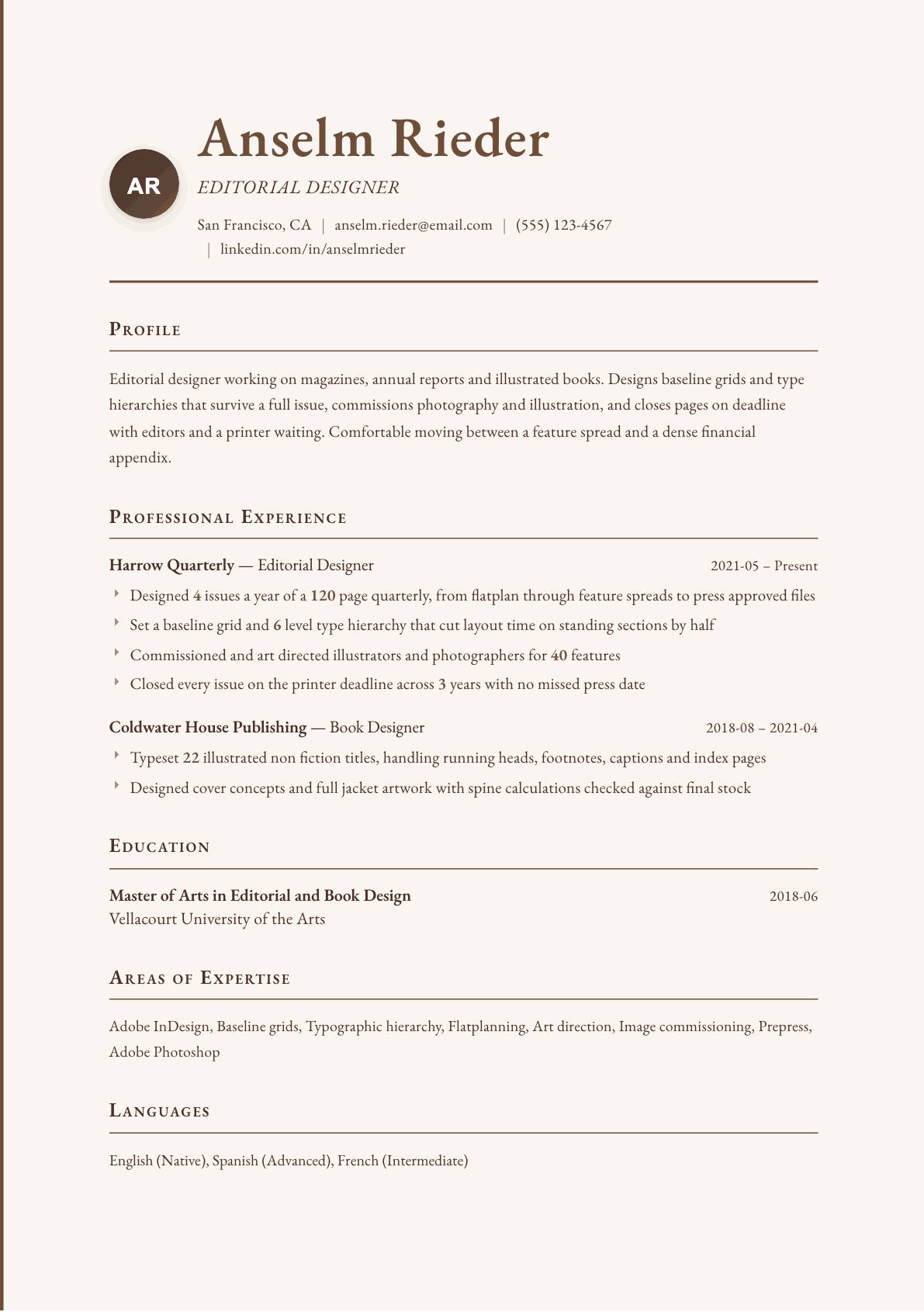
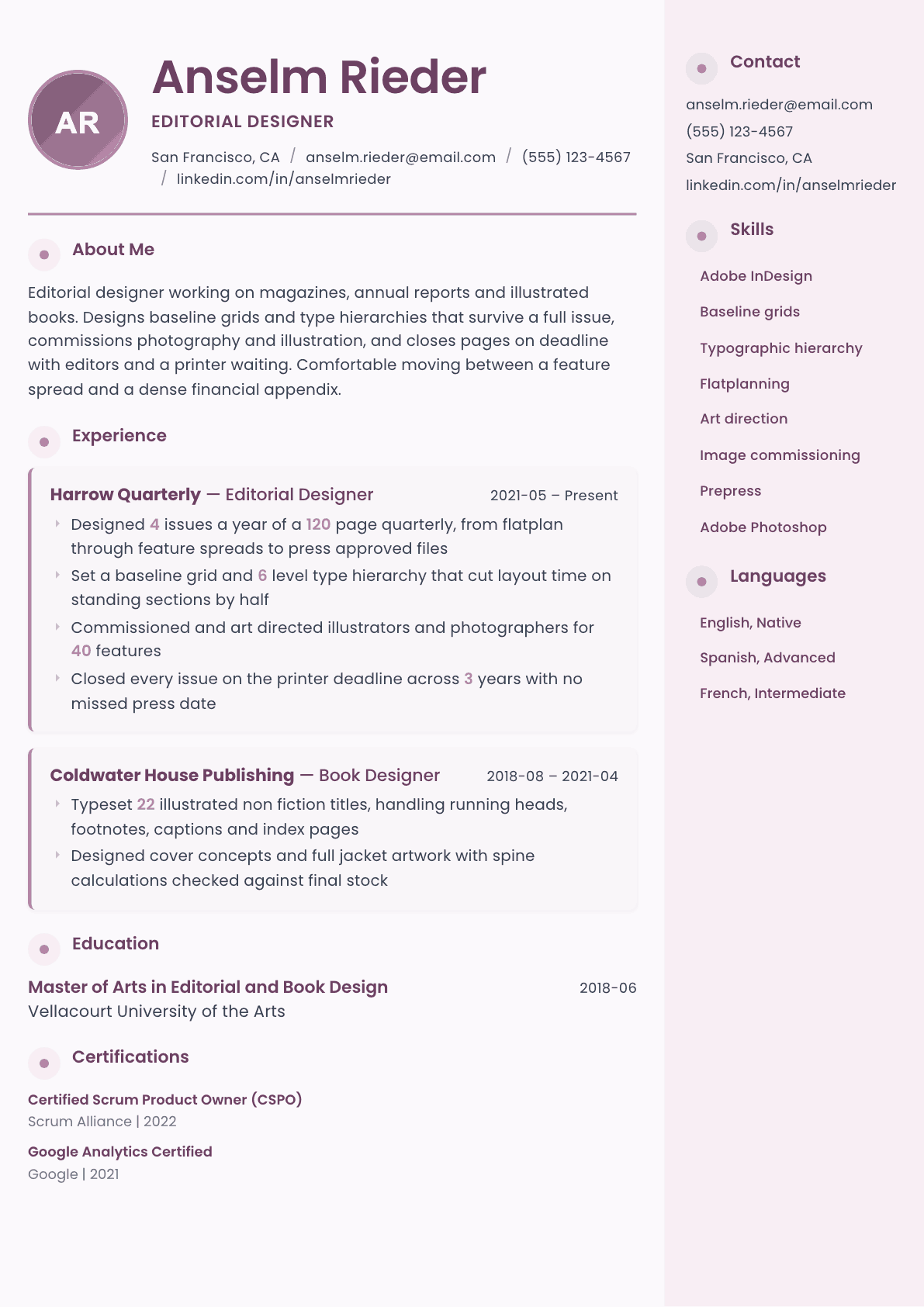
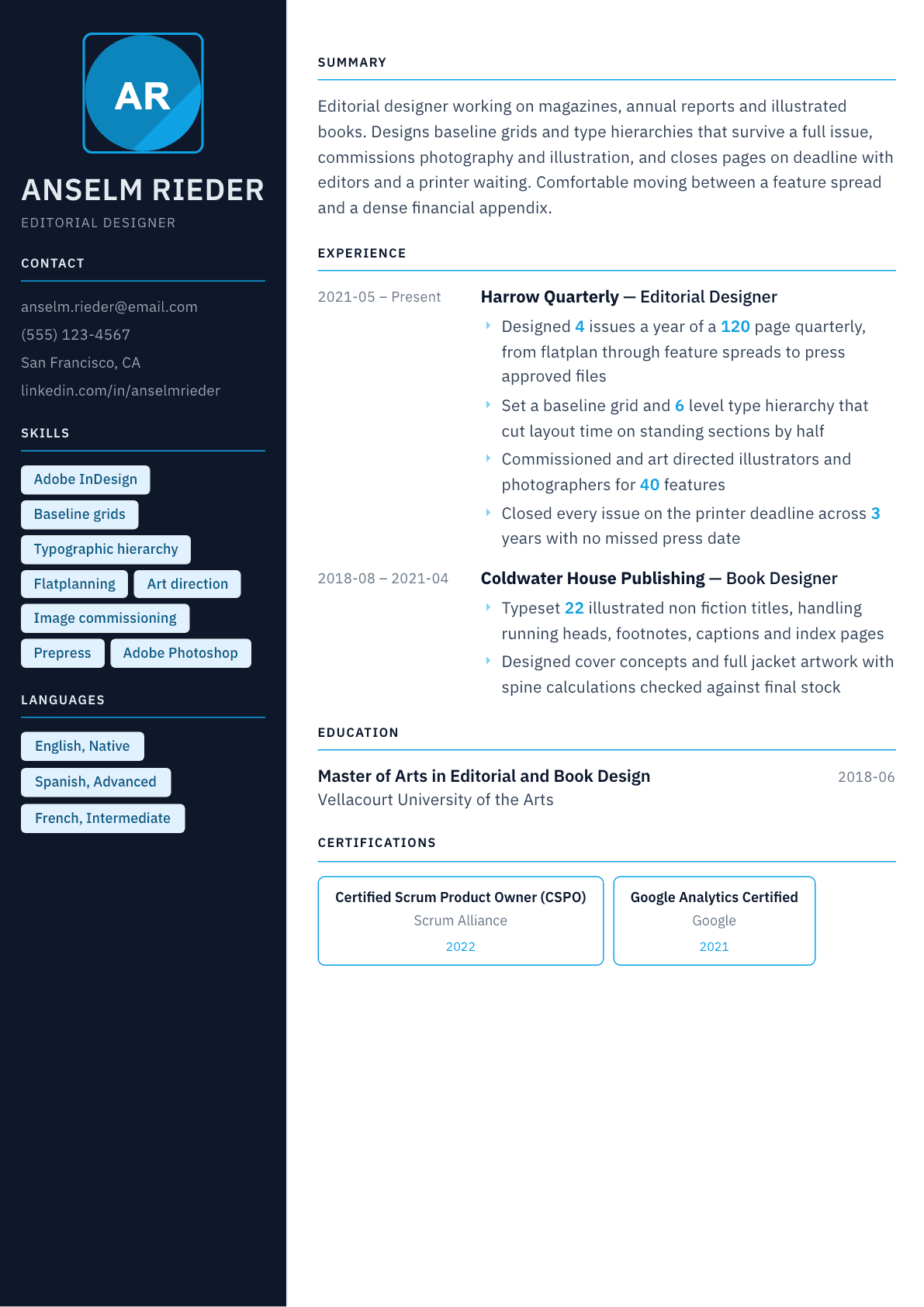
Example Editorial Designer summary
Editorial designer with seven years across magazines, annual reports and illustrated books. Builds baseline grids and type hierarchies that hold across a full issue, commissions and art directs photography and illustration, and closes pages against a fixed press date. Equally at home on a feature spread and a dense data appendix. Looking for a publication that still invests in craft and gives designers a voice in the story.
Skills to list on a Editorial Designer resume
- Adobe InDesign
- Adobe Photoshop
- Adobe Illustrator
- Baseline grid systems
- Typographic hierarchy
- Long document layout
- Flatplanning and pagination
- Cover design
- Art direction
- Photo editing and selection
- Image commissioning
- Prepress and press PDFs
- Copy fitting
- Digital editions
What actually gets this resume read
- Give the publication scale: page count, issue frequency, and how many pages you personally laid out.
- Show typographic depth by naming grids, hierarchy levels, typeface pairings and how you handled long copy.
- Include art direction work such as commissioning photographers and illustrators and directing a shoot.
- Name the deadline reality, since editorial hiring managers screen hard for people who close pages on time.
- Cover both print and digital editions if you have produced them, including reflowable formats and web features.
- Bring physical samples to the interview and mention in the resume that printed work is available to view.
How to write a editorial designer resume
Editorial design is a deadline job wearing a typography job coat. An art director hiring for a magazine, a book list or an annual report wants beautiful pages, but what keeps them awake is whether the issue closes on the date the printer has reserved. So the resume needs to prove two things at once: that you can set a grid and a hierarchy that hold across a whole publication, and that you have closed pages against a fixed press date without drama.
The second signal is range within the discipline. A feature spread and a dense financial appendix are the same craft applied at different temperatures, and a designer who can only do the glossy half is a partial hire. Say plainly which formats you have produced: magazines, books, annual reports, catalogs, digital editions.
This guide covers how to state publication scale, how to describe typographic systems in a way a design director recognizes, when art direction and image commissioning belong on the page, and how to present a portfolio for work that lives on paper.
Format: set the page like you would set a spread
Reverse chronological, one page early, two once the publication credits justify it. This is the one role where the typography of your resume is read as a work sample almost consciously. Use one typeface family well, set a real baseline rhythm, keep the measure comfortable, and check for widows and rivers before you send it.
Add a publication credits block if you have several titles. Name the publication, the format, the page count and your role. An art director scanning that block learns your entire experience shape faster than they could from any summary paragraph.
- Header: name, title, city, email, portfolio address.
- Sections: summary, experience, publication credits, typographic and production skills, education.
- Note that printed samples can be viewed at interview, then bring them.
Summary: formats, frequency, and the scale of the documents
Name the formats and the cycle: quarterly magazine, annual report season, illustrated book list, or all three. Frequency is the thing a hiring art director translates immediately into workload, because a quarterly and a monthly are different lives.
Then give the page scale and one line on what you own. Designing a full issue from flatplan through features to press approved files describes a complete editorial role. Add the appendix or long copy point if you have it, since designers who happily handle tables and footnotes are rarer than designers who want the cover.
Experience: grids, hierarchy, flatplans and press dates
Give each publication its shape: page count, frequency, how many pages you personally laid out, and where your responsibility started and stopped. Then the structural work: the baseline grid, the number of hierarchy levels, the typeface pairings, the standing section templates and how they changed production time.
Flatplanning and pagination deserve their own line. Managing the running order, the ad positions, the color forms and the signature structure is production knowledge many designers never acquire, and it is one of the reasons an editorial designer can be trusted with a whole issue.
Close every job description with the deadline evidence. Closing issues on the printer date across several years, without a missed press slot, is a claim an art director will remember longer than any spread you show them.
Art direction: commissioning and directing images
If you commission illustration and photography, write it as art direction rather than as picture selection. Briefing an illustrator, agreeing a fee and a delivery date, giving feedback on roughs and directing a shoot are producer skills that separate a senior editorial designer from a layout artist.
Include picture editing craft too: selecting from a large take, cropping for the grid, sequencing a photo essay so it builds, and color correcting for the paper stock the issue prints on. Those decisions shape a feature more than the type does.
Production and digital editions: finish the chain
Say how far you take a file. Preflighting, packaging, press PDFs against the printer profile, spine calculations checked against final stock, cover finishes and the proof approval route. Editorial teams are small, so the designer usually owns production, and an art director will assume you cannot do it unless you say you can.
Add digital editions where you have produced them: reflowable formats, tablet layouts, or web features derived from the print story. A designer who can carry an issue across both is easier to justify hiring than one who can only do the paper half.
- Long document tools: master pages, paragraph and character styles, running heads, footnotes, indexes.
- Production: preflight, packaged files, press PDFs, spine and cover calculations.
- Digital: reflowable formats, tablet layout, web feature adaptation.
Editorial Designer resume summary examples
Junior editorial designer
Junior editorial designer with 2 years typesetting illustrated non fiction titles, handling running heads, footnotes, captions and index pages on 22 books. Designed cover concepts and full jacket artwork with spine calculations checked against final stock. Seeking magazine or report work with more art direction responsibility.
Seven years in
Editorial designer with 7 years across magazines, annual reports and illustrated books. Designs 4 issues a year of a 120 page quarterly from flatplan to press approved files, sets baseline grids and 6 level type hierarchies, and commissions illustrators and photographers for feature packages.
Art director
Art director with 13 years leading the visual direction of a quarterly title and a full annual report program. Sets the typographic system and redesign strategy, commissions photography and illustration, directs a designer and a picture editor, and has closed every issue on the printer date for the last 6 years.
Work experience bullets: before and after
Before: Laid out pages for a quarterly magazine.
After: Designed 4 issues a year of a 120 page quarterly, from flatplan and running order through feature spreads to press approved files delivered against the printer schedule.
Frequency, page count and the full production range describe an editorial role rather than a layout task.
Before: Created a consistent look for the magazine.
After: Set a baseline grid and a 6 level type hierarchy with defined pairings for display, standfirst, body, captions, furniture and data, which halved layout time on standing sections.
Naming the hierarchy levels and the production effect turns a taste claim into a typographic system.
Before: Worked with photographers and illustrators.
After: Commissioned and art directed illustrators and photographers for 40 features, briefing each on concept, format and delivery, and reviewing roughs before final artwork.
Describing the commissioning process shows producer responsibility instead of image selection.
Before: Always met deadlines.
After: Closed every issue on the printer deadline across 3 years, coordinating late copy changes with editors and holding the color forms to the agreed signature schedule.
The mechanism behind the reliability is what makes an art director believe the claim.
Before: Designed book covers.
After: Designed jacket artwork for illustrated non fiction titles, calculating spine width against the final paper bulk and adjusting the wrap for the cover finish before plate production.
Spine and stock calculation is the production detail that distinguishes a real book designer.
Hard skills
- Adobe InDesign
- Adobe Photoshop
- Adobe Illustrator
- Baseline grid systems
- Typographic hierarchy
- Long document layout
- Flatplanning and pagination
- Copy fitting
- Cover and jacket design
- Art direction
- Image commissioning
- Photo editing and sequencing
- Prepress and press PDFs
- Digital and reflowable editions
Soft skills
- Working with editors
- Holding a press schedule
- Briefing illustrators and photographers
- Editing your own layouts
- Composure during late changes
Certifications worth listing
- Adobe Certified Professional: Print & Digital Media Publication (InDesign) (Adobe)
- Adobe Certified Professional in Visual Design Using Adobe Photoshop (Adobe)
Mistakes that cost editorial designer candidates the interview
- Showing only feature spreads and never a dense information page, which suggests half a skill set.
- Leaving out page counts and issue frequency, so an art director cannot estimate your workload experience.
- Describing typography as a sensibility instead of naming grids, hierarchy levels and pairings.
- Omitting production ownership on a small team where the designer always handles press files.
- Never mentioning deadline record, which is the anxiety every editorial hiring manager carries.
- Sending a typographically careless resume for a job that is entirely about typographic care.
Editorial Designer resume questions
How do I show typographic skill on an editorial design resume?
Name the systems rather than the adjectives: the grid, the number of hierarchy levels, the typeface pairings, the copy fitting rules and how standing sections were templated. Then let the resume typography itself demonstrate the same discipline.
Do I need magazine experience to get an editorial design job?
Not necessarily. Annual reports, illustrated books, catalogs, journals and long form brand publications all build the same grid, hierarchy and production skills. Frame the experience in publication terms and show a feature sequence in the portfolio.
Should an editorial portfolio be printed or online?
Both. An online portfolio gets you the interview, and printed samples win it, because paper stock, trim and binding cannot be judged on a screen. Note the availability of physical samples on the resume itself.
How much production work should I claim?
Whatever you genuinely do. On small editorial teams the designer usually owns preflight, packaging, press PDFs and proof approval, so state it explicitly. If a production department handles it, describe the handoff and the specifications you worked to.
Is editorial design a shrinking field?
Print titles have consolidated, but annual reports, brand publications, books, journals and premium magazines still hire, and many roles now include the digital edition. Show both print and screen work so you fit the combined briefs being posted.