Resume With a Picture: Should You Include a Photo?
By Mustafa Tarabya, founder of CVBooster · Published · Updated
11 min read
Include a photo if you are applying in a country where photos are a normal part of the application, and leave it off if you are not. In Germany, Austria, France, Spain, much of Latin America and much of East Asia, a plain headshot is unremarkable. In the United States, the UK, Ireland, Canada, Australia and New Zealand, it is normally left off.
That split is the answer to the question most people arrive with, whether they search for photos for a CV or a resume with a picture. What is worth understanding is why the split exists, because the reasoning tells you what to do in the cases the list does not cover.
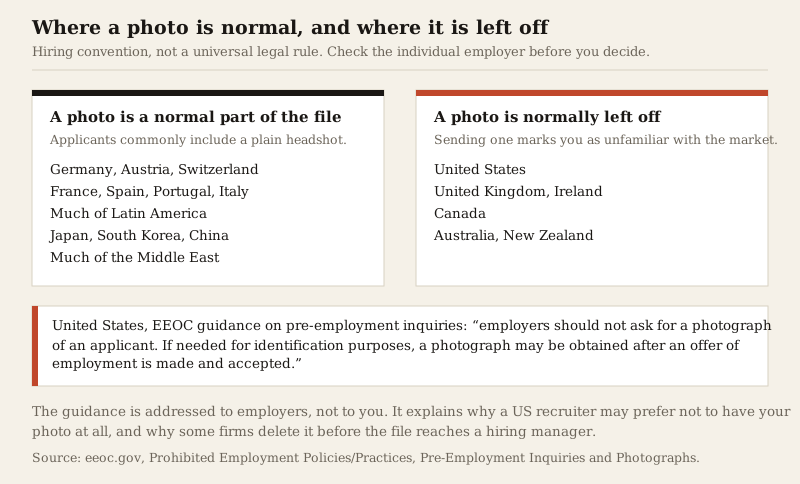
Where is a photo expected?
The German-speaking countries are the clearest case. A Bewerbungsfoto is a normal part of a German application, taken by a photographer, and its absence is noticed. France, Spain, Portugal and Italy sit in the same territory, as does much of Latin America and the Middle East.
In Japan the standard rirekisho form has a box for the photograph printed on it, which settles the question before you start. South Korea and China follow similar conventions.
If you are applying into one of these markets, a missing photo reads as an incomplete file rather than as a principled stand. Include one, and make it a proper one.
Where is a photo a liability?
In the United States, the UK, Ireland, Canada, Australia and New Zealand, sending a photo marks you as unfamiliar with the market. It is not usually fatal, but it is a small unforced signal, and some employers strip the image before the file reaches a hiring manager.
The reasoning is about discrimination risk, and it is worth being precise here rather than repeating the usual vague warnings. In the United States, the Equal Employment Opportunity Commission, the federal agency that enforces employment discrimination law, publishes guidance addressed to employers on pre-employment inquiries. On photographs it says: "employers should not ask for a photograph of an applicant. If needed for identification purposes, a photograph may be obtained after an offer of employment is made and accepted."
Read that carefully, because it is often misquoted. It is guidance for employers about what they should ask for, not a rule prohibiting you from sending one, and it is not a statute. But it explains the behaviour you encounter: a recruiter who would rather not hold your photograph before an offer, and an applicant tracking system configured to discard the image.
Other jurisdictions frame the same territory differently. In the UK, the Equality Act 2010 sets out nine protected characteristics: age, disability, gender reassignment, marriage and civil partnership, pregnancy and maternity, race, religion or belief, sex, and sexual orientation. Germany's General Act on Equal Treatment, the AGG, states its purpose as preventing or stopping discrimination on the grounds of race or ethnic origin, gender, religion or belief, disability, age or sexual orientation.
Neither of those texts mentions photographs. That is the point worth taking away. A photo is not illegal to send anywhere in this list. What a photo does is put several of those characteristics in front of the decision-maker before your qualifications arrive, and employers in these markets manage that exposure by preferring not to have the image at all.
Tip: None of this is legal advice, and anti-discrimination rules vary by country and, in the US, by state and city. If a specific rule matters to your situation, check the authority that governs it rather than an article about resumes.
What about roles where appearance is part of the job?
Acting, modelling, broadcast presenting and some hospitality and client-facing roles ask for photographs openly, and in those fields the image is a professional document rather than a personal one. Actors submit headshots; models submit a comp card. Dancers do the same, and the CV for a dancer shows where the headshot sits on the page.
The rule there is that the photo goes where the employer asks for it, in the format they specify, and it is a professionally produced image rather than a cropped holiday photo. If the application form has a field for it, fill the field. If it does not, do not volunteer it.
Does a LinkedIn photo count as the same thing?
No, and this is the inconsistency people notice. A photo on your LinkedIn profile is expected in every market on both lists, including the ones where you would never attach one to a resume.
The difference is who chose to look. A recruiter who opens your profile has gone looking; a photo embedded in an attachment arrives whether or not anyone wanted it, and lands in a system that stores it. That distinction is the whole convention, and it is why linking your profile from a photo-free resume is not a contradiction.
How do you take a resume photo that works?
If you have established that a photo belongs on your document, the bar is higher than a good selfie. A weak photo is worse than no photo even in the markets that expect one.
- Head and shoulders, framed so your face fills most of the frame, looking at the camera.
- A plain, light, uncluttered background. No doorframes, no kitchens, no other people cropped out at the edge.
- Soft, even light on your face. A window to one side beats a ceiling light or a flash.
- Dress as you would for the interview, one small step smarter rather than one step more casual.
- A neutral, unforced expression. A slight smile is fine; a laugh is not.
- Recent, and recognisably you. The person who walks into the interview should be the person in the photo.
Technically: colour, high enough resolution that it stays sharp when printed, and inserted as an image in the document rather than as a background or a fill. Portrait crop, roughly passport proportions, sized so it occupies a corner of the header and not a quarter of the page.
Where does the photo go on the page?
Top right or top left of the header, aligned with your name, small enough that the name is still the largest element on the page. Never centred above your name, and never floating over text.
One mechanical warning. An image contributes nothing to the text layer of a document, so anything that only exists inside the picture is invisible to software reading your file. That includes the trick of putting your contact details into a designed graphic alongside the photo, which is the kind of choice covered in ATS resumes in 2026. Your name and contact details must exist as real text regardless of what the photo does. The same applies to the small symbols in a template header; the CV icons guide shows how to keep them beside the text they label.
What happens to the photo mechanically?
Separately from whether a photo helps you, it is worth knowing what a photo does to the file, because two of the effects are ones people do not anticipate.
The first is that an image contributes nothing to the text layer. When a document is processed, extraction pulls out a sequence of characters; an embedded picture is not part of that sequence. This matters only if you have let the photo absorb responsibilities that belong to text. A designed banner where the photo sits alongside your name and contact details rendered as part of the same graphic produces a resume whose extracted text begins with your professional summary and contains no name at all.
The second is size. A high-resolution photo dropped into a document without being resized can take the file from a couple of hundred kilobytes to several megabytes. Some application portals cap upload size, and the rejection you get is about the file rather than about you. Resize the image to roughly the dimensions it will print at before you insert it, rather than inserting a large image and dragging the corner.
The third effect is the one that surprises people: in some processes identifying details are deliberately removed before a shortlisting panel sees the applications. The UK Civil Service tells applicants on its own careers site: "We may ask you to provide your CV in an anonymised format. This will remove information that could identify you, such as your name, age or gender." A photograph is the single richest source of exactly that information, so where anonymised screening is in use it is one of the first things to go. If your document is designed around the photo, the anonymised version of it arrives with a hole in the layout.
The same header, with and without
For a German application, the photo sits top right, aligned with the name block, roughly passport proportions, occupying about the depth of the four contact lines beside it. The name remains the largest text on the page. Beneath the contact block, a German file will often continue into details a US resume would never carry, and that is the point: the photo is one convention inside a set of conventions, not a decoration bolted onto an American document.
For the UK version of the same person, the photo comes out and nothing else moves. The name, title line, location, email, phone and LinkedIn stay exactly where they were, and the space the image occupied becomes margin rather than being filled with something else. That is the correct instinct: removing a photo should leave white space, not trigger a redesign.
If you find that deleting the photo breaks your layout, the layout was built around the photo, and it will also break in every anonymised process you enter. Build the document so the photo is an addition to a header that works without it.
Four situations worth walking through
Applying from a no-photo market into a photo market
A British candidate applying to a German employer should include the photo. Sending the UK version is not neutral there; a German application file has an expected shape, and an incomplete-looking file from abroad reads as a candidate who has not engaged with the market. Add the photo and check the rest of the document against local convention at the same time, since the photo is rarely the only difference.
A US-headquartered employer hiring in a photo market
This is the most common ambiguous case, and the employer usually resolves it without meaning to. If the application runs through a global portal in English with a US-style process, follow the US convention and leave the photo off. If you are emailing a local hiring manager and the job ad is in the local language, follow the local one. When both signals are present, the portal is the stronger signal, because the portal is where the file is stored.
A graduate applying in Japan
The form decides. A rirekisho has a printed photo box, so the question is not whether but how: a formal photograph, plain background, business dress, taken for the purpose. Photo booths that produce exactly this format are commonplace precisely because the expectation is specific. Improvising here is more visible than in almost any other market.
A designer or performer anywhere
Acting and modelling have their own documents and their own rules, and the headshot is a professional artefact with its own conventions. A graphic or product designer, by contrast, is in the ordinary market: the portfolio is the visual argument, and the resume does not need a photo to prove they can art-direct one. Put the effort into the portfolio link instead.
Common mistakes when a photo is required
In markets that expect a photo, the error is rarely including one. It is including a bad one, and a bad one is more damaging than none because it is a sample of your judgement sitting at the top of the page.
- A cropped social photo, where someone else's shoulder is still in the frame or the background is a bar.
- A photo taken from below, at arm's length, in the light of a laptop screen.
- Sunglasses, a hat, a heavy filter, or an image processed until the skin tones are unrecognisable.
- A photo from a decade ago. If the interviewer has to reconcile two people, you have created a small awkwardness for nothing.
- An image stretched out of proportion to fit a box, which is visible instantly and looks careless.
- A photo placed so it competes with your name, or so large that it is the first thing on the page.
What if you cannot tell which convention applies?
Three tie-breakers, in order. First, the job ad. If it asks for a photograph, send one; if it says not to, that settles it permanently. Second, the employer rather than the country: a US-headquartered multinational hiring in Frankfurt will usually run a US-style process.
Third, when it is genuinely ambiguous, leave it off. A missing photo in a market that expects one is a small gap that an otherwise strong application survives. A photo in a market that does not want one is a signal you cannot take back, sitting at the top of the first page.
The short version
- Applying in the US, UK, Ireland, Canada, Australia or New Zealand: no photo.
- Applying in the German-speaking countries, much of southern Europe, Latin America, the Middle East or East Asia: include a proper one.
- The employer's own instruction beats the country convention every time.
- Acting, modelling and broadcast are their own world, with their own formats.
- Keep the photo on LinkedIn either way.
- When in doubt, leave it off and let the document argue for you.
The photo question absorbs far more attention than it deserves, largely because the advice online is written from one market and presented as universal. Decide it once for the market you are applying into, then spend the time on the parts of the page that actually make the case, starting with the resume format guide.
Related articles
- Accounting Executive Resume: 5 Examples by Career Level
- Administration Resume Examples: 8 Samples, Entry to Manager
- Aged Care Resume: 6 Australian Examples and a Template
- Another Word for Resume: CV, Bio and 10 More Options
More articles
- Retail Assistant CV Example: 6 Full UK CVs and the Layout
- Covering Letter Example for Retail: 6 Letters for UK Shops
- CV Template for Retail: 6 UK Examples and a Fill-in Layout
Looking for a worked example for your job title? Browse the resume examples by job title.