Produce Clerk Resume Examples: free ATS score and gap list
Build a Produce Clerk Resume Grocery Managers Respond To
By Mustafa Tarabya, founder of CVBooster · Published · Updated
Produce clerk resume examples with rotation, culling and display keywords, plus a guide to showing freshness and shrink control.
Sample resumes for a produce clerk
The same produce clerk content laid out in three CVBooster templates, so you can see what the finished document looks like before you write a word.
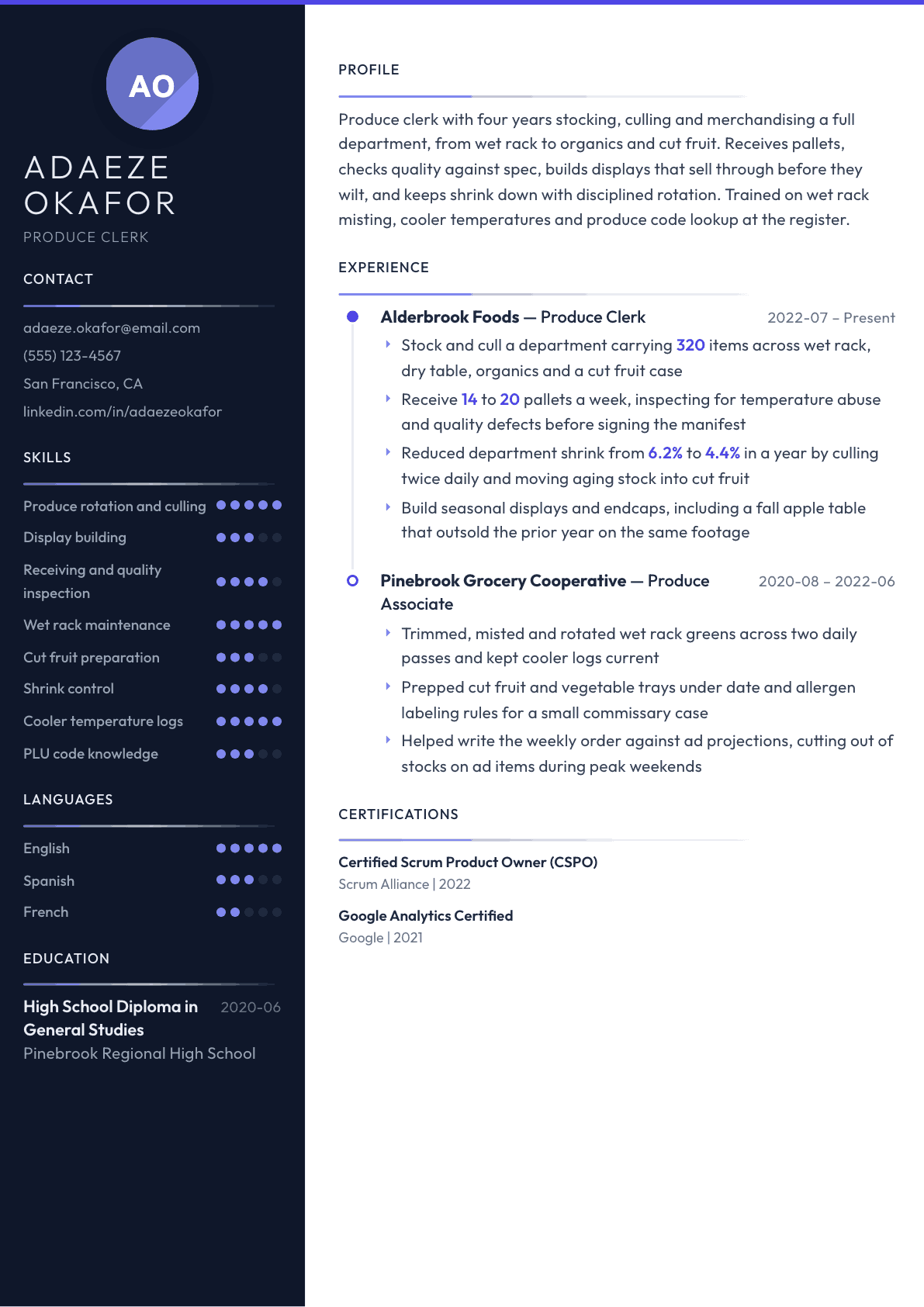
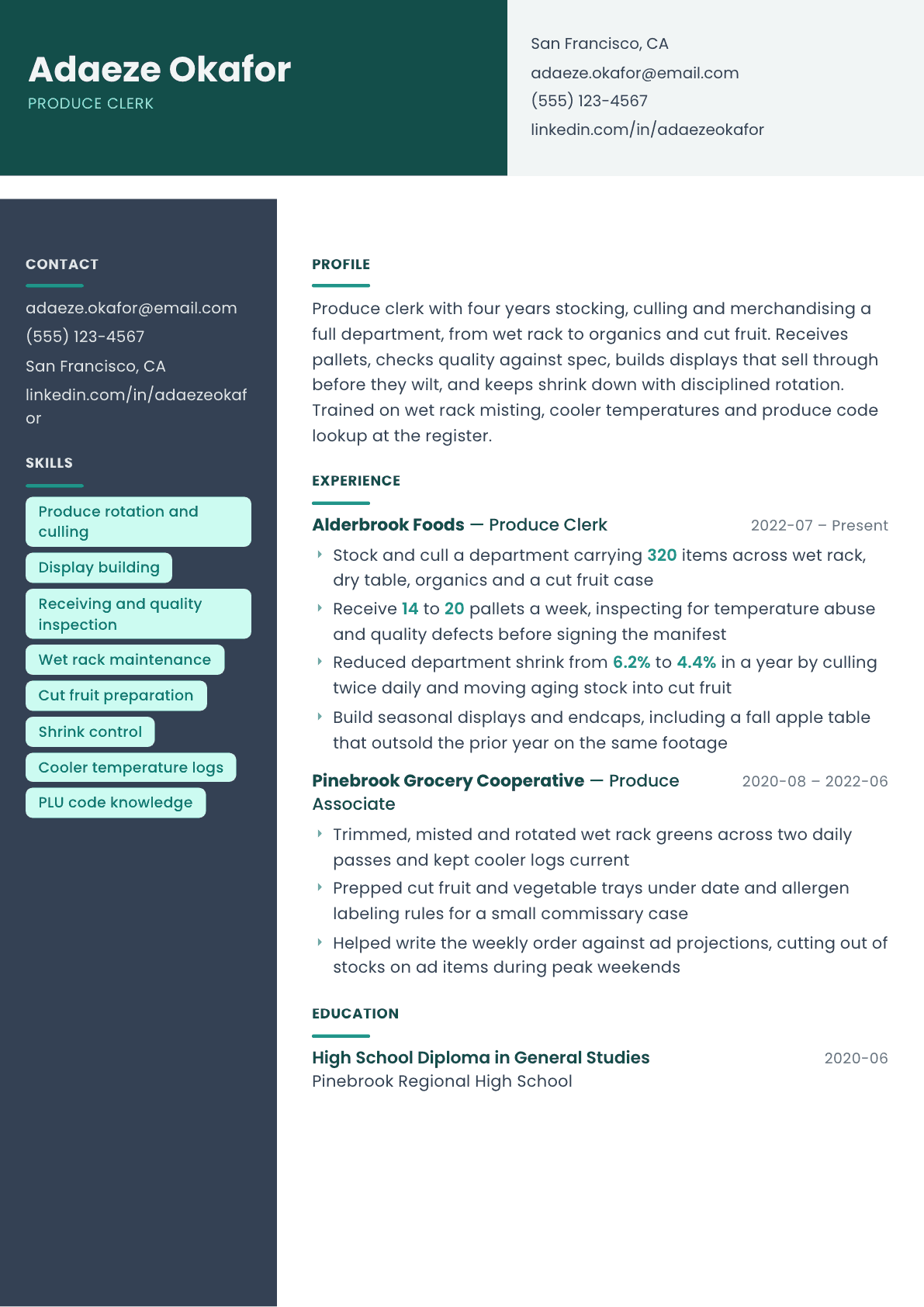
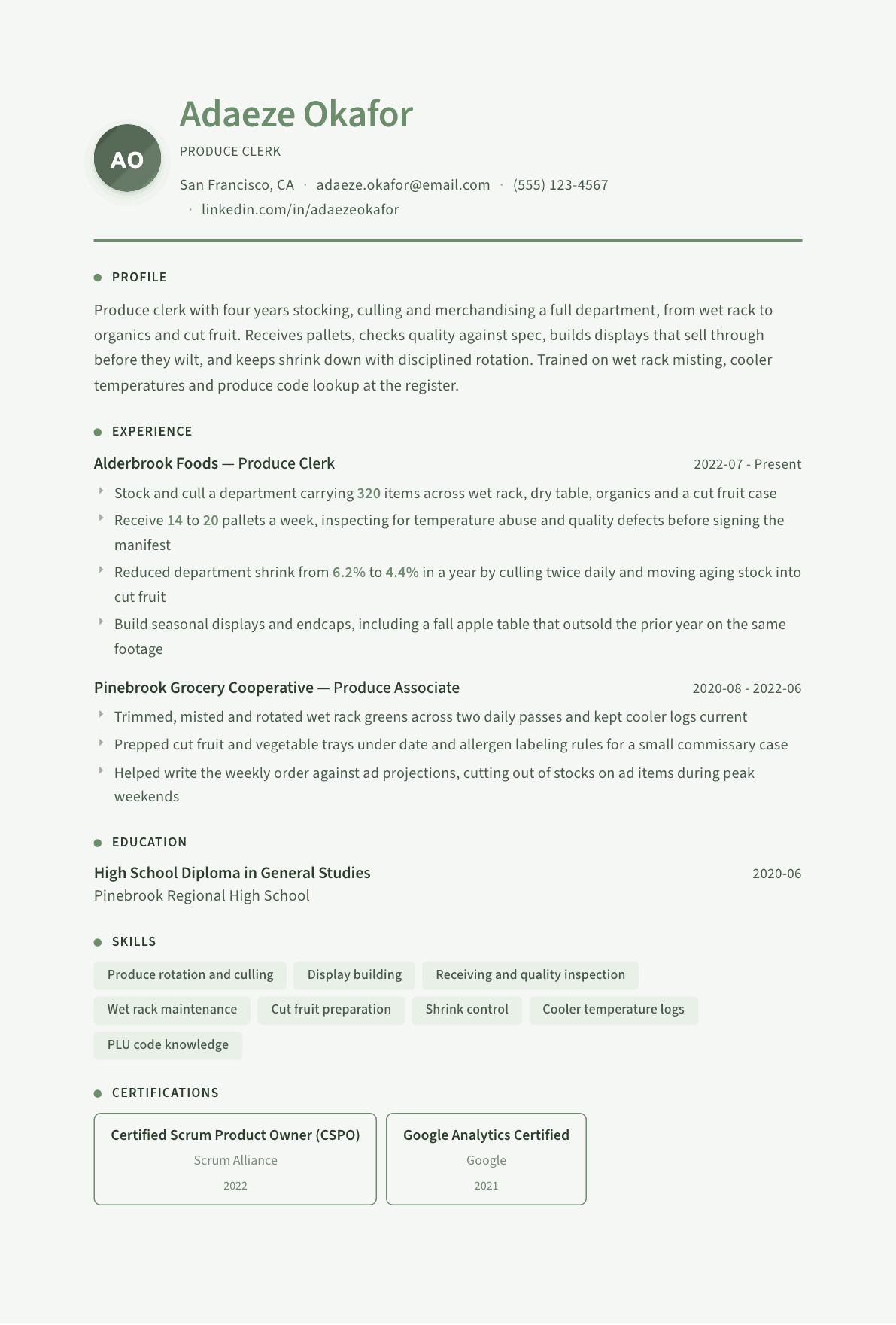
Example Produce Clerk summary
Produce clerk with four years running a full department from wet rack to organics and cut fruit. Receives and inspects pallets, culls twice daily, and builds seasonal displays that sell through before quality drops. Cut department shrink by nearly two points in a year through disciplined rotation and moving aging stock into value added cut fruit. Trained in food safety, cooler logs and PLU lookup.
Skills to list on a Produce Clerk resume
- Produce rotation and culling
- Quality inspection at receiving
- Shrink and waste control
- Display and endcap building
- Wet rack and misting systems
- Cut fruit preparation
- Cooler and case temperature logs
- PLU codes
- Ordering against ad plans
- Food safety and sanitation
- Pallet handling and jacks
- Organic segregation standards
- Customer service
What actually gets this resume read
- Give your department size in items or linear feet, because a produce manager sizes candidates by scope.
- Show shrink as a before and after number, since freshness and waste are the department scorecard.
- Describe receiving and quality checks, because catching a bad pallet at the dock saves the whole week.
- Mention display and endcap work with a sales result, not just that you built a nice looking table.
- List your food safety training and any cut fruit or commissary experience with date labeling rules.
- Include PLU knowledge and register support, since produce clerks are often pulled to the front end.
How to write a produce clerk resume
Produce is the department a grocery store is judged on before a customer reaches anything else, and it is also the department that throws the most product in the trash. The manager reading applications is trying to hire someone who can keep a rack looking full at eight in the evening without burying the store in waste, which is a harder balance than it sounds.
That balance is a skill, and it is one candidates rarely write down. Culling, rotation, quality checks at receiving and knowing when aging fruit should move into the cut case are the difference between a clerk who stocks and a clerk who runs a department. Almost every produce resume in the pile describes the stocking half only.
This guide covers the layout a grocery manager expects, three summaries from a first stock job to a lead clerk, before and after bullets that put numbers on freshness work, and the questions people ask when they move from another department into produce.
Format: one page, plain, and quick to scan on a back room screen
Single column, one page, no graphics. Grocery applications route through a shared system with the rest of the store, and a produce manager usually reads the shortlist on a small terminal near the cooler. Anything that needs a wide screen or a color printer works against you.
Put your availability and any equipment certification near the top. Produce runs on early mornings, and a clerk who can start at five and run a pallet jack is immediately more useful than one who cannot, so those two facts belong above the experience section.
- Header: name, city and state, phone, email, earliest start time you can work.
- Section order: summary, certifications and equipment, experience, skills, education.
- Open each job with the department scope: item count, whether it included organics, wet rack and a cut fruit case.
Summary: department scope and what you did about shrink
Three lines. The size and type of department, the areas you covered, and one fact about waste or freshness. A clerk who says the department carried several hundred items across wet rack, dry table, organics and cut fruit has told the manager exactly which parts of the job they can be left alone with.
If you are coming from another department or from outside grocery, name the transferable ground plainly: early starts, receiving, rotation discipline and physical stamina. Then say what you want to learn, because produce managers train willingly when the applicant already understands the hours.
Experience: receive, cull, build, rotate
Receiving is where a good produce clerk earns the department money. Describe how many pallets you took in a week, what you checked for at the dock, and what happened when a load arrived warm or bruised. Rejecting or claiming a bad pallet on arrival is worth more than a week of careful culling afterward.
Culling is the second bullet. How often you walked the department, what you pulled, and where aging stock went. Moving product into cut fruit, a value rack or a store prepared item before it is unsellable is a real technique, and naming it separates you immediately.
Then display work and the numbers. Endcaps, seasonal tables, ad item execution and whether the display sold through. Finish with the routine that supports all of it: cooler logs, misting and wet rack maintenance, PLU knowledge, and ordering against the ad forecast if you were trusted with it.
Food safety and equipment
Produce carries genuine food safety weight, especially anywhere a store cuts fruit or vegetables in house. Say what you know about date labeling, allergen segregation, organic separation rules and the sanitation schedule for a prep room. If you hold a food handler card, list it with the issuing authority.
Equipment matters too. Pallet jacks, power jacks, baler operation and misting systems are all part of a normal produce shift, and any certification you hold to operate powered equipment should appear where a manager can see it without searching.
Keywords a grocery posting repeats
Rotation, culling, shrink, wet rack, display building, receiving, cut fruit, cooler logs, PLU codes, ad execution and stock conditions. Use the wording the posting uses, once in the summary and once inside a bullet that carries a fact, so both the screening pass and the manager reading afterward find what they came for.
Produce Clerk resume summary examples
First grocery job
Applicant seeking a produce clerk position, with a year of stock work in a convenience store and experience with early morning deliveries. Food handler certified, comfortable lifting through a full shift, available from five in the morning, and eager to learn rotation and display standards.
Four years in produce
Produce clerk with four years stocking and culling a department of 320 items across wet rack, dry table, organics and a cut fruit case. Receives 14 to 20 pallets a week and inspects each for temperature abuse, and cut department shrink from 6.2% to 4.4% in a year through twice daily culling.
Lead produce clerk
Lead produce clerk supporting ordering, display planning and crew training for a high volume department. Writes the weekly order against ad projections, builds seasonal tables including a fall apple display that beat the prior year on the same footage, and trains new clerks on culling standards.
Work experience bullets: before and after
Before: Stocked fruit and vegetables on the sales floor.
After: Stocked and culled a department carrying 320 items across wet rack, dry table, organics and a cut fruit case, working two full passes every shift.
Item count, department areas and pass frequency show the scope and the discipline behind the stocking.
Before: Checked deliveries when they arrived.
After: Inspected 14 to 20 pallets a week at the dock for temperature abuse, bruising and pack date, rejecting or claiming loads before they entered the cooler.
Inspecting at the dock is the decision that prevents shrink, and the volume shows how often you made it.
Before: Helped reduce waste in the department.
After: Reduced department shrink from 6.2% to 4.4% in a year by culling twice daily and moving aging stock into the cut fruit program before it lost quality.
A before and after figure with the technique behind it makes freshness management measurable.
Before: Built displays for seasonal items.
After: Built seasonal endcaps and feature tables including a fall apple display that outsold the prior year on the same footage.
Tying a display to a sales comparison shows commercial results rather than an attractive arrangement.
Before: Helped with ordering for the department.
After: Wrote the weekly order against ad projections and past movement, cutting out of stocks on advertised items through peak weekends.
Naming the inputs and the outcome proves ordering judgment rather than filling in a suggested quantity.
Hard skills
- Product rotation and culling
- Quality inspection at receiving
- Shrink and waste control
- Display and endcap building
- Wet rack and misting maintenance
- Cut fruit and value added preparation
- Cooler and case temperature logs
- PLU code knowledge
- Ordering against ad forecasts
- Organic segregation standards
- Pallet jack and baler operation
- Food safety and sanitation
Soft skills
- Early morning reliability
- Eye for quality and condition
- Physical stamina across a full shift
- Working quickly before store open
- Helping customers while stocking
Certifications worth listing
- ServSafe Food Handler (National Restaurant Association)
- Food Handler Certificate (State or County Health Department)
- Powered Industrial Truck Operator Training (Occupational Safety and Health Administration)
Mistakes that cost produce clerk candidates the interview
- Describing stocking only, with no mention of culling, rotation or what happened to product nearing the end of its life.
- Leaving shrink out entirely when it is the number the department is scored on every period.
- Skipping receiving and quality checks, which is where an experienced clerk protects the whole week.
- Listing displays without any sales comparison, so the reader cannot tell whether the table actually worked.
- Omitting the earliest start time you can work, when produce shifts frequently begin before dawn.
- Forgetting PLU familiarity and register support, since produce clerks are often pulled to the front end at peak.
Produce Clerk resume questions
What is the most important thing to put on a produce clerk resume?
Evidence that you manage freshness, not just fill shelves. Culling frequency, receiving inspections and a shrink figure carry more weight than anything else, because waste control is the part of the department a manager cannot easily teach.
How do I find my department shrink number?
Ask a former manager, since shrink is reported by period and most produce managers know their figure by heart. If you cannot get it, describe the practice instead: how often you culled, what you moved into cut fruit, and how out of stocks changed.
Do I need food safety certification to work in produce?
Requirements vary by state and county, and stores that cut fruit in house usually require a food handler card at minimum. Holding one before you apply removes a scheduling barrier and signals that you take the prep room rules seriously.
Can I move into produce from another grocery department?
Yes, and it happens constantly. Lead with rotation discipline, receiving experience and early shift reliability, then be honest about what you have not done, such as wet rack maintenance or cut fruit prep, and say you want to learn it.
How do I show display work without photographs?
Describe the footage, the season and the result. A fall table on the same footage as the prior year with a better sales comparison tells a manager more than an image would, and it demonstrates that you were tracking whether the display earned its space.