Stocker Resume Examples: free score, then the gap list
Write a Stocker Resume That Shows Pace and Reliability
By Mustafa Tarabya, founder of CVBooster · Published · Updated
Stocker resume examples, overnight and pallet-count bullets, and a guide to writing one when your experience is mostly physical work.
Sample resumes for a stocker
The same stocker content laid out in three CVBooster templates, so you can see what the finished document looks like before you write a word.
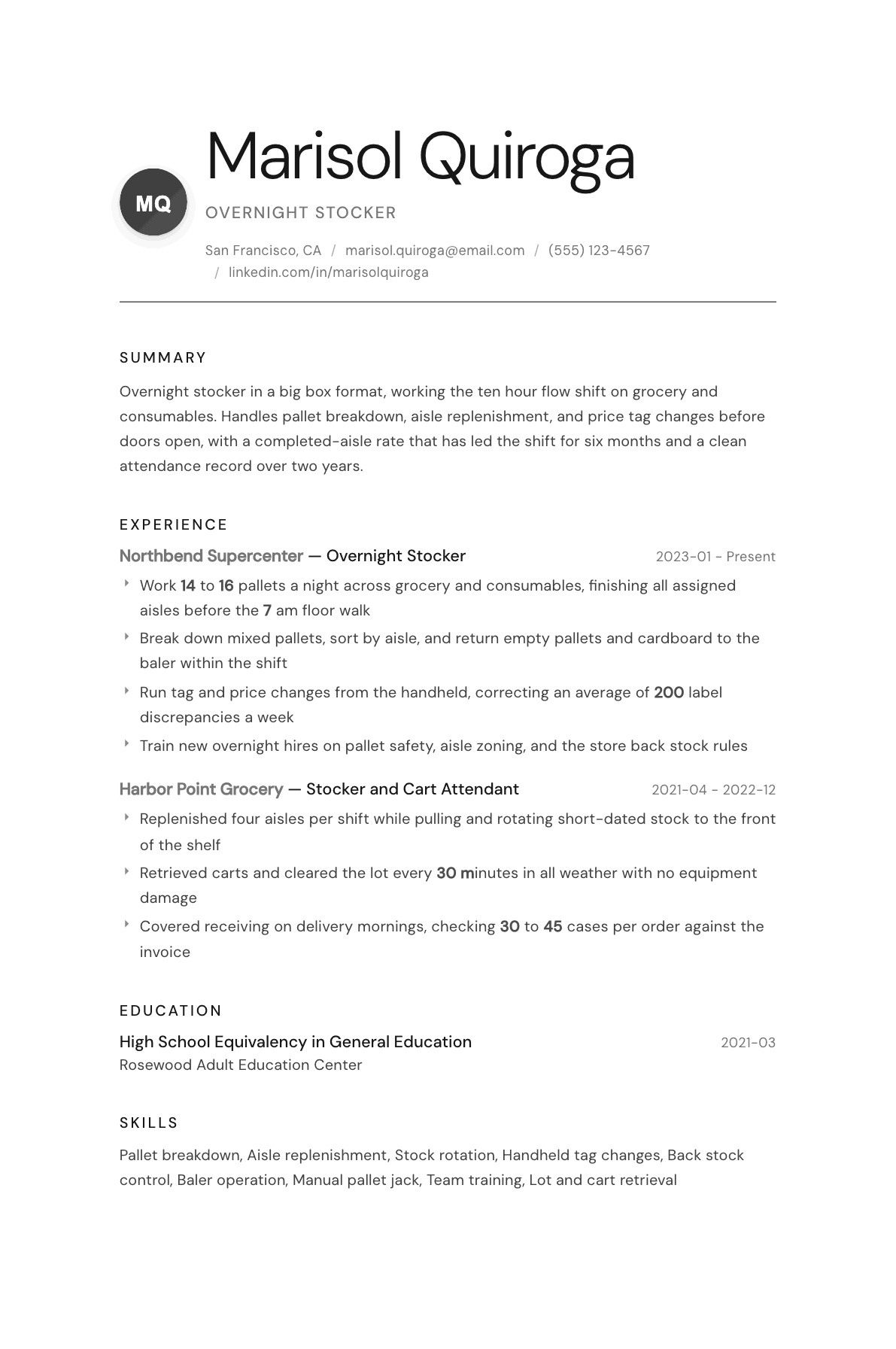
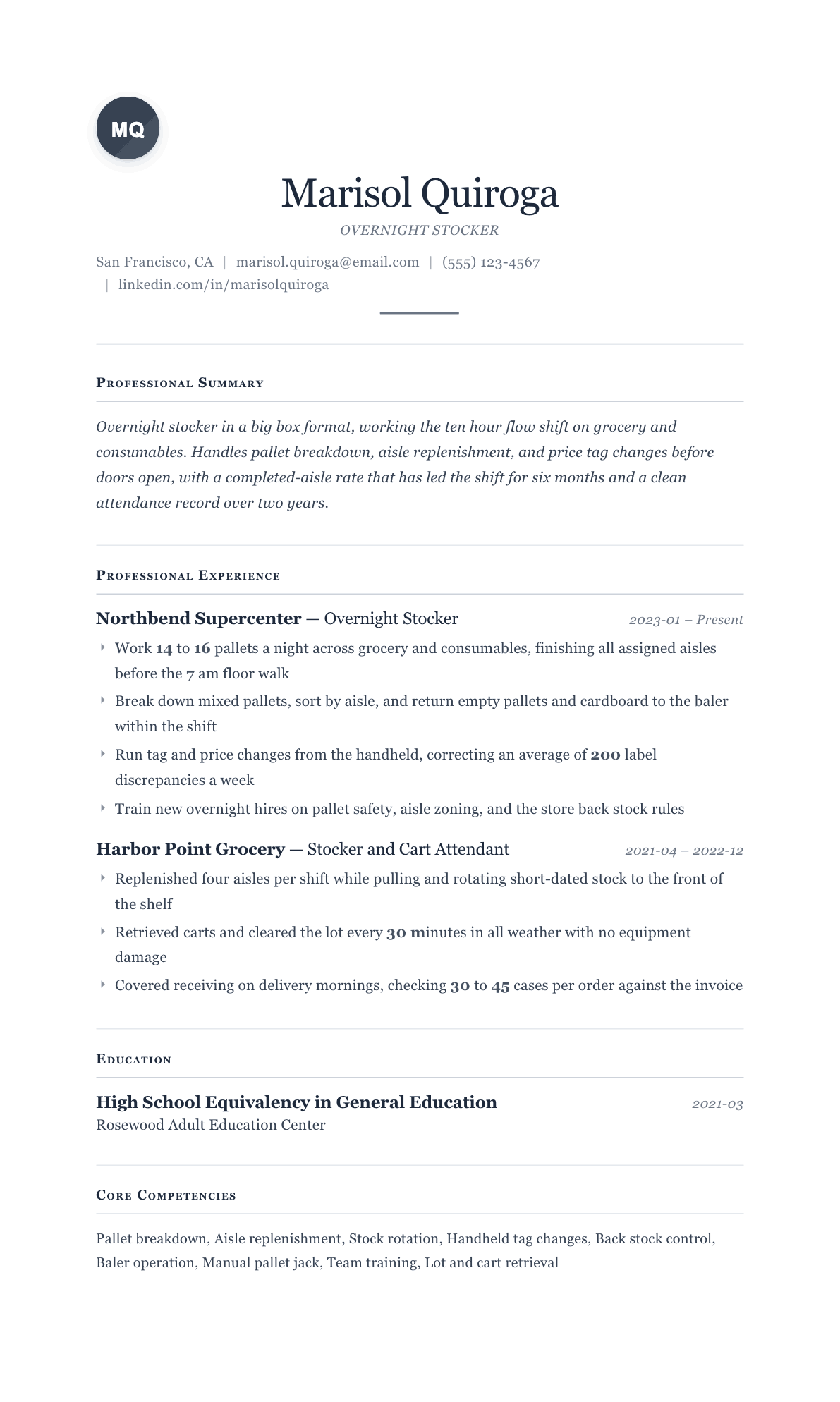
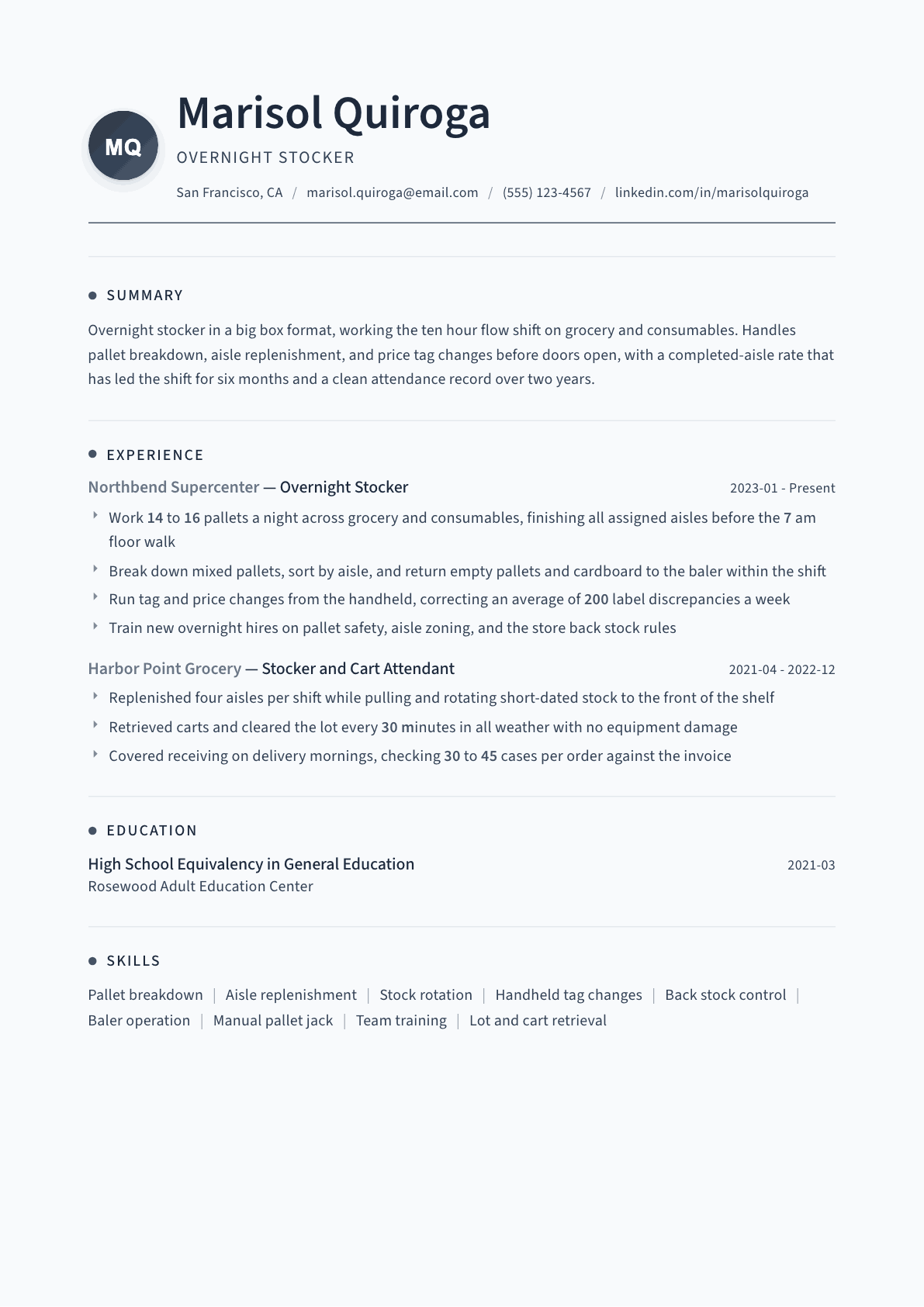
Example Stocker summary
Overnight stocker with three years on big box flow crews, working 14 to 16 pallets a night across grocery and consumables and finishing every assigned aisle before doors open. Handles pallet breakdown, rotation, and handheld tag changes, trains new hires on safety, and holds a clean two year attendance record.
Skills to list on a Stocker resume
- Pallet breakdown
- Aisle replenishment
- Stock rotation
- Back stock organization
- Handheld scanner use
- Price tag changes
- Manual pallet jack
- Baler and compactor operation
- Overnight flow process
- Safety compliance
- Cart retrieval
- New hire training
- Aisle zoning
What actually gets this resume read
- Put pallets per shift and aisles completed at the top, because that is the only pace number a stocking lead trusts.
- State your shift clearly: overnight, early morning, or split, since crews are hired by shift, not by store.
- Mention attendance and reliability directly, as no-shows are the biggest problem this role has.
- Include tag changes, back stock rules, and rotation, which separate a trained stocker from a first-week hire.
- Name the equipment you can safely use, from manual pallet jacks to balers and compactors.
- If you trained new hires, say how many, because that is the first step toward a lead position.
How to write a stocker resume
A stocker resume is a reliability document. The overnight or early morning manager filling this job has a crew that shrinks every month through no-shows, and the applicant who can prove they turn up and finish their aisles wins over the applicant with a longer work history. Pace and attendance carry the page.
The mistake is writing three lines of duties that any store could have written for you. Stocked shelves, unloaded boxes, and helped customers is the default text on hundreds of applications sitting in the same folder. A stocker who writes pallets per night, aisles completed before doors open, and a two year attendance record stands apart immediately.
This guide covers how to lay the page out, what to write when this is your first job, three summary examples from a first shift through a crew trainer, before and after bullets, and the questions night crew applicants ask when they want more hours or a lead role.
Format: one page, shift and pace above the fold
Keep it to one page in a single column with ordinary headings. Chain application portals strip formatting, and a stocker resume has nothing to gain from design. Put the shift you want and your availability directly under the contact block, because crews are hired by shift and a mismatch ends the application before the experience is read.
Use month and year dates. Seasonal and peak work is normal in this job and a manager expects to see it. What raises questions is a resume with only years, which looks like an attempt to cover a gap that would have been fine if it were simply stated.
- Header: name, city and state, phone, email, and the shift window you can work.
- Section order: summary, experience, skills and equipment, education, certifications if any.
- Add one line on transport if you work overnight, since the manager will otherwise wonder how you get in.
Summary: pallets a night, aisles finished, attendance
Three short lines. Name the format and the departments, then pallets or cases per shift and whether you finish your assigned aisles before the floor walk. Close with your attendance record and the shift you want. That is the whole hiring decision in three lines.
Coming from a different job, translate what you have. Restaurant prep, moving work, landscaping, and delivery all involve early starts, heavy lifting, and finishing a fixed workload before a deadline, and the manager cares far more about that pattern than about the industry it came from.
Experience: the flow process in the words the crew uses
Write the shift as it actually runs. Pallets received and staged, breaking down mixed pallets and sorting by aisle, pushing to the shelf, working back stock, returning empties and cardboard to the baler, then zoning and facing before the floor walk. A manager reading that sequence knows you have done it and does not need to test you on it.
Add the accuracy work that many stockers never mention: tag and price changes from the handheld, correcting label discrepancies, checking date rotation on food items, and following the back stock rules so overstock does not vanish into the top shelf. These bullets make the difference between a general laborer and someone a manager can leave in an aisle alone.
Finish with anything that shows range: covering receiving on delivery mornings, cart and lot work in bad weather, training new hires, or stepping into the baler and compactor routine. Managers value the person who can be moved without a conversation.
No experience yet: build the page from evidence, not adjectives
With no paid history, use what shows physical work and dependability: moving crews, farm or yard work, school athletics, a food pantry, or a family business. Describe the workload and the schedule you kept rather than the feelings involved, because a night crew manager is screening for someone who will still be there in week six.
Say directly that you can lift repeatedly through a full shift and stand for the duration. Job postings state a weight and an endurance requirement, and answering it on the page removes a reason to pass over you.
Skills, equipment, and the keywords the portal reads
List the process terms first: pallet breakdown, replenishment, back stock, rotation, zoning, facing, tag changes, and floor push. Then the equipment: manual pallet jack, electric pallet jack if you were trained and evaluated on it, baler, and compactor. Add the handheld or scanner if the store issued you one.
Do not put reliable, hardworking, or fast learner into a list. Attendance and pace already appear in your summary and bullets as facts, and repeating them as adjectives makes the specific numbers look less convincing than they are.
Stocker resume summary examples
First stocking job
Applicant seeking an overnight stocker position with fully open availability from ten at night to seven in the morning. Two summers of moving and warehouse help, comfortable lifting to 50 pounds repeatedly, and used to finishing a set workload before a fixed deadline. Reliable transport for night shifts.
Three years on nights
Overnight stocker on a big box flow crew, working 14 to 16 pallets a night across grocery and consumables and finishing every assigned aisle before the morning floor walk. Handles pallet breakdown, rotation, and handheld tag changes, with a clean two year attendance record.
Crew trainer
Senior stocker and night crew trainer, leading the consumables side of a ten hour flow shift and onboarding new hires on pallet safety, back stock rules, and zoning standards. Led the shift on completed aisles for six months and covers receiving on delivery mornings.
Work experience bullets: before and after
Before: Stocked products on shelves overnight.
After: Worked 14 to 16 pallets a night across grocery and consumables, finishing all assigned aisles before the seven in the morning floor walk.
Pallet count and a deadline give the manager the pace figure that decides scheduling.
Before: Broke down pallets and threw away trash.
After: Broke down mixed pallets, sorted product by aisle, and returned empty pallets and cardboard to the baler within the same shift so the dock stayed clear.
The full sequence plus the reason shows an understanding of flow rather than a series of chores.
Before: Changed price tags when needed.
After: Ran tag and price changes from the handheld, correcting an average of 200 label discrepancies a week before opening.
A weekly volume turns an occasional task into a measurable accuracy contribution.
Before: Trained other new workers.
After: Trained new overnight hires on pallet safety, aisle zoning, and back stock rules, taking each through their first three shifts.
Naming the topics and the onboarding length is what makes a training claim look real to a night manager.
Before: Always showed up for my shifts.
After: Held a clean attendance record over two years, including holiday weeks and every peak season Sunday the crew needed covered.
A stated period and the hard-to-fill shifts convert a claim into the evidence this job is hired on.
Hard skills
- Pallet breakdown and sorting
- Aisle replenishment and floor push
- Stock rotation and date checks
- Back stock organization
- Handheld scanner operation
- Price and shelf tag changes
- Manual pallet jack operation
- Baler and compactor operation
- Zoning and facing standards
- Receiving support on delivery days
- Cart and lot retrieval
- Workplace safety procedures
Soft skills
- Punctuality on night shifts
- Steady pace without supervision
- Following instructions exactly
- Helping the crew finish
- Care with fragile product
- Willingness to cover peak weeks
Certifications worth listing
- OSHA 10-Hour General Industry (OSHA Outreach Training Program, U.S. Department of Labor)
- Food Handler Card (State or county health department)
Mistakes that cost stocker candidates the interview
- Writing three generic duty lines that read identically to every other application in the manager's folder.
- Leaving the shift and availability off the page, when crews are hired shift by shift and a mismatch ends the review.
- Never giving a pace figure, so a night manager has no way to compare you with the people already on the crew.
- Listing reliable and hardworking as skills instead of stating an attendance record and the peak weeks you covered.
- Omitting handheld work, tag changes, and rotation, the details that show you were trusted with more than lifting.
- Building the resume in a designed template whose columns come out scrambled in the store application portal.
Stocker resume questions
What does a hiring manager look for first on a stocker resume?
Availability for the shift being filled, then pace, then attendance. Overnight and early morning crews carry the freight, so a manager reads the shift line first and stops reading if it does not match the opening they are trying to cover this week.
How do I write a stocker resume with no work experience?
Use physical and scheduled work of any kind: moving help, yard or farm work, school sports, or volunteering at a pantry or event. Describe the workload, the hours you kept, and your ability to lift repeatedly through a full shift, then state your availability clearly.
Should I list how much I can lift?
Yes, in one line matching the posting. Most stocking jobs state a repeated lifting weight and require standing for the whole shift. Answering the requirement directly removes a screening question and shows you read the description before applying.
Is overnight stocking experience useful for other jobs?
Very. Flow crews teach inventory rotation, back stock control, scanner accuracy, and equipment safety, all of which transfer into warehouse, receiving, and retail supervision roles. Record the pallet counts and accuracy details now so you can reuse them later.
How do I get promoted from stocker to a lead position?
Put ownership on the page: training new hires, covering receiving, holding zoning standards, and leading a section of the shift. A manager promotes the person already doing the coordination work, and the resume should show that pattern before you ask.