Deli Clerk Resume Examples: free ATS score and gap list
Write a Deli Clerk Resume That Gets You Behind the Counter
By Mustafa Tarabya, founder of CVBooster · Published · Updated
Deli clerk resume examples with slicing, food safety and hot case keywords, plus a guide to proving speed and sanitation on paper.
Sample resumes for a deli clerk
The same deli clerk content laid out in three CVBooster templates, so you can see what the finished document looks like before you write a word.
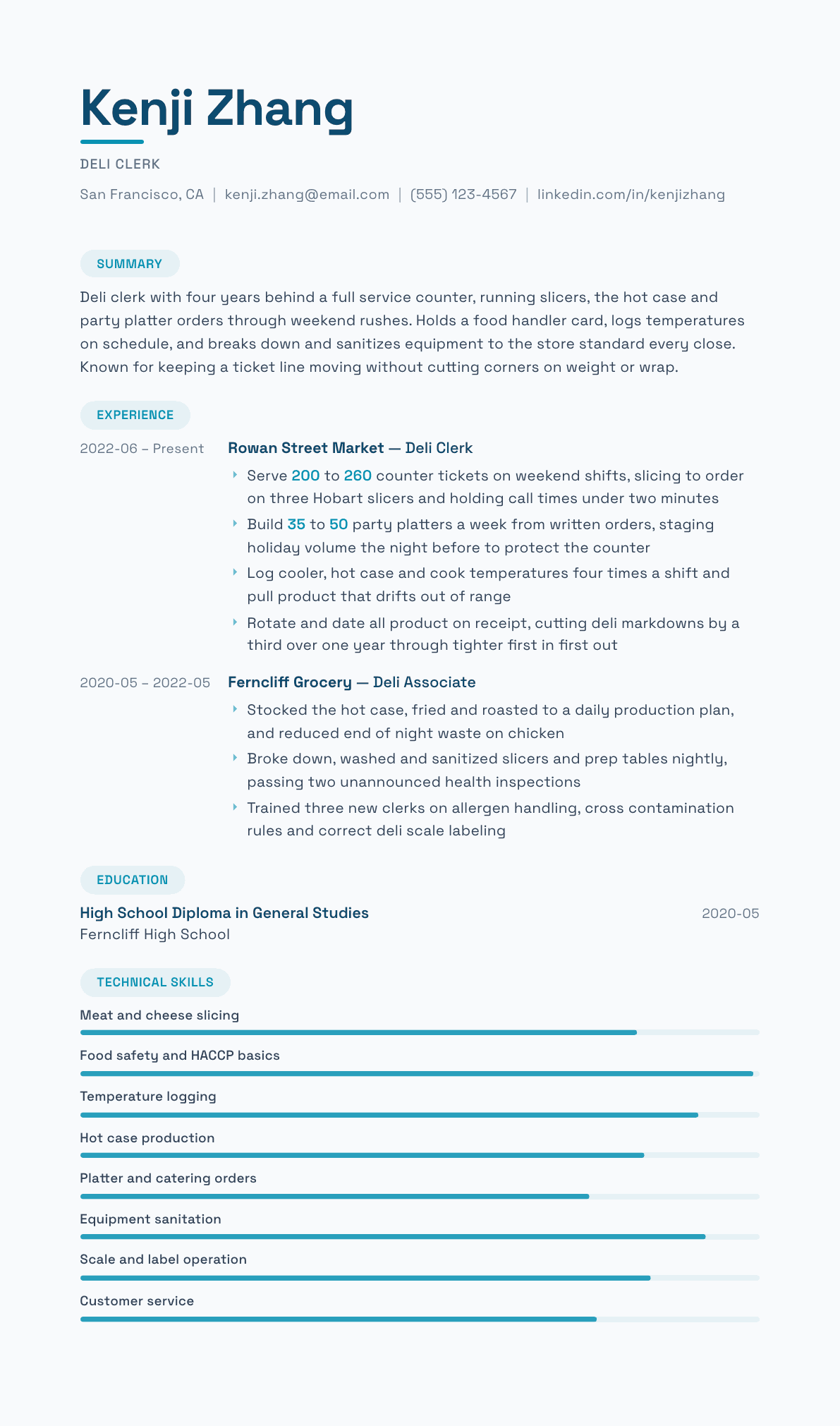
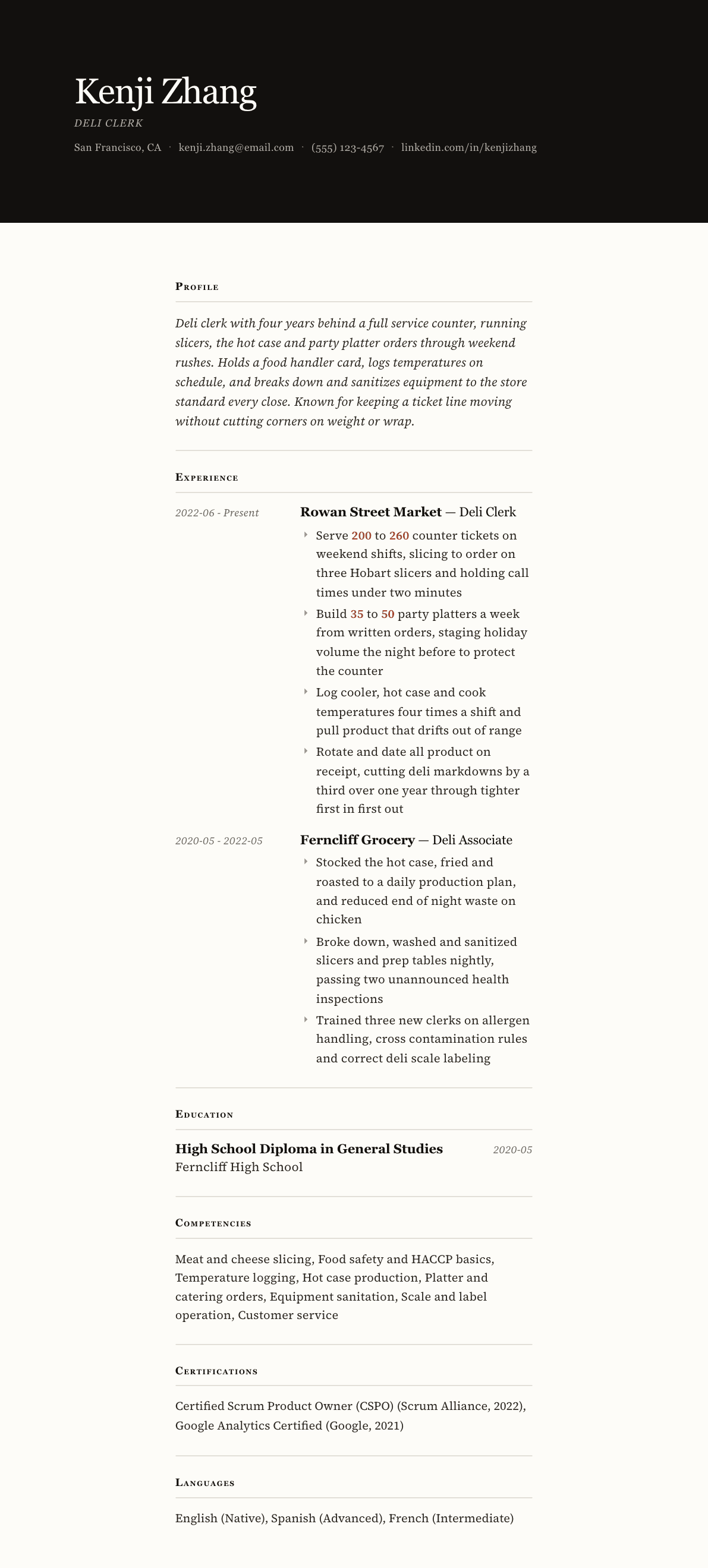
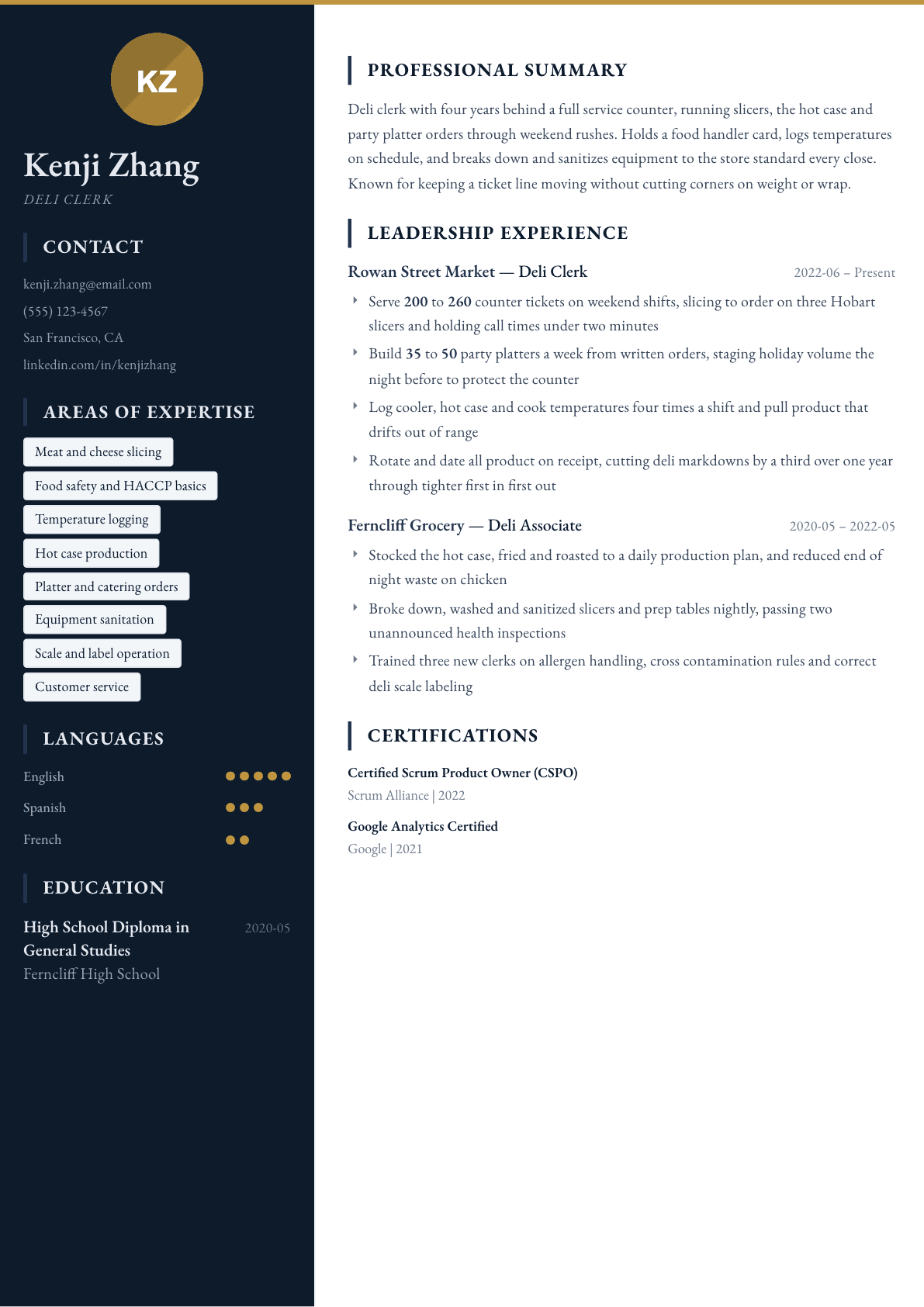
Example Deli Clerk summary
Deli clerk with four years on a full service counter, slicing to order, running the hot case and assembling catering platters through weekend rushes. Holds a food handler card, logs temperatures on schedule, and breaks down slicers and prep tables to store sanitation standards every close. Tightened product rotation to cut deli markdowns while keeping the ticket line moving.
Skills to list on a Deli Clerk resume
- Slicer operation
- Food safety and sanitation
- Temperature monitoring
- Hot case and rotisserie production
- Catering platter assembly
- Product rotation and dating
- Allergen handling
- Deli scale and labeling
- Case merchandising
- Customer order taking
- Waste and markdown control
- Equipment breakdown and cleaning
- Inventory and ordering support
What actually gets this resume read
- Put your food handler card or ServSafe certification in the header area where a store manager sees it first.
- Give ticket volume and call times, since deli hiring is about whether you can hold a line on Saturday.
- Name the slicers and equipment you have run, because training time on unfamiliar machines costs the store.
- Show temperature logging and sanitation explicitly, because a health inspection failure is the manager worry.
- Include catering and platter work with order volume, which separates a counter clerk from a full deli hand.
- Mention rotation and waste reduction, since shrink at the deli counter is watched as closely as sales.
How to write a deli clerk resume
A deli manager hiring a clerk is thinking about Saturday. There will be a ticket line twelve deep, a hot case that has to be filled on schedule, two platter orders due at noon, and a temperature log that has to be signed whether or not anyone has time. The resume that gets called is the one that suggests you have already survived that shift somewhere else.
The second thing on the manager mind is the health inspection. A deli is one of the highest risk departments in a grocery store, and a clerk who does not date product, log coolers or break down a slicer properly can cost the store its rating. Food safety detail on your resume is not padding, it is the reassurance the reader is looking for.
This guide covers how to lay the page out, how to write summaries from a first food job through a lead clerk, how to turn counter work into bullets with volume and standards attached, and the questions that come up when clerks move between stores.
Format: one page with your food handler card visible immediately
One page, one column, plain headings. Grocery chains run applications through the same system as the front end and the warehouse, so decorative layouts get parsed badly, and a deli manager is often reading on a back room terminal between production runs.
Put your food handler card or food safety certification directly under your contact details along with the issuing state or county. In many jurisdictions a clerk cannot be scheduled without it, so it belongs at the top rather than in a certifications block at the bottom of the page.
- Header: name, city and state, phone, email, food handler card and issuing authority.
- Section order: summary, certifications, experience, skills, education.
- Open each job with the department type: full service deli, hot case, sandwich station, or a combined deli and bakery.
Summary: counter type, volume, and your safety record
Three lines. What kind of counter you worked, how busy it was, and one line about food safety discipline. A deli clerk who names weekend ticket volume and mentions passing unannounced inspections has answered both of the manager questions before the experience section begins.
If this is your first food job, use the summary to show you know what the work is. Standing shifts, early starts, cold rooms, sharp equipment and holiday weeks. Managers in this department lose people to the physical reality of the job, so an applicant who names it plainly reads as someone who will still be there in March.
Experience: the line, the case, the log, the platter
Start with counter volume. Tickets per weekend shift, average call time, and how many slicers you ran at once. That trio tells a manager whether you can hold a queue, and it is a fact almost no other applicant will put on the page.
Then production. Hot case output against a daily plan, fried and roasted items, sandwich station work, and end of night waste. Any bullet where you reduced waste while still having product on the case at six in the evening is worth more than three bullets about customer service.
Then catering. Platters per week, holiday staging, written order accuracy and how you protected the counter while building a fifty tray Thanksgiving order. Finish with the compliance work: temperature logs, rotation and dating, allergen handling, and slicer breakdown and sanitation at close.
Food safety: name the practice, not just the certificate
The certificate proves you sat the course. The bullets prove you practice it. Say how often you logged temperatures, what you did with product that drifted out of range, how you separated raw from ready to eat, and how allergen orders were handled at a shared slicer.
Inspections are the clearest evidence available to a clerk. If your department passed unannounced visits while you were responsible for closing sanitation, say so with the count. It is verifiable, it is unusual on a resume at this level, and it answers the manager real fear directly.
Skills and the words a grocery posting uses
Expect slicer operation, food safety, sanitation, rotation, temperature control, hot case, catering platters, allergen awareness, scale and labeling, and customer service. Put the true ones in a compact skills block and make sure the important ones also appear inside a bullet with a number or a standard attached.
Deli Clerk resume summary examples
First food service job
Food handler certified applicant seeking a deli clerk role, with a year of quick service line work through lunch rushes and closing sanitation duties. Comfortable on early starts and weekend shifts, trained on cross contamination rules, and ready to learn slicer operation and case production.
Four years at the counter
Deli clerk with four years on a full service counter, serving 200 to 260 tickets on weekend shifts across three slicers while holding call times under two minutes. Logs cooler and hot case temperatures four times a shift and builds 35 to 50 catering platters a week from written orders.
Lead deli clerk
Lead deli clerk running production planning, ordering support and closing sanitation for a high volume department. Trained six clerks on allergen handling and scale labeling, cut deli markdowns by a third through tighter rotation, and passed two unannounced health inspections with no critical violations.
Work experience bullets: before and after
Before: Served customers at the deli counter.
After: Served 200 to 260 counter tickets on weekend shifts, slicing to order across three slicers and holding call times under two minutes through the lunch peak.
Ticket volume, equipment count and call time show a manager you can hold the busiest shift in the department.
Before: Made sure food was stored at the right temperature.
After: Logged cooler, hot case and cook temperatures four times a shift and pulled and recorded any product that drifted outside the safe range.
The cadence and the corrective action prove a practiced routine rather than an awareness of the rule.
Before: Made party platters for customers.
After: Built 35 to 50 catering platters a week from written orders and staged holiday volume the night before to keep the counter line moving.
Weekly volume plus the staging decision shows planning around the counter rather than at its expense.
Before: Cleaned the equipment at the end of the night.
After: Broke down, washed and sanitized three slicers and all prep tables nightly to store specification, contributing to two unannounced inspection passes.
Naming the equipment and tying it to an inspection outcome turns cleaning into a verifiable standard.
Before: Reduced waste in the department.
After: Cut deli markdowns by roughly a third over a year by dating on receipt and enforcing first in first out on every case rotation.
The mechanism explains the result, which is what convinces a manager the improvement will travel with you.
Hard skills
- Slicer operation and blade safety
- Hot case and rotisserie production
- Catering platter assembly
- Temperature monitoring and logging
- Product rotation and date coding
- Allergen and cross contamination control
- Deli scale and label operation
- Case merchandising and facing
- Equipment breakdown and sanitation
- Waste and markdown control
- Order taking and special requests
- Receiving and stock rotation
Soft skills
- Speed without losing accuracy
- Calm through a long ticket line
- Clear communication across a counter
- Reliability on early and weekend shifts
- Training newer clerks
Certifications worth listing
- ServSafe Food Handler (National Restaurant Association)
- ServSafe Food Manager (National Restaurant Association)
- Food Protection Manager Certification (National Registry of Food Safety Professionals)
- Food Handler Certificate (State or County Health Department)
Mistakes that cost deli clerk candidates the interview
- Leaving the food handler card off the page when many jurisdictions will not let the store schedule you without one.
- Describing customer service in general terms while never stating how busy the counter actually was.
- Skipping temperature logs and sanitation, which is the area a manager worries about most when hiring.
- Listing catering work without any order volume, so a reader cannot tell one platter a week from fifty.
- Treating equipment as generic instead of naming the slicers, grinders and warmers you have actually run.
- Hiding availability, when weekend and holiday coverage is usually the reason the position opened.
Deli Clerk resume questions
Do I need a ServSafe certificate to apply for a deli clerk job?
Many stores will accept a basic food handler card and train you further, but holding a recognized certificate before you apply removes a scheduling obstacle. Check your county rules, because some jurisdictions require the card in hand on your first day.
How do I make counter work sound substantial on a resume?
Attach volume and standards to it. Tickets per shift, slicers run, platters per week, temperature log frequency and inspection outcomes all convert a routine description into evidence, and they are numbers a former manager can confirm in a reference call.
Can restaurant experience transfer to a grocery deli?
Yes, especially line speed, sanitation habits and knife work. Translate the vocabulary so a grocery manager recognizes it: prep list becomes production plan, line becomes counter, and closing duties become slicer breakdown and case cleaning.
What should I say about the holiday season?
Say what you did during it. Thanksgiving and December weeks are the hardest shifts in a deli, so describing platter volume, extra production and how orders were staged tells a manager you have worked the period that decides the department year.
Should a deli clerk resume be more than one page?
No. One page is right for this role, and a longer file usually means duties are repeated across jobs. Use the space for volume figures, food safety detail and equipment names rather than restating the same counter tasks three times.