Handyman Resume Examples: free score, then the gap list
Build a Handyman Resume That Books Steady Work
By Mustafa Tarabya, founder of CVBooster · Published · Updated
Handyman resume examples with repair skills, tools, licensing notes and keywords that property managers and homeowners search for.
Sample resumes for a handyman
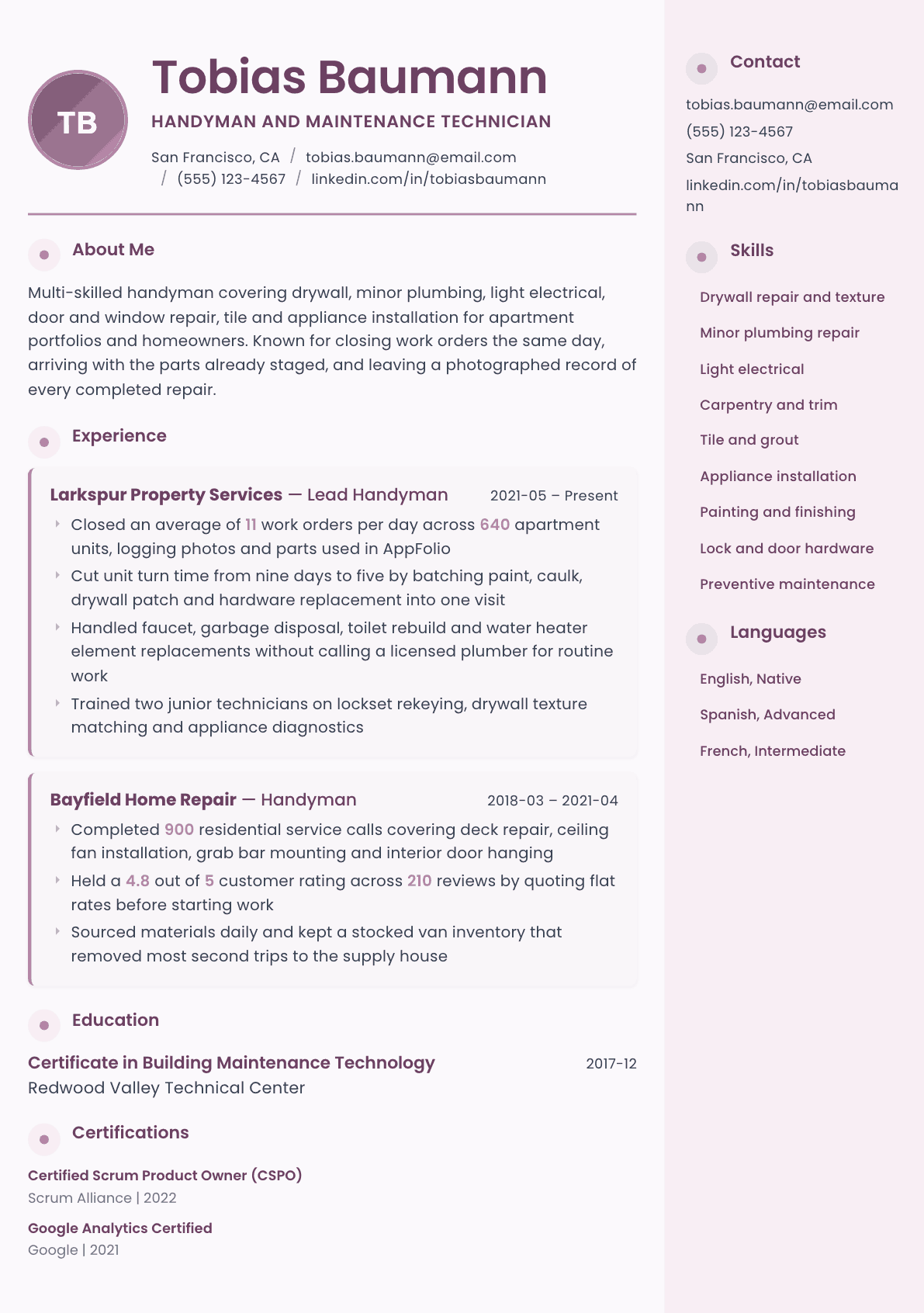
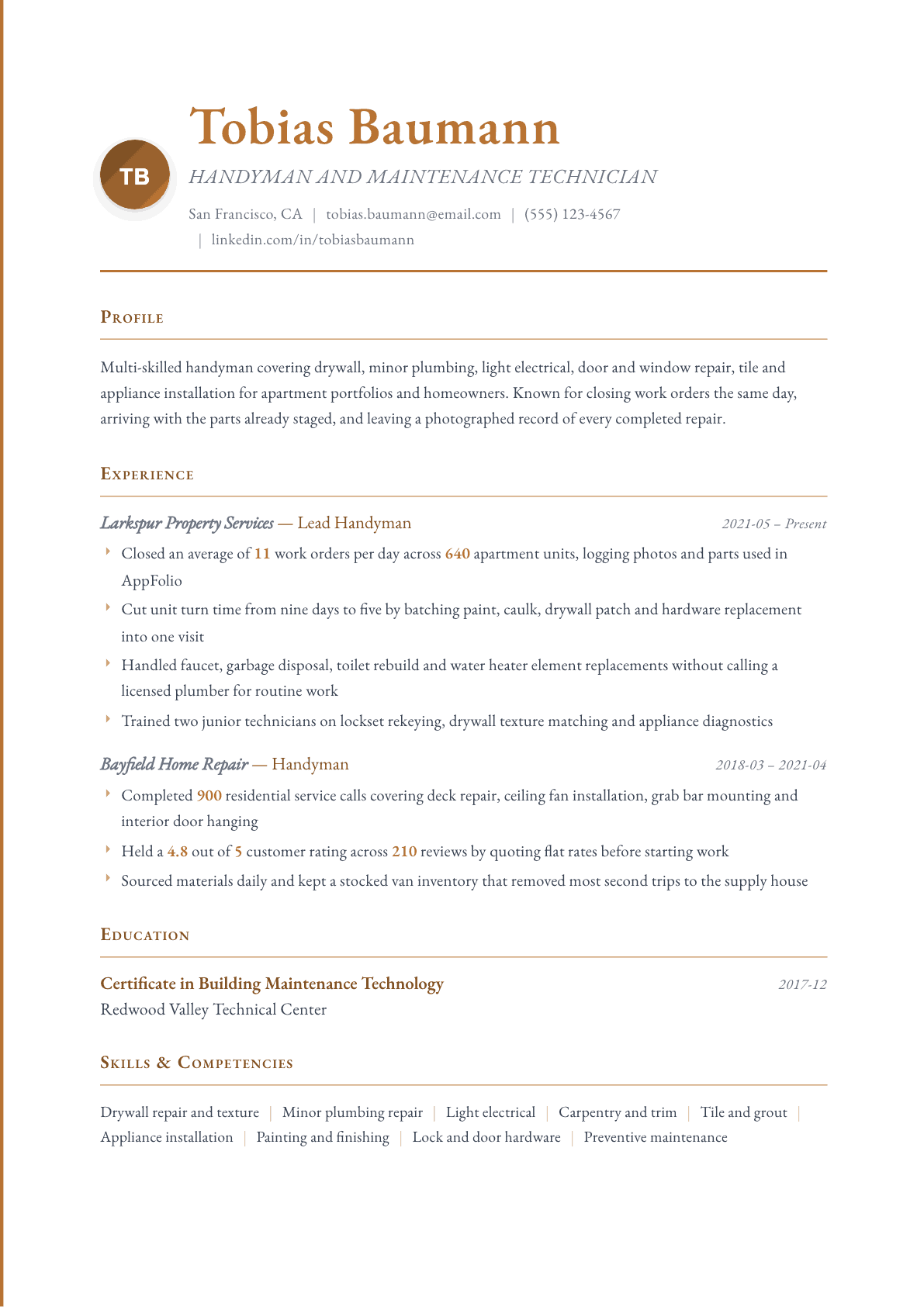
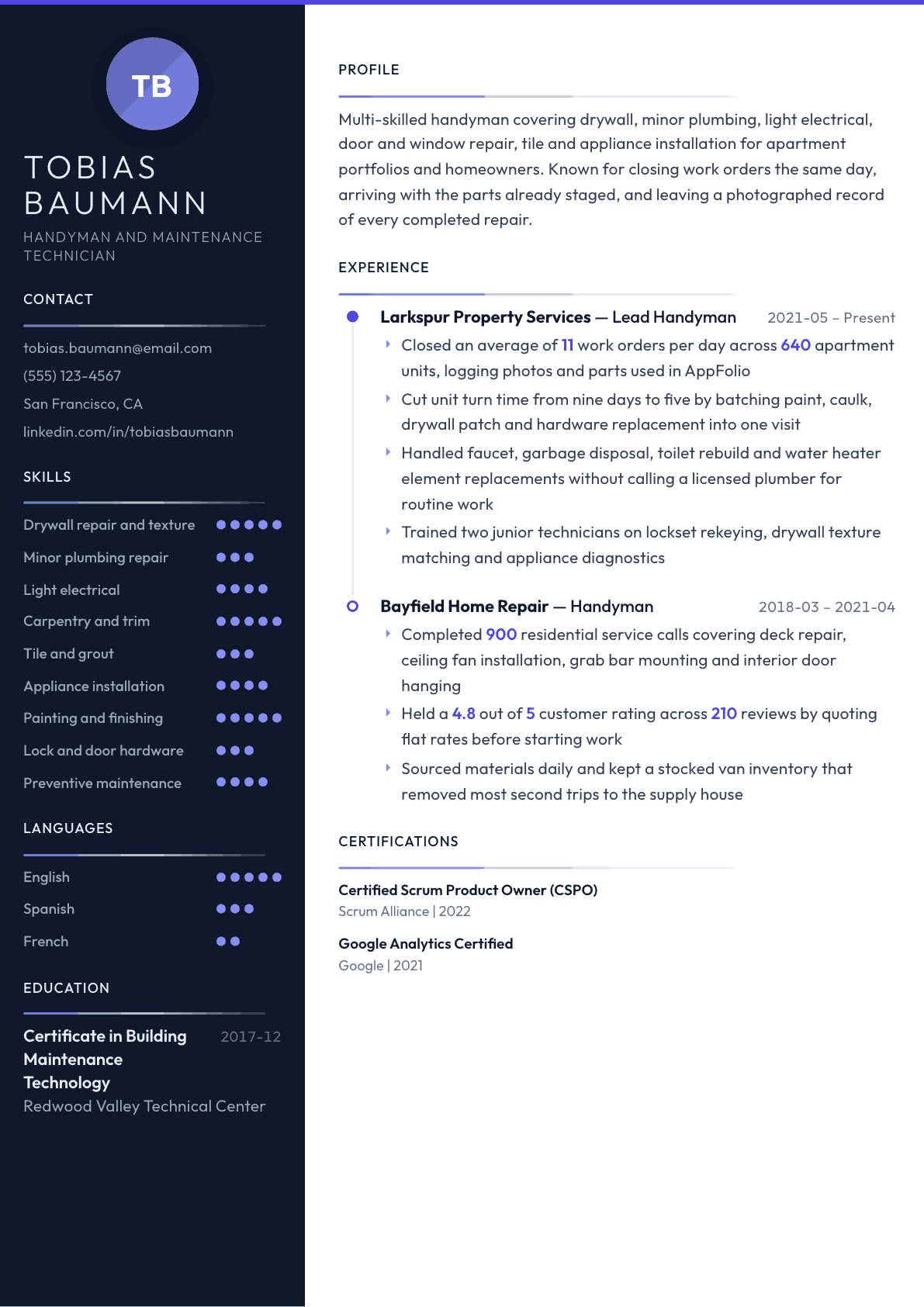
The same handyman content laid out in three CVBooster templates, so you can see what the finished document looks like before you write a word.
Example Handyman summary
Handyman with seven years of apartment and residential repair covering drywall, painting, minor plumbing, light electrical, tile and appliance work. Closes roughly eleven work orders a day across a six hundred unit portfolio, documents every job with photos in AppFolio, and cut unit turn time from nine days to five. Owns a fully stocked van and a complete power tool set.
Skills to list on a Handyman resume
- Drywall patching and texture
- Interior and exterior painting
- Faucet and toilet repair
- Outlet and fixture replacement
- Door and window adjustment
- Tile setting and grout
- Deck and fence repair
- Appliance installation
- Caulking and weatherproofing
- Lockset rekeying
- Work order documentation
- Preventive maintenance rounds
- Power and hand tool safety
- Customer service
What actually gets this resume read
- Open with the trades you cover, because a property manager is scanning for the exact repair categories she stops paying vendors for.
- Say what you can legally do without a specialty license in your state, and say plainly where you hand off to a licensed trade.
- Quantify throughput: work orders closed per day, unit turn time, callback rate, and the size of the portfolio you covered.
- List your own tools and vehicle, since many employers treat a stocked van and power tools as a hiring requirement.
- Mention the work order software you have used, such as AppFolio, Yardi or ServiceTitan, so the ATS matches you.
- Include a customer rating or review count if you have worked direct to homeowners, because trust is the product you sell.
How to write a handyman resume
Two very different readers hire a handyman. A property manager wants the list of vendor calls she can stop paying for, and she measures you in work orders closed per day. A homeowner wants to know you will show up when you said, quote before you start, and not damage the finish around the repair. The same page has to answer both.
What that page needs is coverage and evidence. Coverage means the repair categories you handle across drywall, paint, plumbing fixtures, light electrical, doors, tile and appliances. Evidence means counts: units serviced, calls completed, callback rate, turn times, review scores. Adjectives such as reliable and hardworking are what everyone else in the stack already wrote.
Below is how to build the resume section by section, with example summaries at three stages of a repair career, before and after bullets, the credentials worth carrying, and the questions handymen ask when they start writing.
Format: a trade coverage list a manager can scan in ten seconds
One page, reverse chronological, plain type. Put a short trade coverage line directly under the header so the first thing anyone reads is the range of repairs you handle. That line does more work than the summary, because it answers the only screening question a maintenance supervisor has.
Add your service radius, whether you have a truck or van, and whether you own your own tools. Many postings treat a stocked vehicle and a full power tool set as a hiring requirement, and leaving it off makes the reader assume you do not have one.
- Header: name, city and service radius, phone, email, vehicle and tools owned.
- Trade coverage line: drywall, paint, fixture plumbing, light electrical, doors and hardware, tile, appliance installation, exterior repair.
- Then experience, credentials and licenses, skills, education or apprenticeship.
Summary: coverage, setting and throughput
Three lines. Name what you fix, where you have fixed it, and how fast. Apartment portfolios, single family service calls, commercial facilities and vacation rentals each run differently, and a manager filtering for one will not guess that your experience transfers.
Close the summary with the boundary. Say which work you hand to a licensed plumber or electrician. Being explicit about the line reads as professional rather than limited, and it protects the employer who has to answer for permits and code.
Experience: portfolio size, work orders, and second trips avoided
Open each job with the setting and its size: the unit count of the portfolio, the number of buildings, or the geography your service calls covered. A supervisor reading a resume for a six hundred unit property needs to know you have worked at that density before.
Then write bullets around throughput and quality. Work orders closed per day, average time to close an emergency call, unit turn time, callback rate, and the repairs you completed without escalating to a licensed trade. If you cut second trips by stocking the van, say what you stocked and what it saved.
One bullet should show documentation, because a manager is judged on the record as much as the repair. Photo logs, parts used, time stamps, and notes entered in the work order system are all worth a line.
Licenses and credentials worth listing
Most handyman work does not require a trade license, but several credentials open doors. A state handyman or home improvement registration where one exists, an EPA lead safe renovator certification for older housing, an EPA Section 608 card if you touch refrigerant, and a current driver license with a clean record. Add first aid and CPR if you hold them.
If your state caps unlicensed work at a dollar threshold per job, do not guess the number on your resume. Say instead that you work within the state limits for unlicensed repair and refer larger scopes to licensed trades. That answers the compliance question without inventing a figure.
Skills and software the posting will ask for
Group your skills by trade rather than listing thirty items in a row. Under each trade, name the specific repairs: toilet rebuild and flapper replacement under plumbing, outlet and switch replacement under electrical, texture matching and corner bead under drywall. Specific repairs read as real experience; the trade name alone does not.
Then name the systems. Work order platforms such as AppFolio, Yardi, Buildium or ServiceTitan are common, and a portfolio already running one will favor a technician who does not need training on it.
Handyman resume summary examples
First maintenance job
Maintenance helper with two years of residential repair covering interior paint, drywall patching, door adjustment and fixture replacement. Comfortable on ladders and with power tools, holds a clean driver license, and completed a building maintenance certificate covering basic plumbing and electrical repair.
Seven years in
Handyman covering drywall, paint, fixture plumbing, light electrical, tile and appliance installation across a 640 unit apartment portfolio. Closes roughly 11 work orders a day, documents every repair with photos in AppFolio, and cut unit turn time from nine days to five by batching trades into one visit.
Lead technician
Lead maintenance technician running a three person team across four residential properties. Sets the preventive maintenance calendar, handles water heater and disposal replacement, trains new hires on texture matching and lockset rekeying, and holds an EPA lead safe renovator certification for pre war buildings.
Work experience bullets: before and after
Before: Completed maintenance work orders for apartments.
After: Closed an average of 11 work orders a day across 640 units, logging photos, parts and labor time in AppFolio before leaving each unit.
Volume, portfolio size and the documentation step turn a duty into a measurable output.
Before: Did drywall and painting repairs.
After: Patched and texture matched drywall on 300 unit turns, then cut in and rolled the repair so the touch up disappeared into the original wall.
The finish detail proves craft, which is the part a property manager notices when a resident complains.
Before: Fixed plumbing problems in units.
After: Rebuilt toilets, replaced faucet cartridges, cleared kitchen and lavatory drains and swapped water heater elements without a plumber callout.
Naming the exact repairs shows the reader which vendor invoices disappear when you are hired.
Before: Kept my van organized.
After: Stocked the van with common valves, cartridges, lockset hardware and drywall compound, removing most second trips to the supply house.
A stocked vehicle is a scheduling gain, and stating what it removed makes the benefit concrete.
Before: Good with customers.
After: Quoted a flat rate before starting every homeowner job and held a 4.8 rating across 210 reviews with no billing complaints.
The quoting practice explains the rating, so the soft skill has a mechanism behind it.
Hard skills
- Drywall patching and texture matching
- Interior and exterior painting
- Toilet and faucet repair
- Drain clearing
- Outlet, switch and fixture replacement
- Door hanging and hardware adjustment
- Lockset rekeying
- Tile setting and grout repair
- Appliance installation and diagnostics
- Caulking and weatherproofing
- Deck and fence repair
- Preventive maintenance rounds
- Work order documentation
- Power and hand tool safety
Soft skills
- Resident communication
- Same day prioritization
- Honest quoting
- Working unsupervised
- Training junior technicians
- Punctuality on scheduled windows
Certifications worth listing
- Lead-Safe Renovator (RRP) (United States Environmental Protection Agency)
- Section 608 Technician Certification (United States Environmental Protection Agency)
- OSHA 10-Hour General Industry (Occupational Safety and Health Administration)
- Certified Apartment Maintenance Technician (CAMT) (National Apartment Association)
Mistakes that cost handyman candidates the interview
- Listing a wall of trade names with no specific repairs under them, which reads as a wish list rather than a work history.
- Leaving out the portfolio size or call volume, so a supervisor cannot tell whether you have worked at her density.
- Never saying where licensed work begins, which makes a compliance minded employer nervous about code and permits.
- Omitting the vehicle and tool inventory when most postings treat both as a condition of hire.
- Describing repairs without any measure of speed, callbacks or turn time, the three numbers maintenance is judged on.
- Padding the page with unrelated jobs instead of the seasonal construction or retail work that shows reliability.
Handyman resume questions
Do I need a license to work as a handyman?
It depends on the state and on the size of the job. Many states allow small repairs without a contractor license but require one above a set value or for plumbing, electrical and structural work. Say on the resume that you work within those limits.
How do I write a handyman resume with no formal employer?
Treat your own repair business as the employer. Give it a name, the years you ran it, the type of clients you served, the number of jobs completed and any review count. Self employment is normal in this trade and reads fine when it carries numbers.
Should I list every tool I own?
No. List categories and the equipment that costs real money or signals capability: a stocked service van, a compound miter saw, a drain auger, a tile saw, a pipe threader. A page of screwdrivers wastes the space a repair example needs.
What should go first, apartments or homeowner work?
Match the posting. Applying to a property management company means leading with unit turns, work order volume and portfolio size. Applying to a home service company means leading with customer ratings, quoting practice and the breadth of repairs you handle.
How do I show reliability without sounding generic?
Attach it to a practice a manager can verify. Same day close rate on routine calls, arrival inside the scheduled window, photos on every completed order, and a callback rate you can state. Reliability described that way survives the interview.
Related resume examples
- Carpenter Resume example
- Painter Resume example
- Construction Worker Resume example
- Flooring Installer Resume example
- HVAC Technician Resume example
- Plumber Apprentice Resume example