Group Home Manager Resume Examples: the lines they read
Group Home Manager Resume That Proves Compliance and Staffing Control
By Mustafa Tarabya, founder of CVBooster · Published · Updated
Group home manager resume example with licensing compliance bullets, staffing and budget keywords, and a full guide to writing every section.
Sample resumes for a group home manager
The same group home manager content laid out in three CVBooster templates, so you can see what the finished document looks like before you write a word.
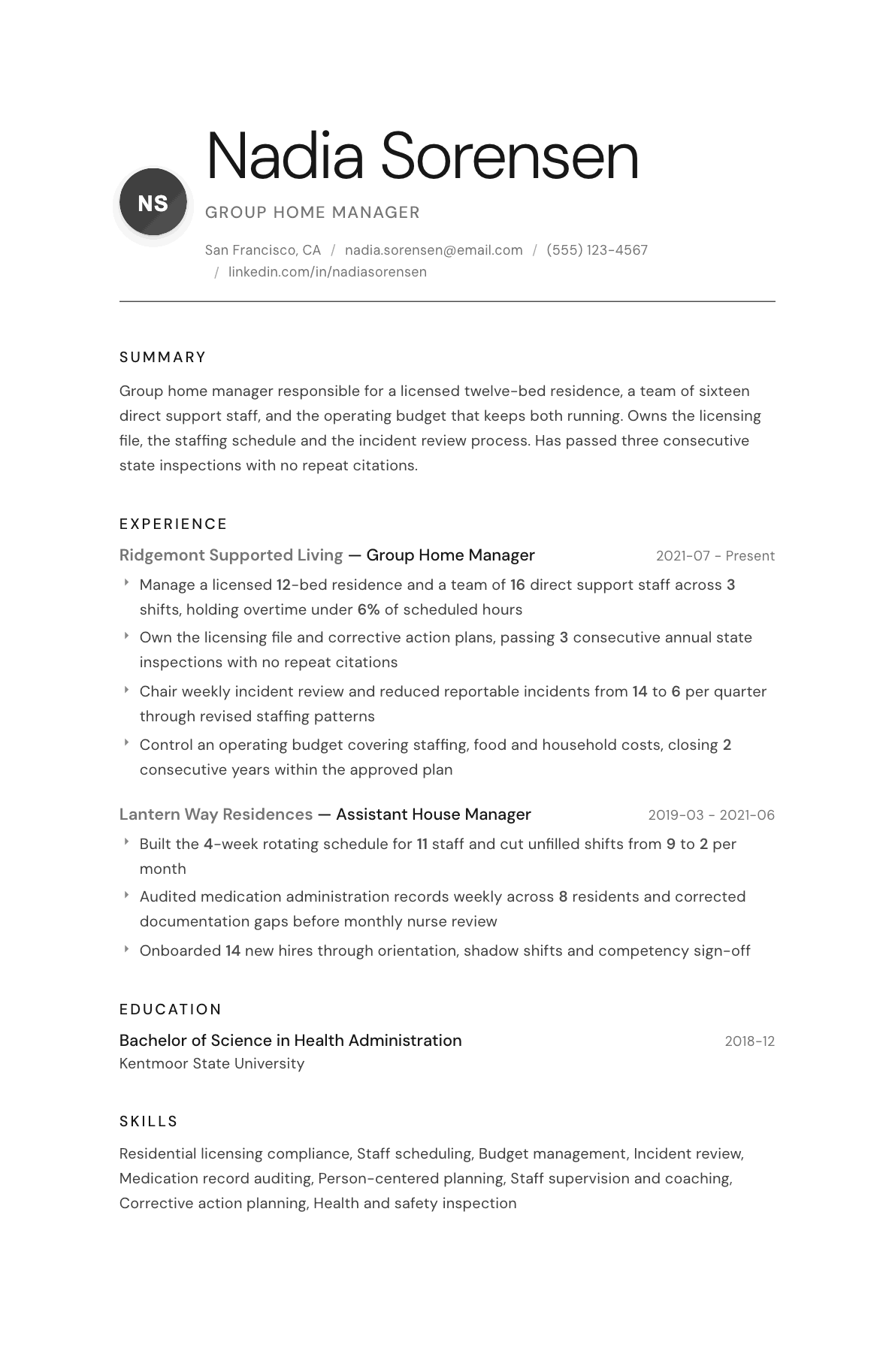
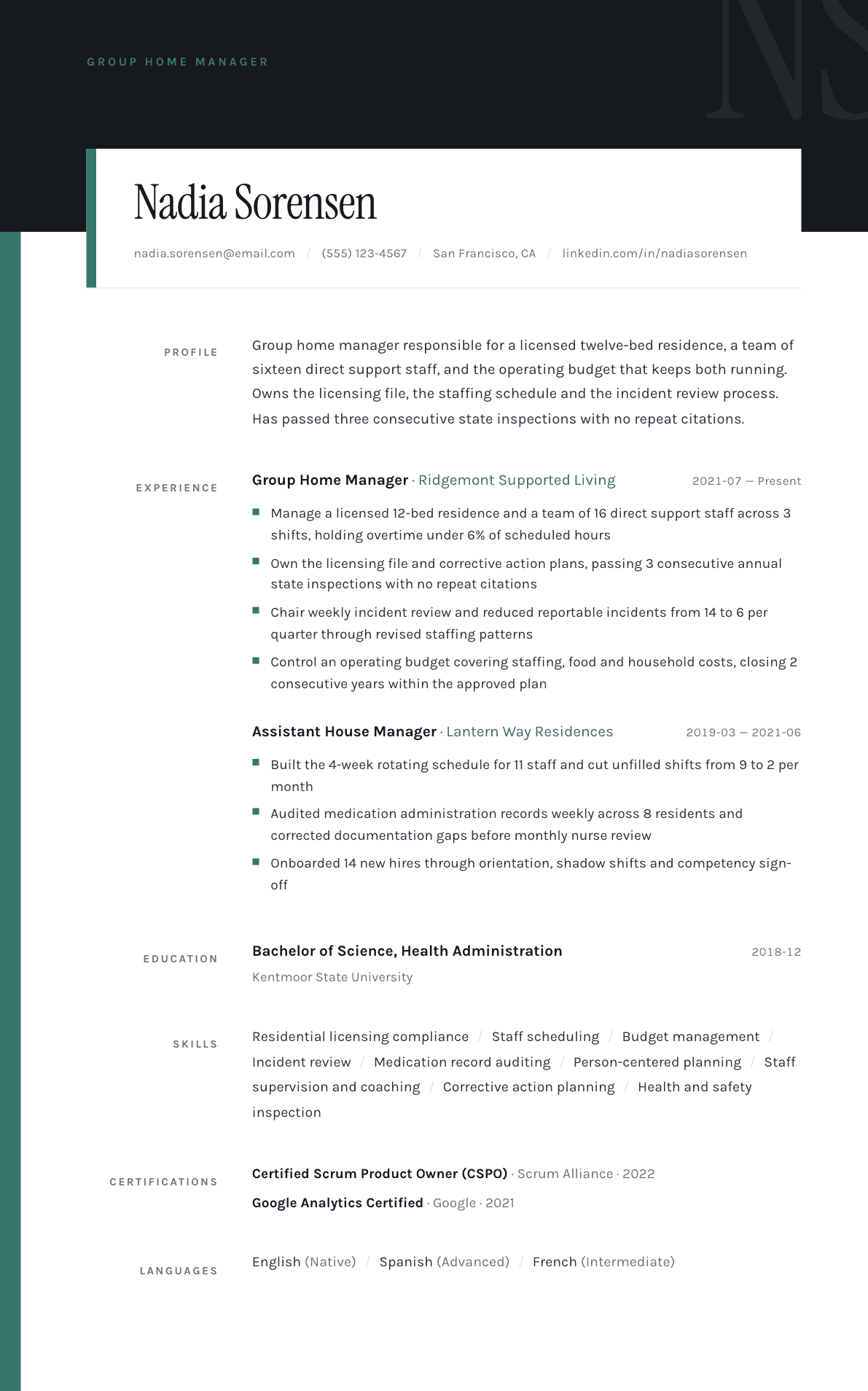
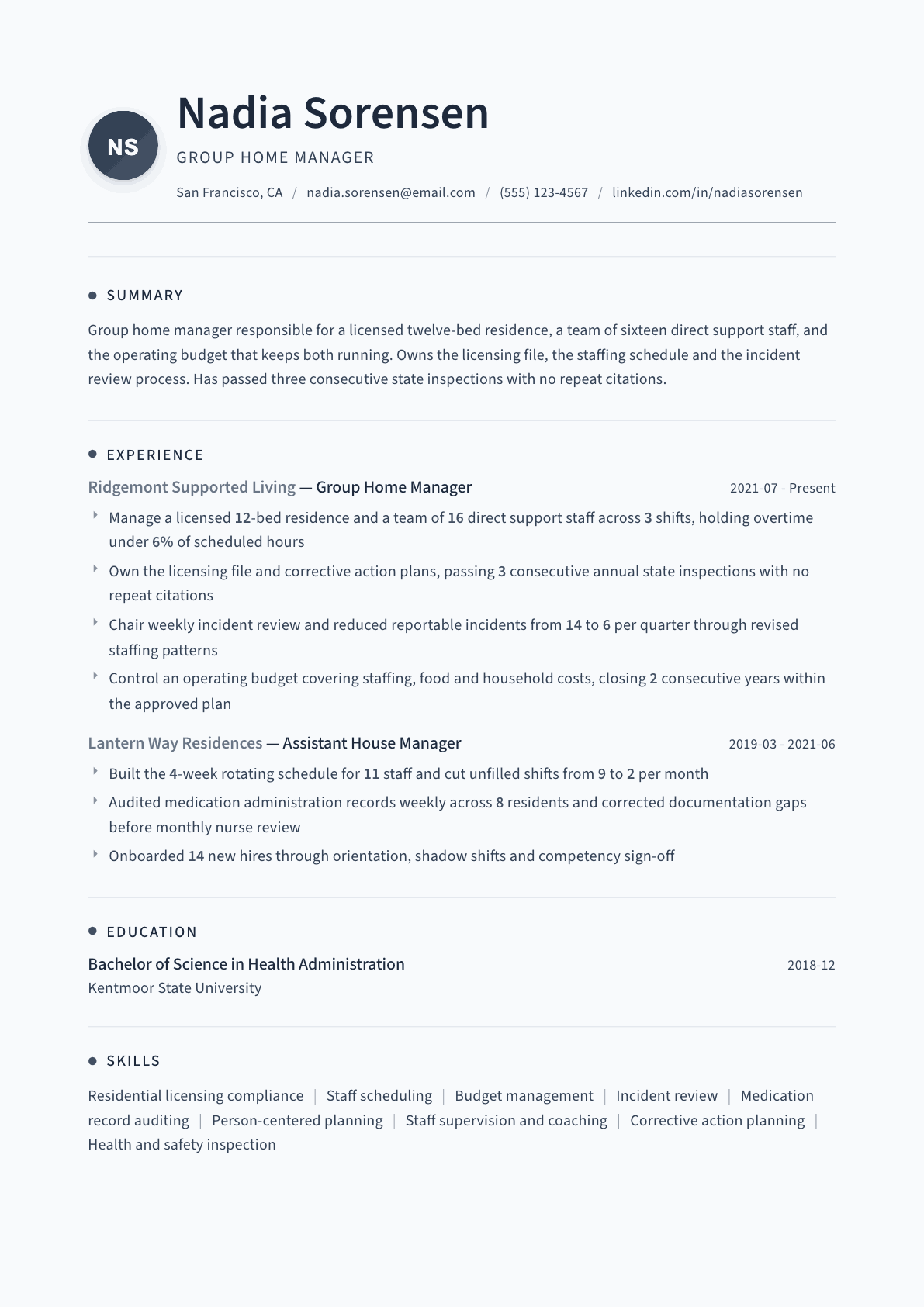
Example Group Home Manager summary
Group home manager with six years running licensed residences for adults with developmental disabilities. Leads sixteen staff across three shifts in a twelve-bed home, owns the licensing file and corrective action plans, and has passed three consecutive state inspections without a repeat citation. Holds overtime low, chairs incident review, and closes the operating budget inside plan.
Skills to list on a Group Home Manager resume
- Residential license compliance
- State survey and inspection readiness
- Corrective action plans
- Staff scheduling and coverage
- Supervision and performance coaching
- Operating budget management
- Incident reporting and review
- Medication administration record audits
- Person-centered service planning
- Behavior support oversight
- Health and safety compliance
- Family and guardian communication
- Hiring and onboarding
- Policy and procedure writing
What actually gets this resume read
- Lead with the bed count, the license category, and the number of staff you supervised across how many shifts.
- Put inspection results on the page: consecutive surveys passed, citations cleared, and corrective plans you authored.
- Show staffing control with overtime rate, unfilled shift counts, or turnover, because that is the daily management problem.
- Name the budget lines you owned and whether you closed the year inside plan, without quoting the dollar amount.
- Include incident review and reporting, since state agencies judge a home on how quickly concerns get investigated.
- Describe person-centered planning work so the resume shows resident outcomes, not only administrative control.
How to write a group home manager resume
A group home manager is hired to keep a license, a schedule and a budget intact at the same time. The regional director reading applications has usually just lost a home to a bad survey, a staffing collapse, or both. She is scanning for someone who has already lived through a state inspection, filled an overnight shift at short notice, and kept resident outcomes moving while doing it.
The applications that miss describe leadership and dedication to quality care. They do not say how many beds, how many staff, what the license category was, or what the last inspection found. Those four facts are the resume. Everything else is context around them.
This guide takes the sections in the order a residential director reads them, gives three summaries across a management career, before-and-after bullets pulled from how managers usually undersell their own operational work, and answers the questions that come up when a shift lead steps up or an experienced manager moves agencies.
Format: operational facts in the first six lines
Two pages is normal for a manager with several homes behind her, one page if this is a first management post. Reverse chronological, single column. Each job opens with the operational line: license category, bed count, population, staff supervised, shifts covered. That line is what a director uses to decide whether you have run something the size of her problem.
Keep credentials, mandated trainings and any administrator certification in a compact block near the top. In licensed residential settings a manager qualification is often a condition of the license itself, so it belongs above the experience rather than at the bottom of the page.
- Header: name, city and state, phone, email, driver license, any administrator credential.
- Order: summary, credentials, management experience, direct support experience, education, skills.
- Name the licensing body category in plain words so a director can map it to her own state.
Summary: beds, staff, license record, budget
Give the size of the operation and the state of it. A twelve-bed licensed residence, sixteen direct support staff across three shifts, three consecutive inspections passed without a repeat citation, and an operating budget closed inside plan reads as a manager who has the job under control.
Then one line on what you improved. Reducing overtime, cutting unfilled shifts, lowering reportable incidents, or raising person-centered plan quality are the four problems every residential director carries, and naming which one you solved is what earns the interview.
Compliance: inspections, citations and corrective action
Licensing is the spine of this job. Write what you owned: the licensing file, policy binders, staff training records, fire and safety drills, resident rights postings, and the file review that happens before a surveyor arrives. Then give the results. Consecutive surveys passed, citations cleared inside the timeframe, and whether any finding repeated across two years.
Corrective action plans deserve a line of their own because writing one is a specific skill. Say that you authored the plan, changed the practice underneath it, and evidenced the change at the follow-up visit. A manager who can turn a citation into a durable process change is far more valuable than one who has never had a finding at all.
- Licensing file ownership: policies, training records, drills, resident rights, incident logs.
- Survey outcomes: inspections passed, citations received and cleared, repeat findings avoided.
- Corrective action: plan authored, practice change made, evidence provided at follow-up.
Staffing, budget and the numbers a director tracks
Staffing is the daily fight. Put your schedule structure on the page: how many staff, across how many shifts, on what rotation. Then the control measures, meaning overtime as a share of scheduled hours, unfilled shifts per month, turnover in the first six months, and how long a vacancy stayed open. Those figures are the ones a regional director reviews with you every month, so they are the ones she wants to see now.
Budget belongs here too, described by responsibility rather than by dollar amount. Say which lines you controlled, whether staffing, food, household, vehicle or activity funds, and whether you closed the year inside the approved plan. Add anything you personally reduced, such as agency staffing spend or vehicle costs, without quoting a figure you cannot defend.
Supervision is the third strand. Hiring, onboarding to competency sign-off, probation reviews, coaching conversations, and formal performance management. A manager who has completed a difficult disciplinary process correctly should say so, because that is the part most first-time managers avoid.
Resident outcomes and keywords
Compliance keeps the doors open, but a director also wants residents to be doing better. Show person-centered planning quality, community participation, health appointment follow-through, and reductions in reportable incidents or restrictive practice. Tie one of those to a change you made in staffing pattern, routine or training, so the improvement has a mechanism behind it.
The keyword layer for these postings is consistent: licensed residential program, regulatory compliance, state survey, corrective action plan, staffing ratio, direct support professional supervision, person-centered planning, incident management, medication administration record audit, budget accountability. Use the phrasing that matches your license category.
Group Home Manager resume summary examples
Stepping up from shift lead
Residential shift lead for a 10-bed home with 3 years of direct support experience, supervising 5 counselors on evening coverage and owning the medication record audit. Built the 4-week rotating schedule, cut unfilled shifts from 9 to 2 a month, and completed supervisory training. Seeking a first home manager post.
Managing one licensed home
Group home manager for a licensed 12-bed residence with 16 direct support staff across 3 shifts. Owns the licensing file and corrective action plans, has passed 3 consecutive state inspections with no repeat citation, holds overtime under 6% of scheduled hours, and closed 2 budget years inside plan.
Multi-site residential manager
Residential manager for 4 licensed homes totaling 38 beds and 52 staff. Oversees survey readiness across all sites, chairs the incident review committee, rebuilt onboarding so new hires reach competency sign-off in 3 weeks, and reduced first-year turnover from 44% to 27% across two years.
Work experience bullets: before and after
Before: Managed a group home and its staff.
After: Managed a licensed 12-bed residence and 16 direct support staff across 3 shifts, owning scheduling, supervision, the licensing file and the household operating budget.
Bed count, headcount, shift structure and scope tell a director whether you have run something her size.
Before: Ensured the home met state regulations.
After: Owned the licensing file and authored corrective action plans, passing 3 consecutive annual state inspections with no repeat citation across the period.
Consecutive survey results and the absence of repeat findings are the only compliance evidence that means anything.
Before: Created staff schedules and covered shifts.
After: Built a 4-week rotating schedule for 16 staff and held overtime under 6% of scheduled hours while cutting unfilled shifts from 9 to 2 per month.
Overtime share and unfilled shifts are the two staffing numbers a regional director reviews every month.
Before: Reviewed incidents that happened in the home.
After: Chaired weekly incident review, traced each reportable event to a staffing or routine cause, and reduced quarterly reportable incidents from 14 to 6 through revised evening coverage.
A cause, a change and a measured drop turn incident review from a meeting into a management result.
Before: Trained new employees on house procedures.
After: Onboarded 14 new hires through orientation, shadow shifts and documented competency sign-off, reducing time to independent shift coverage from 6 weeks to 3.
The onboarding structure and the time to independence show a system rather than an informal handover.
Hard skills
- Residential license compliance
- State survey and inspection readiness
- Corrective action plan authoring
- Staff scheduling and coverage control
- Supervision and performance management
- Operating budget accountability
- Incident reporting and review
- Medication administration record auditing
- Person-centered service planning
- Behavior support plan oversight
- Hiring, onboarding and competency sign-off
- Policy and procedure development
Soft skills
- Composure during an unannounced inspection
- Difficult conversations with long-serving staff
- Guardian and family diplomacy
- Decision making with a shift half staffed
- Coaching rather than correcting
Certifications worth listing
- NADSP Certified Frontline Supervisor (National Alliance for Direct Support Professionals)
- Certified Social Work Case Manager (C-SWCM) (National Association of Social Workers)
- First Aid, CPR and AED (American Red Cross)
Mistakes that cost group home manager candidates the interview
- Writing about leadership philosophy while leaving out bed count, staff numbers and license category.
- Hiding inspection history, when a director assumes the worst about a manager who does not mention surveys.
- Reporting scheduling as a duty rather than showing overtime share, vacancies and unfilled shift counts.
- Ignoring resident outcomes entirely, which makes the file read as an administrator with no interest in the people.
- Claiming budget ownership without naming which lines you controlled and whether the year closed inside plan.
- Leaving out supervisory training or an administrator credential that the license itself may require.
Group Home Manager resume questions
What qualifications does a group home manager usually need?
It varies by license category and state, but most positions want a bachelor degree in human services or a related field, or substantial direct support experience with supervisory training. Some licenses require a named administrator credential, so list any supervisory certification you hold with the issuing body.
Should I mention citations my home received?
Yes, framed as a resolution. A manager who received a finding, authored the corrective plan, changed the practice underneath it and cleared the follow-up is showing exactly the competence a director needs. Silence about inspections reads as either inexperience or something being hidden.
How do I move from shift lead to group home manager?
Foreground the management fragments you already own: building schedules, auditing medication records, onboarding new staff, covering the on-call phone, or preparing files for a survey. Those are the components of the manager job, and naming them individually is more persuasive than asking for a chance.
How do I show budget responsibility without disclosing figures?
Name the lines you controlled, such as staffing hours, food, household supplies, vehicles or resident activity funds, and state whether you closed the year inside the approved plan. That gives a director scope and outcome without publishing an internal number.
What matters most when applying to a different license category?
Show that you understand the regulatory frame you are entering. Name the systems that transfer, meaning survey preparation, incident management, staffing control and person-centered planning, then say what you have studied or trained on for the new category. Directors hire transferable process skill when the candidate demonstrates awareness of the differences.
Related resume examples
- Program Coordinator Resume example
- Social Worker Resume example
- Residential Counselor Resume example
- Social Services Manager Resume example
- Disability Support Worker Resume example
- Volunteer Manager Resume example