Volunteer Manager Resume Examples: the lines they read
Craft a Volunteer Manager Resume That Shows Retention and Program Scale
By Mustafa Tarabya, founder of CVBooster · Published · Updated
Volunteer manager resume example with recruitment, retention and volunteer database keywords, plus a full guide to writing every section.
Sample resumes for a volunteer manager
The same volunteer manager content laid out in three CVBooster templates, so you can see what the finished document looks like before you write a word.
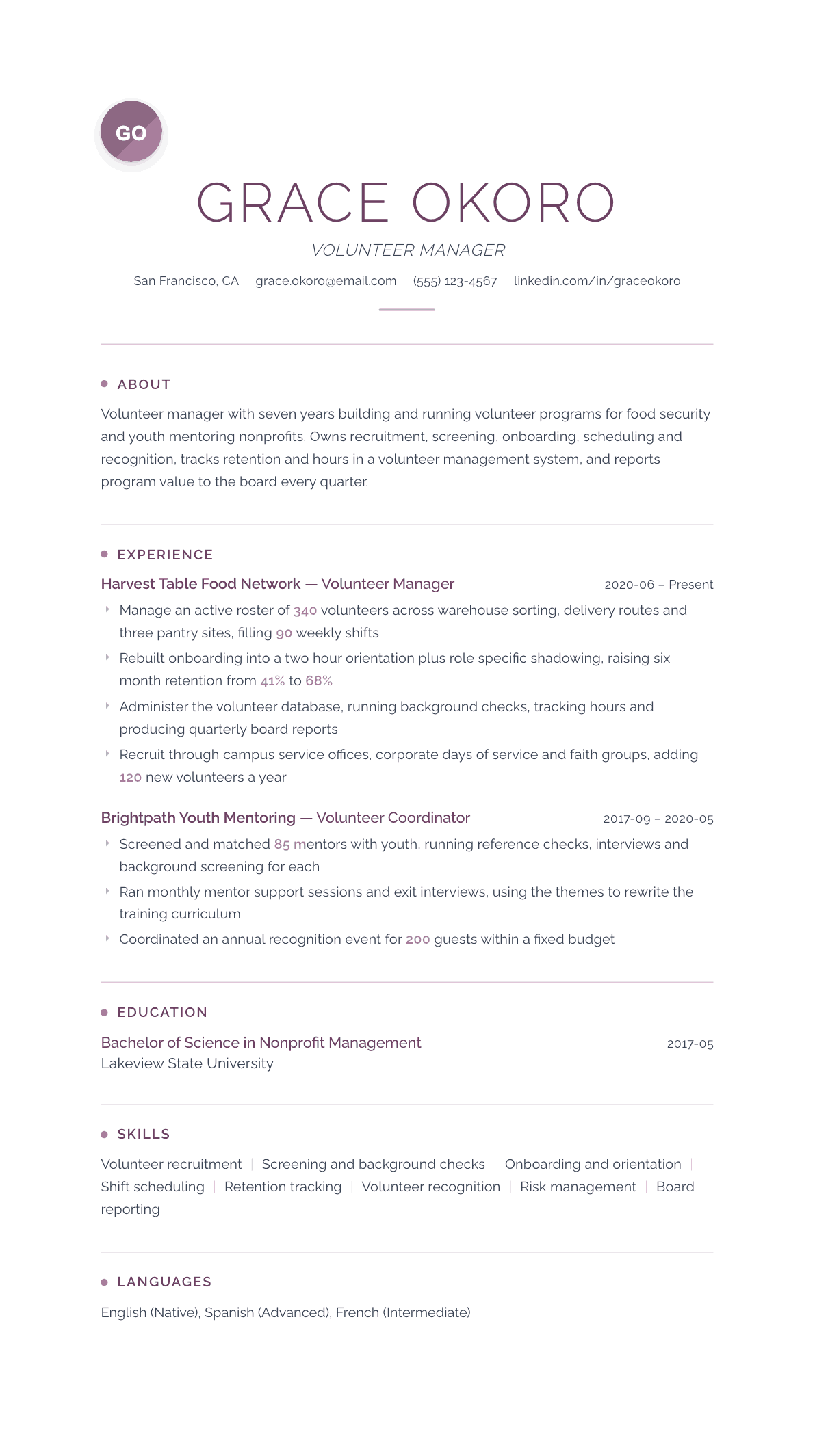
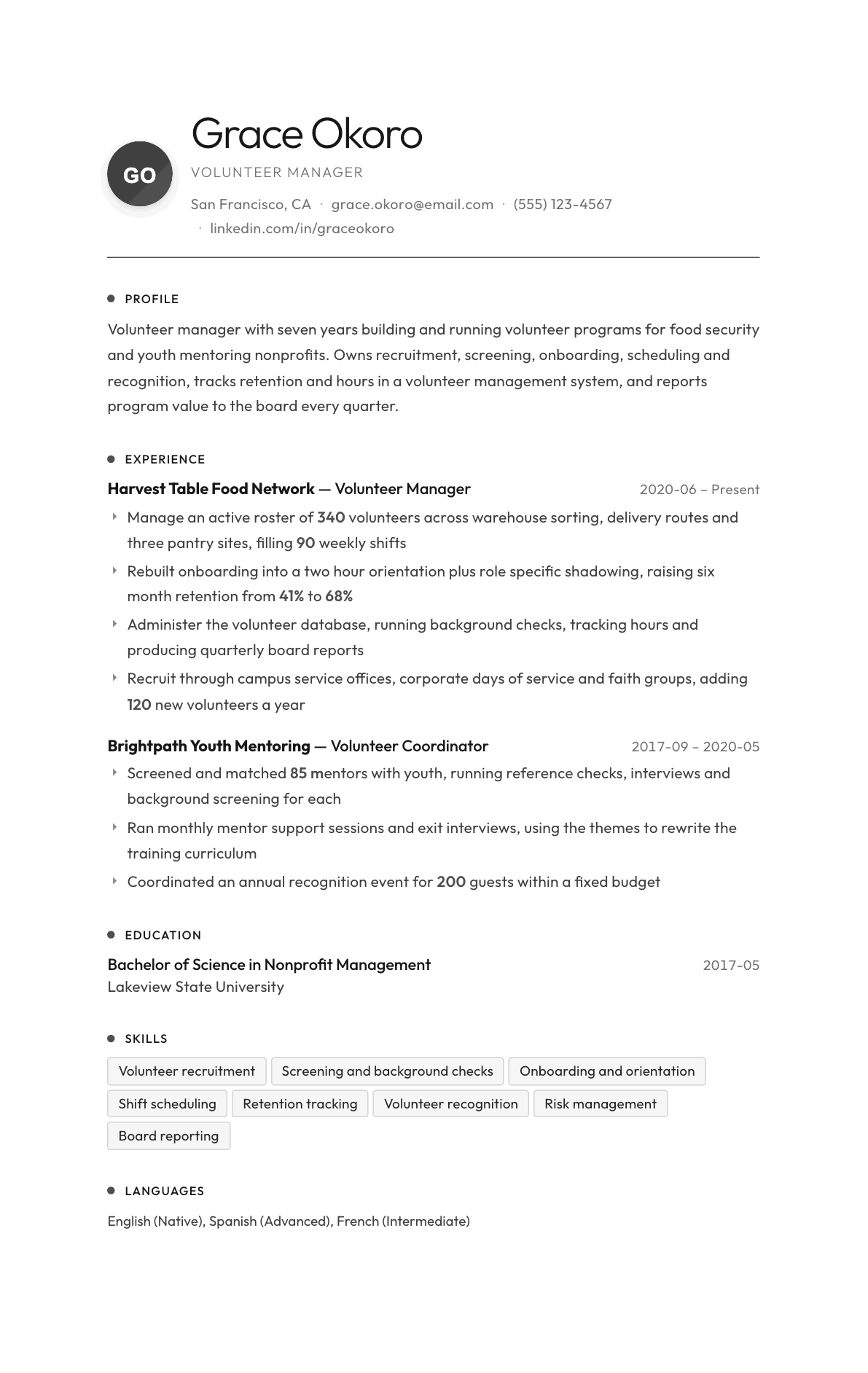
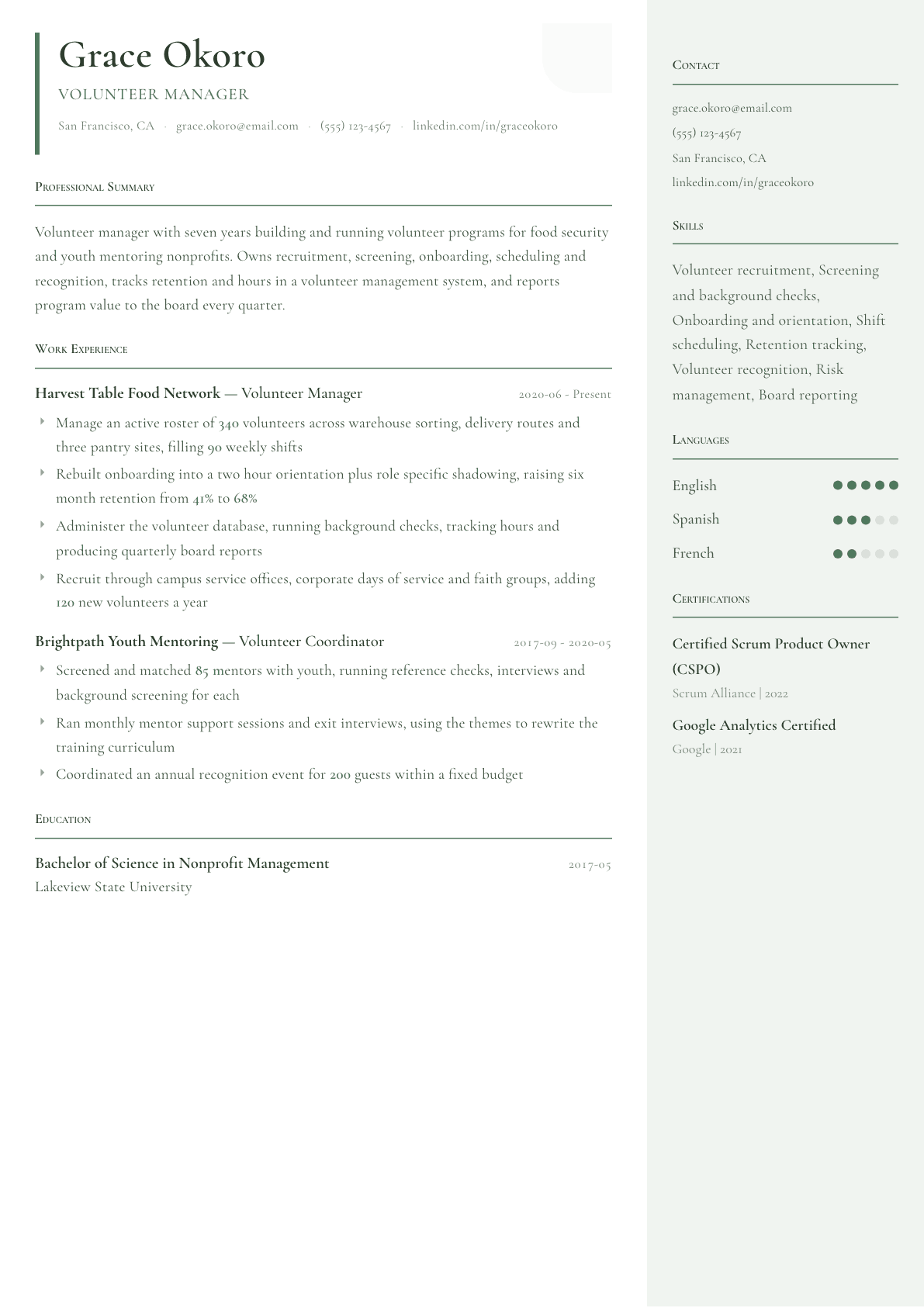
Example Volunteer Manager summary
Volunteer manager with seven years running programs for food security and youth mentoring organizations. Recruits, screens, trains and schedules large rosters, administers the volunteer database, and lifted six month retention by rebuilding onboarding around role specific shadowing. Reports hours and program capacity to the board each quarter and is seeking a director of volunteer services role.
Skills to list on a Volunteer Manager resume
- Volunteer recruitment
- Volunteer retention strategy
- Screening and background checks
- Orientation and training design
- Shift and roster scheduling
- Volunteer database administration
- Recognition programs
- Risk and liability management
- Corporate group coordination
- Community partnership building
- Program reporting
- Budget management
- Supervision and coaching
- Event coordination
What actually gets this resume read
- Open each job with the size of the roster and the number of shifts or placements you kept filled.
- Report retention as a rate over a stated period, because that is the number a nonprofit director asks about first.
- Name the volunteer management system you administer and what you ran inside it, from hours to background checks.
- Show your recruitment channels: campus service offices, corporate days of service, faith groups, retiree networks.
- Include the risk side of the job, such as screening policy, waivers, mandated reporter training and incident logging.
- Convert volunteer hours into program capacity rather than a dollar figure, since capacity is what the board plans around.
How to write a volunteer manager resume
A volunteer manager is judged on two numbers that pull against each other: how many people you recruit and how many of them are still there six months later. Recruiting is the easy half. Any organization can fill a one-off corporate day of service. Keeping a roster large enough to cover ninety weekly shifts, screened, trained and actually turning up, is the work that gets someone hired.
The person reading your resume is usually an executive director or a program director who has watched a volunteer program collapse under bad record keeping. She wants to see roster size, retention over a stated period, the database you administered, and whether you understand that screening and risk are part of the job rather than an obstacle to it.
This guide sets out how to structure the page, how to write about retention and risk without inflating either, three summaries for different career points, before and after bullets drawn from real program work, and the questions volunteer managers ask when they apply for the next role up.
Format: lead with program scale, not with duties
One page for under eight years. Reverse chronological. Under each employer, write a one-line program scope before the bullets: roster size, shifts or placements covered, sites, and whether you managed staff or worked alone. Nonprofit hiring managers compare programs by scale first because it tells them whether you have run something the size of theirs.
If you have carried other portfolios, and most volunteer managers have, name them in the scope line rather than mixing them into bullets. Events, in-kind donations, a community newsletter and board committee support are common add-ons and they explain why your week was full.
- Scope line: active volunteers, weekly shifts or placements filled, number of sites, direct reports.
- Portfolio line: the extra duties you carried, such as events, in-kind donations or committee staffing.
- Systems line: the volunteer management platform, the screening vendor and the scheduling tool you administered.
Summary: roster size, retention, and the type of volunteering
Say what kind of volunteering you have run, because episodic and ongoing programs are managed differently. A pantry that needs the same six people every Tuesday runs on relationships and reminders. A build day for ninety corporate participants runs on logistics and waivers. Name which you have done and at what scale.
Put your retention figure in the summary if it is good and if you can define it. Retention only means something with a window attached, so write it as retention at six months or at one year and be ready to explain the denominator in an interview.
Experience: recruitment, screening, retention, recognition
Structure your bullets around the volunteer journey, because that is how a director thinks about the program. Recruitment channels first: campus service offices, corporate partnerships, faith communities, retiree networks, court-referred service and online listings each behave differently and knowing that is expertise.
Then screening and onboarding. Background checks, references, interviews, waivers, mandated reporter training and role-specific shadowing are what stand between an organization and a serious incident. Describe the process you built or inherited and what you changed.
Then retention and recognition. This is where you prove you are more than a scheduler. Exit interviews, supervisor check-ins, a promotion path from general helper to shift lead, and recognition that costs little but lands well. Attach a number to at least one of these changes.
- Recruitment: channels used, new volunteers added per year, conversion from inquiry to first shift.
- Screening: background check process, references, interviews, waivers, mandated reporter training.
- Onboarding: orientation length, role-specific shadowing, how competence was signed off.
- Retention: rate at a stated window, exit interview themes, and the change you made because of them.
Data, systems and reporting to the board
Every volunteer manager job description asks for database administration and most applicants gloss over it. Name the platform, say what you configured, and say what you produced from it: hours by program, retention cohorts, background check expiry alerts, shift fill rates and a quarterly board report.
Translate hours into program capacity rather than a currency figure. A director plans staffing around capacity, so telling her your roster covered the equivalent of four full-time positions across three pantry sites is more useful than a valuation nobody in the room can verify.
Keywords a nonprofit filter and a director both look for
Postings repeat a narrow vocabulary: volunteer recruitment, retention, onboarding, screening, background checks, scheduling, recognition, risk management, database administration, community partnerships and stewardship. Use the posting words once in your skills block and once inside a bullet where the work is demonstrated.
Watch the word stewardship. In volunteer work it means the ongoing care of a relationship, and using it correctly signals to a nonprofit reader that you come from inside the sector.
Volunteer Manager resume summary examples
Coordinator moving up
Volunteer coordinator with two years scheduling 90 active volunteers across two food pantry sites, running orientation and background screening, and maintaining the volunteer database. Rebuilt the shift reminder process and cut no-shows across a season. Ready for a manager role with program design responsibility.
Five years in
Volunteer manager running a roster of 300 across warehouse, delivery and pantry operations, filling 90 weekly shifts and adding 120 new volunteers a year. Administers screening, scheduling and hours tracking, and lifted retention at six months by restructuring onboarding around role-specific shadowing.
Director of volunteer services
Director of volunteer services with a decade in nonprofit program leadership, supervising three coordinators across five sites. Owns policy, risk and screening standards, reports program capacity to the board quarterly, and built a volunteer leadership pipeline that now supplies most shift leads internally.
Work experience bullets: before and after
Before: Recruited and managed volunteers for the organization.
After: Recruited and managed an active roster of 300 volunteers across three pantry sites and a warehouse, filling 90 weekly shifts with a fill rate above ninety across the year.
Roster size, sites and shift fill rate give a director something she can compare with her own program.
Before: Improved volunteer retention.
After: Raised retention at six months from 41% to 68% by replacing a single group orientation with role-specific shadowing and a check-in call after a volunteer third shift.
A window, a before and after, and the specific intervention make the improvement believable and repeatable.
Before: Handled background checks and paperwork.
After: Ran background screening, reference checks and mandated reporter training for every volunteer working with youth, and set expiry alerts in the database so no clearance lapsed.
Framing screening as risk management, with the expiry control, shows the judgment an executive director worries about.
Before: Organized volunteer appreciation events.
After: Built a recognition program of shift-lead promotions, handwritten milestone notes and one annual gathering for 200 guests, delivered inside an unchanged budget.
Recognition tied to a progression path and a budget constraint reads as program design rather than party planning.
Before: Reported on volunteer activity to leadership.
After: Produced quarterly board reports on hours by program, retention cohorts and shift coverage gaps, and used them to win approval for a second coordinator post.
The report leading to a staffing decision proves your data changed something instead of sitting in an appendix.
Hard skills
- Volunteer recruitment and channel development
- Screening, background checks and references
- Orientation and role-specific training design
- Shift scheduling and coverage planning
- Volunteer database administration
- Retention measurement and cohort tracking
- Risk, waiver and liability management
- Corporate group and campus partnerships
- Recognition and stewardship programs
- Board and funder reporting
- Policy and handbook writing
- Event coordination
Soft skills
- Persuading people who are not paid to show up
- Redirecting an unsuitable volunteer with grace
- Cross-department negotiation for shift needs
- Public speaking to community groups
- Calm handling of last-minute coverage gaps
Certifications worth listing
- Certified in Volunteer Administration (CVA) (Council for Certification in Volunteer Administration)
- Certified Nonprofit Professional (CNP) (Nonprofit Leadership Alliance)
- Certified Fund Raising Executive (CFRE) (CFRE International)
Mistakes that cost volunteer manager candidates the interview
- Giving a total number of volunteers ever registered instead of the active roster you actually kept covered.
- Quoting retention with no time window, which any experienced director will read as a number chosen to flatter.
- Treating screening and waivers as admin trivia rather than the risk control an executive director loses sleep over.
- Converting volunteer hours into a currency figure that nobody can verify instead of into program capacity.
- Leaving out the volunteer management platform, when database administration appears in almost every posting.
- Writing only about recruitment, which suggests you have never had to fix a program that people kept leaving.
Volunteer Manager resume questions
What is the difference between a volunteer coordinator and a volunteer manager?
Coordinator work is mostly scheduling, onboarding and day-to-day support. Manager work adds program design, policy, risk standards, budget and often supervision of coordinators, so your resume should show ownership of the system rather than operation of it.
How should I measure volunteer retention on a resume?
Pick a cohort, pick a window and state both. Retention at six months among volunteers who completed orientation is defensible. A single number with no denominator invites a hiring manager to assume the flattering interpretation and then test it in interview.
Do I need a certification for volunteer management roles?
It is rarely required and often valued. A credential in volunteer administration signals that you know screening standards, risk and program evaluation, which matters most when you are applying above coordinator level or into a larger organization.
How do I show experience if my volunteer program was small?
Show depth instead of scale. A roster of thirty with strong screening, clear role descriptions, real training and measured retention demonstrates more competence than a large program you only scheduled, so describe the system you built end to end.
Should I include the corporate groups and campuses I partnered with?
Yes, because a partner network is portable and a director values it directly. Name the type of partner and what the relationship produced, such as a recurring monthly team or a steady supply of student volunteers each term.
Related resume examples
- Volunteer Coordinator Resume example
- Program Coordinator Resume example
- Community Organizer Resume example
- Social Services Manager Resume example
- Group Home Manager Resume example
- Residential Counselor Resume example