Disability Support Worker Resume Examples: free score
Write a Disability Support Worker Resume That Proves Hands-On Care Skill
By Mustafa Tarabya, founder of CVBooster · Published · Updated
Disability support worker resume example with supported living duties, behavior support keywords, and a section by section writing guide.
Sample resumes for a disability support worker
The same disability support worker content laid out in three CVBooster templates, so you can see what the finished document looks like before you write a word.
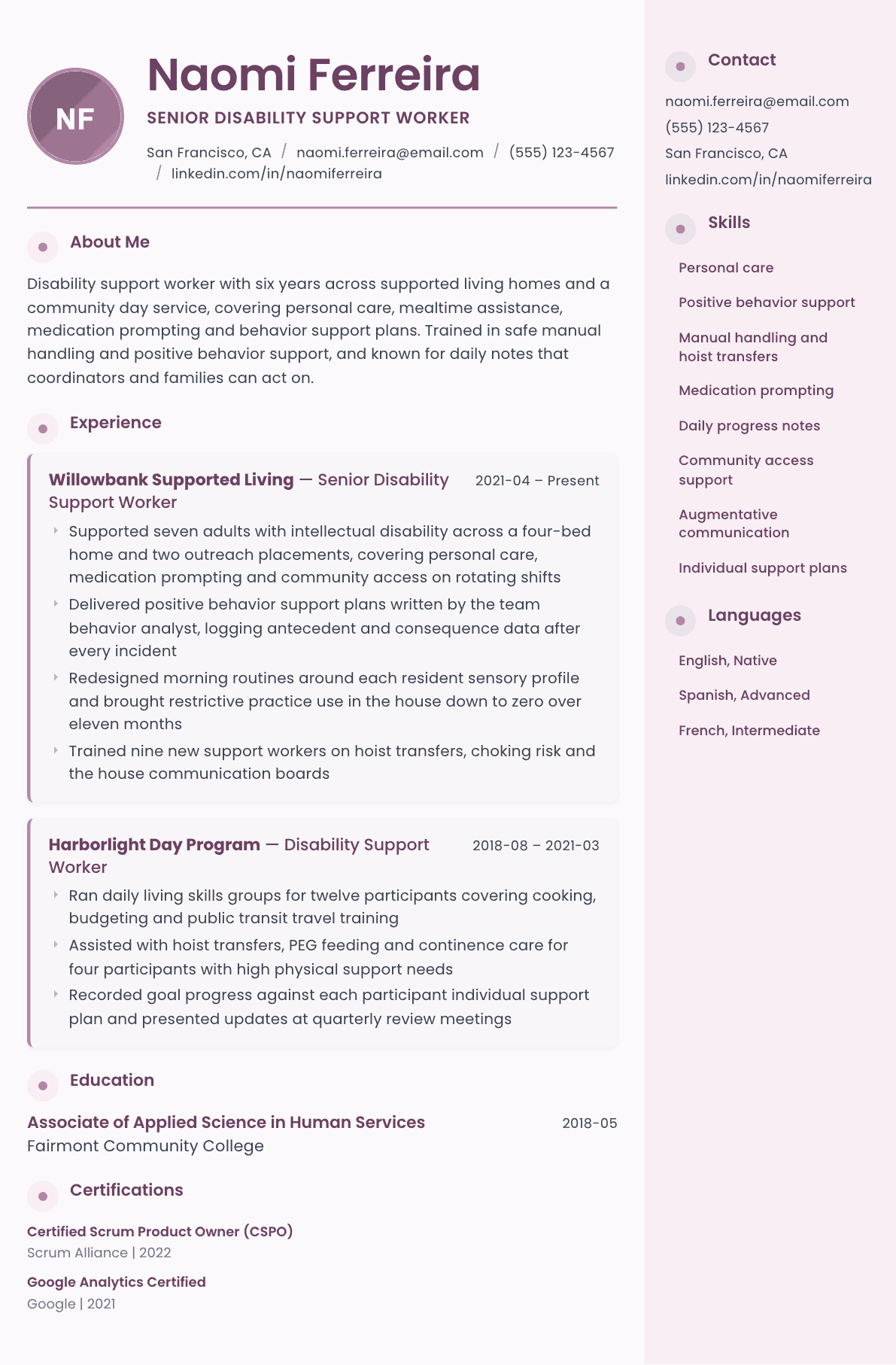
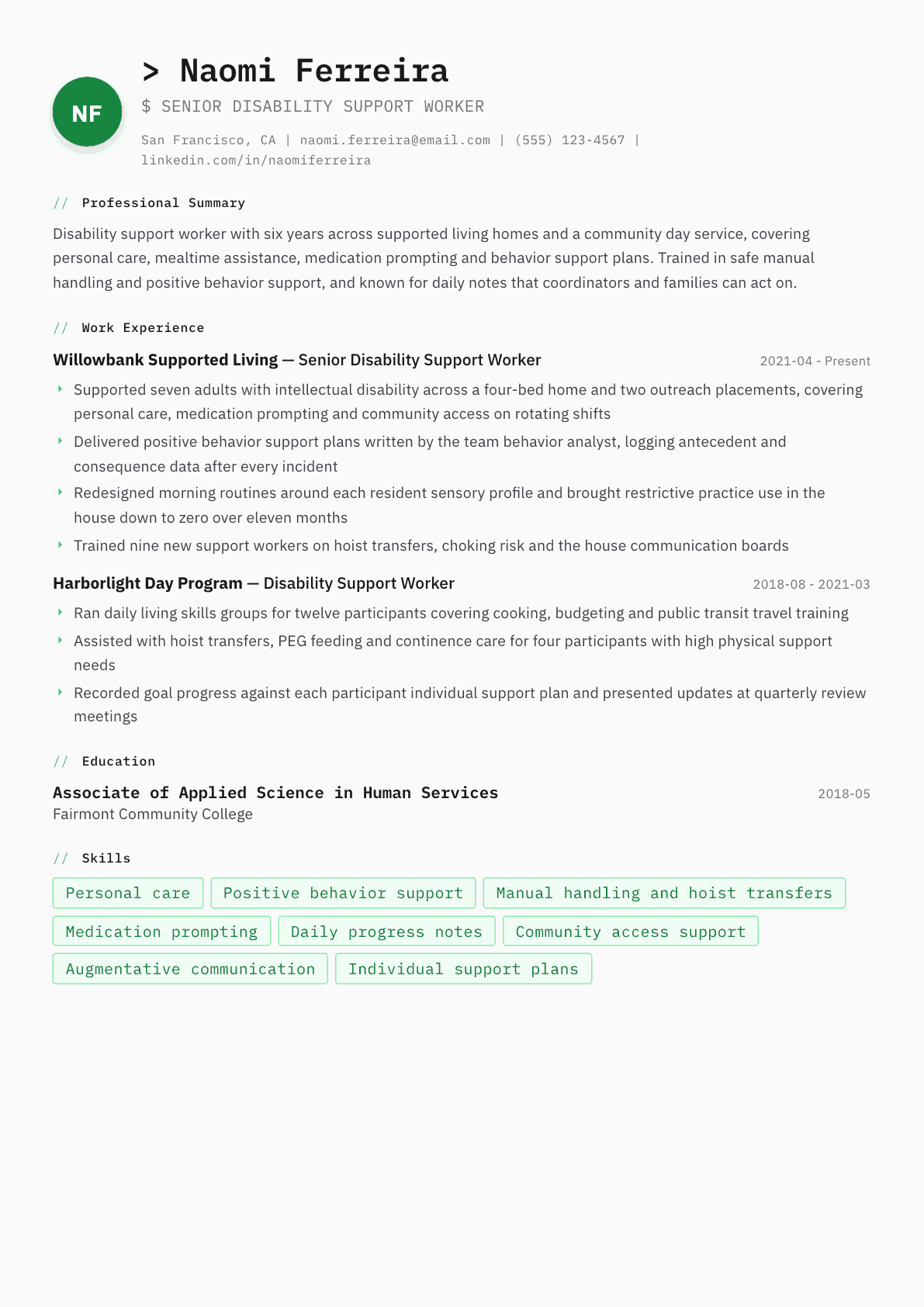
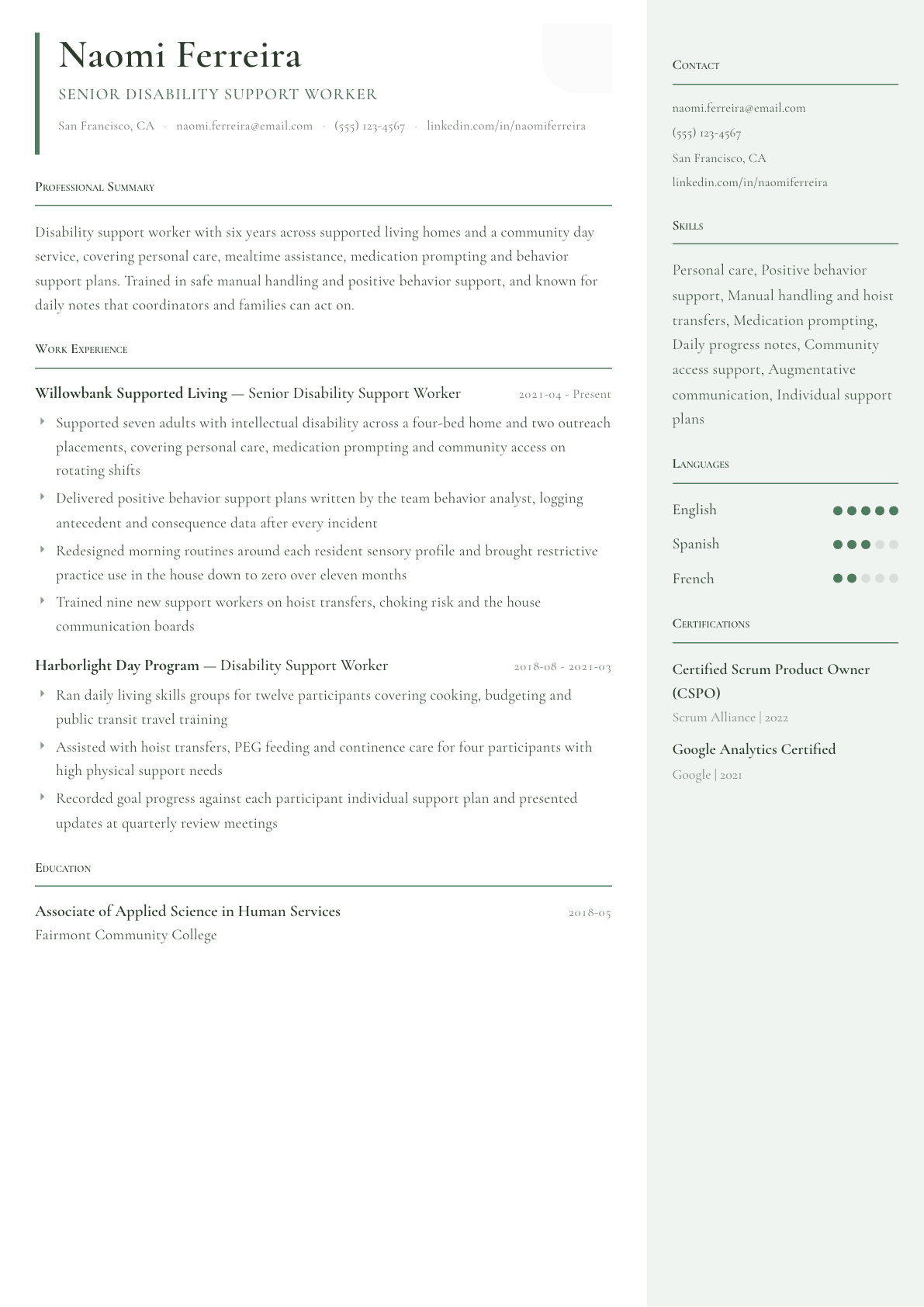
Example Disability Support Worker summary
Disability support worker with six years in supported living and day services for adults with intellectual disability, autism and complex physical needs. Trained in hoist transfers, PEG feeding and positive behavior support, with a record of reducing restrictive practice through routine redesign. Seeking a senior support role in a provider that invests in staff training and person centered planning.
Skills to list on a Disability Support Worker resume
- Personal care and hygiene support
- Hoist and transfer technique
- Positive behavior support plans
- Medication prompting and recording
- PEG and mealtime assistance
- Seizure response
- Individual support planning
- Progress note writing
- Community access and travel training
- Augmentative and alternative communication
- Safeguarding and incident reporting
- Daily living skills coaching
- Family and guardian communication
- Sensory regulation strategies
What actually gets this resume read
- Name the setting in every job: supported living home, group home, day service, respite unit or in-home outreach.
- State how many people you supported and their support level, because a four-bed house differs from a thirty-place day program.
- List the physical care you are trained for: hoist transfers, PEG feeding, continence care, seizure response, safe swallowing.
- Show behavior support work by naming the plan, the data you recorded and what changed for the person.
- Put first aid, CPR and medication administration training in a credentials block near the top with the issuing body.
- Mention communication methods you use, such as picture exchange boards, sign supported speech or a speech device.
- Say which shifts you cover, since sleepovers, waking nights and weekend rotations are what many rosters need filled.
How to write a disability support worker resume
Support work is hired on trust and on evidence that you can be left alone with someone at three in the morning and make the right call. The person screening your resume is usually a house manager or a service coordinator who is short two shifts a week and has a specific gap to fill: a waking night in a four-bed home, an outreach run for a man who uses a wheelchair and a communication device, a day service group of twelve. She is reading to find out whether you have done that exact thing before.
That means a support worker resume lives or dies on setting detail. Supported living, group home, respite unit, day service, in-home outreach and residential school are six different jobs with different rosters, different paperwork and different physical demands. A resume that says "provided care and support to service users" could describe any of them, so it describes none.
This guide covers the sections a provider actually reads in order, how to write about personal care and behavior support without either hiding it or oversharing, three example summaries for different stages of a support career, and the questions people ask when they sit down to write this one.
Format: one page, credentials visible before the fold
Keep it to a single page unless you have more than a decade across several providers. Reverse chronological order, plain headings, no photograph, no icons. Rosters get filled fast and a manager will scan your page for about twenty seconds before deciding whether to call.
Put a short credentials block directly under your contact details. First aid and CPR with the issuing body and expiry, medication administration training, safe manual handling, any crisis intervention certificate, a driving license with clean record if you will be transporting people, and whether your background clearance is current and portable.
- Credentials block: first aid and CPR, medication administration, manual handling, crisis intervention, driving license, current background clearance.
- Availability line: waking nights, sleepovers, weekend rotations, split shifts, and how far you will travel for outreach.
- Section order that suits this job: credentials, support experience, training, education, then skills.
Summary: who you support, in what setting, at what level
Three lines. Name the disabilities you have direct experience with, the settings, and the level of physical or behavioral support you are used to. There is a real difference between a support worker who has done prompting and community access and one who has done hoist transfers, PEG feeding and a plan with restrictive practice authorization on it, and a coordinator needs to know which you are before she reads further.
Avoid describing yourself as caring and patient. Every applicant claims it and no manager has ever hired on it. Put your temperament into a bullet where it shows: the resident whose morning meltdowns stopped once you changed the order of the routine.
Experience: the house, the caseload, the support level
Open every job with a scope line before the bullets: the provider, the setting, how many people you supported, their ages and diagnoses, and the ratio. "Four-bed supported living home, three residents with intellectual disability and one with acquired brain injury, two staff on days and one waking night" tells a manager more than a paragraph of adjectives.
Then three to five bullets. Cover the physical care you are competent in, the behavior support work you delivered from someone else plan, the community access and skill building, and the paperwork. Paperwork matters more than new support workers expect, because incomplete notes are what gets a provider in trouble at audit.
Write about behavior in the language the sector uses: antecedent, function, replacement behavior, de-escalation, restrictive practice. If you helped bring a restrictive practice down or out, that is the single strongest bullet you can write.
- Scope line: provider, setting, number of people supported, diagnoses, staffing ratio, shift pattern.
- Physical care: transfers and hoist use, mealtime assistance, PEG support, continence care, seizure response, pressure care.
- Behavior support: plan delivery, data recording, de-escalation, incident reporting, debrief participation.
- Skill building: cooking, budgeting, travel training, employment support, social and leisure goals.
Training and credentials: the block that gets you shortlisted
Providers cannot roster an uncertified worker on medication or on a hoist, so every current certificate you hold shortens their onboarding. Give the certificate name, the issuing body and the year it renews. If a certificate has expired, say so and say you are booked to renew rather than leaving a manager to guess.
Mandatory training you completed with a previous provider still counts even though it was internal. Name it plainly: epilepsy and emergency medication, dysphagia and safe swallowing, infection control, safeguarding adults, positive behavior support, autism awareness, sign supported communication.
Skills and keywords the screening filter looks for
Large providers run applicant tracking software with a keyword list drawn straight from their job description. Mirror their exact words once in your skills list and once inside a bullet where the work is visible. Common ones for this role are personal care, individual support plan, positive behavior support, manual handling, medication prompting, community access, safeguarding, progress notes and person centered support.
Keep soft claims out of the list. A skills section that reads reliable, compassionate, team player wastes the space where the words that actually match the posting should be.
Disability Support Worker resume summary examples
First support role
Human services graduate with 300 placement hours in a day service for adults with intellectual disability, covering community access, cooking groups and daily notes. Current first aid, CPR and safe manual handling certificates. Available for waking nights and weekend rotations, looking for a supported living post.
Three years in
Support worker with three years in a six-bed group home for adults with autism and complex behavior support needs. Delivers positive behavior support plans, records antecedent data after every incident, and is signed off on medication administration and hoist transfers. Seeking a lead support worker role.
Senior or house lead
Senior disability support worker with eight years across supported living and outreach, including two years leading a house of five residents with high physical support needs. Trains new staff on transfers and dysphagia protocols, coordinates with allied health, and has taken two restrictive practices out of active plans.
Work experience bullets: before and after
Before: Provided care and support to service users with disabilities.
After: Supported five adults with intellectual disability and epilepsy in a supported living house, covering personal care, emergency medication protocols and community access across days and waking nights.
The disabilities, the setting and the shift pattern let a coordinator match you to an open roster instead of guessing.
Before: Followed behavior support plans.
After: Delivered positive behavior support plans for two residents with a history of property damage, recording antecedent and consequence data after every episode and feeding it into the quarterly plan review.
Naming the data you collected shows you understand that a plan is only as good as the recording behind it.
Before: Helped residents with daily living.
After: Taught meal preparation, laundry and bus route travel to three residents working toward semi-independent living, moving one from full prompting to a written checklist within a year.
A concrete skill and a movement toward independence is the outcome a person centered service is measured on.
Before: Did paperwork and reports.
After: Wrote daily progress notes against individual support plan goals, completed incident reports the same shift, and kept medication charts audit ready across a house of four.
Documentation is a compliance risk for the provider, so specifying what you kept accurate is genuinely reassuring.
Before: Trained new staff members.
After: Inducted nine new support workers on hoist technique, choking risk and the house communication boards, shadowing each for their first three shifts before sign off.
The count, the topics and the shadowing structure turn a claim of training into a description of a real process.
Hard skills
- Personal care and hygiene support
- Hoist and manual transfer technique
- Medication administration and prompting
- PEG feeding and mealtime assistance
- Seizure and emergency medication response
- Positive behavior support plan delivery
- Antecedent and incident data recording
- Individual support plan goal tracking
- Progress note and daily log writing
- Community access and travel training
- Augmentative and alternative communication
- Safeguarding and mandatory reporting
Soft skills
- Patience under repeated escalation
- Handover communication between shifts
- Family and guardian rapport
- Working alone without supervision
- Respect for dignity and choice
- Steady judgment in emergencies
Certifications worth listing
- DSP-I Certification (National Alliance for Direct Support Professionals)
- First Aid, CPR and AED (American Red Cross)
- Basic Life Support (BLS) (American Heart Association)
- Nonviolent Crisis Intervention (Crisis Prevention Institute)
- The Mandt System Certification (The Mandt System)
Mistakes that cost disability support worker candidates the interview
- Writing "service users" throughout without ever naming a disability, a setting or a support level.
- Hiding personal care duties because they feel unglamorous, when they are exactly what the roster needs covered.
- Leaving first aid, CPR and medication training off the page, which forces the provider to treat you as a longer onboarding.
- Claiming to be caring and passionate in the summary instead of using those lines to name the population you know.
- Skipping the availability line, so a coordinator with a waking night to fill moves to the next application.
- Listing every short internal workshop as if it were a qualification, which buries the certificates that matter.
- Describing an incident in identifying detail, which reads as a confidentiality risk to anyone in this sector.
Disability Support Worker resume questions
Do I need a qualification to become a disability support worker?
Many providers hire on values and reliability then train you, but a human services or community services credential moves you up the pile. Current first aid, CPR and a clean background clearance are usually non-negotiable before your first shift.
Should I put personal care duties on my resume?
Yes, and specifically. Showering, continence care, transfers and mealtime assistance are the tasks a roster is built around, and a manager who cannot see them will assume you have only done companionship or community access work.
How do I write about behavior support without breaching confidentiality?
Describe the behavior, the function and what you did, never the person. Say a resident with a history of self-injury rather than a name, an address or a diagnosis attached to identifying detail, and keep dates general enough that nobody can be traced.
What should I put on a support worker resume with no paid experience?
Placement hours, volunteering, caring for a family member and any work with people who need help count. Give each one hours, setting and tasks, then lead the page with your current first aid, CPR and manual handling certificates.
Does listing my shift availability really help?
It does more than almost anything else on the page. Waking nights, sleepovers, weekends and split shifts are the hardest slots to fill, so a worker who states availability up front gets called before one whose flexibility is unknown.
Related resume examples
- Social Worker Resume example
- Case Manager Resume example
- Residential Counselor Resume example
- Job Coach Resume example
- Group Home Manager Resume example
- Youth Counselor Resume example