Program Coordinator Resume Examples: what gets the call
Coordinate Success with a Program Coordinator Resume
By Mustafa Tarabya, founder of CVBooster · Published · Updated
Create a program coordinator resume highlighting your project management, stakeholder communication, and program delivery expertise.
Sample resumes for a program coordinator
The same program coordinator content laid out in three CVBooster templates, so you can see what the finished document looks like before you write a word.
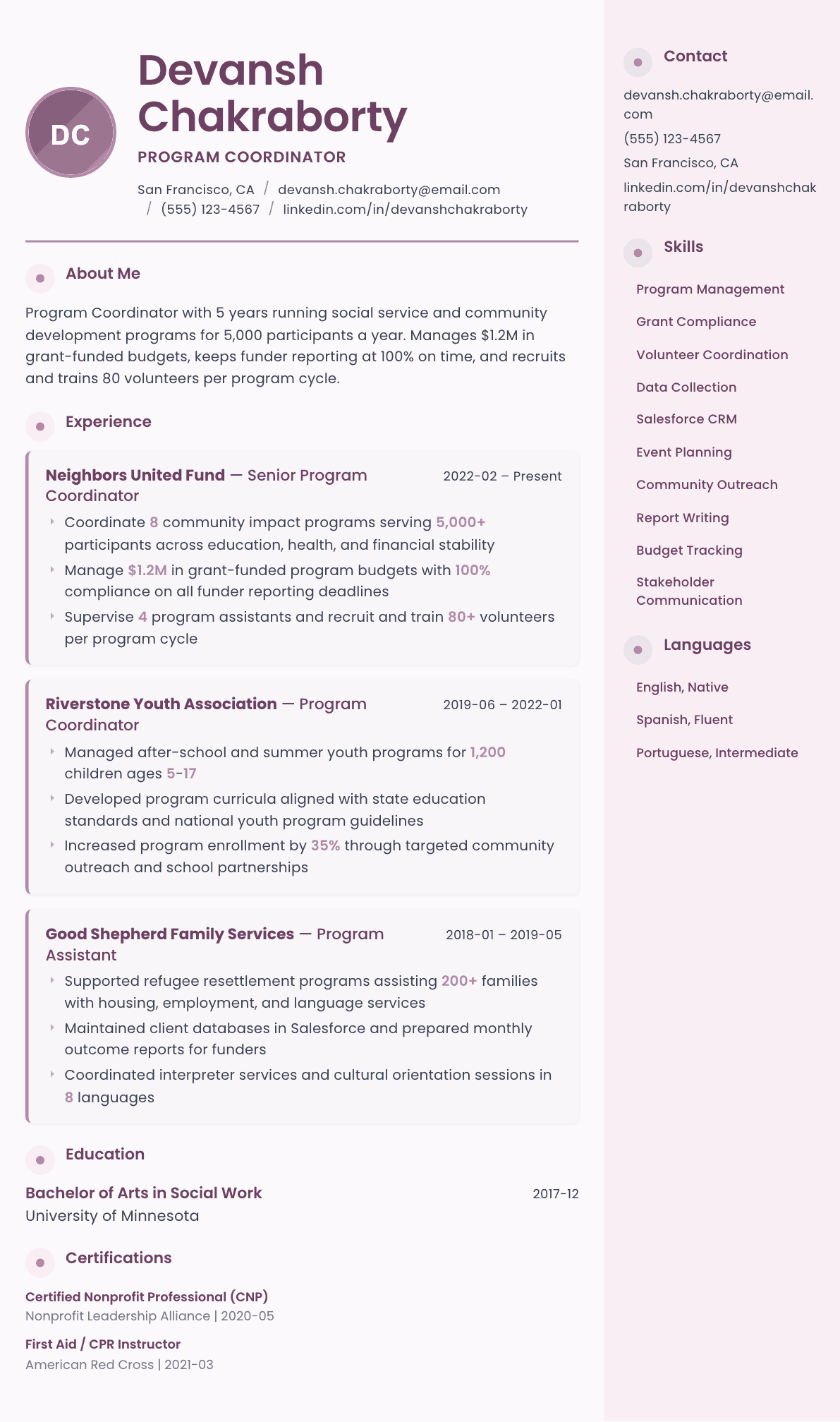
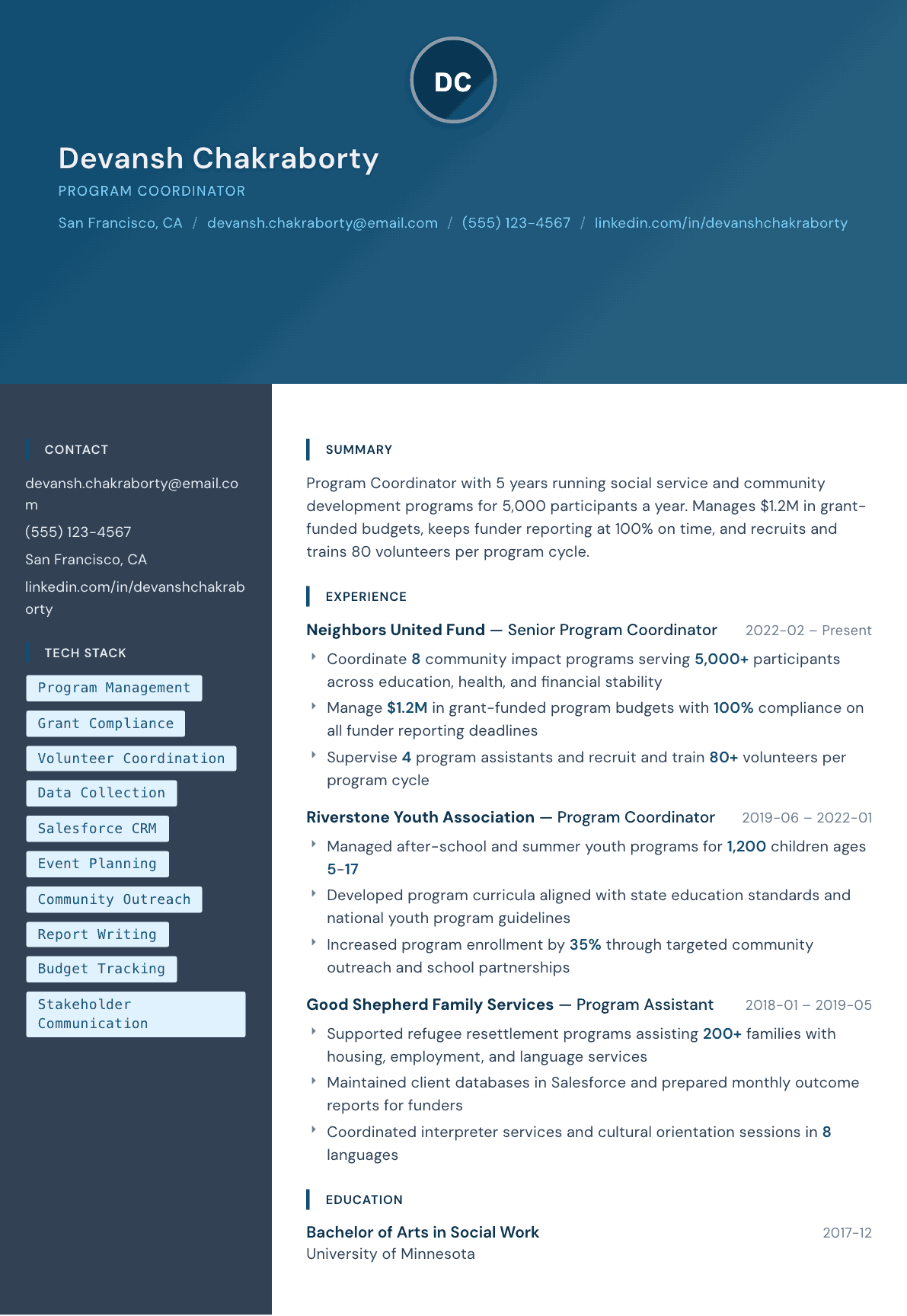
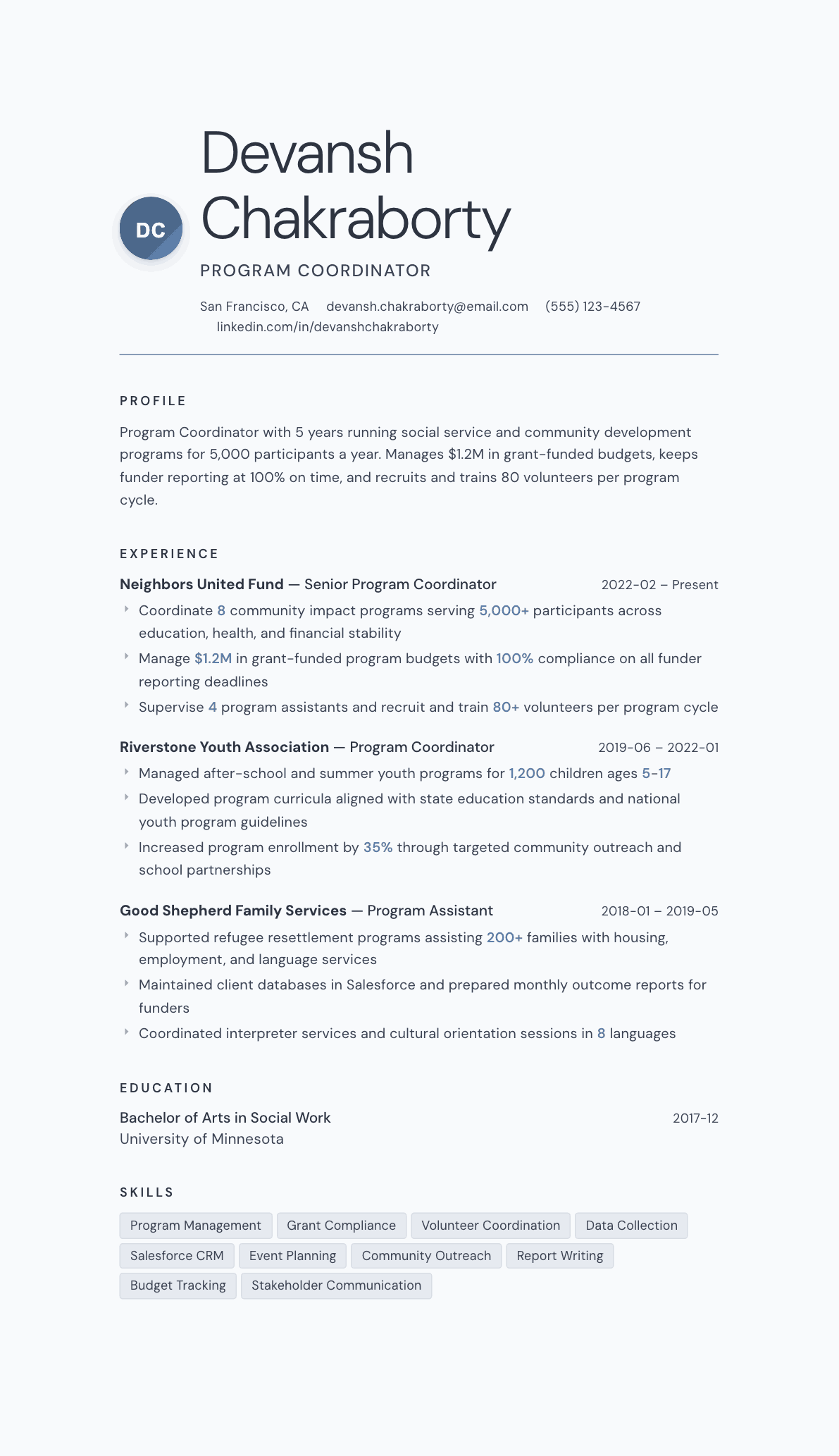
Example Program Coordinator summary
Program Coordinator, 5 years across youth, refugee resettlement, and community impact programs serving 5,000 participants a year. Owns $1.2M in grant-funded budgets and the outcome reporting behind them. Looking for a program manager role.
Skills to list on a Program Coordinator resume
- Program Management
- Grant Compliance
- Volunteer Coordination
- Data Collection & Reporting
- Salesforce / CRM
- Event Planning
- Community Outreach
- Report Writing
- Budget Management
- Stakeholder Communication
- Curriculum Development
- Outcome Measurement
- Cultural Competency
- Team Supervision
What actually gets this resume read
- Quantify program impact: participants served, outcomes achieved, enrollment growth rates.
- Highlight grant compliance and reporting experience with specific funders and dollar amounts.
- Show your ability to coordinate multiple stakeholders: staff, volunteers, partners, and funders.
- Include data management skills: Salesforce, Excel, survey tools (SurveyMonkey, Qualtrics).
- Mention curriculum development and program design experience.
- Demonstrate cultural competency and language skills for diverse community-serving roles.
How to write a program coordinator resume
Program coordinator is one of the most loosely defined titles in the nonprofit and public sector, which is exactly why the resume has to define it. Two candidates with the same title can be doing wildly different jobs: one runs a grant-funded service with a budget and participants, the other schedules meetings for a director. A hiring manager reads the resume to find out which one you are within about fifteen seconds.
The way to answer that is scope. Whose program, how many participants, what budget, which funder, what compliance regime, and who you coordinated across. A coordinator who names the grant, the deliverables in the contract and the reporting cycle is signaling that they can be handed a program on day one.
This guide covers the section order that shows scope quickly, how to write about grant compliance and data without sounding clerical, summaries from a first coordinator role through a senior coordinator running several programs, and rewrites that lift administrative language into program ownership.
Format: one page, a scope line in every role
One page for most coordinators, two only when you have run multiple funded programs over many years. Under each job title, put a single scope line before the bullets: program name, participants served per year, budget, funding source, and staff or volunteers coordinated. This is the fastest fix available to almost every program coordinator resume.
Use the funder's own vocabulary where it applies. Terms like deliverables, units of service, subrecipient, allowable costs and period of performance are shorthand that tells a manager you have worked inside a contract rather than around one.
- Scope line: program, participants, budget, funder, people coordinated.
- Order: summary, program experience, systems and reporting, education, training.
- List the grant or contract type when it shaped your work, such as a federal pass-through or a city contract.
Summary: what kind of program, and what you own inside it
Name the field first: workforce development, after-school, housing, public health, research administration, arts education. Then say what part of the program you own. Coordinators typically own some mix of scheduling and logistics, participant enrollment and tracking, budget monitoring, subcontractor or vendor relationships, and reporting.
End with the strongest result you can attach to your own decisions, which for coordinators is usually retention, completion, utilization or an on-time reporting record rather than revenue.
Compliance and budget: the part that separates coordinators from assistants
Grant-funded programs are governed by a document, and a coordinator who has read it is worth more than one who has not. Show that you tracked deliverables against the contract, monitored spending against approved line items, flagged variances before the funder found them, and prepared or contributed to interim and final reports.
Add the operational compliance work: participant eligibility documentation, consent and release forms, confidentiality practice, background checks for staff and volunteers working with minors or vulnerable adults, incident reporting, and the file audit a funder runs when they visit. Coordinators who have survived a monitoring visit should say so plainly.
- Contract deliverables tracked and met, with the reporting cycle named.
- Budget monitoring: line item tracking, variance flags, spend-down management.
- Eligibility and consent documentation, and file readiness for a funder site visit.
- Subcontractor or vendor oversight, including invoices and scope adherence.
Data and evaluation: what you collected and what it changed
Almost every coordinator collects data and very few write about using it. Name the system, the measures and the reporting rhythm, then name one decision the data drove: moving a session time after attendance data showed a pattern, adding a follow-up call after completion rates dropped in a cohort, or retiring a workshop nobody finished.
Say who received the numbers. Reporting to a program director is one thing, presenting to a funder or a governing board is another, and the second is a promotion signal.
Coordination across people: the actual skill in the title
The verb in the title is the job. Show the coordination surface: how many staff, volunteers, interns, partner agencies, facilitators, contractors or sites you kept synchronized, and the mechanism you used to do it. Standing meetings you ran, a shared calendar you owned, a workflow you built, an onboarding packet you wrote.
Include the recovery stories, because coordinators are hired for them. Covering a facilitator who canceled the night before, moving a program to a new site mid-cycle, or absorbing a cohort from a partner that closed all demonstrate the composure the job requires.
Program Coordinator resume summary examples
First coordinator role
Program coordinator with 2 years running an after-school literacy program for 180 students across 4 school sites, coordinating 22 tutors and a modest city-funded budget. Raised session attendance by moving start times and rebuilt the tutor onboarding packet.
Five years in
Program coordinator with 5 years in workforce development, managing a federally funded training program serving 400 participants a year. Tracked deliverables against contract, held placement above target for 3 consecutive periods, and passed a funder monitoring visit with no findings.
Senior coordinator
Senior program coordinator with 9 years overseeing 3 concurrent grant-funded programs across housing and health, coordinating 14 staff and 6 partner agencies. Built the shared data workflow in Apricot and presented quarterly outcome reporting to the board program committee.
Work experience bullets: before and after
Before: Coordinated program activities and schedules.
After: Ran the weekly schedule for a literacy program across 4 school sites, coordinating 22 tutors, 3 site leads and a district transportation contact so that 180 students had consistent session times.
The site count, the people coordinated and the participant number make the coordination surface visible.
Before: Assisted with grant reporting requirements.
After: Tracked contract deliverables monthly against a federally funded training award, prepared the participant and expenditure sections of each quarterly report, and submitted every cycle before the deadline.
Naming the tracking rhythm and the sections you wrote separates ownership from assistance.
Before: Maintained participant records and files.
After: Maintained eligibility documentation and consent forms for 400 participants a year, ran quarterly file audits against funder requirements, and cleared a monitoring visit with no findings.
A clean monitoring result is the outcome that record keeping exists to produce, so lead with it.
Before: Collected data on program outcomes.
After: Built attendance and completion dashboards in Apricot, found a 30% drop between session 4 and session 5, and added a mid-program check-in call that lifted completion in the following 2 cohorts.
Data work only counts when the reader learns what you noticed and what you changed because of it.
Before: Managed the program budget.
After: Monitored a grant budget by line item, flagged an underspend in participant support costs at the halfway point, and worked with finance on a modification that redirected the balance to transportation stipends.
Spotting a variance and driving the modification shows real budget responsibility rather than expense entry.
Hard skills
- Program planning and scheduling
- Grant deliverable tracking
- Budget monitoring and variance analysis
- Participant eligibility documentation
- Outcome data collection and reporting
- Apricot and Efforts to Outcomes systems
- Salesforce for case and program records
- Vendor and subcontractor coordination
- Volunteer and staff onboarding
- Funder monitoring and file audits
- Meeting facilitation and agenda setting
- Curriculum and session logistics
Soft skills
- Follow-through on many threads
- Calm rescheduling
- Clear written updates
- Diplomacy with partner staff
- Anticipating problems early
- Comfort with participants
Certifications worth listing
- Certified Associate in Project Management (CAPM) (Project Management Institute)
- Project Management Professional (PMP) (Project Management Institute)
- Certified Nonprofit Professional (CNP) (Nonprofit Leadership Alliance)
- Certified Grants Management Specialist (CGMS) (National Grants Management Association)
Mistakes that cost program coordinator candidates the interview
- Writing a duties list with no scope line, so the reader cannot tell a funded program from a calendar full of meetings.
- Using assisted and supported for work you actually ran, which pushes a coordinator resume into an assistant pile.
- Leaving out the funder and the contract, when compliance experience is often the reason a coordinator gets hired.
- Reporting data collection without a single decision that the data changed.
- Listing software you have opened rather than the one system you can build a report in.
- Omitting the number of people and partners you coordinated, which is the literal content of the job title.
Program Coordinator resume questions
How do I make a program coordinator resume sound less administrative?
Replace the verbs that describe support with verbs that describe ownership, and attach scope to each one. Ran, tracked, monitored, rebuilt and cleared are ownership words. Then follow every one with a number: participants, sites, partners, budget or a reporting cycle.
What if my program had no measurable outcomes?
Every program has operational measures even without outcome data. Attendance, completion, waitlist length, on-time reporting, cost per participant and retention of facilitators are all fair game, and a manager will accept them as evidence you paid attention.
Should I list the grants that funded my program?
Name the funder type and the award if it is public information, since it tells the reader the compliance environment you worked inside. A federal pass-through, a state contract and a private foundation grant impose different rules, and experience with the right one shortens your learning curve.
How do I move from program coordinator to program manager?
Show the three things managers do that coordinators often already do quietly: owning the budget, supervising people, and presenting to funders or a board. Pull those out of your bullets and give them prominence, because they are the promotion criteria.
Does a project management certification help a program coordinator?
It can, particularly when moving between sectors or into a role with formal project reporting. It is rarely required in community organizations, so treat it as a supporting credential and keep the grant compliance and participant outcome record in front of it.
Related resume examples
- Volunteer Coordinator Resume example
- Case Manager Resume example
- Outreach Coordinator Resume example
- Social Services Manager Resume example
- Volunteer Manager Resume example
- Pastor Resume example