Sports Marketing Manager Resume Examples: free ATS score
Shape a Sports Marketing Manager Resume Around Revenue
By Mustafa Tarabya, founder of CVBooster · Published · Updated
Sports marketing manager resume examples with sponsorship, ticket campaign and fan engagement keywords, plus a guide to proving revenue impact.
Sample resumes for a sports marketing manager
The same sports marketing manager content laid out in three CVBooster templates, so you can see what the finished document looks like before you write a word.
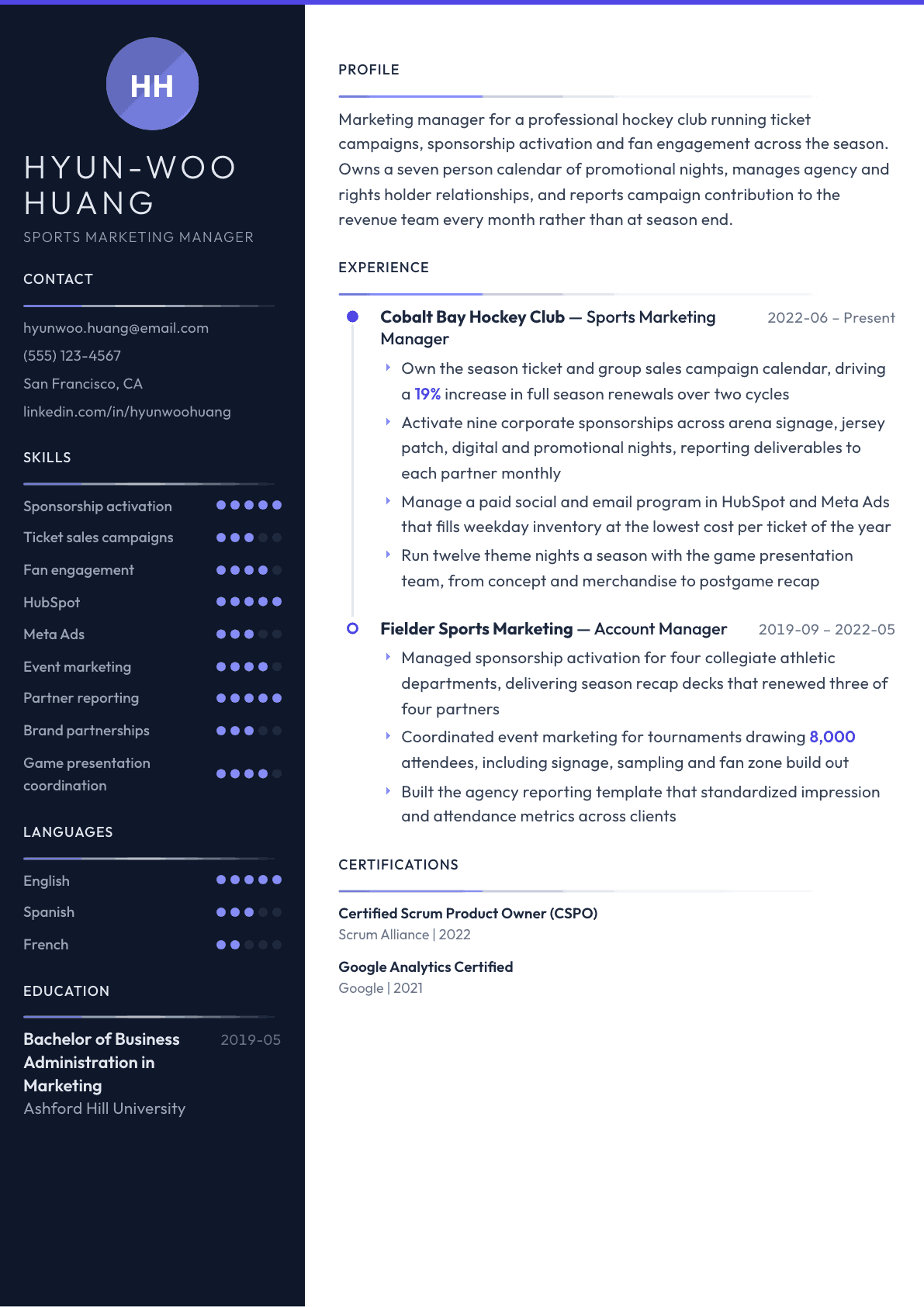
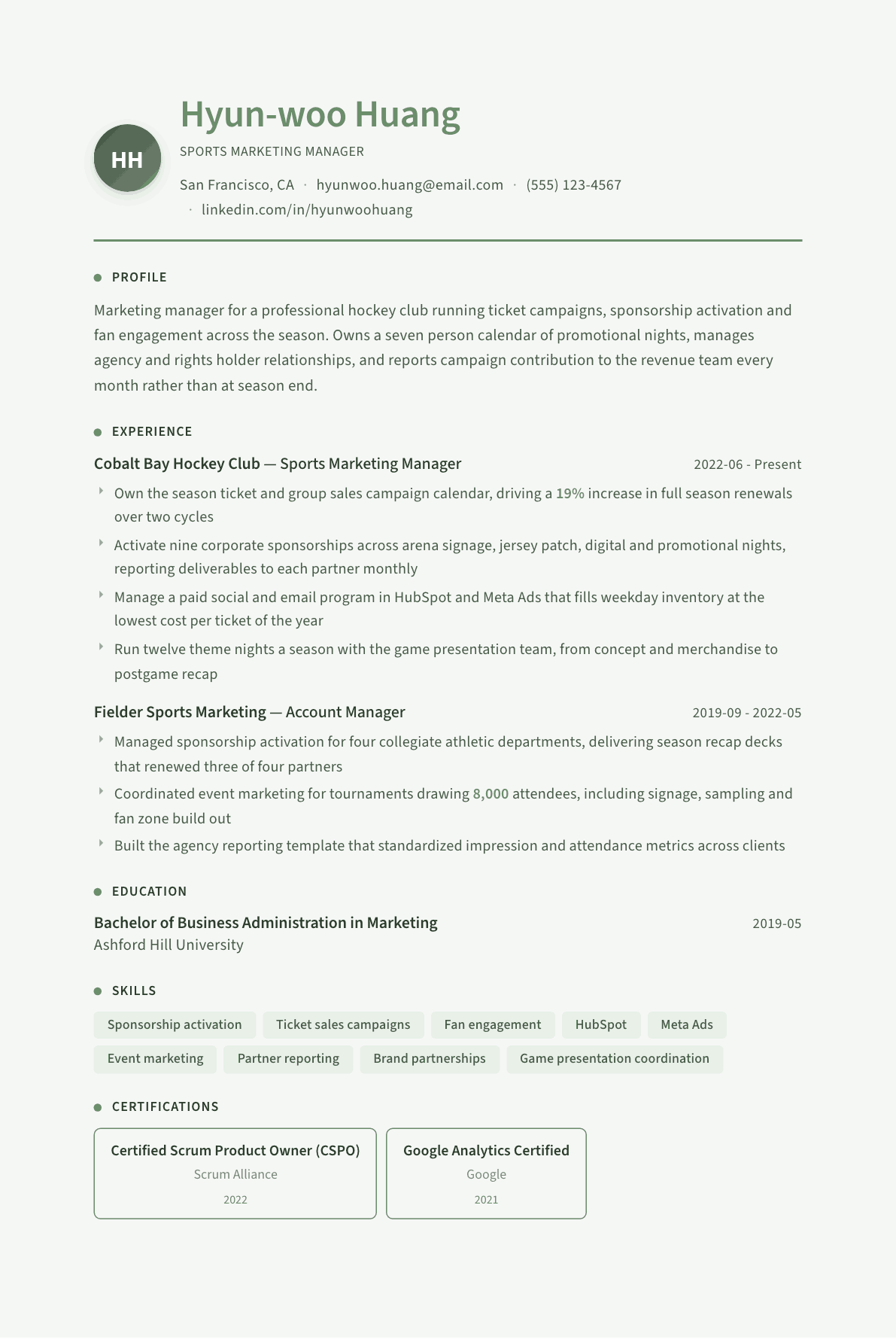
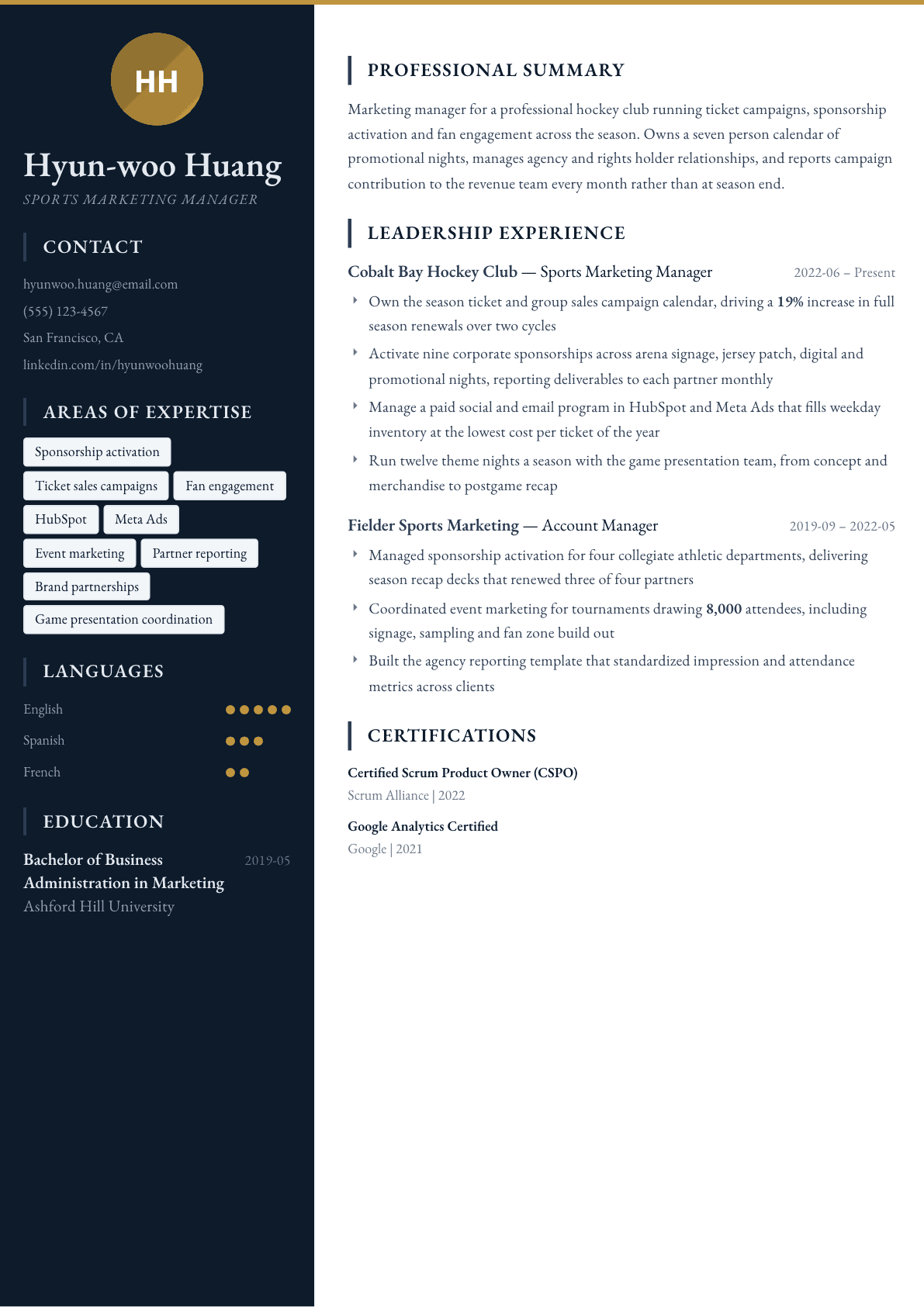
Example Sports Marketing Manager summary
Sports marketing manager with six years across a professional club and a sponsorship agency, owning the ticket campaign calendar and the activation of nine corporate partnerships. Runs paid social and email in HubSpot, builds promotional nights with game presentation staff, and reports partner deliverables monthly so renewals arrive with evidence attached.
Skills to list on a Sports Marketing Manager resume
- Sponsorship activation and fulfillment
- Season ticket and group sales campaigns
- Fan engagement strategy
- Partner reporting and recap decks
- HubSpot and email marketing
- Meta and Google paid media
- Ticketing platform data
- Promotional night planning
- Merchandise and licensing coordination
- Community and grassroots programs
- Agency and vendor management
- Brand identity and campaign creative
- Budget ownership
What actually gets this resume read
- Tie every campaign to the revenue line it moved, whether renewals, group sales, merchandise or sponsorship inventory.
- Name the rights holders, leagues or properties you have worked with, since sponsorship experience is verified by context.
- Show the activation side, not just the ads: signage, promotional nights, fan zones, jersey patches and recap decks.
- List the marketing stack by name, including the CRM, ticketing platform and ad tools you have run campaigns in.
- Include the partner reporting cadence, because sponsors renew on evidence delivered monthly rather than a season recap.
- Show one bullet on working with game presentation or operations, which is where club marketing succeeds or stalls.
How to write a sports marketing manager resume
Club marketing sits between two impatient audiences. Above you, a chief revenue officer wants renewals, group sales and sponsorship inventory sold. Beside you, a game presentation team wants a promotional night that works with forty minutes of pregame and a rink or field crew that cannot be moved. A sports marketing manager who cannot show both sides on a resume looks like a brand person applying to an operations job.
The applications that get interviews read like a season. They show the campaign calendar, the partners activated, the inventory filled, and the deliverables reported back to sponsors while the season was still running. They also name the stack, because ticketing data, CRM and paid media platforms are what the day actually consists of.
This guide covers what a club or agency hiring manager reads first, sample summaries for a coordinator moving up, a working manager and a director level candidate, rewritten bullets, and the questions that come up when strong general marketers keep losing sports roles to weaker candidates with league experience.
Format: property, revenue scope and stack near the top
One page early, two once you have owned budgets and staff. Reverse chronological. Keep the design conservative even though the work is creative, because club and league recruiters run applications through a tracking system before a human sees them.
State the property type in the first lines: professional franchise, collegiate athletic department, sponsorship agency, venue, league office or governing body. Each buys a different skill set, and the reader is sorting on that before anything else.
- Header: name, city and state, phone, email, and a portfolio link if you have campaign and activation work to show.
- Section order: summary, marketing experience, campaign and partnership highlights, tools, education.
- Name the leagues, conferences or properties you have worked with, since sponsorship experience is verified by context.
- Agency candidates list the client roster by category rather than describing agency life in the abstract.
Summary: what you own, which revenue line, which season
Three lines that answer ownership. What did you control, a campaign calendar, a partnership portfolio, a fan engagement program, a full department budget. Which revenue line did it move, season tickets, group sales, merchandise, sponsorship or gate on weekday inventory. And at what scale, in venue capacity, membership base or partner count.
Resist the temptation to describe creative taste. Every candidate believes in storytelling. The reader is looking for someone who can fill a Tuesday night against a weak opponent, and that is a planning and pricing problem before it is a creative one.
Experience: campaigns, activation, and the reporting sponsors renew on
Split each job into the three things club marketing does. Demand generation is the ticket campaign work: season renewals, group packages, flex plans, weekday inventory, paid media and email. Activation is the partner side: signage, jersey patches, promotional nights, sampling, fan zones, digital inventory and the contracted deliverables behind each. Fan engagement is the retention half: theme nights, community programs, membership benefits, app and loyalty features.
Then add the layer applicants forget, which is reporting. Sponsors do not renew on a highlight reel at season end. They renew because someone sent a monthly recap showing signage impressions delivered, promotional night attendance and the digital inventory that ran. Say you built and sent that, and name the cadence.
Tie the numbers to the club calendar. A renewal increase across two cycles, group sales for a specific promotion, cost per ticket on weekday paid media, sponsor renewal count out of a portfolio. Those are the figures a chief revenue officer already tracks.
- Give the portfolio size: how many corporate partners you activated and across which inventory types.
- Show ticket campaign outcomes by product: renewals, new full season, group and single game.
- Name the paid media and email platforms and the audience segments you built them against.
- Include promotional night execution with the operational partners you worked through.
- State the partner reporting cadence and what was in the recap you sent.
Tools: the stack a club actually runs
Be specific and current. Ticketing and CRM sit at the center, so name the platform you pulled data from and the CRM your sales team worked in. Marketing automation, email and paid social belong next, along with the analytics you used to judge a campaign. Design and video tools go last, because in most clubs the manager briefs creative rather than producing it.
If you have worked with league or rights holder systems, sponsorship management platforms or a fan data warehouse, list them separately. Those are scarce and a hiring manager will notice.
Keywords in league and club postings
Postings on club and league job boards reuse a narrow set of terms: sponsorship activation, partnership fulfillment, season ticket renewal, group sales, fan engagement, game presentation, promotional calendar, brand campaign, community relations, revenue generation. Use the ones that describe real work, once in a skills block and once inside a bullet where the work happened.
Sports Marketing Manager resume summary examples
Coordinator moving up
Marketing coordinator at a collegiate athletic department running promotional nights, student engagement campaigns and social content across twelve sports. Built the recap template the department now sends to corporate partners, and ready to take ownership of a ticket campaign calendar at a professional club.
Club marketing manager
Sports marketing manager at a professional hockey club owning the season ticket campaign calendar and the activation of nine corporate partnerships. Runs paid social and email in HubSpot, plans twelve theme nights a season with game presentation staff, and sends partner recaps monthly rather than at season end.
Director level
Director of marketing for a franchise and its venue, leading a team of six across brand, ticket demand and partnership fulfillment. Owns the annual marketing budget and the agency roster, sets the promotional calendar with ticket operations, and reports campaign contribution to the executive team every month.
Work experience bullets: before and after
Before: Managed marketing campaigns for the team.
After: Owned the season ticket and group sales campaign calendar across a full season, driving a 19% increase in full season renewals over two cycles.
Naming the products and the renewal outcome ties marketing work to the revenue line the executive team tracks.
Before: Worked with corporate sponsors.
After: Activated nine corporate partnerships across arena signage, jersey patch, digital inventory and promotional nights, reporting contracted deliverables to each partner every month.
Inventory types plus a reporting cadence show fulfillment discipline, which is what keeps sponsors from churning.
Before: Ran social media and email marketing.
After: Built a paid social and email program in HubSpot and Meta Ads targeting lapsed single game buyers, filling weekday inventory at the lowest cost per ticket of the season.
A named audience segment and a cost measure turn channel work into a demand problem solved.
Before: Organized theme nights and promotions.
After: Produced twelve theme nights a season with game presentation and ticket operations, from concept and giveaway sourcing through run of show and postgame recap.
Showing the cross department workflow proves you can execute inside a venue rather than only plan a campaign.
Before: Improved sponsor relationships.
After: Rebuilt the partner recap deck around delivered impressions, attendance and activation photography, and renewed three of four collegiate sponsors in the first cycle after the change.
A specific process change with a renewal result shows initiative that produced money rather than goodwill.
Hard skills
- Sponsorship activation and fulfillment
- Season ticket and group sales campaigns
- Ticketing and CRM data
- HubSpot and marketing automation
- Meta and Google paid media
- Fan engagement and loyalty programs
- Promotional calendar planning
- Partner recap and reporting decks
- Community and grassroots programs
- Merchandise and licensing coordination
- Agency and vendor management
- Marketing budget ownership
Soft skills
- Negotiating with rights holders
- Working around a fixed game calendar
- Briefing creative teams
- Partner relationship recovery
- Cross department coordination
- Decision making on a game day timeline
Mistakes that cost sports marketing manager candidates the interview
- Submitting a general brand marketing resume with no ticket product, partner inventory or game day operation anywhere on it.
- Reporting impressions and reach while ignoring renewals, group sales and the inventory the club needed filled.
- Describing sponsorship as relationship management without naming the deliverables you actually fulfilled and reported.
- Omitting the ticketing and CRM platforms, which are the first technical filter a club recruiter applies.
- Claiming credit for a full season campaign when you owned one channel inside it, which unravels in the interview.
- Listing creative software at the top when the role briefs agencies and owns budget rather than producing artwork.
Sports Marketing Manager resume questions
How do I move into sports marketing from another industry?
Lead with the transferable revenue work: subscription renewals, membership growth, paid acquisition and partner reporting all map directly. Then close the gap with volunteer or part time work at a local club or event so the resume shows game day experience.
What metrics belong on a sports marketing manager resume?
The ones a revenue leader already watches: season ticket renewal rate, new full season accounts, group sales, cost per ticket on paid media, sponsor renewal count and promotional night attendance. Impressions alone rarely persuade a club hiring manager.
Should I include collegiate athletics experience?
Yes. Athletic department work covers sponsorship, ticketing, promotions and community programs with far fewer staff, so it demonstrates breadth. Name the division, the sports you supported and the partners you serviced rather than describing the department generally.
How important is the marketing stack on this resume?
Very, because clubs run lean teams and cannot afford a long ramp. Name the ticketing platform, the CRM, the automation tool and the ad platforms explicitly, and show at least one of them doing real work inside an experience bullet.
Is agency or club side experience better?
Neither ranks higher, but they read differently. Agency work shows breadth across properties and disciplined reporting. Club work shows ownership of a season, a venue and a revenue target. Say clearly which one you bring and what you would carry over.
Related resume examples
- Marketing Manager Resume example
- Brand Manager Resume example
- Sports Agent Resume example
- Recreation Director Resume example
- Event Coordinator Resume example
- Sports Journalist Resume example