Student Athlete Resume Examples: the lines they read
Write a Student Athlete Resume for Your First Real Job
By Mustafa Tarabya, founder of CVBooster · Published · Updated
Student athlete resume examples and a guide to turning practice hours, captaincy and travel schedules into evidence employers and recruiters value.
Sample resumes for a student athlete
The same student athlete content laid out in three CVBooster templates, so you can see what the finished document looks like before you write a word.
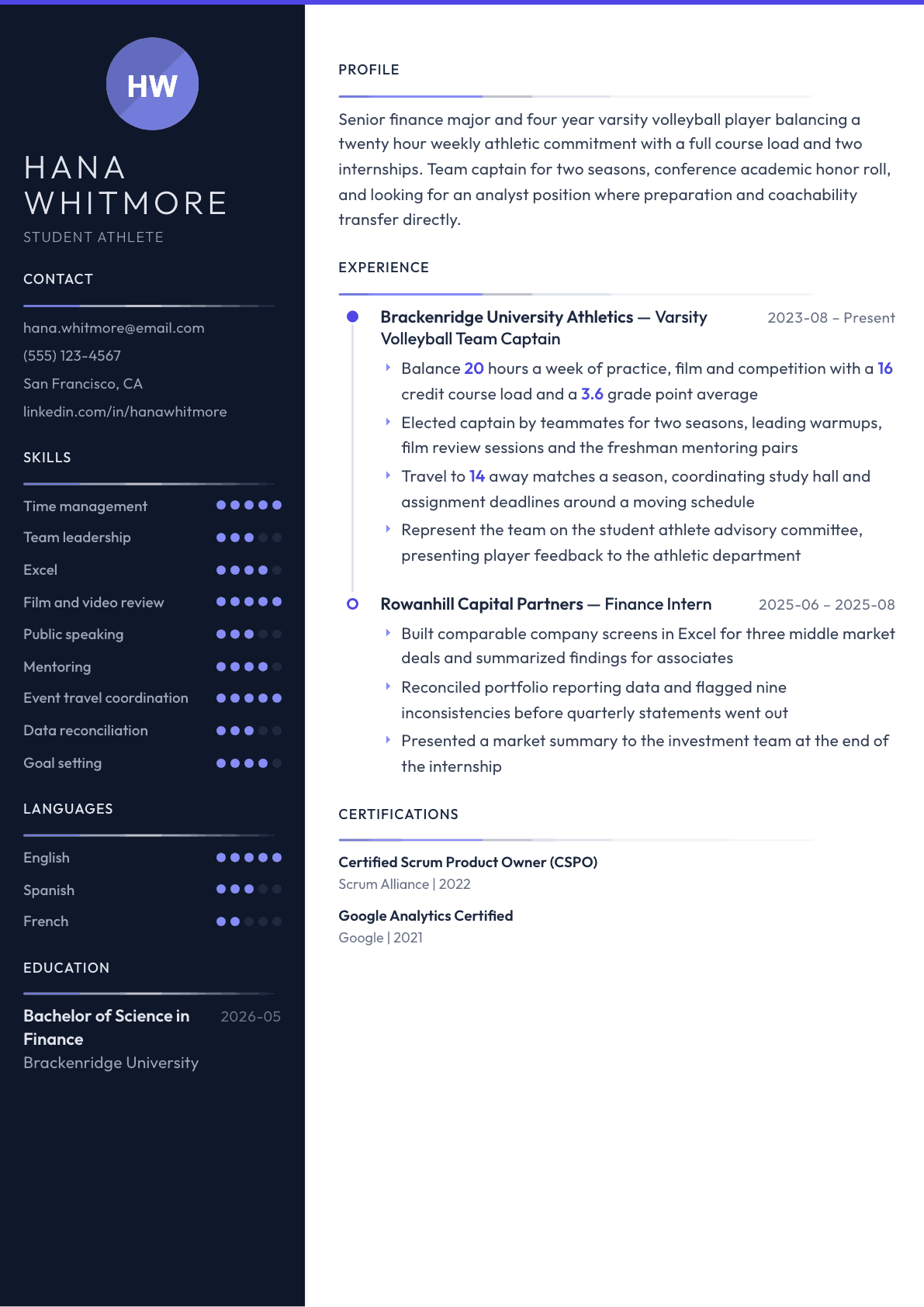
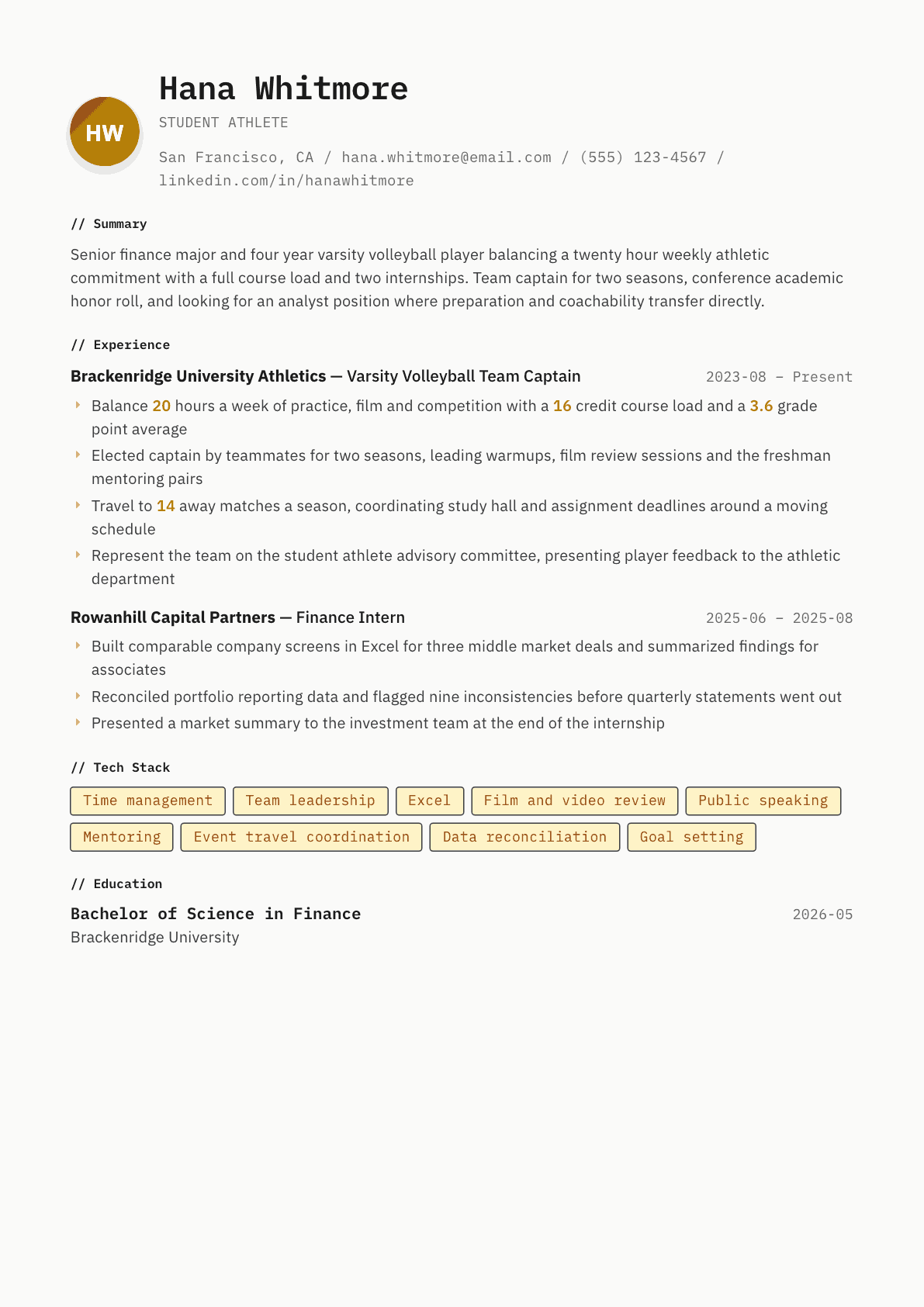
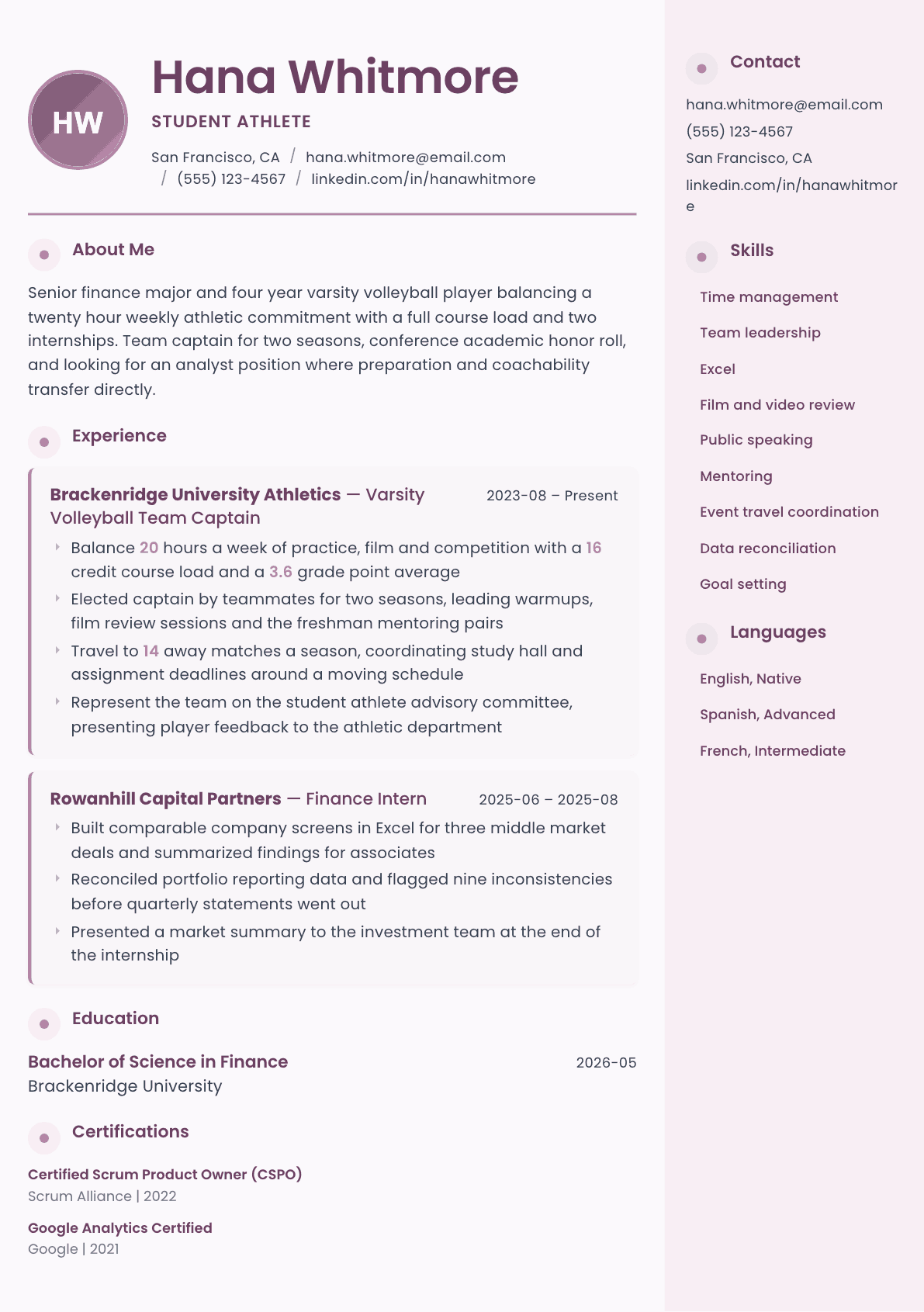
Example Student Athlete summary
Senior finance major and four year varsity volleyball captain who carried a twenty hour weekly athletic commitment alongside a full course load, a conference academic honor and a summer analyst internship. Led film review and freshman mentoring, served on the student athlete advisory committee, and now seeking an entry level analyst role.
Skills to list on a Student Athlete resume
- Time and schedule management
- Team leadership and captaincy
- Coachability and feedback response
- Film and performance review
- Peer mentoring
- Public speaking and media training
- Microsoft Excel
- Travel and logistics coordination
- Community service and outreach
- Goal setting and self assessment
- Conflict resolution
- Working under pressure
What actually gets this resume read
- Put athletics in the experience section with dates and duties, not in a hobbies line at the bottom of the page.
- Quantify the commitment: weekly practice hours, credit load, travel matches and the grade point average you held.
- Name the leadership you held, whether captaincy, advisory committee service or mentoring incoming first year players.
- Translate sport habits into employer language such as film study, preparation, feedback response and performance review.
- Keep internships, campus jobs and research above athletics if the role you want is closer to that experience.
- Include the conference academic honors you earned, since they prove the balance rather than just claiming it.
How to write a student athlete resume
Recruiters like hiring athletes and are bad at reading athlete resumes. The instinct is real: someone who held a twenty hour weekly training commitment alongside a full course load has already proven she can carry two jobs at once. The problem is that most student athlete resumes put the sport in a one line interests section, which converts the strongest evidence on the page into a decorative detail.
The second failure is more subtle. A student athlete lists the sport with no numbers, so the reader cannot tell a walk on with two seasons from a four year starter who captained the team and served on an advisory committee. Both write the same sentence: member of the varsity team. Only one of them was carrying the workload the recruiter is imagining.
This guide shows where athletics belongs on a first job resume, how to quantify a commitment nobody outside sport measures, and how to translate film study and coaching feedback into language a hiring manager already values. It includes sample summaries for an underclassman, a graduating senior and an athlete a couple of years out, rewritten bullets, and the questions that come up in a first job search.
Format: one page, athletics in experience, not in interests
One page, always, and reverse chronological within each section. A campus recruiter reading a stack at a career fair gives each page well under a minute, so the top third has to carry your major, your graduation timing, and the two experiences you want discussed.
Athletics goes into the experience section as a real entry: the athletic department as the employer, your role and any leadership title as the position, and the seasons as dates. Internships, campus jobs and research go in the same section, ordered by relevance to the job you are applying for rather than strictly by date when the two conflict.
- Header: name, city, phone, email, and a professional profile link, with the sport and position optional.
- Section order for a job search: education with graduation timing, experience including athletics, projects or leadership, skills.
- When the target role is close to an internship you held, put that entry above athletics.
- Keep the grade point average on the page while it is strong, since it is the fastest proof the balance worked.
Summary: major, graduation, the commitment, the target
Four lines at most. Name the degree and when it finishes, the sport and the level, the weekly commitment alongside the course load, and the role you are applying for. That last part is what most student resumes omit, and without it a recruiter cannot route you to a team.
Give the leadership honestly. Captain, advisory committee representative, mentor to incoming players, team community service lead. If you held none of those, lead with a season statistic, an academic honor or a role on the travel roster instead of inventing a title.
Experience: making the athletic commitment countable
The load is the story, so put numbers on it. Practice, lifting, film and treatment hours in a typical week. Credit hours carried at the same time. Away matches or meets a season and the class time you had to manage around them. Grade point average held through it. Those four numbers together tell a recruiter more about your capacity than any adjective on the page.
Then the responsibilities that look like work. Leading warmups is running a session for a group. Film review is analyzing performance and preparing for a specific opponent. Mentoring first year players is onboarding. Serving on a student athlete advisory committee is representing a constituency to an administration. Recruiting hosting is candidate experience. Community appearances are outreach on behalf of an organization.
Keep internships and campus employment written the way any candidate would write them, with tools, volumes and outcomes. Athletics proves capacity and character. Work experience proves you can do the specific job, and a recruiter needs both.
- State weekly athletic hours next to the credit load you carried in the same term.
- Give the seasons played, the leadership held and how you were selected for it.
- Count away competitions and describe how you handled coursework around travel.
- Include the academic honor or grade point average that proves the balance held.
- Describe film, scouting and preparation work in the language of analysis and readiness.
- List community service and outreach appearances with hours or event counts.
Translation: what coaches taught you that employers pay for
Coachability is the trait recruiters actually mean when they say they like hiring athletes, and it is easy to evidence. You received direct critical feedback every week, in front of teammates, and changed your behavior from it. Say so in those terms in a bullet, attached to a concrete example such as a position change or a technique correction that improved a measurable outcome.
The other transfers are equally concrete. A season is a long project with a fixed schedule and public results. A depth chart is performance review with visible consequences. A locker room is a team you cannot choose. Preparation for an opponent is research feeding a plan. Write each of these once, with the sport detail attached, and skip the generic list of teamwork and dedication that every applicant claims.
Keywords and what to do with name image likeness work
Entry level postings scan for the vocabulary of the target function first: analysis, client service, project coordination, sales, laboratory technique. Mirror those. Then layer the athlete evidence beneath each. A resume that only says leadership, teamwork and time management is competing with every other new graduate on the same three words.
If you have earned name image likeness income, treat it as a business. Brand partnerships negotiated, content delivered on a schedule, audience built, tax and contract administration handled yourself. That is marketing and small business experience, and very few of your competitors for an entry level marketing role have it.
Student Athlete resume summary examples
Underclassman seeking an internship
Sophomore marketing major and varsity soccer midfielder carrying eighteen practice hours a week alongside fifteen credits. Runs the team social account, completed a campus fundraising project, and seeking a summer internship in brand or event marketing where preparation and schedule discipline transfer directly.
Graduating senior
Senior finance major and four year varsity volleyball captain balancing a twenty hour weekly athletic commitment with a full course load and a summer analyst internship. Led film review and freshman mentoring, served on the student athlete advisory committee, and now seeking an entry level analyst role.
Two years out
Operations associate and former collegiate track athlete with two years in logistics coordination after four competing seasons. Brings the same preparation habits to shift planning and vendor scheduling, and continues to coach a youth club team on weekends. Targeting a supervisor position in distribution operations.
Work experience bullets: before and after
Before: Member of the varsity volleyball team for four years.
After: Balanced twenty hours a week of practice, film and competition with a sixteen credit course load and a 3.6 grade point average across four varsity seasons.
Hours, credits and grades give a recruiter a workload she can compare, where team membership alone gives her nothing.
Before: Was captain of the team.
After: Elected captain by teammates for two seasons, leading warmups, running weekly film review sessions and managing the freshman mentoring pairs across a roster of eighteen.
Naming how you were chosen and what you actually ran turns a title into demonstrated responsibility.
Before: Traveled with the team for away games.
After: Traveled to fourteen away matches a season, coordinating study hall, assignment deadlines and exam rescheduling with professors around a moving competition schedule.
The logistics detail is what proves self management, which is the trait the travel is evidence of.
Before: Learned teamwork and discipline through sports.
After: Took weekly video critique from coaching staff in front of teammates and changed my approach at the net, which lifted my attack efficiency over the second half of the season.
A specific feedback loop with a measurable change evidences coachability instead of claiming it.
Before: Represented the team at department meetings.
After: Served on the student athlete advisory committee, gathering feedback from three teams and presenting scheduling and facility concerns to athletic department administrators each term.
Showing the constituency, the cadence and the audience makes committee service read as real stakeholder work.
Hard skills
- Microsoft Excel
- Film and performance review
- Scheduling around fixed commitments
- Data entry and reconciliation
- Presentation and public speaking
- Social media content for a team account
- Event and travel coordination
- Fundraising and community service organizing
- Statistical record keeping
- Training log tracking
Soft skills
- Coachability and response to critique
- Composure in competition
- Peer mentoring
- Accountability to a group
- Recovery from a loss
- Consistency over a long season
Certifications worth listing
- Adult and Pediatric First Aid/CPR/AED (American Red Cross)
- Microsoft Office Specialist: Excel Associate (Microsoft)
Mistakes that cost student athlete candidates the interview
- Filing four varsity seasons under interests, which turns the strongest evidence on the page into a footnote.
- Writing member of the team with no hours, seasons, leadership or academic result attached to it.
- Leading with teamwork, leadership and time management, the three words every new graduate uses.
- Leaving out internships and campus jobs because they felt unrelated, when they prove you can do the actual work.
- Sending the same page to every posting instead of reordering experience toward each target function.
- Padding to two pages with high school achievements once a college season and an internship exist.
Student Athlete resume questions
Where should athletics go on a student athlete resume?
In the experience section as a full entry with the athletic department as employer, your role and any leadership title, and the seasons as dates. An interests line signals a hobby, and recruiters read it that way even when they value athletes.
How do I quantify being a college athlete?
Use four numbers: weekly hours across practice, lifting and film, the credit load you carried in the same term, away competitions per season, and your grade point average. Together they describe a workload any recruiter can evaluate.
Should I include high school sports?
Only if you have no college competition and are applying in the first year after graduation. Once you have a college season, an internship or a campus job, high school achievements take space from evidence that carries more weight.
How do I handle name image likeness income on a resume?
Write it as business experience: partnerships negotiated, content delivered on a schedule, audience built and contract and tax administration handled yourself. For marketing, sales and communications roles it is a genuine differentiator.
What if I did not start or hold a leadership title?
Lead with the commitment rather than the depth chart. Practice hours, travel, academic results and any service role still evidence capacity. Then give the work experience more space, because it proves the specific skills the job needs.
Related resume examples
- Professional Athlete Resume example
- Sports Coach Resume example
- Athletic Trainer Resume example
- Personal Trainer Resume example
- Fitness Coach Resume example
- Assistant Coach Resume example