Nurse Informaticist Resume Examples: what gets the call
Write a Nurse Informaticist Resume That Proves Clinical and Technical Range
By Mustafa Tarabya, founder of CVBooster · Published · Updated
Nurse informaticist resume examples with Epic and Cerner build keywords, sample project bullets, and a guide to showing both clinical and system work.
Sample resumes for a nurse informaticist
The same nurse informaticist content laid out in three CVBooster templates, so you can see what the finished document looks like before you write a word.
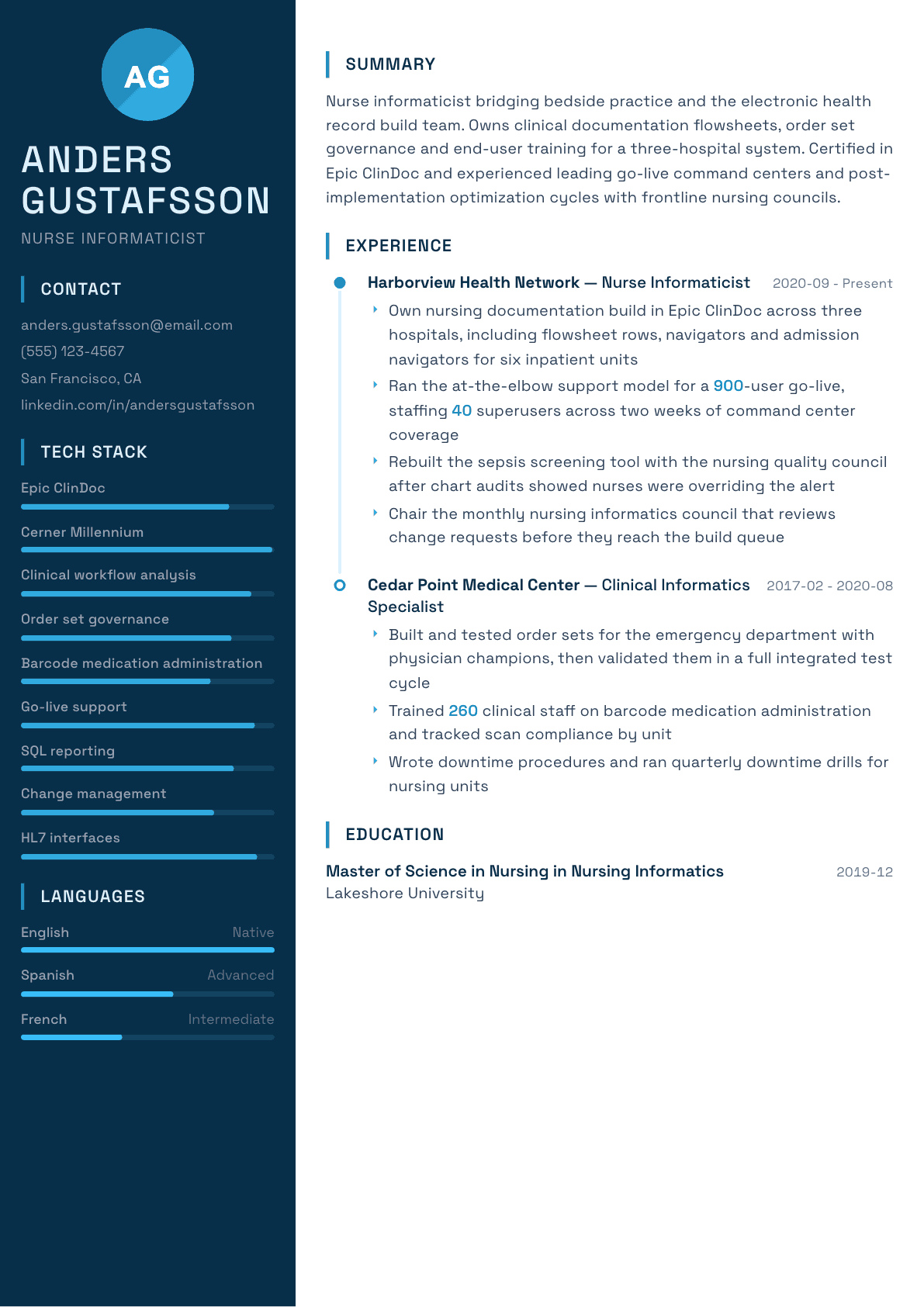
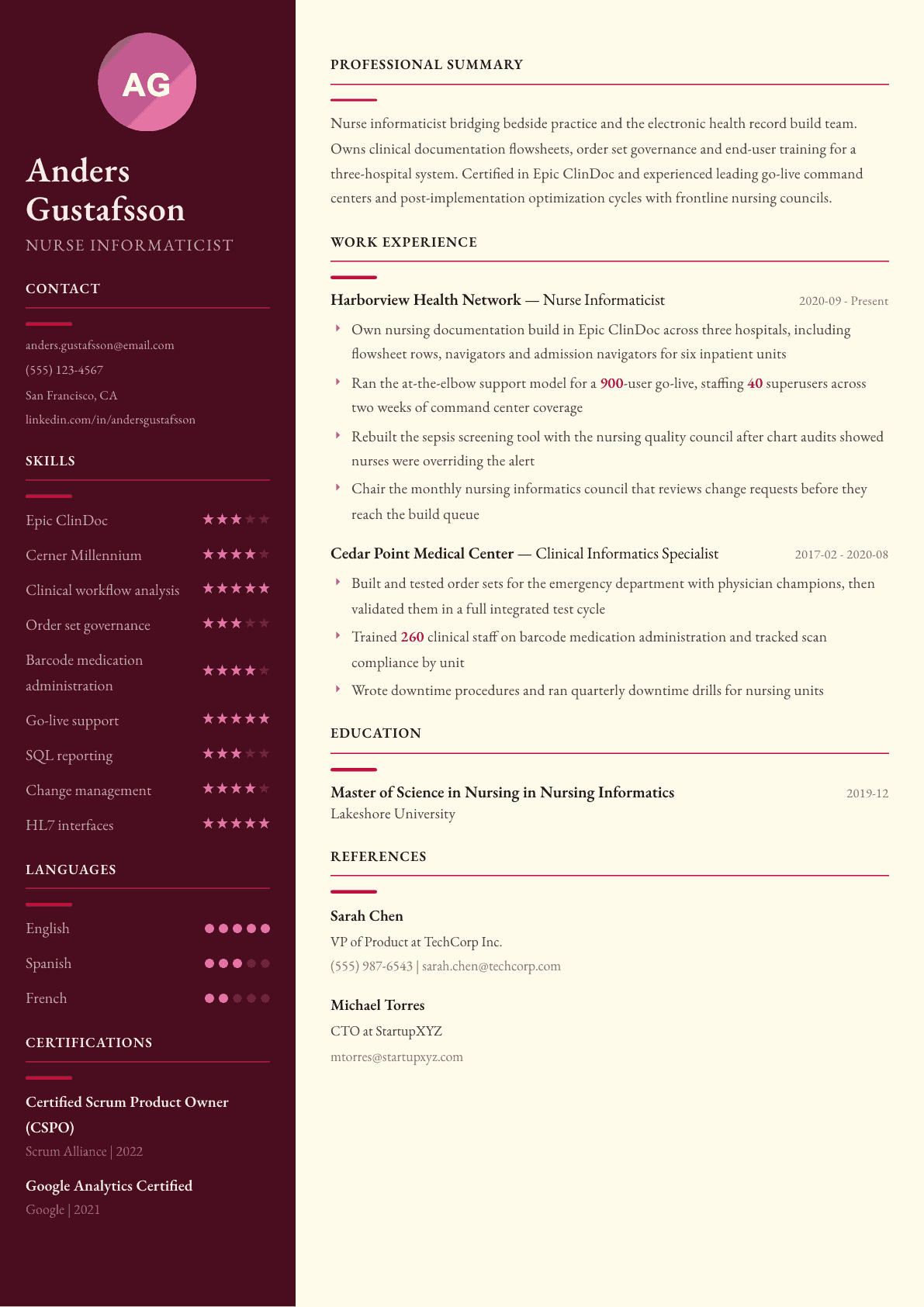
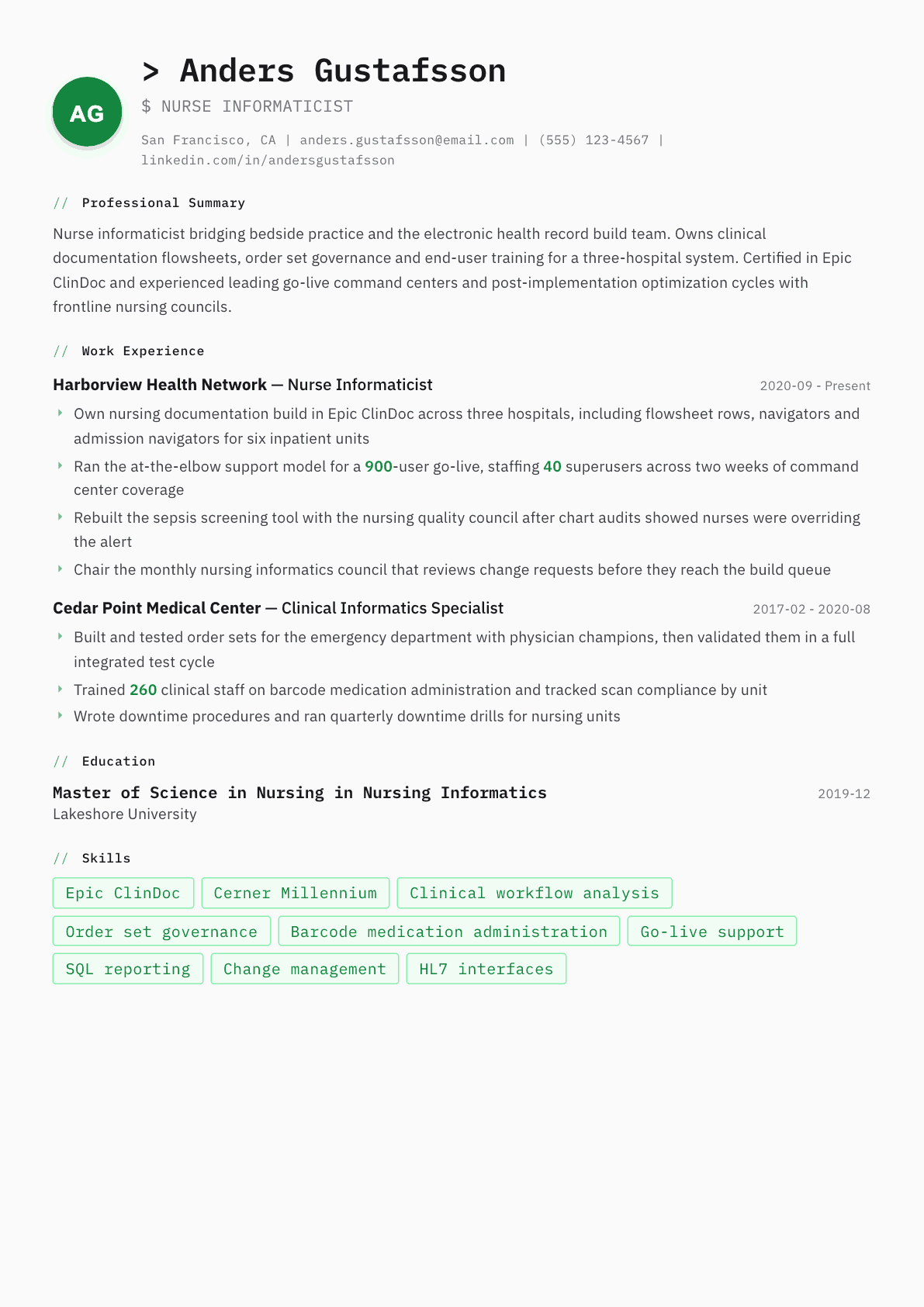
Example Nurse Informaticist summary
Nurse informaticist with a decade of acute care nursing and five years owning clinical documentation build for a multi-hospital system. Certified in Epic ClinDoc, experienced running go-live command centers and rebuilding alerts that clinicians were dismissing. Translates frontline workflow problems into scoped change requests and validated builds. Looking for a system-level informatics role with governance responsibility.
Skills to list on a Nurse Informaticist resume
- Epic ClinDoc
- Cerner Millennium
- Clinical workflow analysis
- Order set governance
- Clinical decision support
- Barcode medication administration
- Go-live and command center support
- Superuser training
- Change control
- HL7 and interface testing
- Reporting Workbench
- SQL
- Downtime procedures
- Nursing quality metrics
- Meaningful use reporting
What actually gets this resume read
- Put your RN license and your informatics certification in the header so both screening filters catch the resume.
- Name the electronic health record and the specific modules you build in, because Epic ClinDoc and Cerner PowerChart are not interchangeable.
- Describe at least one implementation by scope: number of users, number of units, and your role in the command center.
- Show an optimization example where you changed a workflow after watching nurses use it, not just a ticket you closed.
- Include any reporting skill you actually have, whether that is Reporting Workbench, SQL or Tableau, and say what you built with it.
- Keep two or three lines of direct bedside experience visible; informatics managers screen for credibility with clinical staff.
How to write a nurse informaticist resume
The nurse informaticist sits between two departments that judge resumes by different rules. Nursing leadership wants proof that you still understand what a night shift charge nurse faces at three in the morning. The information services director wants proof that you can scope a build, test it, and hand it over without breaking an interface. A resume written only for one of them gets passed to the other and dies there.
The reader is looking for named modules, not for the phrase electronic health record. Epic ClinDoc, Epic OpTime, Cerner PowerChart and Cerner FirstNet are distinct build environments, and a certification in one is a hiring signal on its own. After that comes implementation scope, governance experience, and evidence that you changed a workflow because you watched clinicians work, not because a ticket asked you to.
This guide sets out the section order informatics leaders read in, three summaries covering the path from superuser to system analyst to informatics lead, before and after bullets from real build and go-live work, and the questions nurses ask when they leave the bedside for the analyst desk.
Format: two credentials in the header, two audiences in the body
Reverse-chronological, two pages, and no columns inside the experience section because hospital applicant tracking systems parse them unpredictably. Put your degree, RN license and informatics certification after your name so both the nursing filter and the technical filter catch you on the same line.
Immediately below the summary, add a systems block: the electronic health record, the modules, the certifications with dates current, the reporting tools and the ticketing platform. Analysts are shortlisted from that block more often than from the job history.
- Header: name, degree, RN, informatics certification, city and state, license state.
- Order: summary, systems and certifications, informatics experience, clinical experience, education, projects.
- Keep a visible bedside block even when it is old; nursing leadership screens for clinical credibility.
Summary: the module you own and the size of the estate
Say what you build, where, and for how many. A nurse informaticist owning documentation build across three hospitals is a different hire from one supporting a single ambulatory clinic, and the reader cannot tell unless you write it.
If you are still transitioning from the floor, lead with superuser and go-live work and name the module you supported. Do not describe yourself as technology savvy; describe the tool you configured and the unit that used it.
Experience: build, test, train, optimize
Structure each informatics role around the four things you were accountable for. Build means the specific artifacts: flowsheet rows, navigators, order sets, documentation templates, clinical decision support rules. Test means the cycle you participated in, whether unit testing, integrated testing or a full validation script. Train means the user count, the delivery format and the superuser model. Optimize means the change you made after the system went live.
Give implementations a size. Number of users, number of units, number of facilities, and your specific role in the command center are the details that separate someone who lived through a go-live from someone who was scheduled during one.
The strongest bullet in this specialty is an optimization story: an alert clinicians were overriding, a documentation burden you measured and reduced, a workflow you rebuilt after observing it. That bullet is what convinces a director you are a nurse who happens to build, rather than an analyst with a lapsed license.
Governance, safety and the parts people forget
Change control is the quiet half of the job. Say which council or committee reviewed your requests, whether you chaired it, and how a request moved from a nursing unit to the build queue. Directors read this as evidence you will not push an untested change into production.
Add downtime procedures, business continuity access and post-downtime recovery documentation. Add any regulatory reporting you touched, such as quality measure abstraction or promoting interoperability requirements. These are the bullets other candidates leave off and the ones an interviewer will probe.
Skills and keywords the analyst screen uses
List the tools by name and split them: the record and modules, the reporting layer, the interface work, the project tooling. Say what you built with each reporting tool rather than listing it alone, because a director has read too many resumes that claim SQL and cannot write a join.
Mirror the posting vocabulary: workflow analysis, clinical decision support, order set governance, barcode medication administration, end user training, superuser model, change control, integrated testing, and the module name. Use each once in the summary or systems block and once inside a bullet where it is doing real work.
Nurse Informaticist resume summary examples
Superuser moving into informatics
Medical-surgical RN with seven years at the bedside and two as a unit superuser through an Epic upgrade, delivering at-the-elbow support for 60 nurses. Trained in flowsheet structure and documentation workflow. Seeking a clinical informatics analyst role supporting inpatient nursing.
Four years building
Nurse informaticist certified in Epic ClinDoc with four years owning nursing documentation build for a two-hospital system. Delivers flowsheets, navigators and clinical decision support, runs integrated testing cycles, and coordinates a 40-person superuser network through each upgrade.
Informatics lead
Nursing informatics lead with nine years in build and governance across a five-hospital system, chairing the nursing informatics council and owning the change control path from unit request to production. Directed command center staffing for two enterprise go-lives and rebuilt sepsis decision support with the quality council.
Work experience bullets: before and after
Before: Supported the electronic health record for nursing staff.
After: Owned nursing documentation build in Epic ClinDoc across three hospitals, including flowsheet rows, admission navigators and discharge documentation for six inpatient units.
Naming the module, the artifacts and the estate replaces a phrase that fits any hospital job.
Before: Helped with the go-live.
After: Ran the at-the-elbow support model for a 900-user go-live, scheduling 40 superusers across two weeks of command center coverage and triaging issues into the build queue each morning.
Scope numbers and a named support model show you led the event rather than attended it.
Before: Improved a clinical alert.
After: Rebuilt the sepsis screening tool with the nursing quality council after chart audits showed nurses were dismissing the alert, then measured acknowledgment behavior for two months afterward.
The evidence, the partner and the follow-up measurement turn a claim into a documented optimization.
Before: Trained staff on new systems.
After: Trained 260 clinical staff on barcode medication administration across three shifts and reported scan compliance by unit to nursing directors each month.
Headcount, shift coverage and a reported metric make the training verifiable.
Before: Worked on order sets with physicians.
After: Built and validated emergency department order sets with physician champions, carried them through a full integrated test cycle, and routed each change through the clinical content committee before release.
It shows the governance path, which is what a director actually screens for in this specialty.
Hard skills
- Epic ClinDoc build
- Cerner PowerChart configuration
- Clinical workflow analysis
- Order set and clinical content governance
- Clinical decision support design
- Barcode medication administration
- Integrated testing and validation scripts
- Go-live and command center coordination
- Superuser program management
- Reporting Workbench and SQL
- HL7 interface testing
- Downtime and business continuity procedures
Soft skills
- Translating clinician complaints into requirements
- Facilitating councils
- Teaching adults under time pressure
- Negotiating scope
- Written change documentation
- Calm during production incidents
Certifications worth listing
- Informatics Nursing Certification (NI-BC) (American Nurses Credentialing Center)
- Certified Professional in Health Information and Management Systems (CPHIMS) (HIMSS)
- Certified Associate in Healthcare Information and Management Systems (CAHIMS) (HIMSS)
- Project Management Professional (PMP) (Project Management Institute)
- Registered Health Information Administrator (RHIA) (American Health Information Management Association)
Mistakes that cost nurse informaticist candidates the interview
- Writing electronic health record everywhere and never naming the module you actually build in.
- Listing a vendor certification without the current status, which makes a recruiter assume it has lapsed.
- Describing go-live participation with no user count, unit count or role in the command center.
- Dropping the bedside history entirely, which costs you credibility with the nursing leaders on the panel.
- Claiming reporting tools with nothing built: name the report, the audience and the decision it supported.
- Leaving out change control and council work, which is the difference between an analyst and a governance owner.
Nurse Informaticist resume questions
Do I need a vendor certification to get a nurse informaticist job?
Not always, because many systems certify you after hire and will not sponsor an outside candidate. What you can control is showing superuser work, testing participation and workflow analysis on the module the employer runs, so the training investment looks small.
How much clinical experience should I keep on the resume?
Keep two or three bedside roles with the unit, the population and two bullets each, even after years in informatics. Nursing directors sit on these interview panels and use that section to decide whether frontline staff will trust your build decisions.
Should a nurse informaticist resume include a projects section?
Yes when your implementations do not map cleanly to job titles. Give each project the system, your role, the scope in users or units, the timeline, and the outcome, then keep the job history focused on ongoing accountability rather than repeating the same detail.
What technical skills matter most for this role?
Workflow analysis first, then build within your module, then testing discipline. Reporting ability is the common differentiator, so name the tool and one report you produced. Interface and integration knowledge matters most for roles that sit inside information services rather than nursing.
How do I show impact when my work is behind the scenes?
Tie every build to the clinician behavior it changed or the burden it removed. Documentation time, alert acknowledgment, scan compliance, ticket volume after an upgrade and training completion are all measurable and all defensible in an interview without inventing anything.