Home Health Nurse Resume Examples: the lines they read
Craft a Home Health Nurse Resume Agencies Call Back
By Mustafa Tarabya, founder of CVBooster · Published · Updated
Home health nurse resume examples with OASIS documentation, visit productivity, wound and infusion skills, plus keywords agencies screen for.
Sample resumes for a home health nurse
The same home health nurse content laid out in three CVBooster templates, so you can see what the finished document looks like before you write a word.
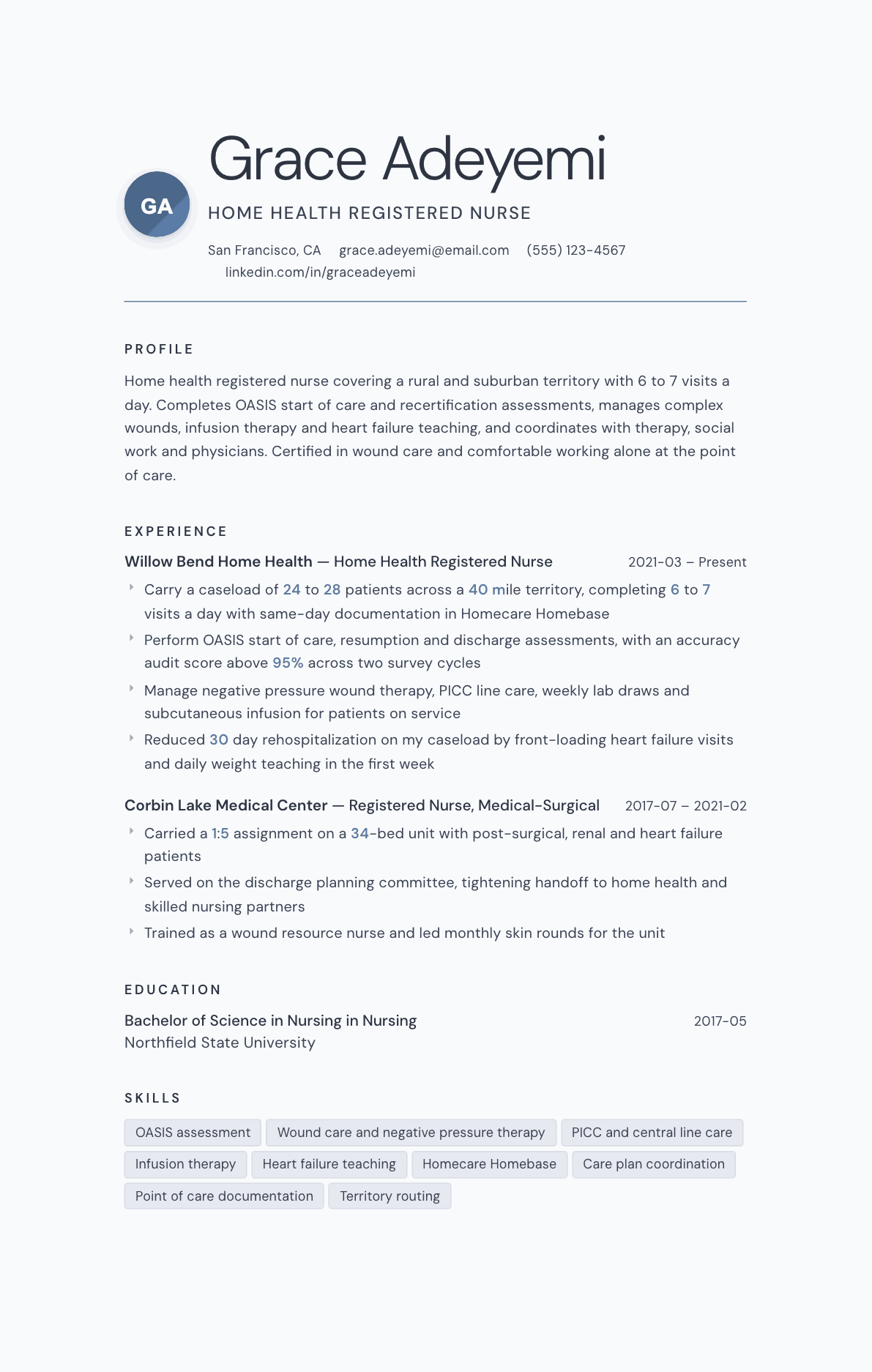
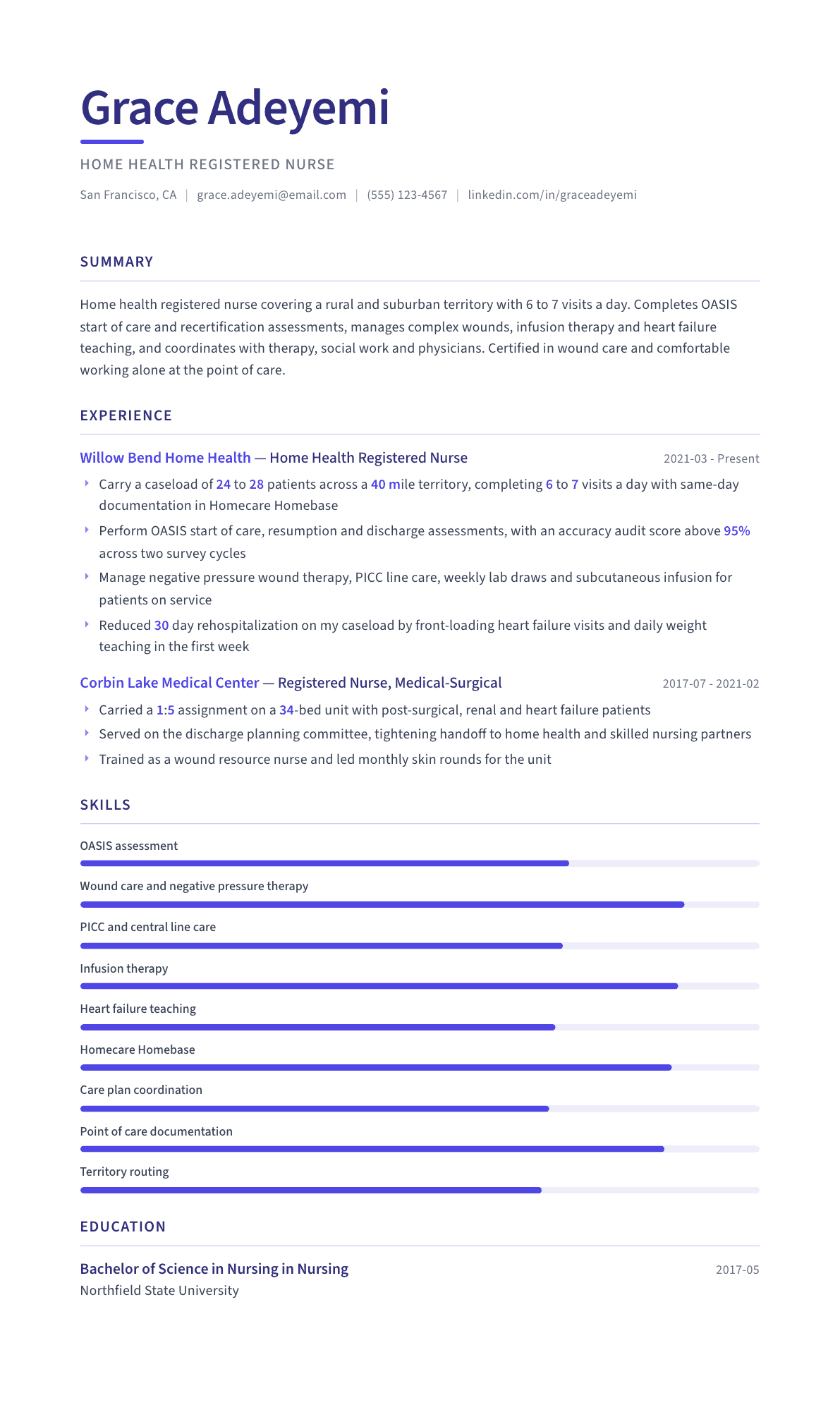
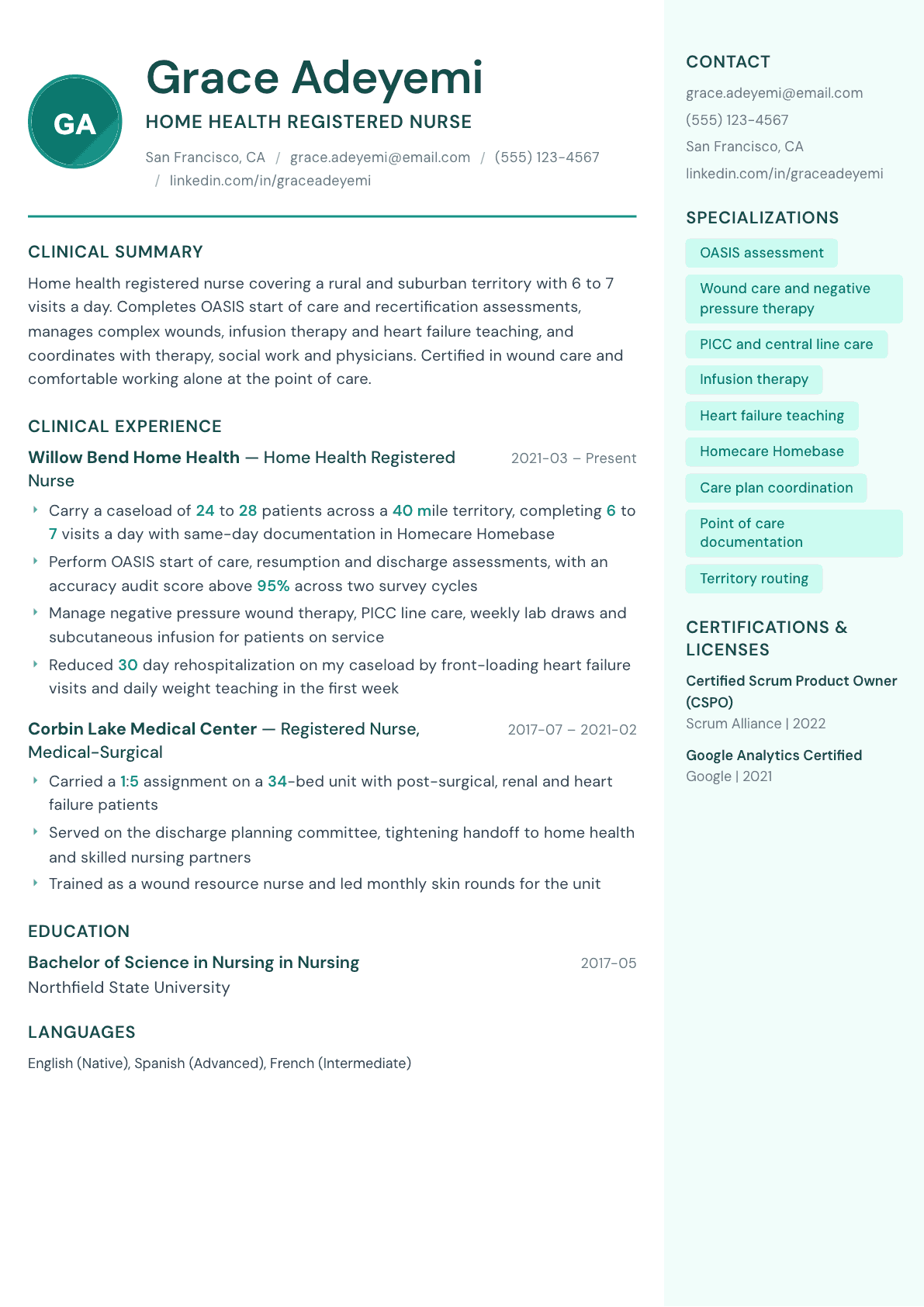
Example Home Health Nurse summary
Home health registered nurse carrying 24 to 28 patients across a 40 mile territory with 6 to 7 visits a day. Completes OASIS start of care and recertification assessments, manages wound vacs, PICC lines and infusion therapy, and documents at the point of care in Homecare Homebase. Front-loads heart failure visits to keep patients out of the emergency department. Wound care certified.
Skills to list on a Home Health Nurse resume
- OASIS documentation
- Start of care assessment
- Wound care
- Negative pressure wound therapy
- PICC line and port access
- Infusion and injection therapy
- Foley and ostomy care
- Medication reconciliation
- Heart failure and COPD teaching
- Diabetes and insulin teaching
- Homecare Homebase
- Care coordination
- Territory and visit routing
- Fall risk and home safety assessment
What actually gets this resume read
- Lead with visit volume, caseload size and territory radius, because agencies staff routes before anything else.
- Name your OASIS experience by item set and say whether you complete start of care and recertification visits.
- List the point of care software you have used, such as Homecare Homebase, Kinnser, WellSky or MatrixCare.
- Show the skills that keep a patient home: wound vacs, infusion, catheter changes, ostomy, injectable teaching.
- Mention rehospitalization reduction, front-loaded visits and medication reconciliation, which are the outcomes agencies report.
- State that you hold a valid driver license and reliable transportation, since every posting asks for it.
How to write a home health nurse resume
Home health agencies hire on three questions, and a resume that answers them clearly gets a call the same week. Can you drive a route and finish your notes the same day? Can you complete an OASIS assessment that survives an audit? Can you walk into a house alone and handle a wound vac, a PICC line or a heart failure crisis without a rapid response team down the hall?
This is why a home health nurse resume looks different from a hospital one. Bed counts and ratios do not apply. Caseload size, visits per day, territory radius, documentation timeliness and the therapies you can deliver at a kitchen table are the currency. Agencies are paid on episodes and scored on rehospitalization, so the numbers that matter to them are the numbers that belong on your page.
This guide covers the section order agencies read, how to write OASIS and productivity so a clinical manager trusts them, three summaries for different points in a home care career, and the rewrites that turn generic visit language into evidence of independent practice.
Format: route facts first, clinical depth second
Reverse chronological, one page under five years and two pages after that. Open each home health job with a route line: caseload size, visits per day, territory radius or the counties covered, the point of care software used, and whether you carry admissions, recertifications or both.
A clinical manager staffing a territory is doing arithmetic while she reads. Give her the arithmetic. Hospital jobs that came before home care get the standard unit and ratio treatment, compressed to three bullets, with anything that transfers to the home pulled to the front.
- Header: name, credentials, city and state, phone, email, license state and compact status.
- Order: summary, licenses and certifications, home health experience, facility experience, education, skills.
- State that you hold a valid driver license and reliable transportation, since every posting asks.
OASIS: the assessment that pays the agency
Say which OASIS visit types you complete: start of care, resumption of care, recertification, transfer and discharge. An agency that has to teach start of care from scratch will hire the nurse who already does them, so this is not a detail to bury inside a skills list.
Add the quality signals around it. Same-day documentation, corrections returned from quality review, participation in an audit or education cycle, and comfort with the functional and cognitive items that drive scoring. If you have been an OASIS reviewer or a coding partner, that is a separate bullet and it is worth more than any clinical line on the page.
Clinical skills that keep a patient out of the hospital
Home health nurses are hired for a specific band of skills: complex wound care and negative pressure therapy, PICC and port access with weekly lab draws, infusion and subcutaneous therapy, Foley and suprapubic catheter changes, ostomy management, tracheostomy care, tube feeding, and injectable teaching for insulin and anticoagulants.
Name the teaching too, because teaching is the intervention that prevents readmission. Daily weights and diuretic response for heart failure, inhaler and rescue plan for chronic lung disease, glucose logs and sick day rules for diabetes, medication reconciliation across the bag of bottles you find on the counter at start of care.
Include the judgment work that only happens in a house: assessing a fall risk from the actual stairs, spotting caregiver burnout, deciding whether a change in mental status needs a provider call or an ambulance, and coordinating with therapy, social work and the physician when the plan of care no longer fits.
Productivity and outcomes without inventing numbers
Agencies measure visits per day, documentation lag, on-call rotation, missed visits and rehospitalization within thirty days. Write the ones you can honestly account for. Six to seven visits a day across a forty mile territory says something precise. High productivity says nothing.
For outcomes, describe the intervention rather than claiming an agency-wide result. Front-loading heart failure visits in the first week, calling the provider on a weight gain trigger, or rebuilding a medication box with the daughter are the concrete moves behind a lower readmission figure, and a clinical manager recognizes them immediately.
Keywords agencies search on
The recurring terms are home health registered nurse, OASIS, start of care, recertification, plan of care, point of care documentation, case management, wound care, infusion therapy, medication reconciliation, care coordination, homebound status and rehospitalization. Use the agency wording once in the skills block and once inside a bullet.
Name the software by product: Homecare Homebase, WellSky, Kinnser, MatrixCare, Axxess or a hospital-owned system. Agencies filter on it because a nurse who already knows the point of care application is productive in the first week rather than the fourth.
Home Health Nurse resume summary examples
First year in home care
Registered nurse with six years of medical-surgical practice and one year in home health, carrying 18 patients across a suburban territory with five visits a day. Completes recertification and discharge assessments, manages wound care and catheter changes, and documents at the point of care in WellSky.
Case manager, four years in home health
Home health case manager with a caseload of 26 patients across a 40 mile territory and six to seven visits a day. Completes OASIS start of care and recertification, manages negative pressure wound therapy, PICC care and infusion, and front-loads heart failure visits to prevent readmission. Wound care certified.
Clinical field supervisor
Home health clinical supervisor overseeing twelve field clinicians and a branch caseload, with responsibility for OASIS review, case conference and survey readiness. Ten years of field practice with complex wound, infusion and end of life caseloads. Trains new hires on point of care documentation and homebound justification.
Work experience bullets: before and after
Before: Visited patients in their homes and provided nursing care.
After: Carried 24 to 28 patients across a 40 mile rural and suburban territory, completing six to seven visits a day with same-day documentation in Homecare Homebase.
Caseload, radius, visit rate and documentation timing are the four facts a staffing manager needs.
Before: Completed OASIS assessments.
After: Completed OASIS start of care, resumption and discharge assessments as the admitting nurse, with corrections from quality review staying minimal across two survey cycles.
Naming the visit types and the review outcome shows accuracy rather than mere exposure.
Before: Did wound care for patients.
After: Managed negative pressure wound therapy, sharp debridement follow-up and multilayer compression wrapping for a caseload that averaged five open wounds at any time.
Specific modalities prove the skill band an agency needs before it accepts a complex referral.
Before: Taught patients about their medications.
After: Reconciled medications at every start of care against the discharge summary and the bottles in the home, resolving duplicate anticoagulant orders with the prescriber twice in one quarter.
The reconciliation method and a real catch turn teaching into a safety intervention.
Before: Helped reduce hospital readmissions.
After: Front-loaded heart failure patients with three visits in the first week, teaching daily weights and a diuretic call trigger, and escalated two patients to the provider before decompensation.
The mechanism behind the outcome is credible in a way that a claimed reduction is not.
Hard skills
- OASIS start of care and recertification
- Plan of care development
- Complex wound care
- Negative pressure wound therapy
- PICC line and port access
- Infusion and subcutaneous therapy
- Foley and suprapubic catheter changes
- Ostomy and tracheostomy care
- Enteral feeding management
- Medication reconciliation
- Heart failure and pulmonary disease teaching
- Point of care documentation software
- Home safety and fall risk assessment
- Care coordination with therapy and social work
Soft skills
- Independent clinical judgment without backup on site
- Time management across a driving route
- Caregiver coaching and family negotiation
- Cultural sensitivity inside a family home
- Boundary setting in unstructured environments
Certifications worth listing
- Certified Wound Care Nurse (CWCN) (Wound, Ostomy and Continence Nursing Certification Board)
- Wound Care Certified (WCC) (National Alliance of Wound Care and Ostomy)
- Certified Registered Nurse Infusion (CRNI) (Infusion Nurses Certification Corporation)
- Basic Life Support (BLS) (American Heart Association)
Mistakes that cost home health nurse candidates the interview
- Leaving out caseload size, visits per day and territory, so a staffing manager cannot place you on a route.
- Mentioning OASIS as a skill without saying which visit types you complete or how your accuracy held up.
- Writing hospital bullets about ratios and bed counts that do not translate to a house with no colleagues in it.
- Skipping the point of care software, which is the first filter many agency recruiters apply.
- Claiming an agency readmission rate as a personal result instead of describing the visits you actually front-loaded.
- Forgetting the driver license line, which some application systems treat as a required field.
Home Health Nurse resume questions
Can I get a home health job straight out of nursing school?
Most agencies want at least one year of acute care first, because you practice alone in the home with no rapid response backup. Some larger agencies run structured home health residencies, and those are worth targeting directly if you have no facility year yet.
How important is OASIS experience on the resume?
It is the single strongest line an agency reads, because reimbursement and quality scores both flow from it. If you have completed start of care assessments, say so in the summary rather than leaving it inside a skills list halfway down page two.
What should I put if I have only worked in a hospital?
Pull forward discharge teaching, wound care, IV therapy, catheter and ostomy work, patient education and any case management or discharge planning committee. Add a line about independent decision making, then say plainly in the summary that you are moving into home care.
Do agencies care about visit productivity numbers?
Yes, but only honest ones. Write visits per day and caseload size as you actually carried them. Inflated productivity is checked in the reference call, and a clinical manager who has run a territory can tell an impossible route from a real one.
Should I mention on-call rotation on a home health resume?
Absolutely, because on-call coverage is one of the hardest slots for an agency to fill. State the rotation frequency, whether you took weekend admissions, and how many after-hours visits a typical rotation involved for your branch.