Hospice Nurse Resume Examples: free ATS score and gap list
Write a Hospice Nurse Resume That Shows Comfort Expertise
By Mustafa Tarabya, founder of CVBooster · Published · Updated
Hospice nurse resume examples covering symptom management, eligibility documentation, family support and the keywords hospice agencies search.
Sample resumes for a hospice nurse
The same hospice nurse content laid out in three CVBooster templates, so you can see what the finished document looks like before you write a word.
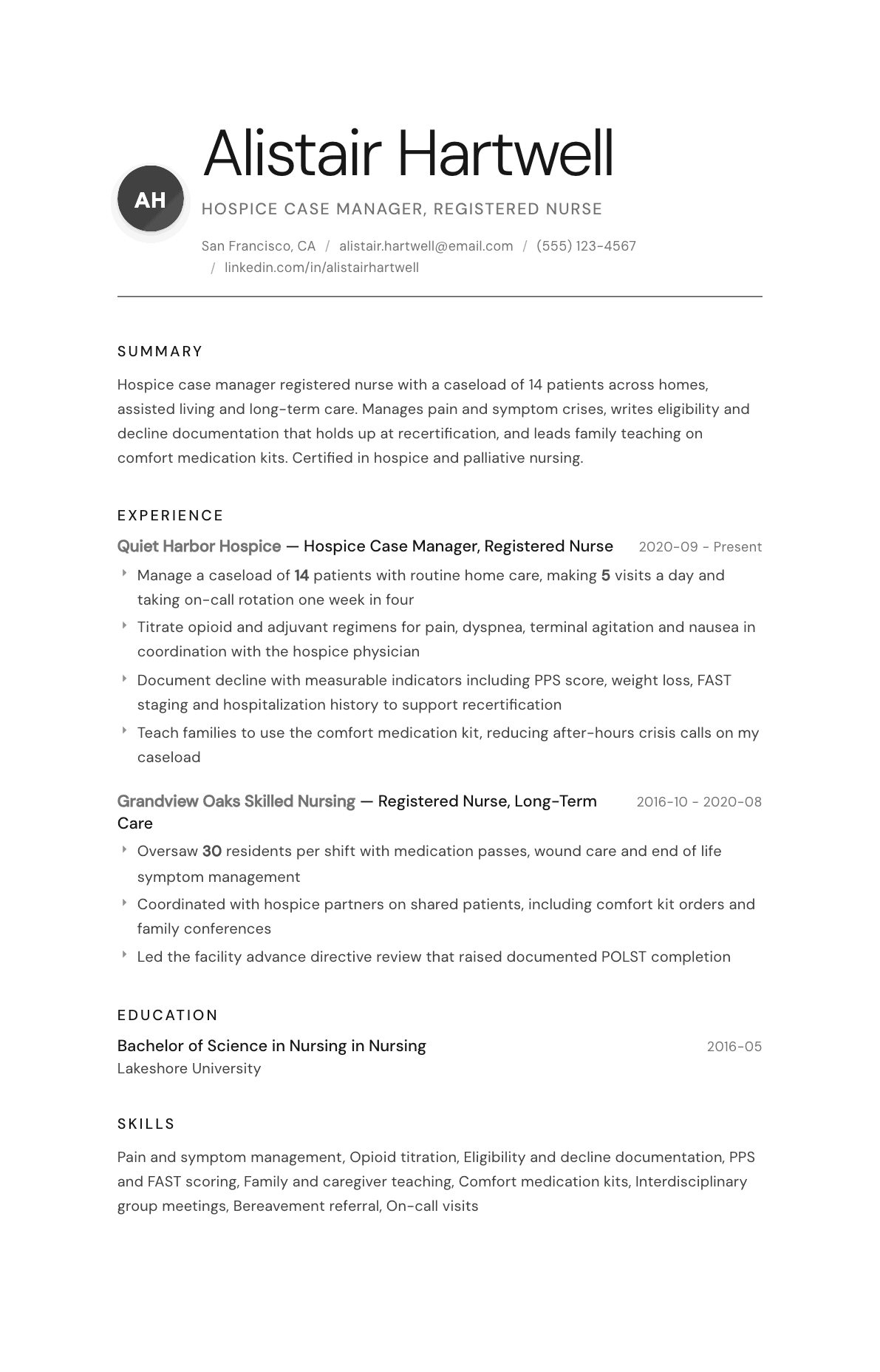
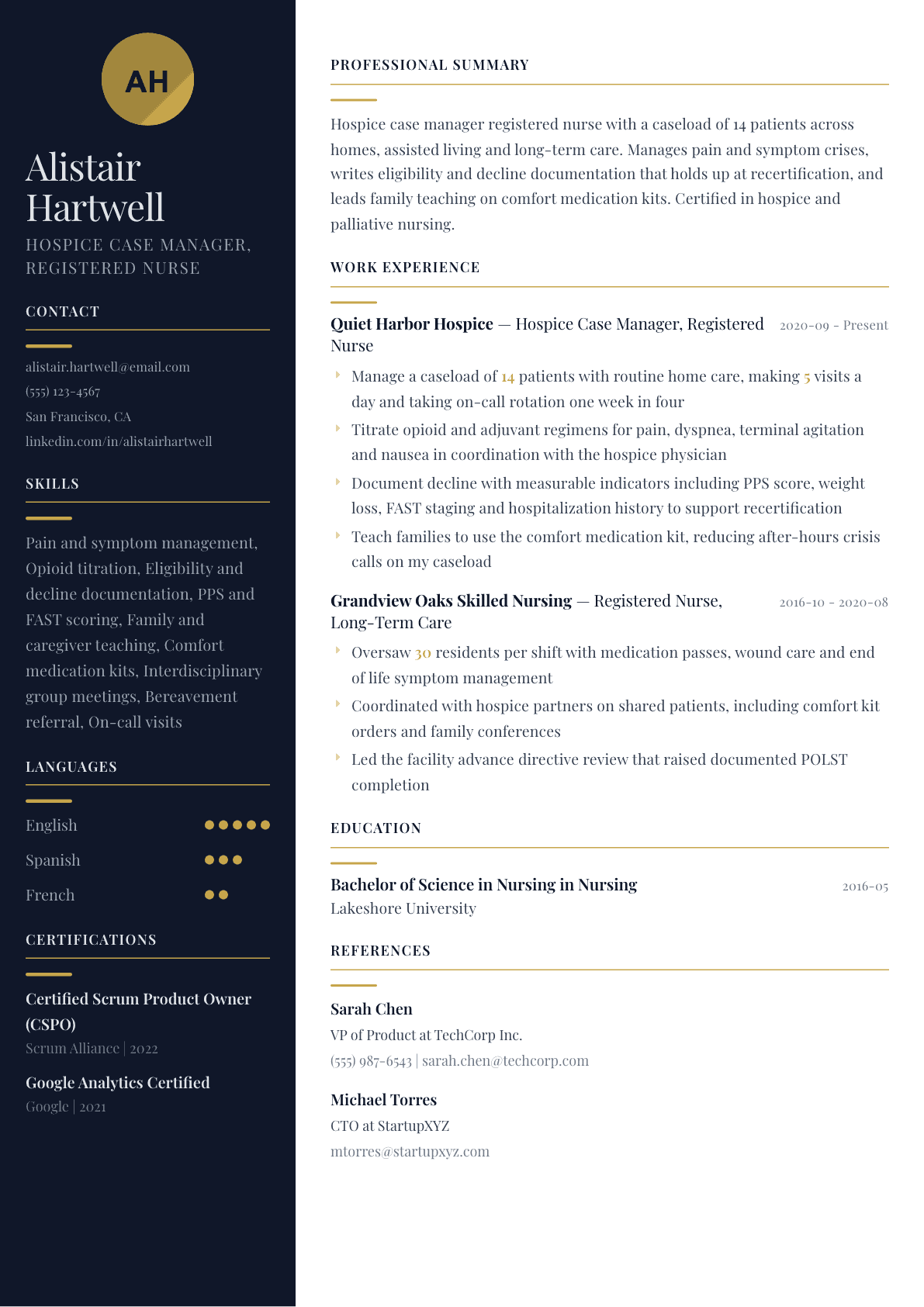
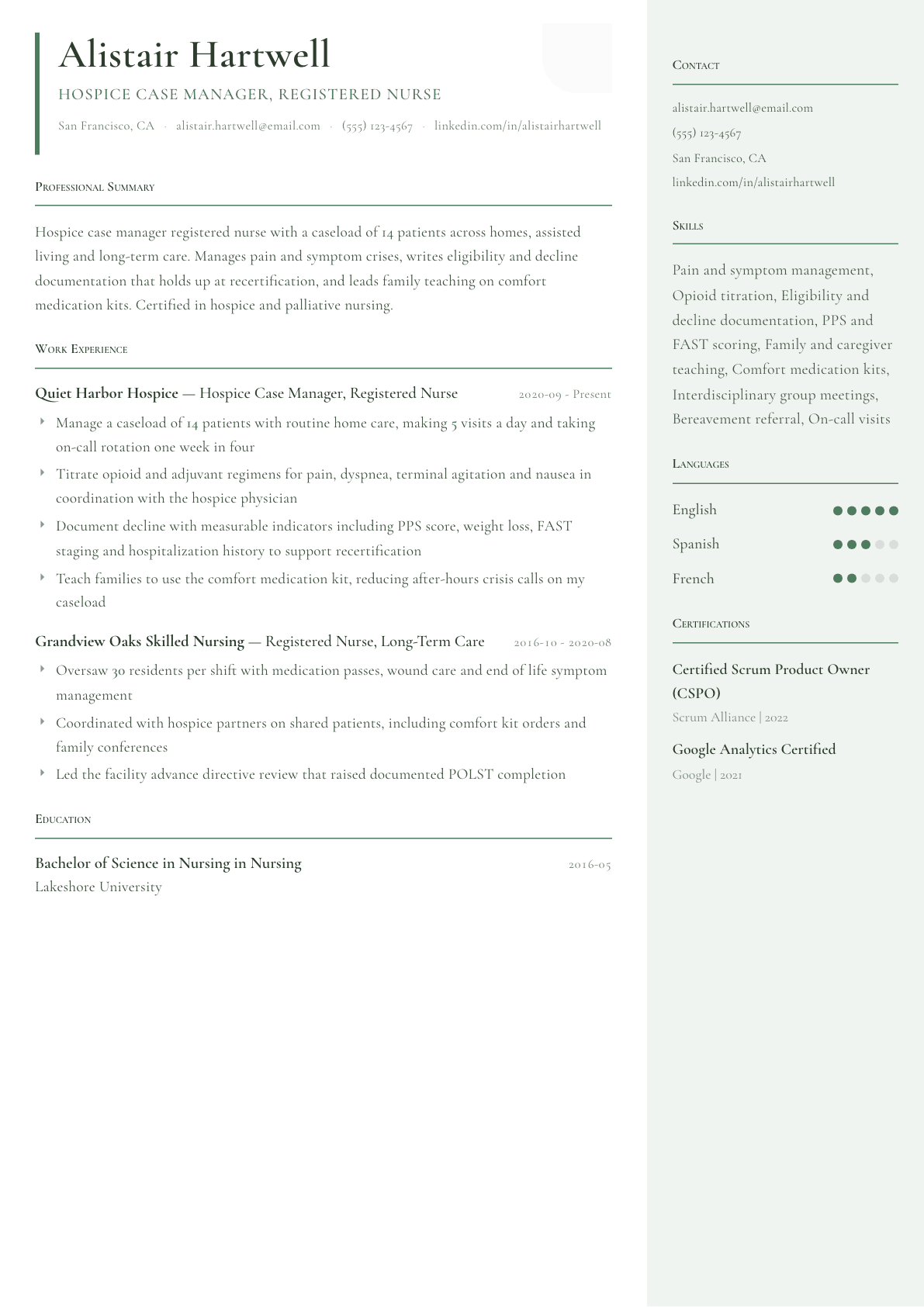
Example Hospice Nurse summary
Hospice case manager registered nurse with a caseload of 14 patients across private homes, assisted living and skilled nursing, making five visits a day with on-call rotation. Titrates opioid and adjuvant regimens for pain, dyspnea and terminal agitation, documents decline with PPS and FAST measures for recertification, and coaches families through the comfort medication kit. CHPN certified.
Skills to list on a Hospice Nurse resume
- Pain and symptom management
- Opioid and adjuvant titration
- Hospice eligibility documentation
- Palliative Performance Scale
- Advance directives and POLST
- Comfort medication kit teaching
- Family and caregiver support
- Interdisciplinary group meetings
- On-call and crisis visits
- Wound and skin care at end of life
- Bereavement referral
- Care plan updates
- Long-term care coordination
What actually gets this resume read
- State caseload size, visit frequency and whether you take on-call, because hospice staffing turns on those three.
- Show that you can document decline: PPS scores, FAST staging, weight loss, and the language recertification requires.
- Name the symptom clusters you manage, such as pain, dyspnea, terminal agitation, nausea and secretions.
- Include the settings you cover, since a home caseload reads differently from assisted living or a hospice house.
- Describe your role in the interdisciplinary group meeting rather than only listing bedside tasks.
- Add the CHPN credential if you hold it, and note comfort with pronouncement where your state allows it.
How to write a hospice nurse resume
Hospice hiring managers read a resume for two capabilities that rarely appear together. The first is pharmacological: can you titrate opioids, benzodiazepines, anticholinergics and antiemetics against a symptom picture that changes hourly, without a physician in the room. The second is documentary: can you write a visit note that proves eligibility, because an agency that cannot defend decline at recertification loses the patient and the payment.
Nurses coming from acute care often write hospice applications around compassion. Compassion is assumed in this field and it is invisible on a page. What distinguishes one hospice resume from another is caseload size, visit frequency, on-call load, the settings covered, the symptom clusters managed, and the specific decline measures you know how to document.
This guide takes the sections in the order a hospice clinical manager reads them, shows how to write eligibility documentation and symptom management without vague language, gives summaries for three career points, and covers the questions nurses ask when they move into end of life care.
Format: caseload, settings and on-call in the first three lines
Reverse chronological, two pages once you have hospice history. Under each hospice job give a context line before the bullets: caseload size, visits per day, the settings you cover, whether you are a case manager or an admission nurse or on-call, and the on-call rotation frequency.
Settings matter more than nurses expect. A caseload spread across private homes, assisted living, skilled nursing and a hospice inpatient unit is four different workflows, four different chart systems and four different sets of staff to teach. Naming them is the fastest way to show range.
- Header: name, credentials including CHPN when held, city and state, phone, email, license state.
- Order: summary, licenses and certifications, hospice experience, other clinical experience, education, skills.
- Say whether you perform admissions, since admission nurses are staffed separately at most agencies.
Symptom management: name the drugs and the decisions
Write the symptom clusters you manage and how: pain with opioid rotation and equianalgesic conversion, dyspnea with low dose opioids and oxygen decisions, terminal agitation with antipsychotics and benzodiazepines, nausea, constipation from the regimen itself, and respiratory secretions near the end.
Say who you work with and how orders move. Most hospice titration happens by phone with the hospice physician or nurse practitioner against standing parameters, and a manager wants to see that you can build a recommendation rather than wait for one. Include comfort with subcutaneous routes and syringe drivers where your agency used them.
Include the crisis skills: continuous care shifts, general inpatient transfer criteria, and what you do when a family calls at two in the morning with a patient in an uncontrolled pain crisis.
Eligibility and decline: the documentation that keeps a patient on service
This is the section most applicants skip and the one clinical managers value most. Show that you can document decline with measurable indicators: Palliative Performance Scale scores, FAST staging for dementia, weight and mid-arm circumference trends, albumin where used, recurrent infections, hospitalizations, and functional loss described in terms of what the patient could do last month.
Mention recertification cycles, face to face encounter requirements, live discharge decisions and any part you have taken in a chart audit. A nurse who has sat in an eligibility review and defended a caseload is a low-risk hire for an agency that is audited on exactly that.
Family, team and the parts of the job that are not clinical
Hospice is delivered by a team, and the interdisciplinary group meeting is where the plan of care is set. Describe your role in it: presenting a caseload, updating goals, calling in the chaplain or social worker, adjusting visit frequency as a patient declines.
Family work deserves its own bullets. Teaching a spouse to use the comfort medication kit, coaching an adult child through what the last days look like, mediating between siblings who disagree about hydration, and handling a family that wants to call an ambulance are all real, teachable skills. Write them as actions with outcomes, not as adjectives about your character.
Skills and keywords a hospice recruiter matches on
The recurring terms are hospice case manager, symptom management, pain management, palliative care, eligibility, recertification, Palliative Performance Scale, advance directives, comfort medication kit, interdisciplinary group, bereavement, continuous care and general inpatient level of care. Use the wording from the posting once in the skills block and once in a bullet.
Name the electronic record: HCHB, WellSky, MatrixCare, Netsmart or a hospital system. Also name any hospice specific credential, since CHPN is a real differentiator and most applicants do not hold it.
Hospice Nurse resume summary examples
Moving from acute care
Registered nurse with five years on an oncology unit moving into end of life care. Experienced with opioid regimens, port access, symptom crises and family conferences on goals of care. Completed a palliative care course and seeking a hospice case manager role covering home and assisted living patients.
Case manager, four years in hospice
Hospice case manager carrying 14 patients across private homes, assisted living and skilled nursing, making five visits a day with on-call one week in four. Titrates opioid and adjuvant regimens for pain, dyspnea and terminal agitation, and documents decline with Palliative Performance Scale and FAST measures.
Team lead and admission nurse
Senior hospice nurse splitting admissions and team leadership, with nine years in end of life care and CHPN certification. Runs eligibility review for a branch caseload, mentors four case managers, and leads the interdisciplinary group meeting. Experienced with continuous care and general inpatient transitions.
Work experience bullets: before and after
Before: Provided compassionate care to hospice patients and families.
After: Managed a caseload of 14 patients across homes, assisted living and skilled nursing with five visits a day, adjusting visit frequency as each patient declined.
Caseload, settings and visit rate describe the job, while compassion describes every applicant.
Before: Managed patient pain and symptoms.
After: Titrated opioid and adjuvant regimens for pain, dyspnea, nausea and terminal agitation with the hospice physician, including opioid rotation with equianalgesic conversion when oral routes failed.
Naming the symptom set and the conversion work proves pharmacological depth rather than presence at the bedside.
Before: Documented patient decline for recertification.
After: Documented decline with Palliative Performance Scale scores, FAST staging, weight trends and hospitalization history, so caseload recertifications held through two chart audits.
Specific measures show you understand what an eligibility reviewer is actually looking for.
Before: Taught families how to give medications.
After: Taught caregivers to use the comfort medication kit with a written symptom and dose sheet at each bedside, which cut repeat after-hours calls on my caseload.
A concrete tool and a measurable consequence turn teaching into a system a manager can copy.
Before: Attended team meetings each week.
After: Presented my caseload at the biweekly interdisciplinary group meeting, updating goals of care and requesting chaplain and social work visits for families in conflict over hydration.
The reader learns what you contribute to the team rather than that a meeting took place.
Hard skills
- Pain and symptom management
- Opioid titration and rotation
- Terminal agitation and delirium management
- Dyspnea and secretion management
- Hospice eligibility documentation
- Palliative Performance Scale and FAST staging
- Recertification and face to face requirements
- Advance directives and POLST review
- Comfort medication kit teaching
- Interdisciplinary group participation
- Continuous care and general inpatient criteria
- Wound and skin care at end of life
- On-call and after-hours crisis visits
Soft skills
- Presence with dying patients and their families
- Goals of care conversation
- Mediating family disagreement
- Self-care and grief boundaries
- Teaching without medical jargon
Certifications worth listing
- Certified Hospice and Palliative Nurse (CHPN) (Hospice and Palliative Credentialing Center)
- Advanced Certified Hospice and Palliative Nurse (ACHPN) (Hospice and Palliative Credentialing Center)
- Basic Life Support (BLS) (American Heart Association)
- Certified Wound Care Nurse (CWCN) (Wound, Ostomy and Continence Nursing Certification Board)
Mistakes that cost hospice nurse candidates the interview
- Writing the whole resume around compassion and dignity, which every applicant claims and no manager can verify.
- Omitting caseload size, visit frequency and on-call rotation, the three numbers that define hospice staffing.
- Saying you managed symptoms without naming the drug classes, the routes or who you titrated with.
- Ignoring eligibility documentation, even though it is the work that keeps an agency solvent under audit.
- Listing only home visits when your experience also covered assisted living, skilled nursing or an inpatient unit.
- Leaving CHPN off the header when you hold it, since it is the credential that sorts the pile.
Hospice Nurse resume questions
Do I need hospice experience to be hired into hospice?
No, but you need a bridge. Oncology, critical care, long-term care and medical-surgical nurses move in regularly. Lead with symptom management, family conferences, goals of care discussions and any palliative coursework, and say plainly that end of life care is the direction you have chosen.
What is the most important section of a hospice nurse resume?
The experience block for your most recent hospice or clinical role, specifically the bullets on symptom titration and eligibility documentation. Those two prove the pharmacological and the administrative halves of the job, and most applicants only demonstrate one.
Should I mention on-call and weekend work?
Yes, and be specific about the rotation. On-call is the hardest coverage for an agency to staff, so a nurse who states a rotation of one week in four and describes after-hours crisis visits is answering a staffing problem before the interview begins.
How do I show emotional resilience without sounding sentimental?
Through actions and structures rather than adjectives. Describe debriefs after a difficult death, participation in bereavement follow-up, mentoring a new case manager through a first patient, or how you set visit boundaries so a caseload stays sustainable.
Is a hospice resume different for an inpatient unit role?
Yes. For a hospice house or general inpatient unit, lead with acute symptom crisis management, continuous assessment, higher patient loads per shift and shift handoff, and move territory and caseload routing language down, since there is no driving route to describe.