Med-Surg Nurse Resume Examples: the lines they read
Write a Med-Surg Nurse Resume That Proves Real Acuity
By Mustafa Tarabya, founder of CVBooster · Published · Updated
Med-surg nurse resume examples with ratios, bed counts, post-operative skills and the keywords hospital recruiters search on every posting.
Sample resumes for a med-surg nurse
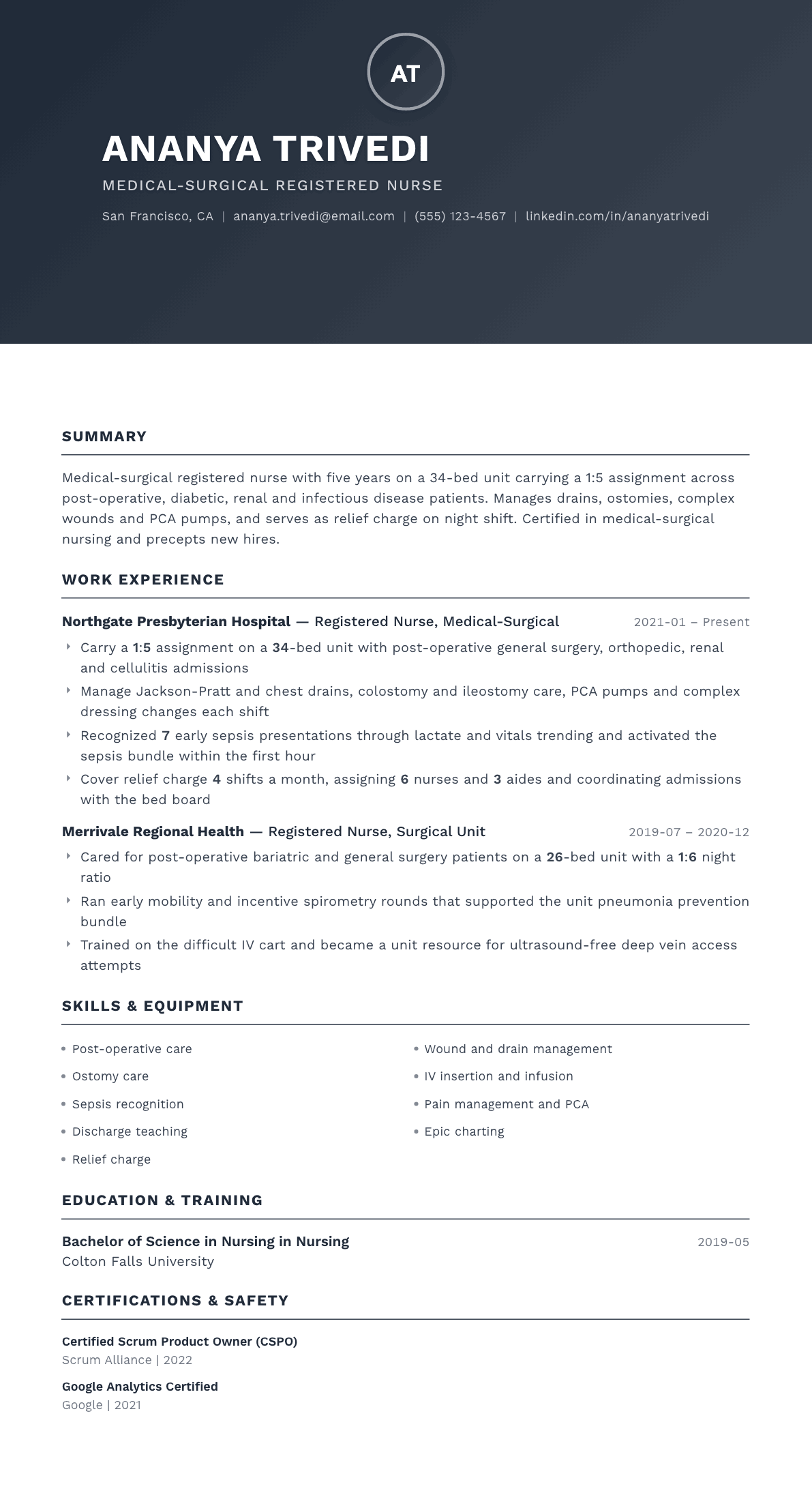
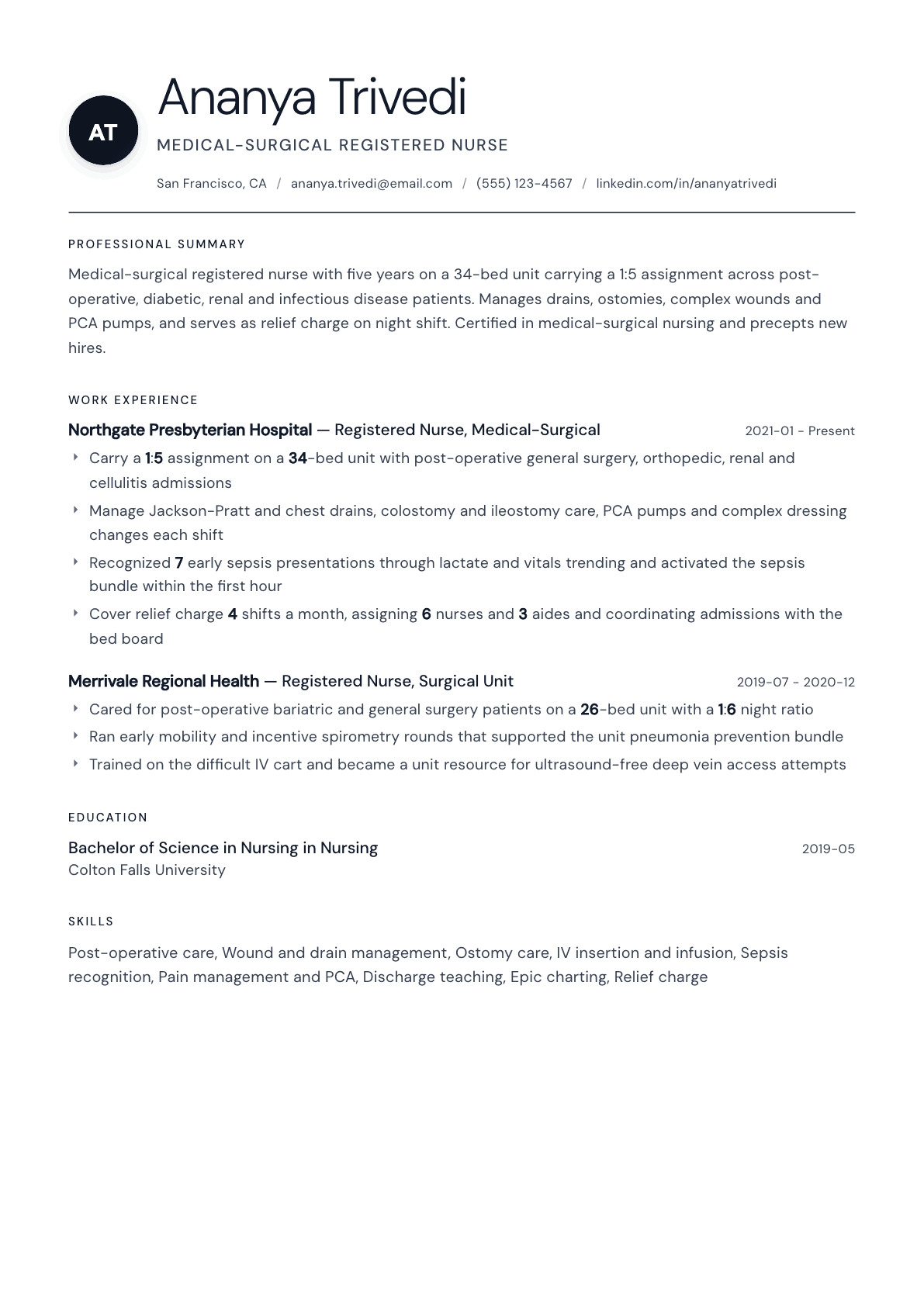
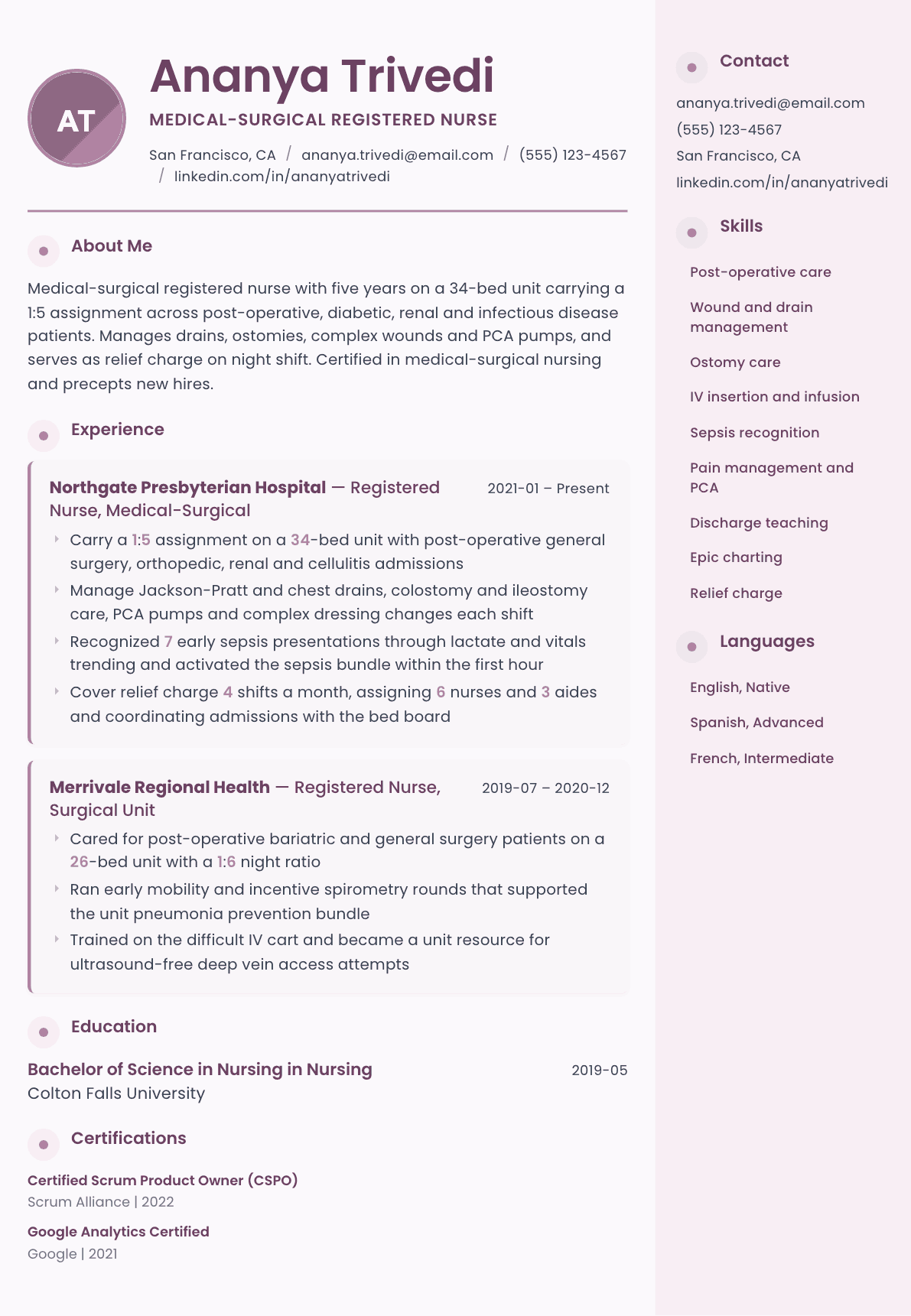
The same med-surg nurse content laid out in three CVBooster templates, so you can see what the finished document looks like before you write a word.
Example Med-Surg Nurse summary
Medical-surgical registered nurse with five years on a 34-bed unit at a 1:5 ratio, caring for post-operative general surgery, orthopedic, renal and infectious disease patients. Manages drains, ostomies, PCA pumps and complex wounds, activates sepsis bundles on early recognition, and covers relief charge four shifts a month. MEDSURG-BC certified and preceptor for new hires on nights.
Skills to list on a Med-Surg Nurse resume
- Post-operative nursing
- Wound and drain care
- Ostomy management
- IV insertion and infusion therapy
- Sepsis screening and bundles
- PCA and pain management
- Tube feeding and enteral care
- Diabetes and insulin management
- Telemetry basics
- Discharge planning and teaching
- Fall and pressure injury prevention
- Rapid response escalation
- Epic and Cerner charting
- Relief charge and precepting
What actually gets this resume read
- Give bed count, ratio and patient mix for every med-surg job, since that single line sets your acuity.
- Replace generic care language with the procedures you own: drains, ostomies, PCA pumps, wound vacs, tube feeds.
- Show early recognition work such as sepsis screening, rapid response calls and deterioration escalation.
- Add throughput contributions like discharge teaching, mobility rounds and coordination with case management.
- Put the MEDSURG-BC certification near the top if you hold it, because it is the field credential managers look for.
- Note relief charge shifts and precepting separately so leadership experience is not buried in bedside bullets.
How to write a med-surg nurse resume
Medical-surgical nursing is the largest specialty in the hospital and the one where resumes look most alike. Hundreds of applicants write the same three lines about providing patient care, administering medications and collaborating with the interdisciplinary team. A manager filling a med-surg line reads past all of it looking for two things: the acuity you have actually carried, and evidence that you catch a patient going bad before the rapid response team is called.
Acuity on this floor is defined by numbers. Bed count, nurse to patient ratio, shift, and the surgical and medical populations you take. A 1:5 assignment on a thirty four bed unit with post-operative bowel resections, renal patients and cellulitis admissions is a specific and demanding job. Provided care on a busy unit is not a description of anything.
This guide shows how to make a med surg nursing resume concrete, how to write the procedural work that is genuinely yours, a complete medical surgical nursing resume written out line by line, three summaries for different career stages, and the rewrites that separate an experienced floor nurse from someone who wrote a job description instead of a resume.
Format: acuity line, procedures, escalation, then extras
Reverse chronological, one page under five years and two after. Open every med-surg job with an acuity line covering bed count, ratio, shift and patient mix. Then four or five bullets in a consistent order: the procedures you own, the deterioration you catch, the throughput you support, and any charge or preceptor work.
Keep the layout single column with no icons or tables in the experience section, because hospital applicant tracking parsers regularly read multi-column resumes out of order and drop employment dates. A dropped date reads as a gap to a recruiter who never sees the original file.
- Header: name, credentials in order, city and state, phone, email, license state and compact status.
- Order: summary, licenses and certifications, experience, education, skills, committees and precepting.
- Name the electronic record you chart in, since it shortens the systems half of your orientation.
Summary: ratio, population, and one thing you are the resource for
Three lines. Years on the floor, the ratio and bed count, the populations you take, and one thing your unit asks you for specifically: difficult intravenous access, wound care, new graduate precepting, relief charge, the diabetes resource role. That last clause is what makes your summary different from the other forty in the folder.
If you are aiming at a step-down, emergency or intensive care posting, use the summary to point that way and lead the bullets with the monitored beds, drips and rapid response calls you already handle. Managers hire med-surg nurses into higher acuity units constantly, but only when the resume argues for it.
Procedures: write what your hands actually do
This is the section that rescues a med-surg resume from anonymity. Jackson-Pratt and Hemovac drains, chest tube monitoring, colostomy and ileostomy care with pouching problems, complex dressing changes and wound vacs, nasogastric and percutaneous feeding tubes, tracheostomy care, patient controlled analgesia pumps, blood administration, central line care and difficult peripheral access.
Add the medical management: insulin sliding scales and correction protocols, anticoagulation bridging, intravenous antibiotics with peak and trough timing, bowel preparation, and pre-operative and post-operative teaching. Naming them costs three lines and tells a manager exactly which patients she can assign you in your first month.
Deterioration, throughput and the work managers actually count
Every med-surg manager is measured on the same handful of things: sepsis bundle compliance, falls with injury, hospital acquired pressure injuries, catheter and central line infections, length of stay and readmission. Write your part in the ones you genuinely touched.
Deterioration bullets are the strongest. Recognizing a sepsis presentation from a lactate and a trending heart rate, calling a rapid response before an arrest, catching a post-operative bleed from drain output, or spotting a pulmonary embolism from sudden shortness of breath. These say more about your practice than any list of tasks.
Throughput is the other half. Discharge teaching that sticks, coordination with case management for equipment and home care, early mobility rounds, and admissions taken from the emergency department during a shift.
Skills and keywords a hospital posting matches on
The vocabulary repeats across postings: medical-surgical, post-operative care, patient assessment, medication administration, wound care, ostomy, drain management, intravenous therapy, sepsis bundle, discharge planning, patient education, fall prevention, interdisciplinary rounds. Mirror the exact posting wording once in your skills block and once inside a bullet where it is demonstrated.
Add the medical-surgical board certification when you hold it. It is the field credential managers recognize and relatively few applicants carry, so it belongs in the header line after your license rather than at the foot of the page.
Med surg resume example, written out
Here is a complete med surg resume for a registered nurse in her fourth year, as plain text in the order a nurse manager reads it. The nurse is invented; copy the order and the level of detail, then replace every fact with your own. Header: Renee Castillo, BSN, RN, CMSRN, Tampa, Florida, phone and email, Florida RN license, multistate compact.
Summary: Medical-surgical registered nurse with four years on a 32-bed surgical unit, 1:5 days with general surgery, colorectal and urology post-operative patients plus medical overflow. Unit wound and ostomy resource, preceptor for new graduates, relief charge two shifts a month.
Experience, Bayside General Hospital, Registered Nurse, Medical-Surgical, four years. Acuity line first: 32 beds, 1:5 days, post-operative surgical and medical overflow, Epic charting. Then the bullets below. Education: Bachelor of Science in Nursing. Certifications: CMSRN, BLS, ACLS. Skills: the posting wording, mirrored once.
- Manage Jackson-Pratt and Hemovac drains, new colostomies and ileostomies, wound vacs and patient controlled analgesia for a five-patient post-operative assignment.
- Called a rapid response on a post-operative day two patient after a rising heart rate and dropping drain output pointed to a bleed; patient returned to surgery the same shift.
- Serve as the unit ostomy resource, teaching pouching to patients before discharge and supporting nurses on the other two surgical floors by phone.
- Precepted five new graduate nurses through a twelve-week orientation, using a weekly skills checklist agreed with the educator.
- Take relief charge two shifts a month: bed assignments, admissions from the emergency department and staffing calls for a team of eight.
Med-Surg Nurse resume summary examples
First year off orientation
Registered nurse in the first year on a 30-bed medical-surgical unit carrying a 1:6 night assignment with post-operative general surgery and medical admissions. Manages drains, intravenous antibiotics and insulin protocols, and completed a difficult access training block. Seeking a day position on a higher acuity surgical floor.
Five years on the floor
Medical-surgical nurse with five years on a 34-bed unit at a 1:5 ratio covering post-operative, renal and infectious disease patients. Manages drains, ostomies, wound vacs and patient controlled analgesia, activates sepsis bundles on early recognition, and covers relief charge four shifts a month. Board certified in medical-surgical nursing.
Unit resource nurse
Senior medical-surgical nurse with nine years on a surgical floor, serving as the unit wound and difficult access resource and preceptor for new graduates. Leads monthly skin rounds, sits on the falls committee, and takes relief charge with responsibility for assignments and admissions. Pursuing a step-down staff position.
Work experience bullets: before and after
Before: Provided care to medical-surgical patients.
After: Carried a 1:5 assignment on a 34-bed unit with post-operative general surgery, orthopedic, renal and cellulitis patients across twelve hour day shifts.
Ratio, bed count and population define the acuity that provided care leaves completely open.
Before: Performed wound care and dressing changes.
After: Managed Jackson-Pratt and chest drains, colostomy and ileostomy pouching, wound vac changes and packed abdominal wounds on a unit without a dedicated wound team.
Specific devices plus the absence of a wound team show ownership rather than assistance.
Before: Monitored patients for changes in condition.
After: Recognized seven early sepsis presentations from lactate and vital sign trending and activated the sepsis bundle with blood cultures and fluids inside the first hour.
A count and a time-bound protocol turn vigilance into a measurable clinical contribution.
Before: Educated patients before discharge.
After: Delivered discharge teaching for new ostomy patients using return demonstration on pouch changes, and arranged home supply delivery with case management before release.
The teaching method and the follow-through show the readmission prevention a manager is measured on.
Before: Filled in as charge nurse sometimes.
After: Covered relief charge four shifts a month, assigning six nurses and three aides, coordinating admissions with the bed board and backfilling call-outs.
Frequency and span of control convert an occasional favor into documented leadership experience.
Hard skills
- Post-operative assessment and care
- Drain and chest tube management
- Ostomy care and pouching
- Complex wound care and wound vacs
- Peripheral intravenous insertion and difficult access
- Central line and port care
- Blood product administration
- Patient controlled analgesia and pain management
- Insulin and anticoagulation protocols
- Enteral feeding and nasogastric tube care
- Sepsis screening and bundle activation
- Fall and pressure injury prevention
- Discharge planning and patient education
- Epic and Cerner documentation
Soft skills
- Prioritizing five competing patients
- Escalating to providers with a clear ask
- Delegating to aides without friction
- Teaching patients who are frightened
- Handoff discipline at change of shift
Certifications worth listing
- Medical-Surgical Nursing Certification (MEDSURG-BC) (American Nurses Credentialing Center)
- Certified Medical-Surgical Registered Nurse (CMSRN) (Medical-Surgical Nursing Certification Board)
- Basic Life Support (BLS) (American Heart Association)
- Advanced Cardiovascular Life Support (ACLS) (American Heart Association)
- Wound Care Certified (WCC) (National Alliance of Wound Care and Ostomy)
Mistakes that cost med-surg nurse candidates the interview
- Omitting the ratio and bed count, which are the only figures that establish acuity on this floor.
- Filling the page with tasks every nurse performs instead of the procedures your unit relies on you for.
- Leaving out deterioration catches, which are the most persuasive evidence of clinical judgment available.
- Using a two column template with icons that hospital parsers read out of order and drop dates from.
- Repeating identical bullets across three similar med-surg jobs instead of showing progression between them.
- Applying to a step-down or intensive care posting without reordering the bullets toward monitored beds and drips.
Med-Surg Nurse resume questions
How do I make a med-surg resume stand out when everyone lists the same duties?
Replace duty language with acuity and ownership. Give the ratio and bed count, name the devices and protocols you handle, describe two deterioration catches, and add the unit role you hold such as wound resource, preceptor or relief charge.
Is medical-surgical certification worth listing?
Yes, and it belongs in the header credentials rather than the bottom of the page. Both the American Nurses Credentialing Center and the Medical-Surgical Nursing Certification Board issue recognized credentials, and relatively few floor applicants carry either one.
How do I use med-surg experience to move into intensive care?
Lead every job with monitored beds, titratable drips, rapid response calls and post-operative high acuity patients, then add advanced cardiovascular life support and a critical care course. State the target unit in the summary so the manager reads the file with that in mind.
What should a medical surgical nursing resume include?
An acuity line for every job with bed count, ratio and patient mix, then the procedures you own, one or two deterioration catches, and any resource, preceptor or charge role. Add license state and compact status in the header, the medical-surgical certification if you hold it, and float units summarized in one line.
How long should a med-surg nurse resume be?
One page for the first five years, two pages after that. Use the second page for precepting, committees, certifications and additional units, and resist stretching bedside duties across a second page when the content does not earn it.