Oncology Nurse Resume Examples: the lines they read
Write an Oncology Nurse Resume Built on Chemotherapy Skill
By Mustafa Tarabya, founder of CVBooster · Published · Updated
Oncology nurse resume example with chemotherapy administration, OCN credentials, port access and infusion detail, plus a writing guide.
Sample resumes for a oncology nurse
The same oncology nurse content laid out in three CVBooster templates, so you can see what the finished document looks like before you write a word.
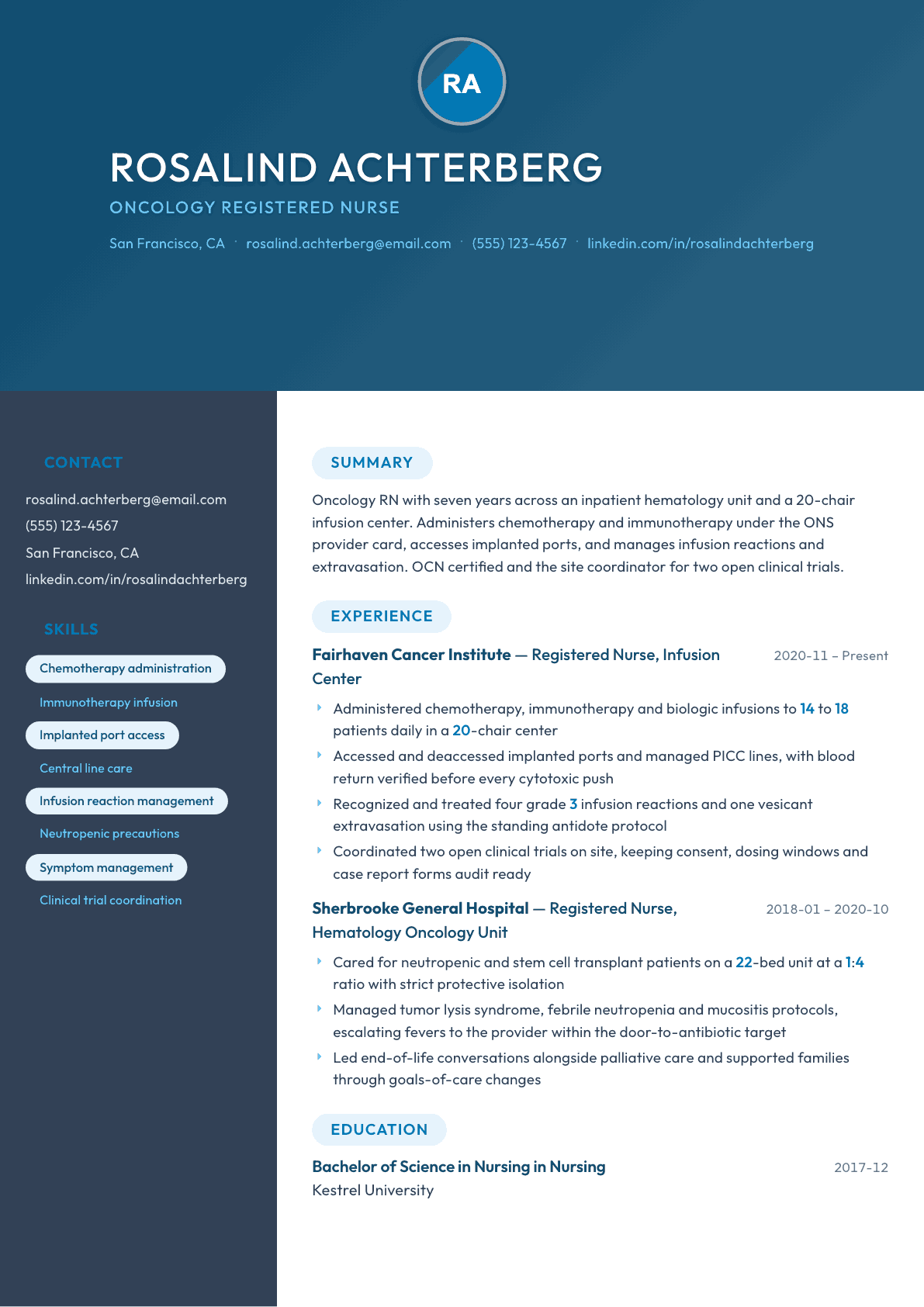
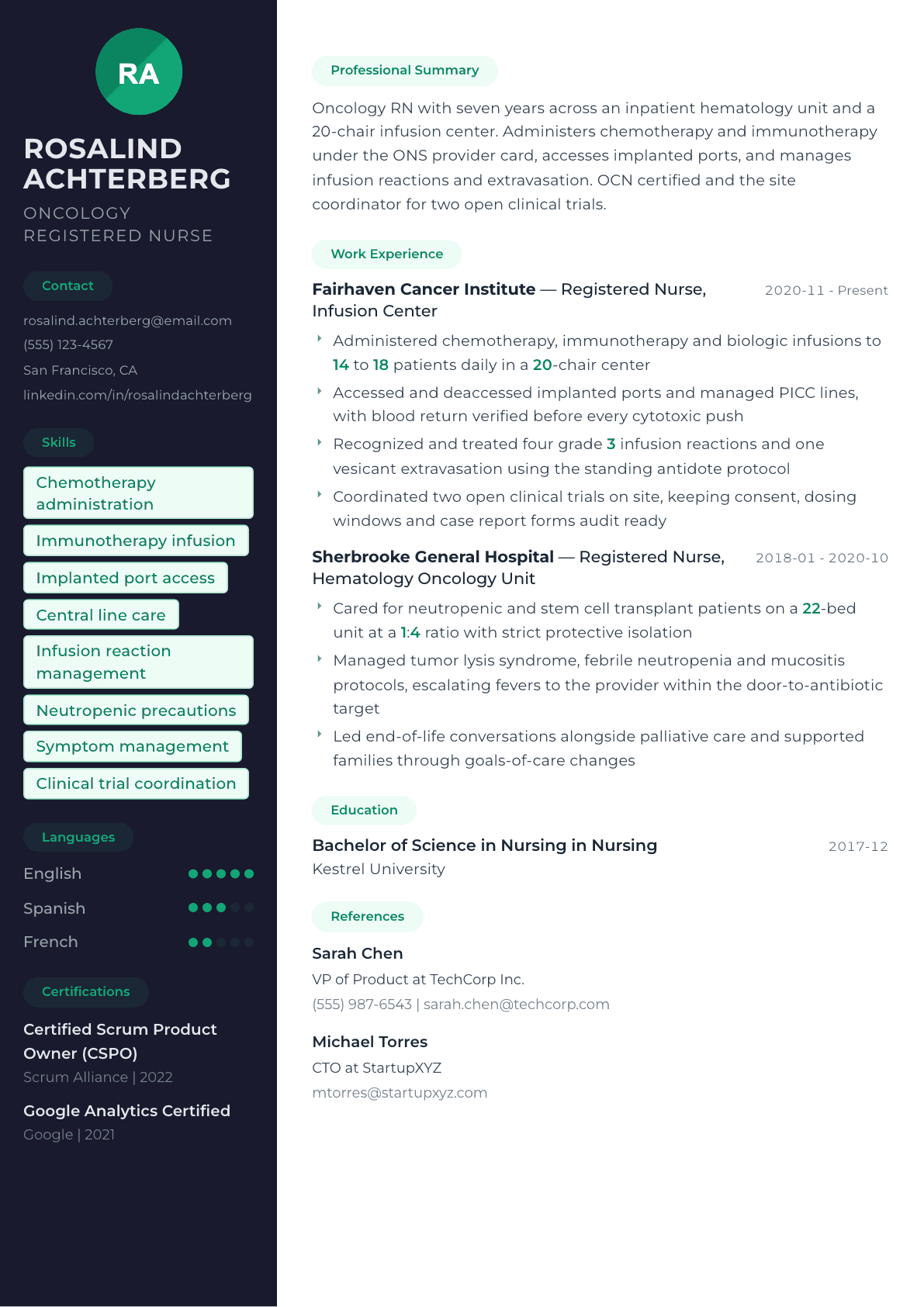
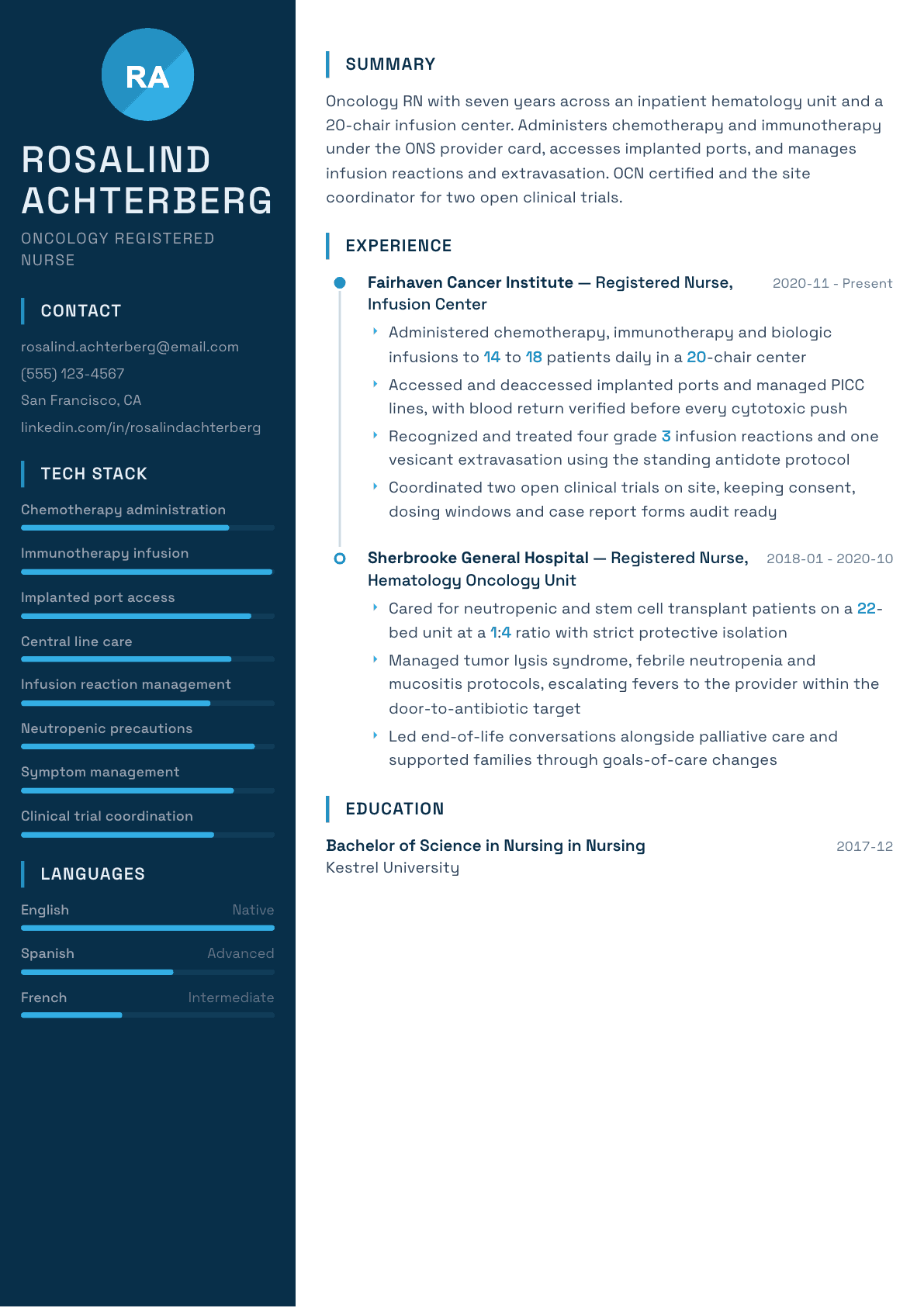
Example Oncology Nurse summary
Oncology nurse with seven years spanning inpatient hematology and a 20-chair infusion center. Administers chemotherapy and immunotherapy under a current provider card, accesses ports and PICCs, and manages reactions and extravasation with standing protocols. OCN certified and the site coordinator for two open trials. Seeking an outpatient cancer center where patient education is part of the role.
Skills to list on a Oncology Nurse resume
- Chemotherapy administration
- Immunotherapy and biologic infusion
- Implanted port access
- PICC and central line care
- Extravasation management
- Hypersensitivity reaction response
- Neutropenic precautions
- Antiemetic protocols
- Pain and symptom management
- Blood product administration
- Stem cell transplant care
- Clinical trial documentation
- Palliative and end-of-life support
- Hazardous drug handling
- Patient and caregiver education
What actually gets this resume read
- Say whether your chemotherapy and immunotherapy provider card is current, because most oncology postings require it before hire.
- Give the chair count or bed count and the daily patient volume so a manager can picture your workload.
- Name the drug classes you handle: cytotoxics, monoclonal antibodies, checkpoint inhibitors, bispecifics, oral agents.
- Describe access skills in detail: implanted ports, PICC lines, tunneled catheters, blood return verification.
- Show emergency competence with reactions, extravasation and tumor lysis rather than listing them as generic skills.
- If you have supported clinical trials, give the number of open studies and what you owned in the protocol.
How to write a oncology nurse resume
Cancer care hiring turns on one question before any other: are you cleared to administer chemotherapy, and is that clearance current. An oncology nurse resume that answers it in the header saves the recruiter an email and moves to the top of the queue. One that mentions chemotherapy vaguely in a bullet halfway down page two gets set aside, because the hiring manager cannot build a schedule around a maybe.
After that, the reader is measuring setting and depth. An infusion center chair count, an inpatient hematology bed count, a bone marrow transplant service, a radiation oncology clinic and a clinical trials unit all sit under the same job title and produce very different nurses. Vascular access skill, reaction management and symptom triage are where the depth shows.
This guide covers the credential block, the setting line that opens each job, how to write access and reaction bullets that survive a technical interview, how to present clinical trial work, and the questions oncology nurses ask when they move between inpatient and outpatient cancer care.
Header and credential block: provider card status first
Write your credentials after your name in the order degree, license, certification, then a block listing the RN license and state, your chemotherapy and immunotherapy provider card with its issue or renewal month, OCN certification, and life support cards. The provider card is the gating credential for the role, so it belongs above the fold rather than in a training list at the bottom.
If your card has lapsed, do not omit it silently. State that renewal is scheduled and give the month, because a manager who sees a plan can still interview you while a blank space reads as unqualified.
- Name with credentials, city and state, phone, email.
- Credentials: license and state, chemotherapy provider card, OCN, ACLS, BLS.
- Order: summary, certifications, oncology experience, education, skills.
- Say whether your practice is inpatient, infusion, transplant, trials or a mix.
The setting line: chairs, beds, daily volume
Open each job with the practice setting and its size. "Registered Nurse, 20-chair infusion center, fourteen to eighteen patients daily" or "Registered Nurse, 22-bed hematology and stem cell transplant unit, 1:4 ratio, protective isolation" places you immediately.
The two settings hire on different strengths. Infusion centers want throughput, vascular access speed and reaction readiness. Inpatient hematology wants neutropenic management, transplant protocols, sustained symptom control and the stamina for long admissions. Name the one you did and the one you want.
Drug classes, access and safe handling
Write the drug classes rather than the word chemotherapy alone. Cytotoxic agents, monoclonal antibodies, checkpoint inhibitors, targeted oral therapies, bispecific antibodies, growth factors and blood products each carry their own administration rules, monitoring windows and reaction profiles, and naming them is what proves you have given them.
Vascular access deserves its own bullet. Accessing and deaccessing implanted ports, caring for tunneled catheters and peripherally inserted central lines, verifying blood return before every vesicant administration, and following the dressing and flush schedule are daily oncology work that a general medical nurse has not done.
Include hazardous drug handling: closed system transfer devices, personal protective equipment, spill kit response and disposal. Safe handling is audited, and a nurse who already works to that standard needs a shorter competency period.
Reactions, emergencies and symptom triage
The strongest bullets in an oncology resume are the ones about things going wrong. Hypersensitivity and infusion reactions graded and treated under a standing order set, vesicant extravasation managed with the antidote protocol and the follow-up documentation, febrile neutropenia escalated inside the door-to-antibiotic target, tumor lysis syndrome monitoring, and cytokine release syndrome recognition if you have worked with cellular therapies.
Outpatient nurses should add telephone symptom triage: nausea, mucositis, diarrhea, neuropathy and fever calls assessed against a triage tool and routed to the provider or the emergency department. It is a large share of the outpatient day and it rarely appears on a resume.
Trials, education and the emotional weight of the work
If you have supported clinical trials, say how many were open at your site and what you owned: consent support, dosing windows, specimen collection and processing, case report forms, and audit readiness. Trial-capable oncology nurses are scarce and cancer centers hire them quickly.
Patient education and end-of-life work belong in the resume too, written concretely. Teaching a patient to manage an oral agent at home, preparing a family for a transition to hospice, or supporting a goals-of-care change with palliative care are real clinical contributions, not soft skills, and they should read that way.
Oncology Nurse resume summary examples
New to oncology
Registered nurse with two years of medical-surgical practice, now completing the chemotherapy and immunotherapy provider course. Experienced with central line care, blood product administration and neutropenic precautions from an oncology overflow unit. Seeking an infusion center position with a structured oncology orientation.
Seven years in cancer care
Oncology nurse with seven years spanning inpatient hematology and a 20-chair infusion center. Administers chemotherapy and immunotherapy under a current provider card, accesses ports and central lines, and manages reactions and extravasation with standing protocols. OCN certified and site coordinator for two open trials.
Oncology charge nurse
Charge nurse over a 30-chair ambulatory infusion service with thirteen years in cancer care, running the daily chair schedule, pharmacy coordination and reaction response. Built the site competency program for bispecific therapies, mentors new oncology nurses, and holds OCN with a blood and marrow transplant credential.
Work experience bullets: before and after
Before: Administered chemotherapy to cancer patients.
After: Administered cytotoxic, immunotherapy and biologic infusions to fourteen to eighteen patients daily in a 20-chair center, verifying orders, labs and consent against the treatment plan before each start.
Drug classes, daily volume and the pre-treatment verification steps prove the actual administration process rather than the label.
Before: Cared for patient IV lines and ports.
After: Accessed and deaccessed implanted ports and managed peripherally inserted central catheters, confirming blood return before every vesicant push and following the site flush and dressing schedule.
Blood return verification is the safety step that separates trained oncology access from general line care.
Before: Handled reactions during treatment.
After: Recognized and treated four grade 3 hypersensitivity reactions and one vesicant extravasation, running the standing antidote protocol and completing the follow-up documentation and provider notification.
Grading, counts and the named protocol turn an emergency claim into evidence of a rehearsed response.
Before: Cared for patients with low blood counts.
After: Managed neutropenic and stem cell transplant patients under protective isolation, escalating every febrile episode to the provider inside the unit door-to-antibiotic target.
The population, the precaution level and the time-bound escalation show protocol fluency, not general awareness.
Before: Assisted with research studies on the unit.
After: Coordinated two open clinical trials on site, keeping consent documentation, dosing windows, specimen processing and case report forms audit ready throughout enrollment.
Naming the deliverables makes trial support a verifiable role rather than incidental assistance.
Hard skills
- Chemotherapy administration
- Immunotherapy and biologic infusion
- Implanted port access and deaccess
- Central and tunneled catheter care
- Extravasation and vesicant management
- Hypersensitivity reaction response
- Neutropenic and protective precautions
- Antiemetic and symptom protocols
- Blood product administration
- Stem cell transplant care
- Hazardous drug handling and closed system devices
- Clinical trial documentation
Soft skills
- Delivering hard news alongside the provider
- Telephone symptom triage judgment
- Long-term relationships with returning patients
- Family support through treatment changes
- Emotional durability
- Coordination with pharmacy and scheduling
Certifications worth listing
- OCN (Oncology Certified Nurse) (Oncology Nursing Certification Corporation)
- BMTCN (Blood and Marrow Transplant Certified Nurse) (Oncology Nursing Certification Corporation)
- CPHON (Certified Pediatric Hematology Oncology Nurse) (Oncology Nursing Certification Corporation)
- Chemotherapy Immunotherapy Certificate Course (Oncology Nursing Society)
- CRNI (Certified Registered Nurse Infusion) (Infusion Nurses Certification Corporation)
- Advanced Cardiovascular Life Support (ACLS) (American Heart Association)
Mistakes that cost oncology nurse candidates the interview
- Leaving the chemotherapy provider card status off the header, when it is the credential that gates the whole role.
- Writing the word chemotherapy without the drug classes, which tells the reader nothing about what you have actually hung.
- Skipping vascular access detail, when port and central line skill is the daily bottleneck in an infusion center.
- Describing reactions and extravasation as general skills instead of naming the protocol you ran and what followed.
- Omitting the chair or bed count, so a reader cannot tell a small community clinic from a busy cancer center.
- Leaving out telephone symptom triage, which is a large part of outpatient oncology work and almost never appears.
Oncology Nurse resume questions
Do I need the chemotherapy provider card before applying?
Many cancer centers will hire without it and pay for the course during orientation, but holding it removes a barrier and shortens your ramp. If you are enrolled, put the course and its completion month on the resume so the manager can plan around it.
How do I move from inpatient oncology to an infusion center?
Lead with the skills the chair schedule needs: port access speed, reaction management, pre-treatment lab and order verification, and patient education. Then note your comfort with high throughput, because outpatient managers worry that inpatient nurses will run behind.
Is OCN certification worth pursuing?
Yes, cancer centers use it as a quality marker and it often carries a pay differential and a role in unit education. It also signals commitment to the specialty, which matters in a field where turnover is expensive to the employer.
How should I describe end-of-life and palliative work?
Write it as clinical work with a process, such as supporting goals-of-care conversations alongside palliative care, coordinating a hospice transition, and teaching families about symptom management at home. Avoid adjectives about compassion and let the described actions carry it.
Should I list the clinical trials I supported by name?
Give the number of open studies and the sponsor type rather than protocol names or numbers. Describe what you owned, such as consent support, dosing window adherence, specimen handling and case report forms, which is what a research manager is actually assessing.