Homeland Security Analyst Resume Examples: free score
Build a Homeland Security Analyst Resume a Panel Can Verify
By Mustafa Tarabya, founder of CVBooster · Published · Updated
Homeland security analyst resume example with threat assessment, fusion center and clearance keywords, plus a guide to writing unclassified evidence.
Sample resumes for a homeland security analyst
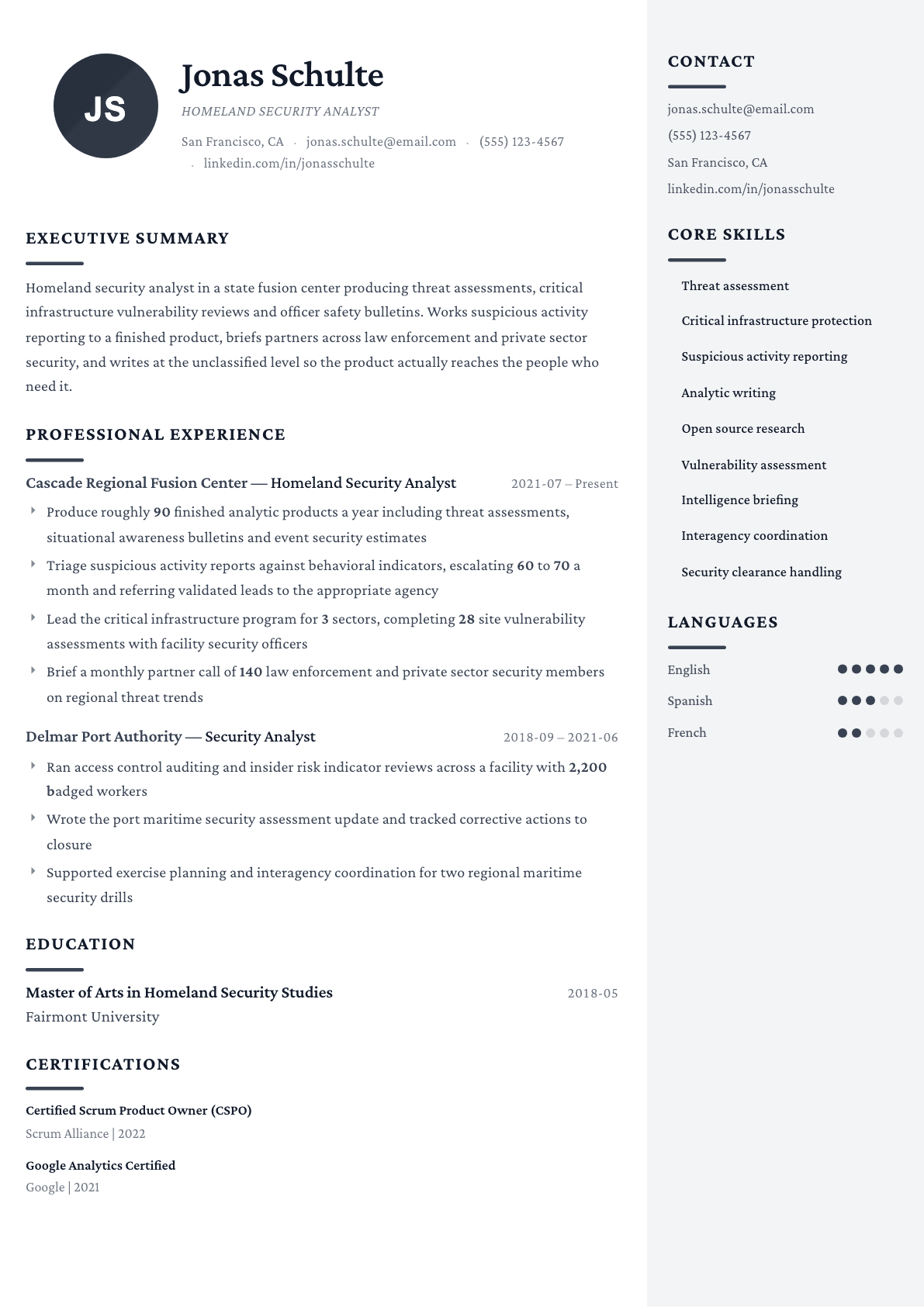
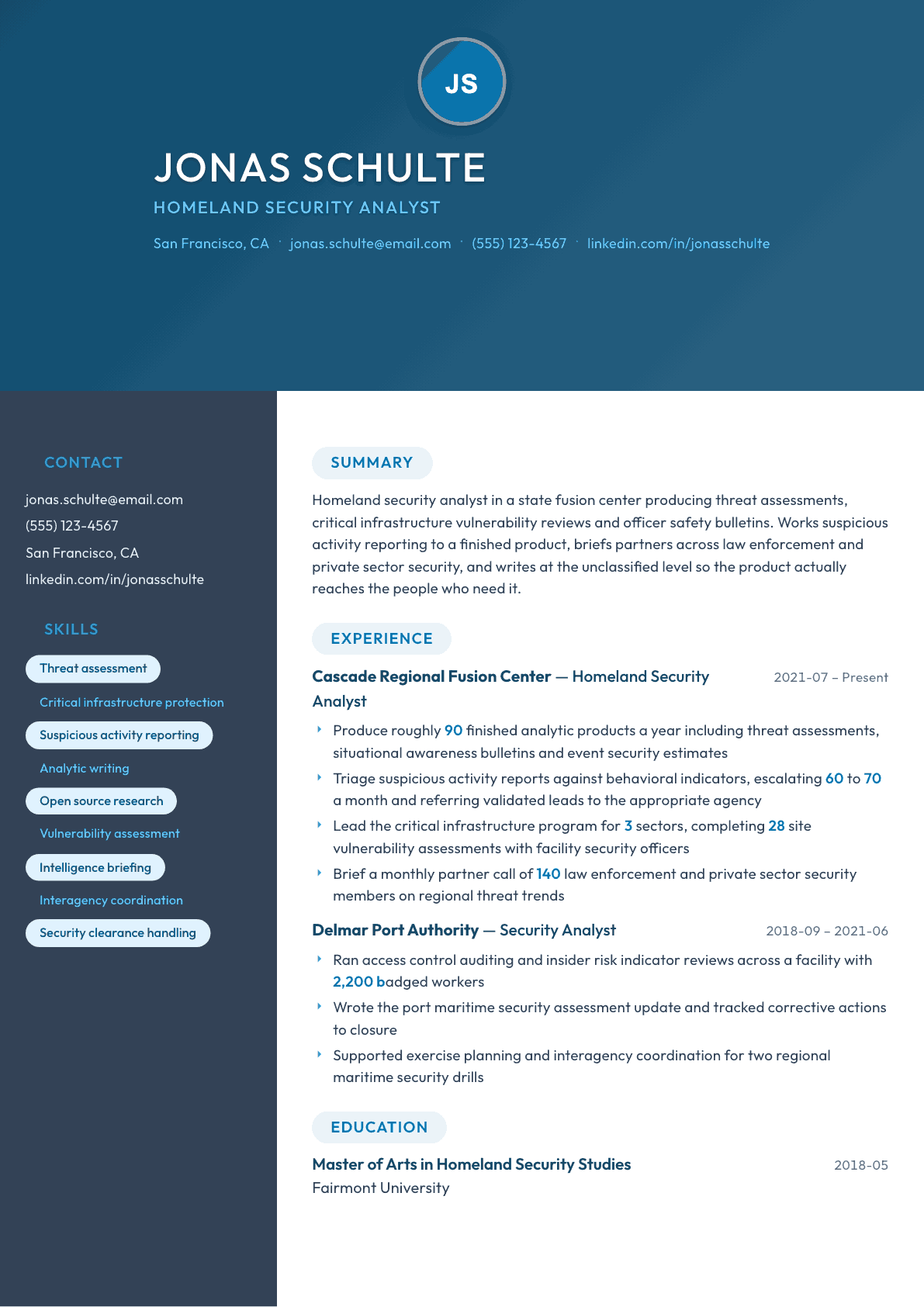
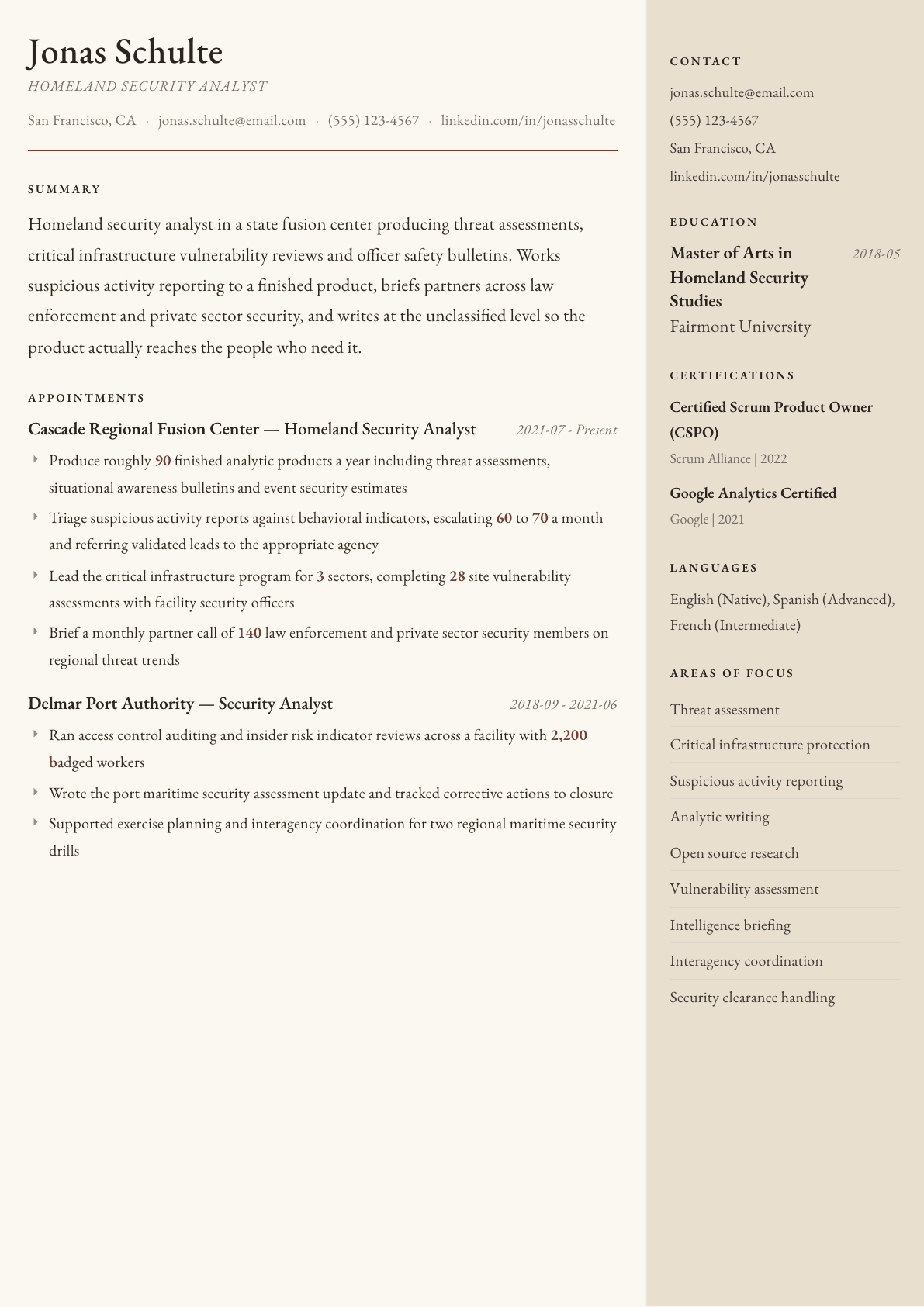
The same homeland security analyst content laid out in three CVBooster templates, so you can see what the finished document looks like before you write a word.
Example Homeland Security Analyst summary
Homeland security analyst with seven years in fusion center and port security roles, producing threat assessments, situational awareness bulletins and critical infrastructure vulnerability reviews. Triages suspicious activity reporting against behavioral indicators, briefs law enforcement and private sector partners monthly, and writes to analytic tradecraft standards at the unclassified level. Holds a current clearance and a Master of Arts in Homeland Security Studies.
Skills to list on a Homeland Security Analyst resume
- Strategic and tactical threat assessment
- Critical infrastructure vulnerability assessment
- Suspicious activity report triage
- Analytic tradecraft and structured techniques
- Open source intelligence research
- Link and pattern analysis
- Geospatial analysis
- Analytic writing and product review
- Verbal briefing and presentation
- Fusion center liaison work
- Information sharing policy and privacy review
- Special event security planning
- Insider risk indicators
- Classified material handling
- Interagency and private sector partnership
What actually gets this resume read
- Describe your work at the unclassified level and say so, because a panel cannot verify anything you cannot share.
- State your clearance level and its status, including the date of your last investigation or reinvestigation.
- Count your finished products by type, since analytic output is the measure everyone in this field uses.
- Name the analytic tradecraft standards you write to and how your products are reviewed before release.
- Show the customers you serve: patrol officers, executives, facility security officers or private sector partners.
- Include infrastructure sectors by name, because assignments are organized around the sector list.
How to write a homeland security analyst resume
Hiring a homeland security analyst is an exercise in reading a page that deliberately withholds its best material. The candidate cannot describe most of what she has produced, and the panel knows it. So the panel reads for structure instead: what kinds of products you write, who consumes them, how your work is reviewed, and whether you can be trusted with information you are not allowed to discuss in an interview.
The applicants who struggle either say too little, leaving a page of vague duty statements that could belong to any office, or too much, describing sources and methods that should never have appeared in an application. Both outcomes come from the same mistake: not deciding in advance what the unclassified version of your career actually looks like.
This guide covers how to build that unclassified version, what analytic output to count, how to present clearances and critical infrastructure work, summaries for three career stages, before and after bullets, and the questions analysts ask when they move between fusion centers, federal agencies and private sector security.
Format: unclassified, plainly labeled, and structured for a federal reader
Reverse chronological. Federal and state applications tolerate longer resumes than the private sector, so do not compress a substantive career onto one page if it costs you the detail a rating panel needs. What matters far more than length is that every claim can be discussed openly at the unclassified level.
Put a short line stating the resume is unclassified and has been reviewed for release if that is true for your agency. It signals awareness of the boundary you are working inside, and it saves a panel from wondering whether you understand it. Keep the whole document at that level, including project names, program codes and partner identities.
- Clearance line: level, granting decision, and the date of the most recent investigation or reinvestigation.
- Product line: the finished product types you write and the customers who receive them.
- Each position names the organization type, the mission set and the geographic or sector account you covered.
- Anyone with a military background translates the billet into the analytic function it actually performed.
Summary: mission set, product types, customers, clearance status
Four lines. Name the environment you work in, the mission set you cover, the product types you produce, and the audience that reads them. Then close with your clearance status. A panel screening a stack of applications is filtering on exactly those five facts, and burying any of them costs you the read.
Say who your customers are. Writing for patrol officers is a different craft from writing for a state executive, a private sector facility security officer or a federal partner. The vocabulary, the length and the confidence language all shift, and an analyst who names her audience is telling a hiring panel that she understands that.
Experience: analytic output, triage volume, and infrastructure work
Open each job with the organization, its mission and the account you held. Then count your output. Finished analytic products a year, broken down by type: threat assessments, situational awareness bulletins, officer safety products, special event security estimates, sector risk summaries. Analytic production is measurable, and this is the profession that measures it.
Suspicious activity reporting deserves a bullet of its own if you have done it. Say how many you triage in a period, what indicator framework you assess against, how many you escalate, and where validated leads go. That describes a defensible process rather than a claim of vigilance, and privacy and civil liberties review is part of it, so say that you work inside that review.
Critical infrastructure work is the other half of many homeland security roles. Name the sectors you support, the number of site vulnerability assessments you have completed, and who you did them with, because these assessments are done alongside facility security officers rather than to them. If you built or maintain a sector partnership program, describe the membership and the briefing rhythm.
Tradecraft, review and how you handle uncertainty
A hiring panel wants to know how you think, not only what you produced. Name the structured analytic techniques you use, say how confidence levels and source characterization appear in your products, and describe the review chain a product passes through before release. An analyst who mentions a peer review step and a supervisory release authority is describing a real shop.
Show one habit that separates good analysts: writing what you do not know. A product that states an intelligence gap, flags a low confidence judgment and identifies what collection would resolve it is more useful to a customer than one that projects certainty. Put that on the page as a practice rather than a personality trait.
Clearances, training and the keywords a homeland security posting screens on
Give your clearance level, whether it is current, and when your last investigation closed. If it has lapsed, say so with the date rather than leaving a panel to guess, since a reinstatement is often quicker than a new investigation and a hiring office will do that math for you.
The screening vocabulary is stable: threat assessment, critical infrastructure, vulnerability assessment, suspicious activity reporting, analytic tradecraft, open source research, information sharing, fusion center, special event planning, insider risk, indicators and warning, and interagency coordination. Use the posting's exact terms once each. Add a tools line covering your analytic platforms, mapping software and research databases at whatever level of specificity you are cleared to state.
Homeland Security Analyst resume summary examples
First analyst position
Homeland security graduate with an internship supporting a state fusion center, contributing open source research to twelve situational awareness products and building a special event indicator checklist. Trained in structured analytic techniques and privacy review, cleared at the secret level, and seeking an entry analyst role in a regional information sharing environment.
Fusion center analyst
Homeland security analyst producing roughly 90 finished products a year including threat assessments, situational awareness bulletins and event security estimates. Triages 60 to 70 suspicious activity reports a month against behavioral indicators, leads critical infrastructure work across three sectors, and briefs a monthly partner call of 140 members.
Senior analyst and program lead
Senior homeland security analyst leading the critical infrastructure program for a regional center, supervising four analysts and owning the analytic review chain before release. Has completed more than one hundred site vulnerability assessments with facility security officers, and rebuilt the special event risk methodology used across the region.
Work experience bullets: before and after
Before: Prepared intelligence products for law enforcement partners.
After: Produced roughly 90 finished analytic products a year including threat assessments, situational awareness bulletins and special event security estimates for law enforcement and private sector partners.
Counting output by product type is how this profession measures analysts, and it stays entirely unclassified.
Before: Reviewed suspicious activity reports submitted to the center.
After: Triaged 60 to 70 suspicious activity reports a month against behavioral indicators under privacy and civil liberties review, escalating validated leads to the responsible agency with a documented rationale.
Volume, the indicator framework and the privacy review describe a process a panel can trust rather than instinct.
Before: Conducted assessments of critical infrastructure sites.
After: Completed 28 site vulnerability assessments across three critical infrastructure sectors alongside facility security officers, delivering prioritized mitigation options to each site owner.
Sector, count and the collaborative framing show how these assessments actually get done in the field.
Before: Briefed partners on regional threats.
After: Briefed a monthly partner call of 140 law enforcement and private sector security members on regional threat trends, stating confidence levels and naming the intelligence gaps behind each judgment.
Audience size and explicit confidence language demonstrate tradecraft, not just the act of presenting.
Before: Assisted with security for large public events.
After: Built the pre-event threat and risk estimate for four large public events, coordinating with venue security, fire and emergency management on the indicator set monitored during each operational period.
Naming the product, the partners and the monitoring period shows planning work rather than presence on site.
Hard skills
- Strategic and tactical threat assessment
- Critical infrastructure vulnerability assessment
- Suspicious activity report triage
- Structured analytic techniques
- Analytic writing and product review
- Open source intelligence research
- Link and pattern analysis
- Geospatial analysis and mapping
- Indicators and warning development
- Special event risk estimation
- Information sharing and privacy review
- Insider risk indicator analysis
- Classified material handling and marking
Soft skills
- Writing for a customer who has ninety seconds
- Saying what is not known without losing credibility
- Working partner relationships across agency boundaries
- Discretion that holds outside the workplace
- Accepting hard peer review on a draft
Certifications worth listing
- Certified Protection Professional (CPP) (ASIS International)
- Physical Security Professional (PSP) (ASIS International)
- Certified Information Systems Security Professional (CISSP) (ISC2)
Mistakes that cost homeland security analyst candidates the interview
- Putting program names, partner identities or method detail on a page that will be emailed and forwarded freely.
- Writing duty statements with no product count, which leaves a panel unable to compare you with any other analyst.
- Omitting the clearance status and investigation date, the two facts a hiring office needs before it can plan a start.
- Treating critical infrastructure assessments as inspections rather than work done jointly with site security staff.
- Claiming analytic rigor without naming a single technique, confidence convention or review step behind your products.
- Leaving military terminology untranslated so a civilian panel cannot tell what analytic function the billet performed.
Homeland Security Analyst resume questions
How much can I say about classified work on a resume?
Describe the function, the product type and the customer at the unclassified level, and stop there. Never name programs, sources, methods or partner operations. If you are unsure whether a detail is releasable, leave it out and offer to discuss your background in a cleared setting.
Should I list my clearance if it has lapsed?
Yes. State the level, that it is currently inactive, and the date your last investigation closed. Hiring offices treat a recent lapsed clearance very differently from no clearance at all, because reinstatement is usually faster than starting a new investigation.
How do I move from a fusion center to a federal analyst role?
Emphasize the parts federal offices value: analytic production volume, tradecraft standards, information sharing across agencies and writing for varied customers. Then mirror the announcement's language exactly, since federal rating panels score against the stated qualifications rather than your summary.
Does private sector security experience count for these jobs?
It counts when you present it in mission terms. Access control auditing, insider risk indicator work, facility risk assessment and partnership with law enforcement all map onto homeland security analysis, and knowing how a private site actually operates is a real advantage in infrastructure work.
What kind of writing sample should I prepare?
Prepare a fully unclassified sample you wrote yourself, ideally a short assessment with a clear judgment, stated confidence and an identified gap. Panels often ask for one, and producing a purpose-built sample beats trying to sanitize a real product under time pressure.
Related resume examples
- Intelligence Analyst Resume example
- Intelligence Officer Resume example
- Emergency Management Coordinator Resume example
- Security Analyst Resume example
- Policy Analyst Resume example
- Policy Advisor Resume example