Intelligence Officer Resume Examples: what gets the call
Write an Intelligence Officer Resume Without Crossing a Line
By Mustafa Tarabya, founder of CVBooster · Published · Updated
Intelligence officer resume example plus keywords and a guide to writing collection, analysis and leadership experience at the unclassified level.
Sample resumes for a intelligence officer
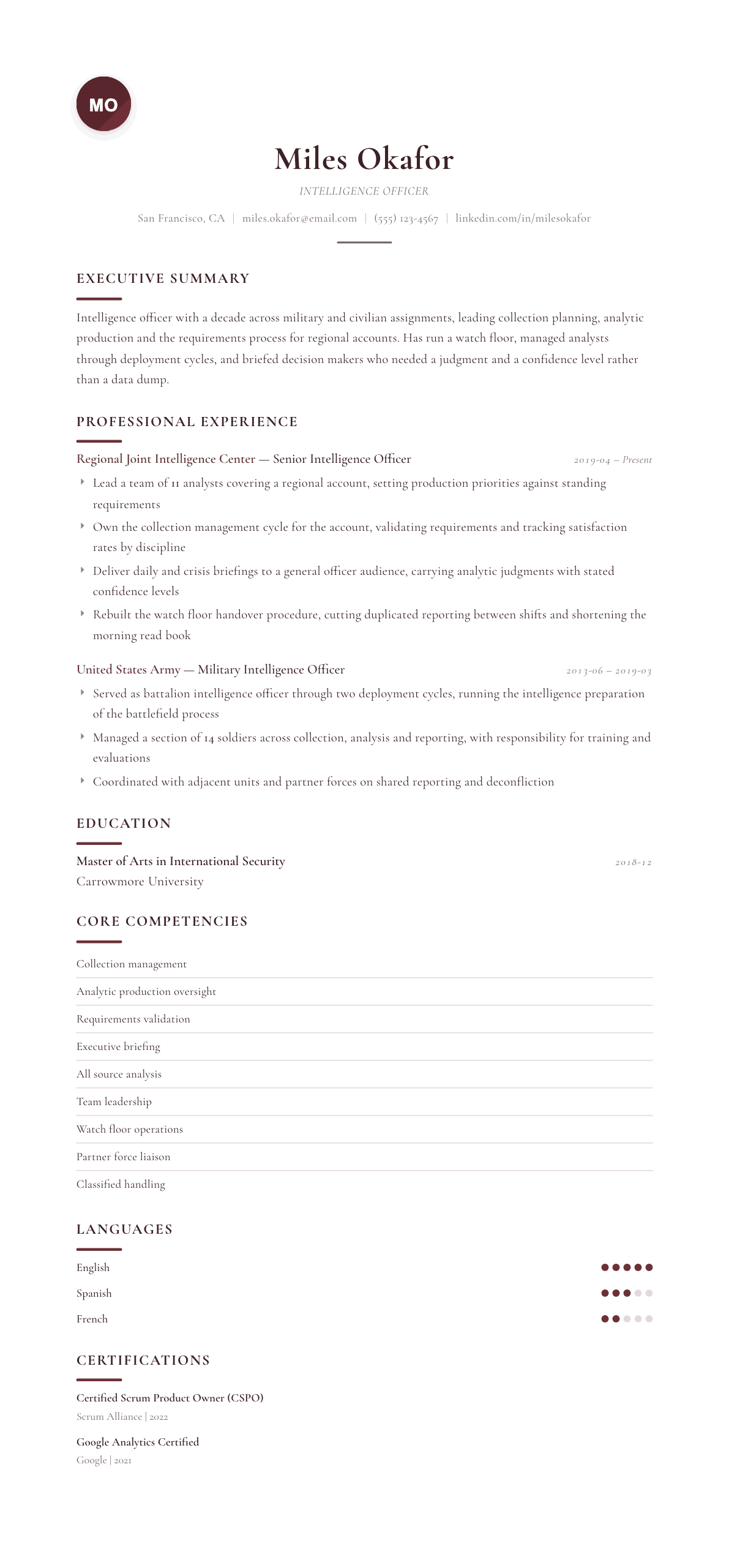
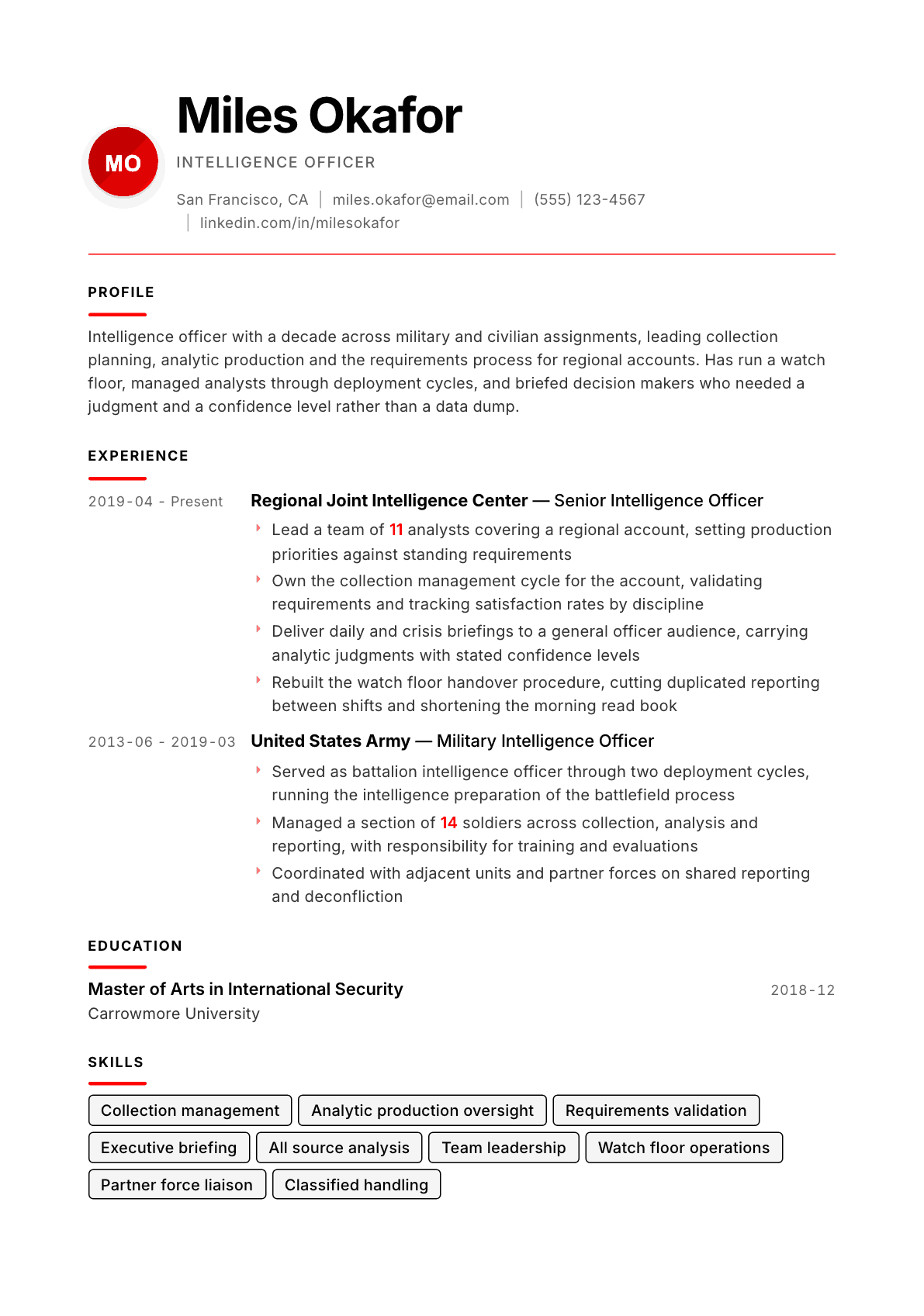
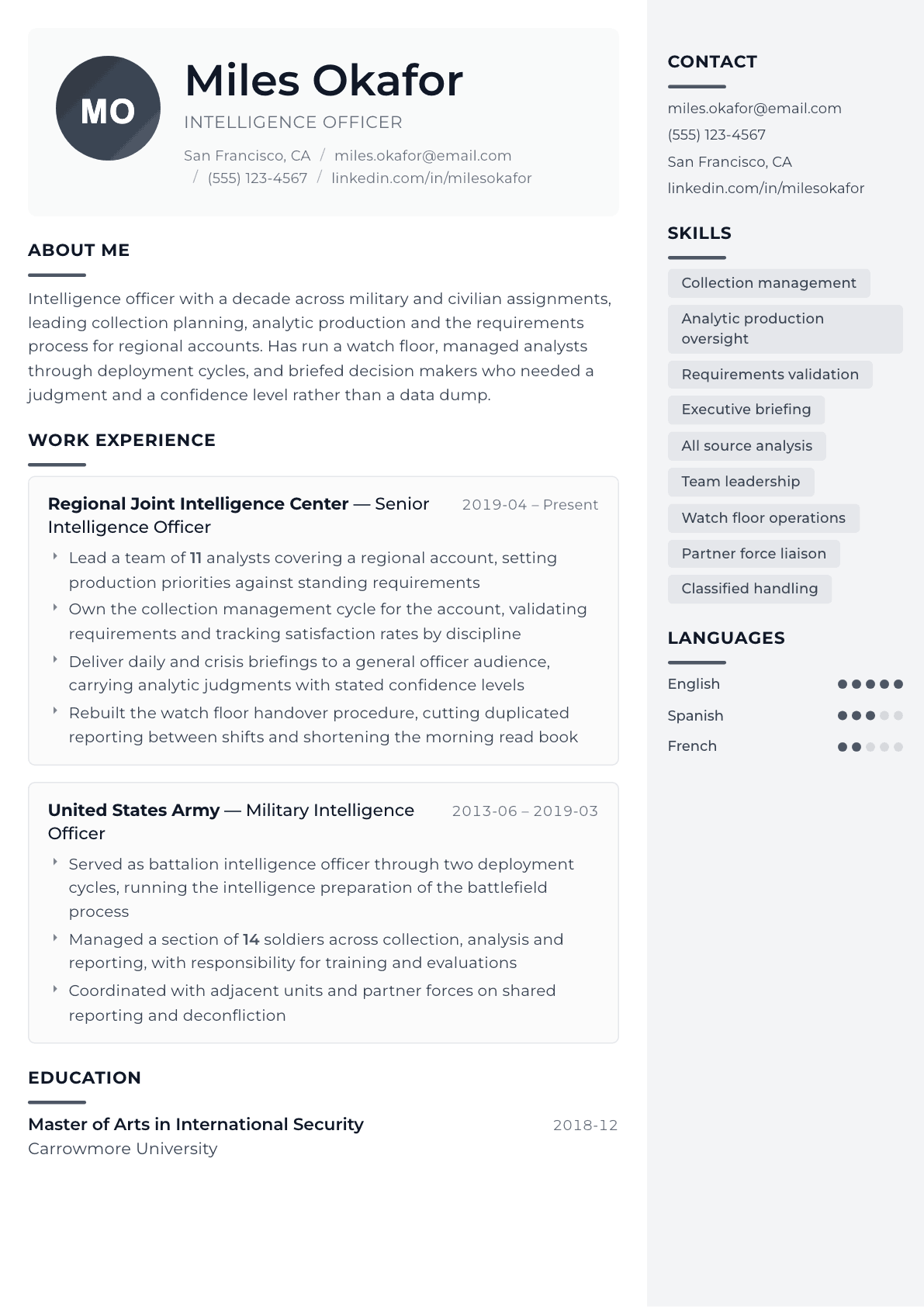
The same intelligence officer content laid out in three CVBooster templates, so you can see what the finished document looks like before you write a word.
Example Intelligence Officer summary
Intelligence officer with ten years across military and joint civilian assignments, leading analytic teams, owning collection management for a regional account and briefing senior decision makers with stated confidence levels. Has run a watch floor through crisis periods, rebuilt shift handover to cut duplicated reporting, and developed analysts through deployment cycles. Holds a current clearance and a Master of Arts in International Security.
Skills to list on a Intelligence Officer resume
- All source intelligence analysis
- Collection management and requirements
- Analytic production management
- Intelligence preparation of the operational environment
- Structured analytic techniques
- Confidence and source characterization
- Executive and command briefing
- Watch floor and crisis operations
- Team leadership and mentoring
- Partner force and interagency liaison
- Targeting support
- Counterintelligence awareness
- Classified information handling
- Report writing and dissemination
- Security clearance sponsorship processes
What actually gets this resume read
- Write everything at the unclassified level and say the page is unclassified, since a reviewer will check.
- Give your clearance, the granting decision and the date of your most recent investigation or polygraph.
- Translate military billet titles into plain function words so a civilian panel can follow the responsibility.
- Show leadership by span: analysts supervised, accounts owned, and the production volume your team carried.
- Name the disciplines you have managed collection against and how you measured requirement satisfaction.
- Describe your briefing audience by level, because briefing a general officer is different work from a shift brief.
How to write a intelligence officer resume
An intelligence officer is hired for judgment and for the ability to run other people who exercise it. The analyst is measured on products. The officer is measured on whether an account stayed covered, whether requirements were validated and satisfied, whether the watch floor handed over cleanly, and whether the decision maker got a usable judgment instead of a briefing full of raw reporting.
The resume problem is that almost none of that can be described in detail on paper. What can be described is the shape: how many people you led, which accounts you owned, what the production cycle looked like, who you briefed and at what level, and how you handled the requirements process. Officers who write that shape well get interviews. Officers who write duty statements copied from a position description do not.
This guide covers the unclassified version of an intelligence career, how to translate a military billet for a civilian panel, summaries across three stages, before and after bullets, and the questions officers ask when they leave uniform or move between the community and the private sector.
Format: unclassified throughout, and long enough to carry the detail
Reverse chronological. Federal applications accept a longer document than a private sector resume, and cutting a fifteen year career to one page removes exactly the detail a rating panel scores. Two pages is normal, three is acceptable for a long government career with many assignments.
Decide the unclassified line before you write a word, then hold it everywhere. No program names, no partner service identities, no target descriptions, no method detail. Describe function, scale and audience. If your organization requires prepublication or security review of application material, do it and say the document has been reviewed.
- Clearance line: level, current status, and the date of the last investigation or polygraph.
- Leadership line: analysts supervised, accounts owned, and the production tempo your team sustained.
- Each assignment names the organization type, the mission, the account and the customer you served.
- Officers leaving uniform translate every billet title into the plain function a civilian manager will recognize.
Summary: level, accounts, leadership span, briefing audience
Four lines. Years in the discipline, the accounts or mission sets you have owned, the size of the teams you have led, and the seniority of the audience you brief. That last one carries real weight, because briefing a command group is a distinct skill from writing for a distribution list and hiring panels treat it that way.
If you are leaving the military, use the summary to set the translation. Say intelligence officer, name the function in civilian terms, and give the span of responsibility in people and accounts. A panel that has to decode rank structure and unit designations before it can judge your experience will usually stop decoding.
Experience: leadership span, collection management, production tempo
Open each assignment with the organization type, the mission set and the account. Then write three things a hiring panel can actually use. First, the leadership span: how many analysts, across what specialties, and what you were accountable for in their development and evaluation. Second, the production: what your team produced, at what tempo, and against which standing requirements. Third, the customer: who read it and what decisions it supported.
Collection management is where officers separate themselves from senior analysts. Say that you owned the requirements cycle for an account, how requirements were validated and prioritized, how you tracked satisfaction across disciplines, and what you did when a requirement went persistently unfilled. That is management work with a measurable output and it stays comfortably unclassified.
Watch floor and crisis operations belong on the page as process improvements rather than war stories. Rebuilding a shift handover so reporting is not duplicated, shortening a morning read book, or restructuring a crisis cell so the same judgment is not briefed twice all describe an officer who improved an organization rather than one who survived a rotation in it.
Translating a military career for a civilian panel
Every billet has a plain function underneath it. A battalion intelligence officer ran an analytic and collection section supporting a commander with a defined area of responsibility. Say it that way, then give the section size, the reporting tempo and the decisions your work supported. Keep the unit type if it helps convey scale, and drop the acronyms that only serve as tribal identification.
Do not discard the leadership content while translating. Managing fourteen soldiers through training, evaluations, deployment preparation and a rotation is personnel leadership at a level many civilian applicants have never held. Present it as personnel management with numbers attached, because a civilian hiring manager will not extract it from a billet title on her own.
Credentials and the keywords a community posting screens on
The recurring vocabulary is narrow and worth mirroring exactly: all source analysis, collection management, intelligence requirements, analytic production, structured analytic techniques, indications and warning, targeting support, counterintelligence awareness, interagency liaison, watch operations and executive briefing. Use each once in the place where the work is shown.
Add education and formal schooling in one block: degrees, the intelligence schools you completed, instructor qualifications you hold, and any language capability with the proficiency scale you were tested on. Language ratings are checked, so give the scale and the date rather than a self assessment.
Intelligence Officer resume summary examples
First officer assignment
Newly commissioned intelligence officer with a completed basic course and an initial assignment supporting a battalion staff, running the intelligence preparation process and supervising a section of six. Cleared at the top secret level with a current investigation, and seeking a follow-on analytic or collection management assignment.
Section leader
Intelligence officer with seven years across two operational assignments, leading a section of fourteen through collection, analysis and reporting across two deployment cycles. Owns the requirements process for a regional account, briefs a command group daily, and holds a current clearance with a Master of Arts in International Security.
Senior officer leading a team
Senior intelligence officer leading eleven analysts on a regional account, setting production priorities against standing requirements and owning the collection management cycle. Briefs a general officer audience with stated confidence levels, rebuilt the watch floor handover procedure, and has developed four analysts into team lead positions.
Work experience bullets: before and after
Before: Supervised a team of intelligence analysts.
After: Led a team of eleven analysts covering a regional account, setting production priorities against standing requirements and owning training, evaluation and development for every member.
Team size, account ownership and the personnel responsibilities make the leadership span concrete for a civilian panel.
Before: Managed collection requirements for the organization.
After: Owned the collection management cycle for a regional account, validating and prioritizing requirements and tracking satisfaction rates by discipline to identify persistent gaps.
The cycle, the validation step and the tracking measure describe management work rather than an inbox.
Before: Briefed leadership on intelligence matters.
After: Delivered daily and crisis briefings to a general officer audience, carrying analytic judgments with stated confidence levels and naming the gaps behind each one.
Audience seniority and explicit confidence language show briefing craft instead of the fact of presenting.
Before: Improved watch floor procedures.
After: Rebuilt the watch floor handover procedure so shifts stopped duplicating reporting, shortening the morning read book and freeing analyst hours for account work.
A named problem, a specific change and the recovered capacity turn a vague improvement into an outcome.
Before: Served as battalion intelligence officer.
After: Ran the intelligence section supporting a battalion staff through two deployment cycles, directing the preparation of the operational environment and managing fourteen personnel across collection, analysis and reporting.
Translating the billet into function, tempo and headcount lets a civilian manager judge the responsibility held.
Hard skills
- All source intelligence analysis
- Collection management and requirements validation
- Analytic production management
- Intelligence preparation of the operational environment
- Structured analytic techniques
- Source characterization and confidence conventions
- Executive and command briefing
- Watch floor and crisis operations
- Targeting support
- Counterintelligence awareness
- Interagency and partner force liaison
- Report writing and dissemination policy
- Classified information handling and marking
Soft skills
- Developing analysts into independent judgment
- Delivering an unwelcome assessment to a commander
- Holding a team steady through long crisis periods
- Deciding what not to brief
- Discretion that outlasts the assignment
Certifications worth listing
- Certified Criminal Intelligence Analyst (CCIA) (International Association of Law Enforcement Intelligence Analysts)
- GIAC Open Source Intelligence (GOSI) (Global Information Assurance Certification)
Mistakes that cost intelligence officer candidates the interview
- Leaving unit designations, billet titles and acronyms untranslated so a civilian panel cannot see the function underneath.
- Writing production without a tempo or an account, which reduces a leadership career to a list of generic duties.
- Skipping collection management detail, the clearest evidence that you managed a cycle rather than consumed its output.
- Describing briefings without naming the audience level, when audience seniority is the whole measure of briefing craft.
- Including any program name, partner identity or method detail on a document that will circulate through email.
- Dropping personnel leadership while translating a military record, discarding the strongest management evidence on the page.
Intelligence Officer resume questions
How do I write an intelligence officer resume for a civilian employer?
Translate every billet into function, scale and audience, then lead with leadership span and production tempo. Civilian managers hire for people management and decision support, so present the account ownership and the team development rather than the unit lineage.
What can I safely say about my assignments?
Function, organization type, team size, product types and customer level are almost always releasable. Programs, targets, partner services, methods and specific operations are not. When a detail sits near the line, leave it out and describe the responsibility instead of the activity.
Should I include my language capability?
Yes, with the testing scale and the date of your last evaluation. Self reported fluency carries little weight in this community because formal ratings exist, and an outdated score presented as current is the kind of error a panel remembers.
How long should the resume be for a federal announcement?
Long enough to address every stated qualification with evidence, which usually means two or three pages. Federal rating panels score against the announcement rather than rewarding brevity, so cutting detail to fit one page tends to cost you points.
Is a graduate degree necessary to advance as an intelligence officer?
It is not universally required, but it appears in many senior announcements and it helps when you move between the military, civilian agencies and the private sector. Regional expertise, a language or a quantitative background usually adds more than a general management degree.
Related resume examples
- Intelligence Analyst Resume example
- Homeland Security Analyst Resume example
- Diplomat Resume example
- Foreign Service Officer Resume example
- Public Information Officer Resume example
- Government Contractor Resume example