Intelligence Analyst Resume Examples: what gets the call
Advance Your Career with an Intelligence Analyst Resume
By Mustafa Tarabya, founder of CVBooster · Published · Updated
Create an intelligence analyst resume that demonstrates your analytical tradecraft, all-source analysis capabilities, and briefing skills.
Sample resumes for a intelligence analyst
The same intelligence analyst content laid out in three CVBooster templates, so you can see what the finished document looks like before you write a word.
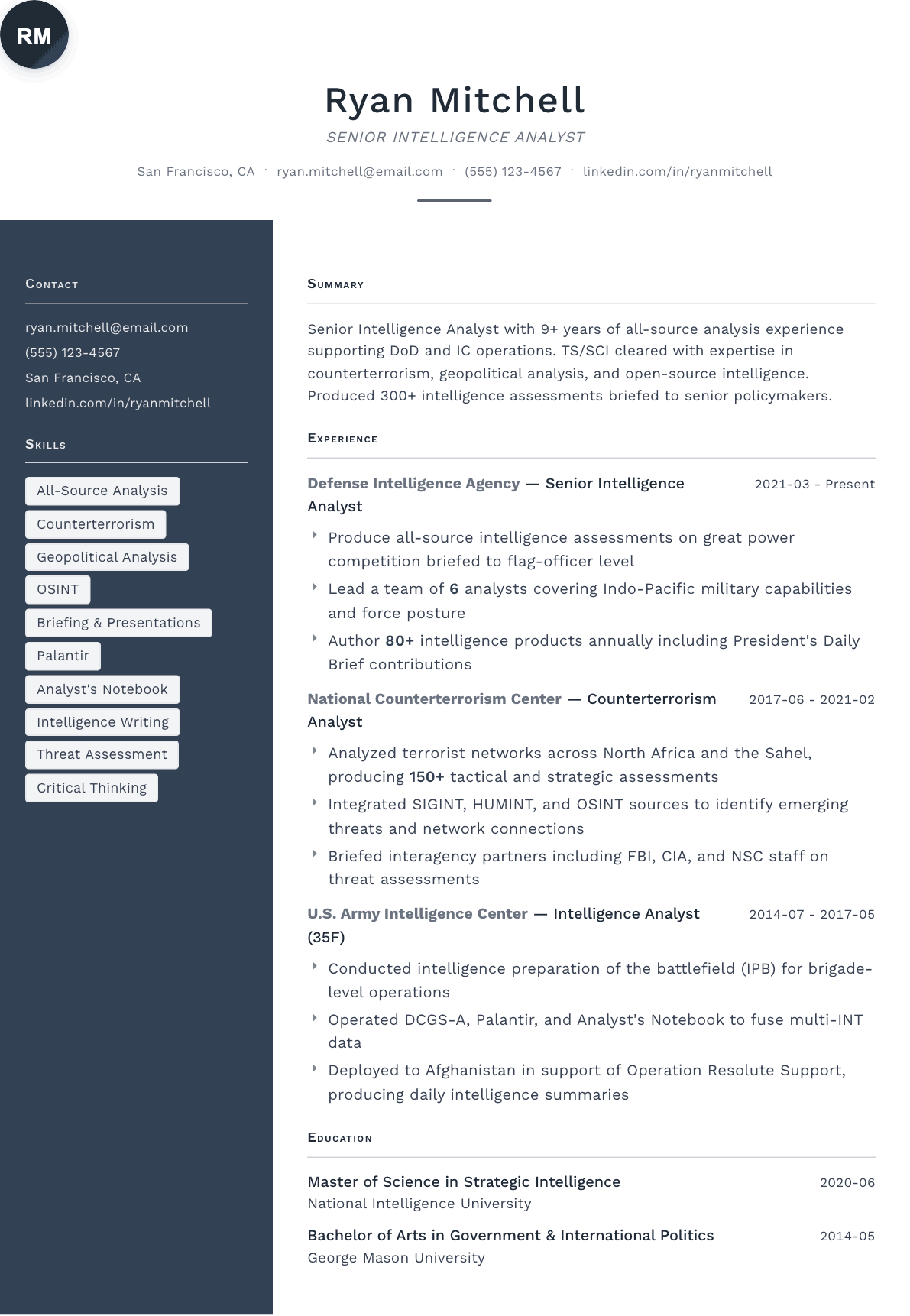
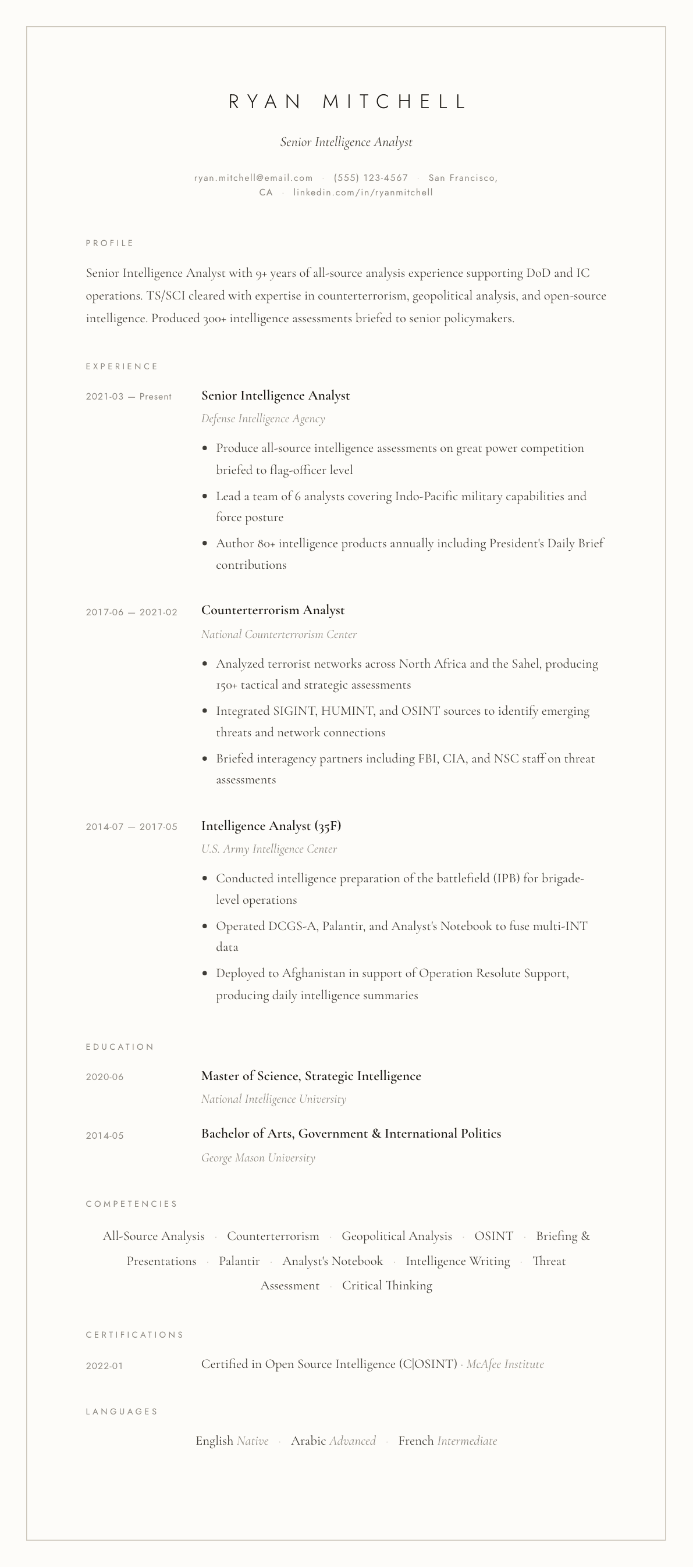
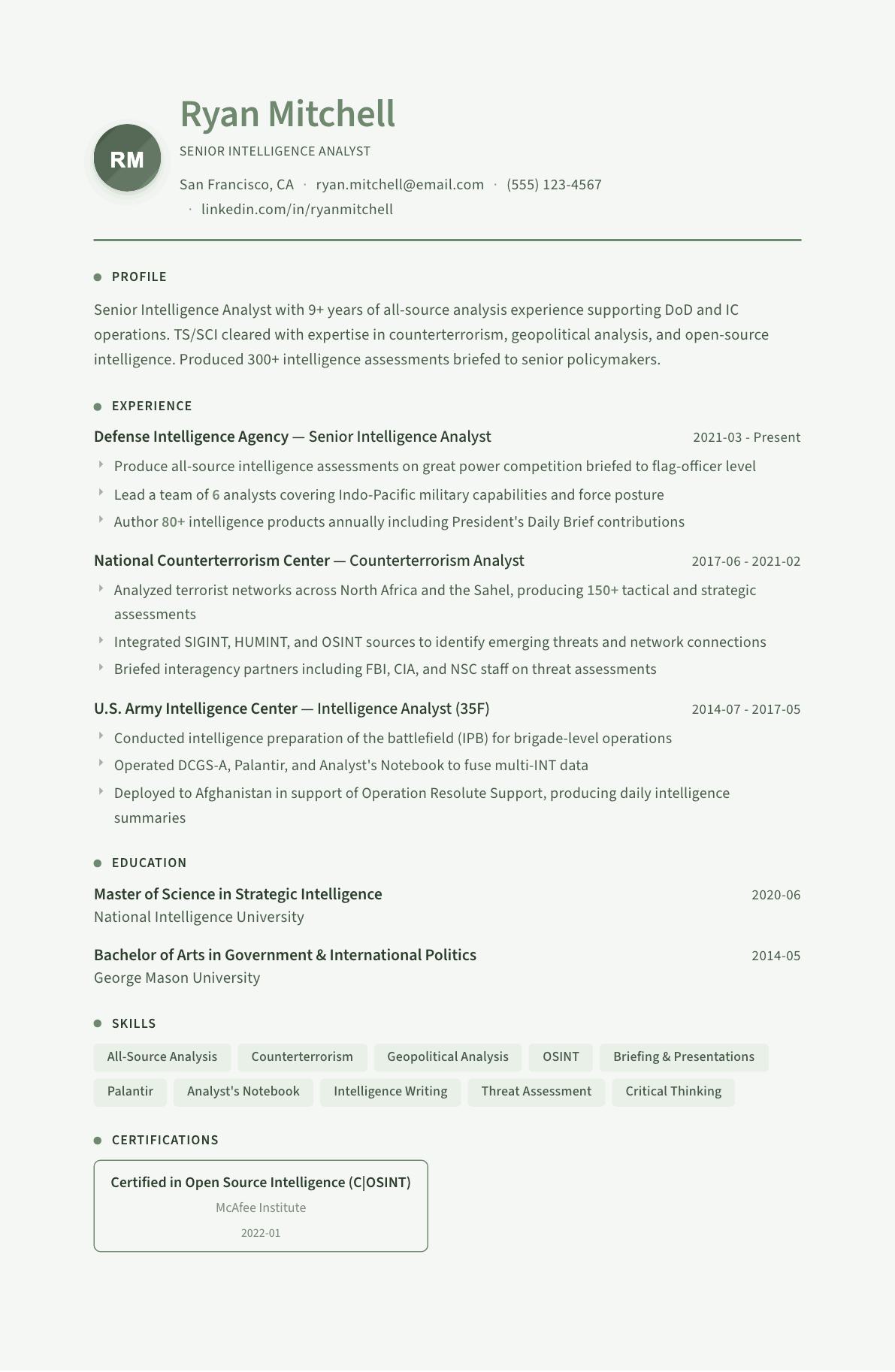
Example Intelligence Analyst summary
TS/SCI-cleared Senior Intelligence Analyst with 9 years of all-source analysis experience at DIA and NCTC. Produced 300+ intelligence assessments briefed to senior policymakers and flag officers. Seeking a senior analyst or team lead role in the intelligence community or defense sector.
Skills to list on a Intelligence Analyst resume
- All-Source Intelligence
- Counterterrorism Analysis
- Geopolitical Analysis
- OSINT Collection
- Threat Assessment
- Intelligence Writing
- Briefing Senior Officials
- Palantir / i2 Analyst's Notebook
- Structured Analytical Techniques
- Critical Thinking
- SIGINT Integration
- HUMINT Coordination
- Foreign Language
- Link Analysis
What actually gets this resume read
- State your clearance level (TS/SCI, with or without poly). This is the first thing employers check.
- Highlight your analytical tradecraft: structured analytical techniques, ACH, red teaming, devil's advocacy.
- Quantify output: number of assessments produced, briefings delivered, or policymakers supported.
- Specify intelligence disciplines: all-source, SIGINT, HUMINT, GEOINT, OSINT, MASINT.
- Include tools and platforms: Palantir, Analyst's Notebook, DCGS, TAC, M3, Voltron.
- Mention foreign language proficiency with DLPT scores if applicable.
How to write a intelligence analyst resume
An intelligence analyst resume gets sorted on one field before anything else is read: clearance. A contractor recruiter filling a cleared requirement checks the level, whether it is active, when the last investigation closed and whether a polygraph is included. If that block is missing or vague, the resume goes to the bottom of a stack that is measured in hundreds.
Past that filter, the reader changes. A branch chief or a senior analyst wants to know what you produce and how you think. Which discipline you work in, which accounts you have covered, whether you write finished assessments or support targeting, whether policymakers or operators are your customer, and whether you can apply structured analytic techniques rather than assembling a summary of reporting.
This guide covers how to lay out clearance and discipline so a cleared recruiter can act on it, how to describe analytic production without touching classified content, how to translate a military intelligence background for a civilian or corporate reader, and the questions analysts ask when they move between the government, contracting and private sector threat intelligence.
Format: clearance block first, then discipline and accounts
Two pages for most analysts, longer for a federal announcement that requires the extended format. Put a clearance and eligibility block directly under your name: level, current status, the date of the most recent investigation or periodic reinvestigation, whether counterintelligence or full scope polygraph is included, and whether you hold SCI access.
Follow it with a short profile of discipline and accounts. All source, signals, geospatial, human intelligence, open source, measurement and signature intelligence, counterterrorism, counterintelligence, cyber threat. Then the accounts or regions you have covered and the customer you served. Recruiters match on those fields directly.
- Header: name, city and state, phone, email, clearance level with status.
- Order: clearance, summary, technical and analytic skills, professional experience, education, training and certifications, languages.
- Add a production line for each role: assessment types written, briefings delivered, and the customer they went to.
Summary: discipline, account, customer, product
Four elements in three lines. The discipline you work in, the account or target set, the customer you support, and the products you write. An analyst producing daily current intelligence for a combatant command and one writing long form strategic assessments for a policy audience share a title and almost nothing else about the working day.
If you are transitioning out of uniform, name the crossing and translate the unit language immediately. A military occupational specialty code means nothing to a corporate reader. Say all source analyst supporting brigade level targeting rather than the code, and keep the deployment record because sustained work under operational pressure is a genuine differentiator.
Experience: production volume, tradecraft, and who consumed it
Give production in countable terms without disclosing content. Number of finished assessments authored or coordinated, current intelligence items contributed, briefings delivered and to what level of audience, requests for information answered, target packages supported, and any product that was picked up into a serialized publication line.
Then show the tradecraft. Analysis of competing hypotheses, key assumptions checks, red team and devil advocacy work, indicators and warning frameworks, source evaluation and confidence language, and structured techniques applied to a specific problem. Naming the technique and the problem it was applied to is what distinguishes an analyst from a reporter of collection.
Coordination is undervalued on most resumes. Say when you coordinated a product across agencies, negotiated a dissent footnote, defended a judgment in a review board, or reconciled conflicting reporting between disciplines. Senior analysts read that as readiness for a lead position.
Tools, data and languages: name the platforms
Cleared recruiters filter on tool names because access and training take time. Name the analytic platforms, link analysis and visualization tools, geospatial software, database query environments and any scripting you use for data handling. If your work involved large data sets, say what you did with them: entity resolution, pattern of life analysis, network mapping, anomaly detection.
Language ability should carry a tested score where you have one, with the listening and reading elements separate, and the test date. An untested but working language should be described functionally rather than given a number. Language plus a regional account is one of the strongest combinations on a cleared resume.
Writing for the private sector and the keywords that carry over
Corporate threat intelligence, financial crime, insider risk and geopolitical advisory all hire from this community, but the vocabulary shifts. Finished intelligence becomes an intelligence report to a security operations customer, indicators and warning becomes early warning for business continuity, and target development becomes threat actor profiling. Keep the tradecraft language, drop the agency shorthand.
Terms that recur across both worlds include all source analysis, threat assessment, structured analytic techniques, intelligence requirements, collection management, source validation, analytic writing, briefing, indications and warning, and dissemination. Use the wording of the posting you are answering, and never carry a classified detail across to a commercial application.
Intelligence Analyst resume summary examples
Junior analyst
All source analyst with two years supporting a regional account, holding an active Top Secret clearance with SCI access and a counterintelligence polygraph. Authored 60 current intelligence items and answered 90 requests for information. Trained in analysis of competing hypotheses and structured analytic techniques.
Five years in
Counterterrorism analyst with five years across a national account and a deployed billet, producing finished assessments for a policy customer and target support for operational partners. Active Top Secret with SCI. Coordinated 24 assessments across three agencies and delivered weekly briefings to senior officials.
Senior or lead analyst
Senior all source analyst with twelve years across defense and interagency assignments, currently leading a team of six on a strategic account. Owns the analytic line of a serialized publication, mentors junior analysts on tradecraft and has defended judgments before a review board. Top Secret with SCI and full scope polygraph.
Work experience bullets: before and after
Before: Produced intelligence reports on assigned topics.
After: Authored 38 finished assessments and 200 current intelligence items on a regional account, coordinated across two partner agencies and disseminated to a policy and operational customer set.
Counted production plus the coordination path and the customer show scale and standing rather than a job description.
Before: Used analytical techniques to evaluate information.
After: Applied analysis of competing hypotheses and a key assumptions check to a contested attribution question, which surfaced a collection gap and changed the confidence language in the published judgment.
Naming the technique, the problem and the consequence proves tradecraft instead of listing it as a familiar term.
Before: Briefed leadership on intelligence matters.
After: Delivered daily current intelligence briefings to a two star staff and prepared read ahead materials for three principal level engagements, fielding follow up questions without support.
Audience level and the ability to answer unaided are how briefing skill is actually judged in this field.
Before: Worked with large data sets and analysis tools.
After: Built network diagrams from bulk reporting using a link analysis platform, resolved duplicate entities across two data sources and produced a pattern of life summary that supported an ongoing collection requirement.
The method and the downstream use turn tool familiarity into demonstrated analytic capability.
Before: Mentored junior analysts on the team.
After: Trained six junior analysts on analytic writing standards and confidence language, reviewed their drafts before coordination, and reduced the number of products returned for rework.
A specific training focus and a measurable effect show leadership rather than an informal helping role.
Hard skills
- All source intelligence analysis
- Structured analytic techniques
- Analytic writing and confidence language
- Indications and warning frameworks
- Threat assessment and actor profiling
- Collection management and requirements
- Source evaluation and validation
- Link and network analysis
- Geospatial analysis
- Open source research and tradecraft
- Briefing and read ahead preparation
- Interagency product coordination
- Foreign language exploitation
Soft skills
- Intellectual honesty about uncertainty
- Defending a judgment under challenge
- Discretion and information handling
- Deadline writing under pressure
- Collaboration across disciplines
- Mentoring on tradecraft
Certifications worth listing
- Intelligence Fundamentals Professional Certification (IFPC) (Defense Intelligence Agency)
- GIAC Cyber Threat Intelligence (GCTI) (Global Information Assurance Certification)
- CompTIA Security+ (CompTIA)
- Certified Threat Intelligence Analyst (CTIA) (EC-Council)
- Certified Fraud Examiner (CFE) (Association of Certified Fraud Examiners)
Mistakes that cost intelligence analyst candidates the interview
- Leaving clearance level, status and polygraph off the top, which stops a cleared recruiter from acting on the resume at all.
- Describing tasks rather than production, so a branch chief cannot tell whether you write assessments or summarize reporting.
- Listing structured analytic techniques as keywords with no example of applying one to a real problem.
- Carrying agency shorthand and program nicknames into a corporate application where the reader cannot decode them.
- Including any detail about sources, methods or classified content, which ends a candidacy and creates a reportable problem.
- Omitting the customer, when supporting a policy audience and supporting an operational one are different professional skills.
Intelligence Analyst resume questions
How should I list my security clearance on an intelligence analyst resume?
Put it directly under your name with the level, the current status, the date of the most recent investigation, and whether a counterintelligence or full scope polygraph is included. Note SCI access separately. Say if a clearance is inactive but within the reinstatement window.
How do I describe my work without disclosing classified information?
Describe function, volume, method and audience rather than content. You can say you authored finished assessments on a regional account for a policy customer using structured techniques, without naming targets, sources, collection systems or the substance of any judgment.
How do I transition from military intelligence to a civilian analyst job?
Strip the unit designators and occupational codes and write in functional terms. Keep the deployments, the production counts and the briefing audiences. Add civilian facing training or a recognized certification, since hiring managers outside defense often need a familiar reference point.
Is a foreign language worth listing if I am not fluent?
Yes when it is genuinely usable. Describe what you can do with it, such as reading regional press or exploiting documents with reference support, and give a tested score if you have one. Do not claim a proficiency level you could not demonstrate in a screening call.
What does a private company want from an intelligence analyst resume?
Business relevance. Show how your analysis protected an organization or informed a decision: threat actor profiling, early warning for operations in a volatile region, insider risk indicators, fraud typologies. Keep the tradecraft, and cut the acronyms a corporate security director will not recognize.
Related resume examples
- Diplomat Resume example
- Policy Analyst Resume example
- Public Affairs Specialist Resume example
- Homeland Security Analyst Resume example
- Intelligence Officer Resume example
- Humanitarian Worker Resume example