Policy Advisor Resume Examples: the lines they read
Policy Advisor Resume That Proves You Can Brief a Principal
By Mustafa Tarabya, founder of CVBooster · Published · Updated
Policy advisor resume example, keyword list and writing guide covering briefing notes, options papers, stakeholder consultation and decisions influenced.
Sample resumes for a policy advisor
The same policy advisor content laid out in three CVBooster templates, so you can see what the finished document looks like before you write a word.
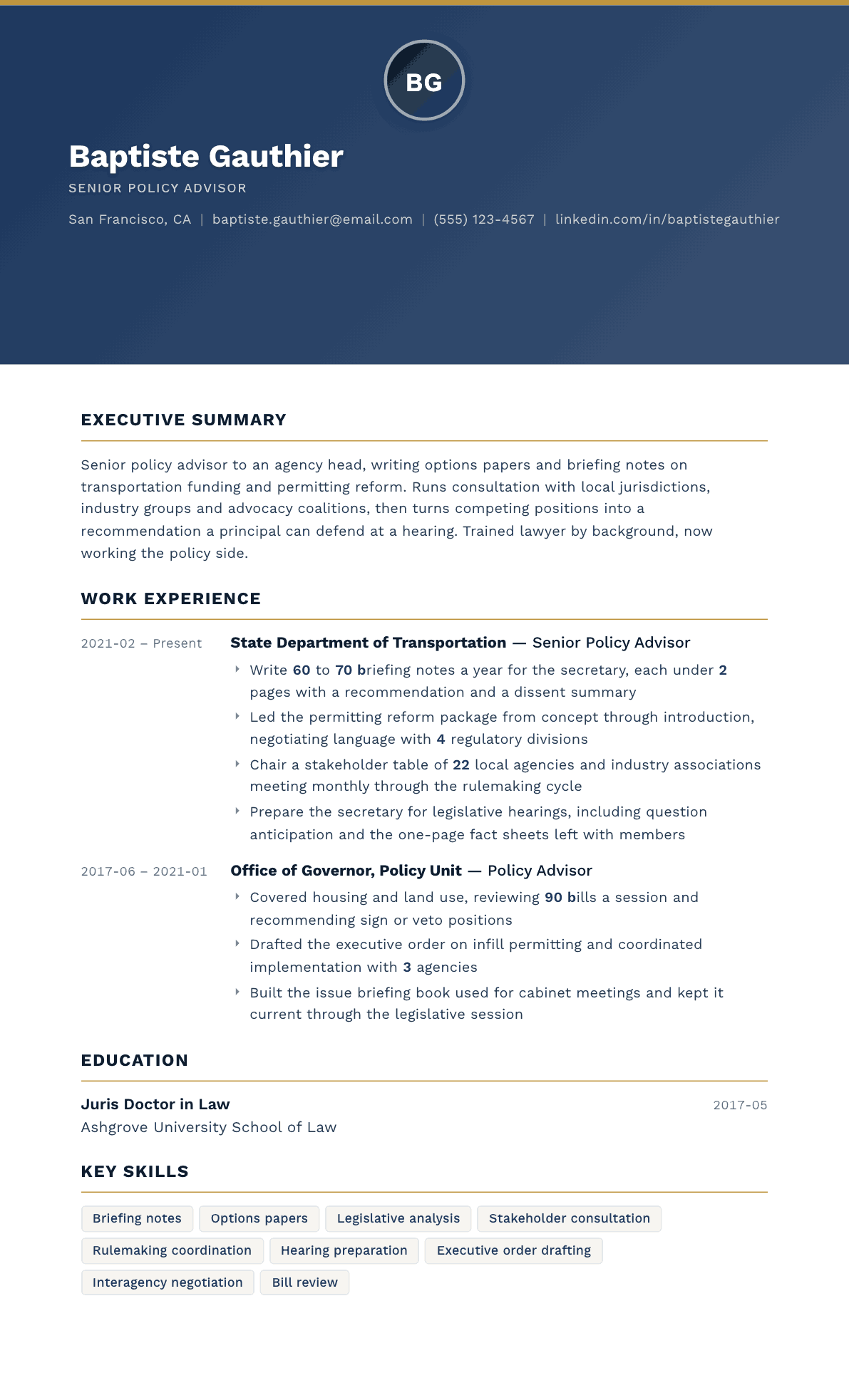
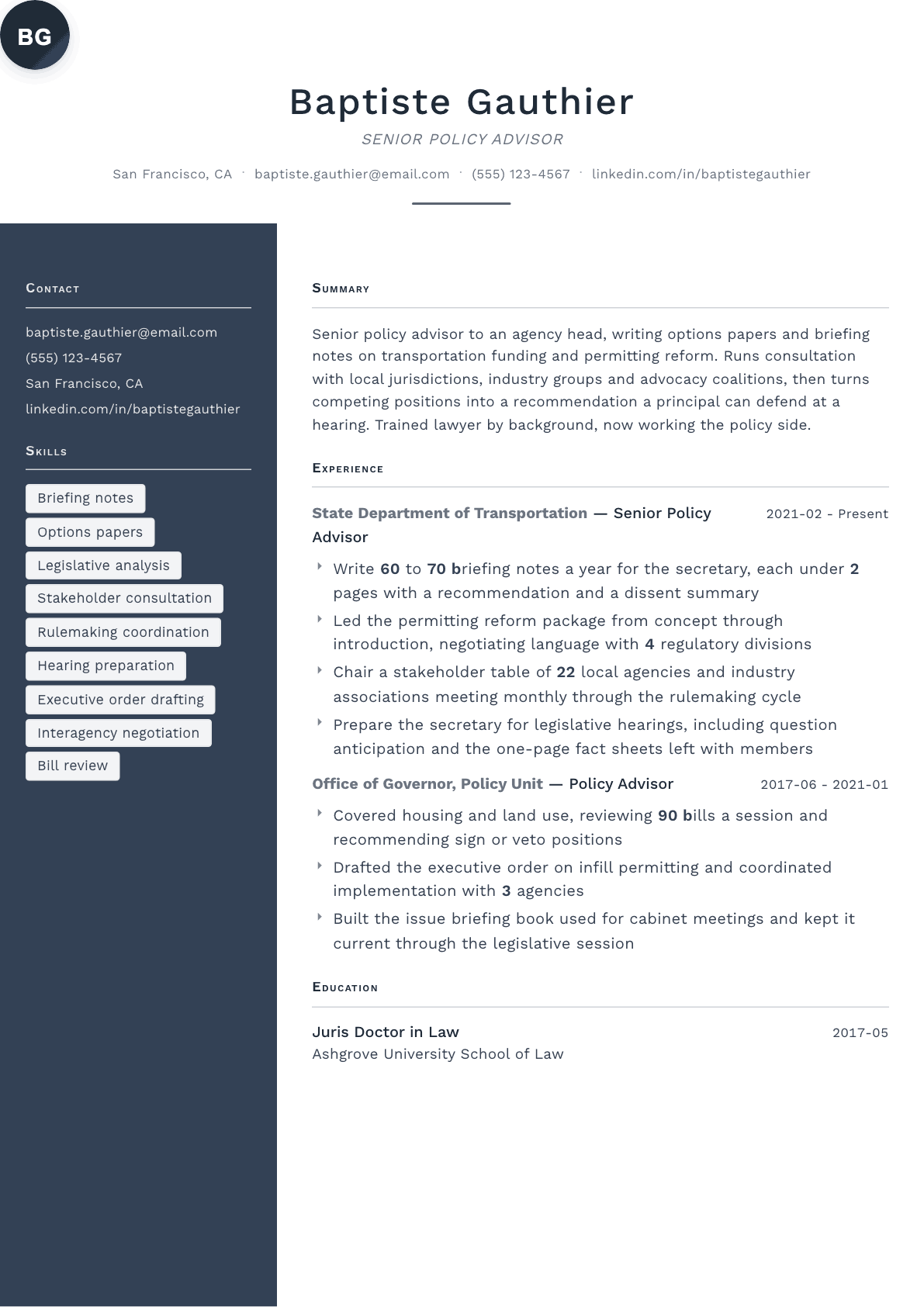
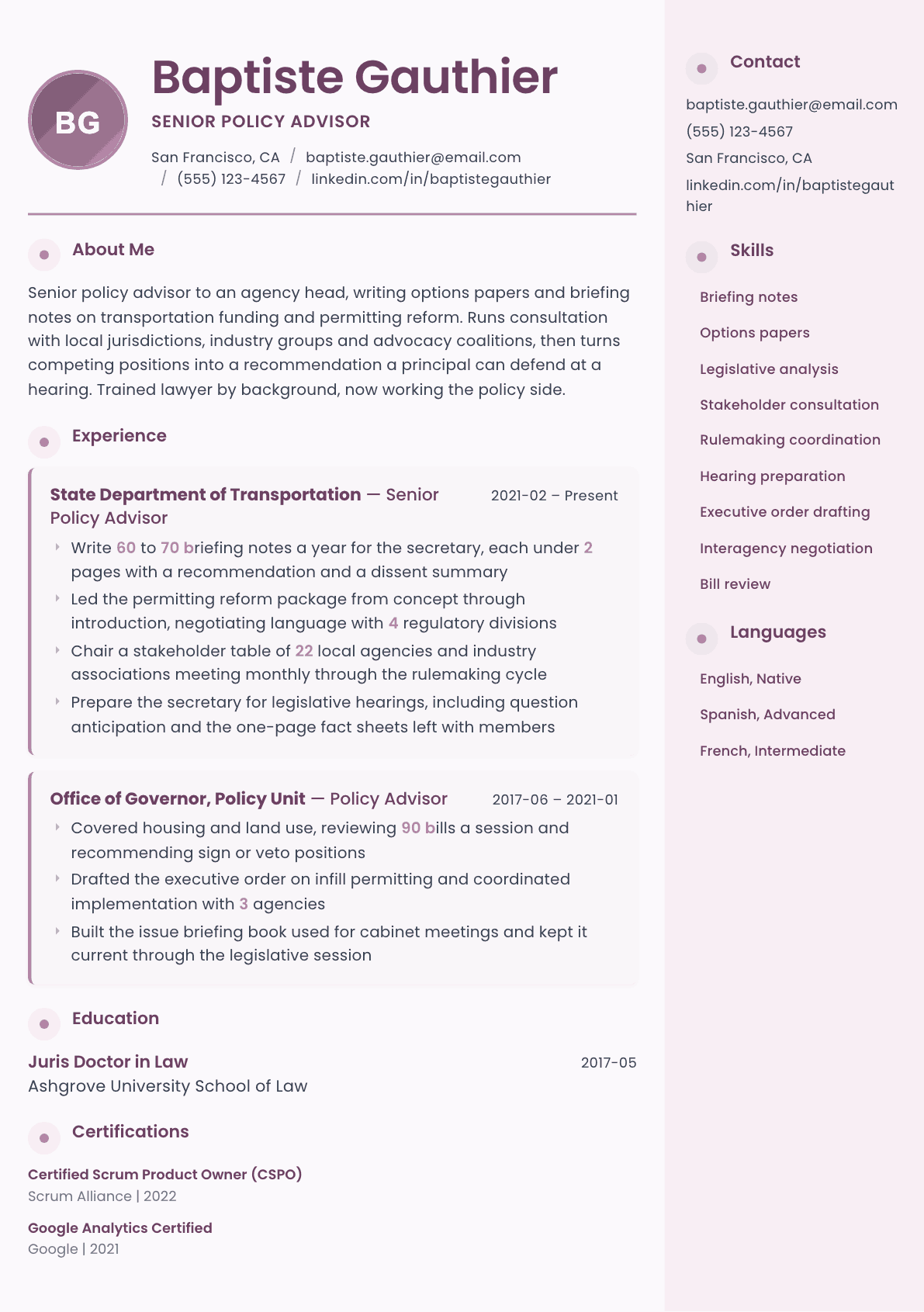
Example Policy Advisor summary
Policy advisor with seven years between a governor office and a state transportation department, covering housing, land use and permitting. Writes short options papers with a clear recommendation, chairs a stakeholder table of local agencies and industry groups, and prepares principals for legislative hearings. Law degree, and looking for a chief policy role in a state or regional agency.
Skills to list on a Policy Advisor resume
- Briefing note writing
- Options and decision papers
- Legislative bill analysis
- Stakeholder consultation and negotiation
- Rulemaking and regulatory process
- Hearing and testimony preparation
- Executive order and directive drafting
- Interagency coordination
- Fiscal impact assessment
- Political risk assessment
- Public comment analysis
- Speech and talking points support
- Coalition management
What actually gets this resume read
- Say who your principal was by office rather than by name: secretary, commissioner, mayor, governor or minister.
- Count the briefing notes and options papers you produce in a year and state the page limit you write to.
- Name the policy areas you own, because a transportation advisor and a health advisor are not interchangeable hires.
- Show a decision that followed your recommendation and describe the change in plain terms rather than claiming credit.
- Describe the stakeholder table you ran: how many organizations, how often, and what came out of it.
- Keep confidential advice off the page and write about the process and the public outcome instead.
How to write a policy advisor resume
A policy advisor is hired to reduce a complicated situation to a decision a principal can make and defend. The chief of staff reading your resume wants evidence of exactly that: that you can take four agency positions, two hostile stakeholder groups and a legal constraint, and produce two pages with a recommendation on top.
The trap is that the work is confidential, so candidates end up describing process instead of substance and the resume goes flat. There is a way through. You can name the policy area, the volume and format of what you produced, the tables you chaired, the public artifacts that came out the other end, and the parts of the process that are on the public record, without disclosing a single piece of advice.
This guide covers how to size a policy portfolio, how to write about briefing products, how to describe consultation without sounding like an event planner, and what to do about attribution when the decision was not yours to claim.
Format: portfolio, principal, product
Two pages, reverse chronological. Under each job, open with one line that establishes three things: the policy areas you covered, who you advised by office, and what you produced. A chief of staff can decide from that line whether to keep reading, and everything else on the page is support.
Name the office rather than the person. Advisor to the secretary of transportation is portable. Advisor to a named individual reads as a personal appointment and ages badly when that person leaves office. Keep the tone institutional throughout, because policy advisor resumes circulate between administrations of different stripes.
- One line per job with portfolio, principal office and core products.
- Then bullets grouped as advice, process and stakeholder work.
- A block for public artifacts: adopted rules, executive orders, published reports, testimony you prepared.
- Education, including law or policy degrees, plus any legislative drafting or negotiation training.
Products: count them and state the constraints you write to
Briefing notes, options papers, decision memos, question and answer packs, fact sheets and speaking notes are the currency of the job. Give annual counts and the format constraints you work to, because writing a recommendation in under two pages under time pressure is the skill being purchased.
Describe the structure of your advice: the options presented, the risks flagged, the dissent recorded. An advisor who documents where agencies disagreed rather than smoothing it over is more useful to a principal, and saying so on the resume signals a mature approach to the job.
Process: rulemaking, legislation and interagency work
Name the process you moved things through. A regulatory package with a comment period, a bill from concept through introduction, an executive order with an implementation plan, a budget change proposal. Each of these has public milestones, so you can describe your role at each milestone without touching confidential advice.
Interagency negotiation deserves its own bullets. Say how many agencies or divisions were at the table, what the disagreement was about in general terms, and how the language settled. This is the part of the job that separates an advisor from an analyst, because analysts produce options and advisors get them agreed.
Consultation and hearings
Describe stakeholder work in structural terms: the table you chaired, how many organizations sat on it, how often it met and over what period, and what it produced. A standing table that ran through a full rulemaking cycle is a much stronger claim than a series of meetings.
Hearing preparation is a distinct and valued skill. Say that you prepare principals for legislative appearances, and name the products: anticipated questions with answers, member profiles, one-page leave-behinds, and the debrief that follows. If you have prepared testimony that was delivered on the record, that document is public and you can cite it.
- Stakeholder table: number of organizations, cadence, duration and output.
- Public comment handling: volume received, how comments were categorized and responded to.
- Hearing preparation products and how often the principal appeared.
- Coalition work: which sectors you kept aligned and where they split.
Attribution: describe the decision, do not claim it
Principals decide. Advisors advise. A resume that says you enacted a reform reads as inflation to anyone who has worked in government, and the interview will expose it. Write the sequence instead: you developed the options, the principal chose one, the package moved and here is what changed in the world. That version is both more accurate and more impressive, because it shows you understand where you sit.
Policy Advisor resume summary examples
Junior advisor
Policy staffer with 2 years in a governor policy unit covering housing and land use, reviewing 90 bills a session and preparing sign or veto recommendations. Maintained the cabinet issue briefing book through session and drafted the implementation timeline for an infill permitting directive.
Policy advisor
Policy advisor with 7 years across an executive policy unit and a state transportation department, writing 60 briefing notes a year under a 2 page limit. Led a permitting reform package from concept through introduction, negotiating language across 4 regulatory divisions and a 22-member stakeholder table.
Chief policy advisor
Chief policy advisor to an agency head, directing a team of 5 across transportation funding, permitting and workforce policy. Owns the legislative program, the rulemaking calendar and hearing preparation, and has taken 3 regulatory packages through public comment to adoption in 4 years.
Work experience bullets: before and after
Before: Wrote briefing materials for senior leadership.
After: Wrote 65 briefing notes a year for the secretary, each under 2 pages with a recommendation, the options rejected and a summary of where divisions disagreed.
Volume, page discipline and the inclusion of dissent describe the actual product rather than the general activity.
Before: Led a policy reform effort.
After: Led the permitting reform package from concept paper through introduction, negotiating statutory language with 4 regulatory divisions and the office of legal counsel.
The milestones and the counterparties make the claim checkable and show where the hard part of the work was.
Before: Worked with stakeholders on rulemaking.
After: Chaired a stakeholder table of 22 local agencies and industry associations that met monthly through a full rulemaking cycle, and categorized 400 public comments into the response document.
Chairing a standing table through a defined cycle is a structural claim, unlike working with stakeholders.
Before: Prepared the secretary for hearings.
After: Prepared the secretary for 9 legislative hearings, producing anticipated question sets, member interest profiles and the one-page fact sheets left with committee offices.
The named deliverables show what hearing preparation means in practice instead of asserting that it happened.
Before: Reviewed legislation for the office.
After: Reviewed 90 bills a session across housing and land use, wrote sign or veto recommendations with fiscal and implementation risk noted, and tracked amendments through both chambers.
The portfolio, the volume and the analytical content turn bill review into a demonstrable workload.
Hard skills
- Briefing note and decision memo writing
- Options and issue paper development
- Legislative bill analysis and tracking
- Rulemaking and regulatory process
- Executive order and directive drafting
- Stakeholder consultation design
- Public comment analysis
- Hearing and testimony preparation
- Interagency negotiation
- Fiscal and implementation risk assessment
- Legislative program management
- Talking points and speech support
Soft skills
- Judgment under political pressure
- Brevity in writing
- Discretion with pre-decisional advice
- Reading a room of competing interests
- Working for a principal you disagree with
Mistakes that cost policy advisor candidates the interview
- Claiming credit for a decision the principal made, which reads as inflation to anyone who has done the job.
- Describing the policy area so vaguely that a chief of staff cannot tell whether you fill the gap on the team.
- Listing meetings attended instead of the table you chaired and what it produced.
- Naming the individual you advised rather than the office, which dates the resume the moment they leave.
- Skipping the briefing product counts, when volume under a page limit is the core skill being bought.
- Including confidential advice, which ends a candidacy faster than a weak resume ever would.
Policy Advisor resume questions
How do I write about confidential advice without disclosing it?
Write the process and the public artifacts. Say what you produced, how many, to what page limit, which agencies you negotiated with and what became public, while leaving the content of the recommendation itself off the page entirely.
Do policy advisor roles require a law degree?
No, though law, public policy and economics degrees are common because the work is statutory and quantitative. What matters more is demonstrated writing under deadline, familiarity with a legislative or rulemaking process, and depth in one policy area.
Should I put my political affiliation on a policy advisor resume?
Leave it off. Name offices rather than parties and keep the tone institutional. Campaign work can appear as experience with dates and duties, but a resume that reads as partisan advocacy limits where it can travel.
How do I move from an analyst role into an advisory one?
Show that you have turned analysis into recommendations. Lead with decision memos, options papers and any time you briefed a decision maker directly, then name the interagency or stakeholder negotiation you have handled without supervision.
What if the policy I worked on never passed?
Describe it anyway with an honest ending. Say the package was introduced, negotiated and held in committee, and note what carried over into a later effort. Government hiring managers know most work does not reach adoption in one cycle.
Related resume examples
- Policy Analyst Resume example
- Diplomat Resume example
- Public Policy Analyst Resume example
- Government Relations Manager Resume example
- Congressional Staffer Resume example
- State Government Employee Resume example