Horse Trainer Resume Examples: free ATS score and gap list
Write a Horse Trainer Resume Barns and Owners Respect
By Mustafa Tarabya, founder of CVBooster · Published · Updated
Horse trainer resume examples covering disciplines, string size, starting young horses, show records and the barn keywords owners search for.
Sample resumes for a horse trainer
The same horse trainer content laid out in three CVBooster templates, so you can see what the finished document looks like before you write a word.
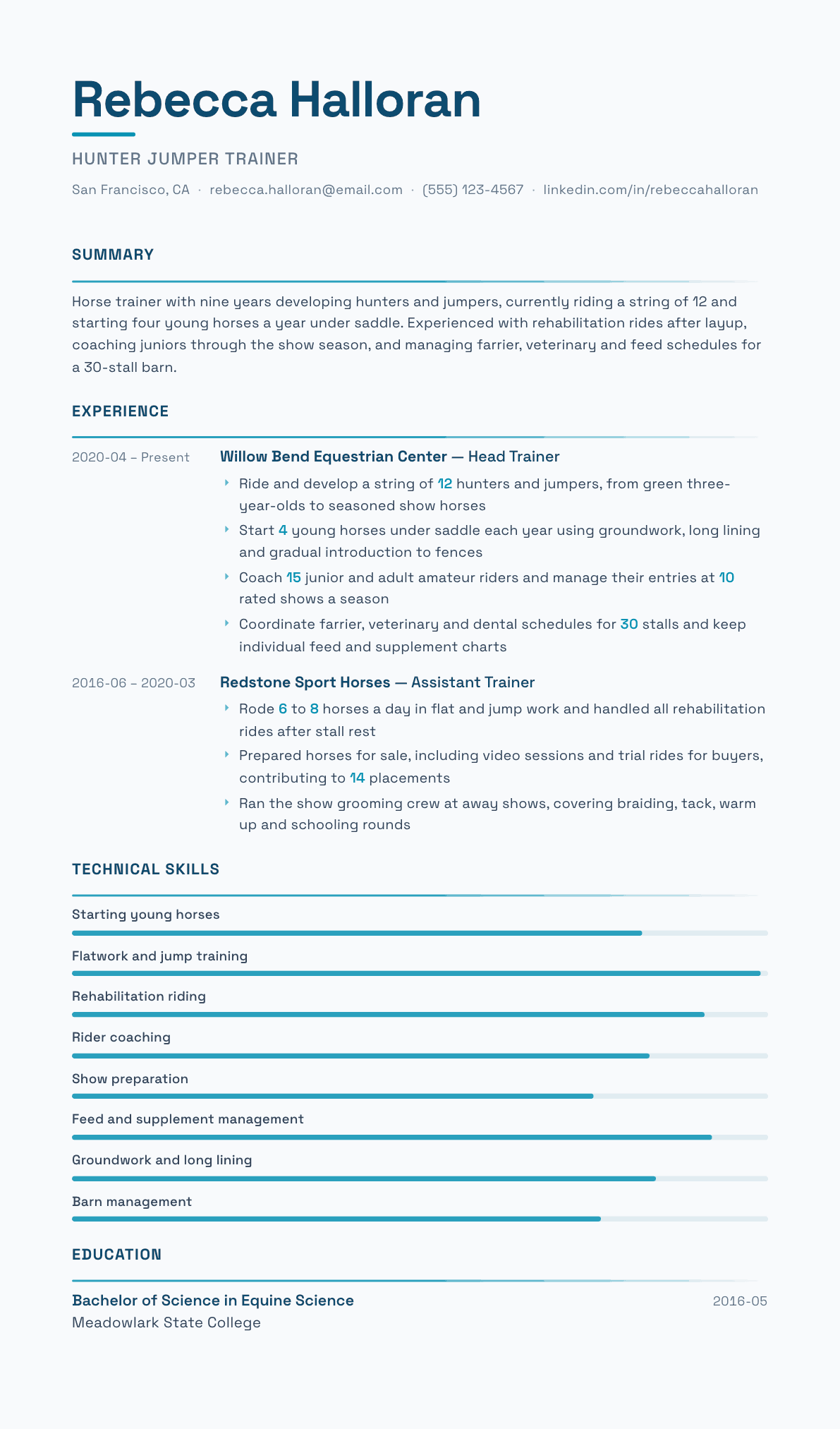
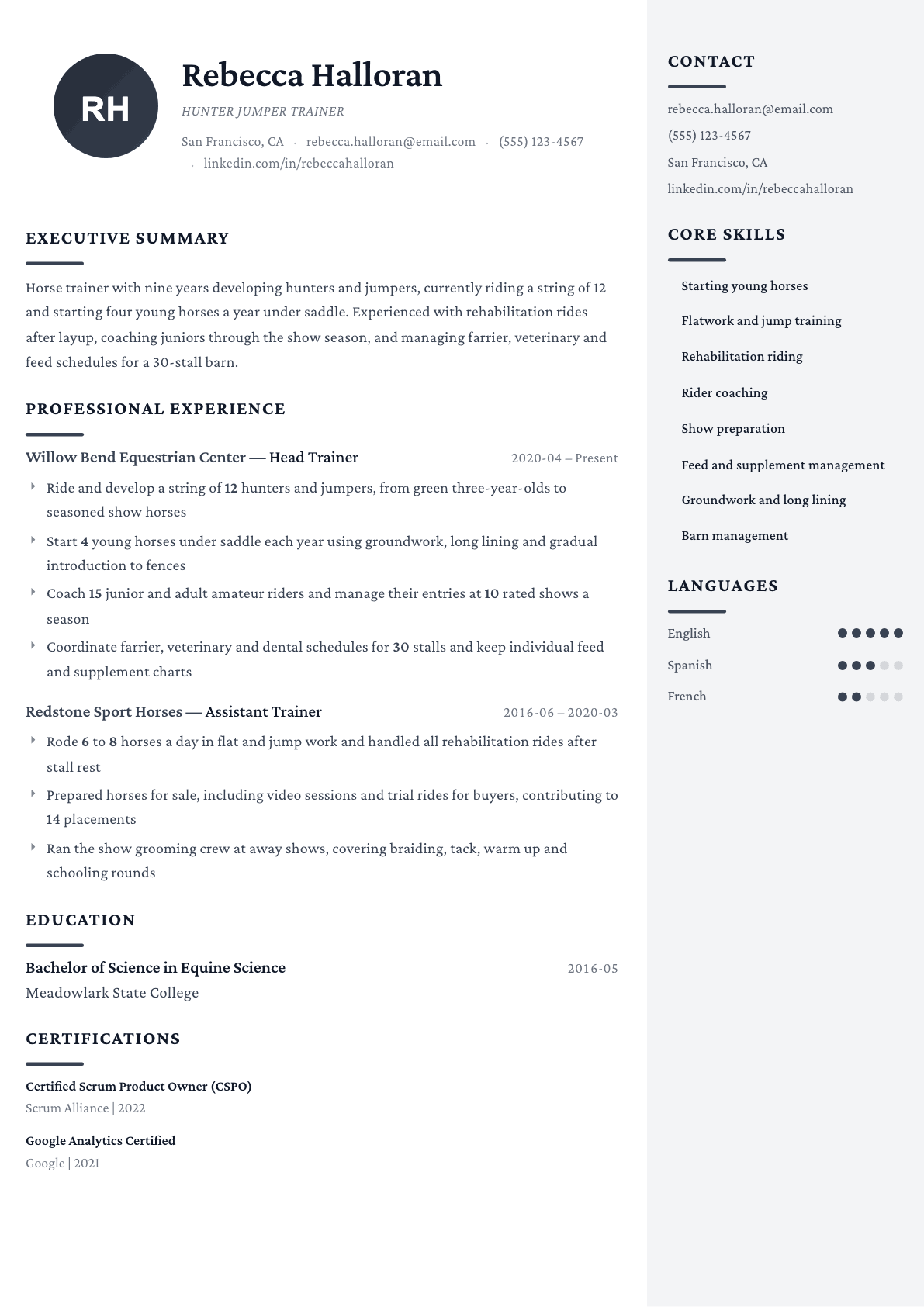
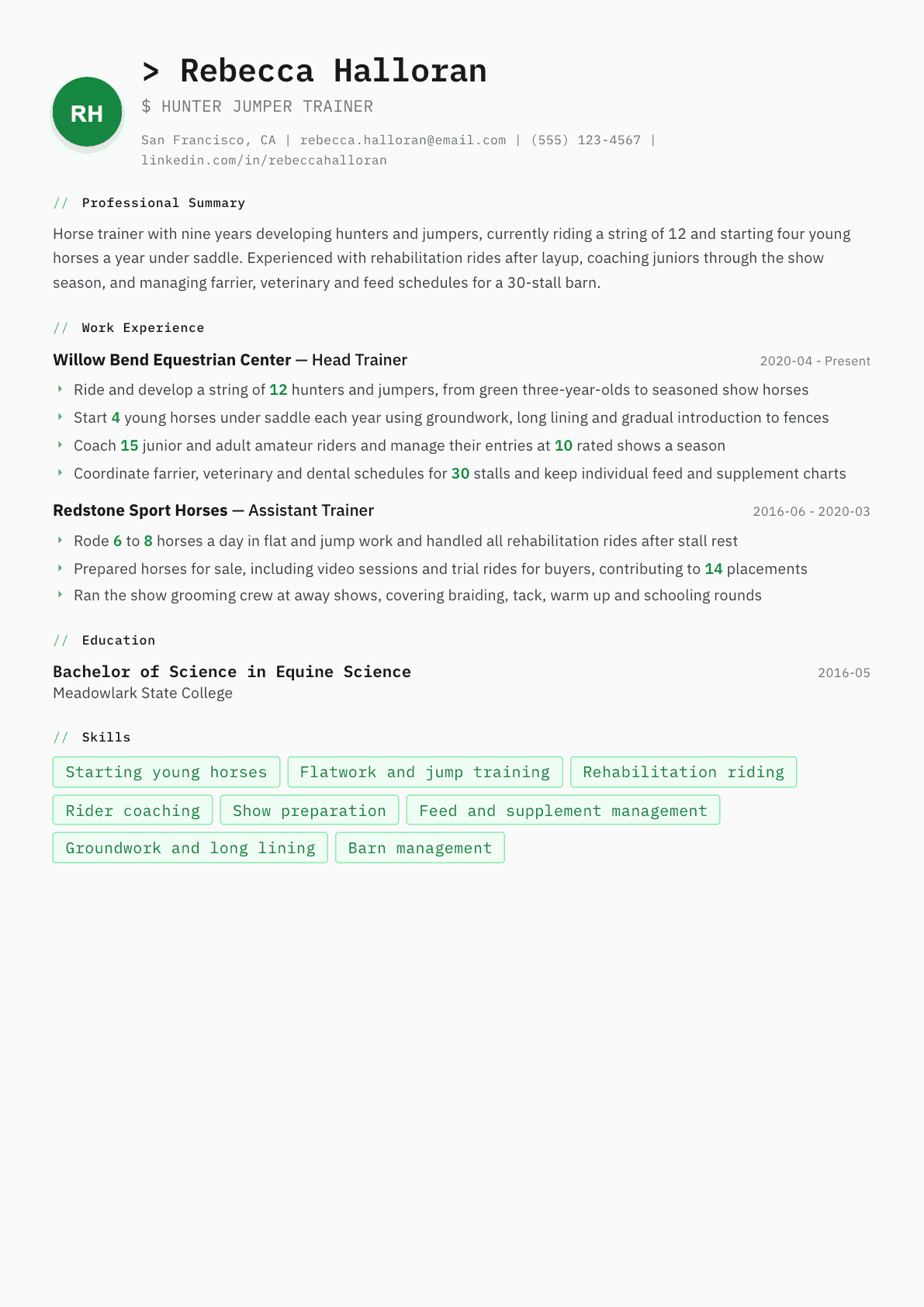
Example Horse Trainer summary
Horse trainer with nine years in hunters and jumpers, riding a string of 12 and starting four young horses under saddle each year. Comfortable with rehabilitation rides after layup, coaching juniors through a rated show season, and running farrier, veterinary and feed schedules for a 30-stall barn. Seeking a head trainer role with a sales program.
Skills to list on a Horse Trainer resume
- Starting young horses
- Groundwork and long lining
- Flatwork training
- Jump schooling
- Rehabilitation and conditioning
- Rider instruction
- Show preparation
- Sales and trial rides
- Feed and supplement programs
- Farrier and veterinary coordination
- Trailering and hauling
- Barn staff supervision
- Tack fitting
- Client communication
What actually gets this resume read
- Name the discipline first, because a reining barn and a hunter barn are hiring for completely different skills.
- Say how many horses you ride a day and how big your string is, since that is the workload owners price.
- Describe the young horse work you do, from groundwork and long lining through the first year under saddle.
- Include rehabilitation and layup riding, because owners trust trainers who can bring a horse back carefully.
- Give show results by division and level rather than a list of ribbons nobody outside your circuit recognizes.
- Show the barn management side: farrier and veterinary scheduling, feed charts, turnout plans and staff supervision.
How to write a horse trainer resume
A horse trainer resume is read by a barn owner, a show manager or a private client who has one question underneath all the others: can this person be trusted with animals worth more than the truck they arrived in. Everything on the page should answer that. Discipline, string size, the young horses you have started, the rehabilitation rides you have handled, the injuries that did not happen on your watch.
Trainers often undersell themselves because the work feels obvious from inside the barn. Riding six horses a day, adjusting a feed chart, holding for the vet, coaching a junior through a nervous first outing and driving the trailer at four in the morning are all normal to you and all invisible to a reader unless you write them down with numbers attached.
This guide covers the sections owners read first, how to present show results without a wall of ribbon names, three example summaries for an assistant, a working trainer and a head trainer, before and after bullets from the same barn, and the questions trainers ask when they move between disciplines or open their own program.
Format: discipline and string size before anything else
Name your discipline in the first line under your contact details, because a reining barn, a dressage yard, a hunter jumper program and a racing stable are separate industries that happen to share an animal. Add the levels you compete or train to and the size of the string you currently ride.
Keep it to one page while you are an assistant, and allow a second page once you have a sales program, staff to supervise and a multi-year show record. Owners read on paper in the barn aisle, so use a clean single column with no decorative graphics.
- Discipline line: the sport, the levels ridden, and the type of horse you specialize in.
- String size and daily ride count, since that is the workload an owner is pricing.
- Young horse work: how many you start under saddle a year and the method you use.
- Barn responsibilities: farrier and veterinary scheduling, feed charts, turnout plans, staff supervised.
Summary: years, discipline, string, what you are known for
Three lines that state years in the industry, discipline, current string size and the one thing clients seek you out for. Starting green horses quietly, bringing horses back after layup, producing sales horses and coaching juniors through their first rated season are all distinct reputations and each attracts a different employer.
If you are changing disciplines, say so and name the transferable ground. A trainer moving from eventing into hunters should point at flatwork quality, rideability and mileage over fences rather than hoping an owner connects it.
Experience: rides per day, horses developed, results
Lead each role with the barn, the discipline and the scale: stalls, string size, horses ridden per day. Then use bullets for development work. A horse taken from unbroken to showing, a difficult horse retrained after a bad start, a rehabilitation ride brought back from stall rest, and a sale prospect prepared and placed are the stories that prove skill.
Write about the method, not just the outcome. Groundwork, long lining, the order you introduce tack and rider weight, how you build fitness after layup, and how you decide a horse is ready to move up all show a client how you think. Barn owners hire judgment because they cannot supervise every ride.
Coaching belongs here too if you teach. Give the number of riders, their levels, and how many shows you manage entries and warm-up for in a season, since that is a large and often unpaid part of a head trainer week.
Show record and sales without the ribbon wall
Do not list every class placing. Summarize by division and level: how many horses shown at what height or level, the circuits attended, championships or year-end standings, and any horse you produced from the beginning of its career. That is readable and it survives a reader who does not know your local circuit.
Sales work deserves its own short block if you do it. Prospects sourced, horses prepared and marketed, video and trial ride management, and placements made are commercial results, and a barn with a sales program will hire on that section alone.
- Divisions and heights or levels shown, with the number of horses at each.
- Championships, year-end standings and horses you produced from the start of their career.
- Sales horses prepared, trials managed and placements completed.
- Client retention: how long owners have kept horses in your program.
Horsemanship credentials, safety and keywords
List real credentials only: riding instructor certification, therapeutic riding certification if you hold it, current first aid and CPR, a commercial driving endorsement if your hauling requires one, and any judging or officiating card. Add the trailer sizes and rigs you are insured and comfortable driving, because hauling is a real hiring factor.
The terms that repeat in job posts are worth mirroring where they are true: starting young horses, groundwork, long lining, flatwork, jump schooling, conditioning, rehabilitation, sales preparation, lesson instruction, barn management, feed program, farrier coordination. Put each next to the work that earns it.
Horse Trainer resume summary examples
Working student to assistant
Assistant trainer with three years in a hunter jumper program, riding 5 horses a day including green four-year-olds and rehabilitation cases. Handles braiding, warm-up and schooling at away shows, holds for farrier and veterinary visits, and manages feed charts for a 24-stall barn.
Nine years, riding a full string
Horse trainer riding a string of 12 hunters and jumpers and starting 4 young horses under saddle a year through groundwork and long lining. Coaches 15 junior and amateur riders across 10 rated shows a season and manages farrier, dental and veterinary scheduling for the barn.
Head trainer with a sales program
Head trainer with sixteen years developing sport horses, running a 40-stall program with three staff and a sales operation placing about a dozen horses a year. Produces young horses from unbroken through the show ring and keeps client horses in program for multiple seasons.
Work experience bullets: before and after
Before: Rode and trained horses daily.
After: Rode a string of 12 hunters and jumpers daily, from green three-year-olds through seasoned show horses, with flat and jump schooling planned around each horse fitness cycle.
The string size and the range of horses show the workload and the level you can ride at once.
Before: Started young horses under saddle.
After: Started 4 young horses a year using groundwork and long lining before first mounting, then introduced poles and small fences over the following six months.
The method and the timeline show an owner how you think about a green horse rather than that you sat on one.
Before: Helped horses recover from injuries.
After: Managed rehabilitation rides after stall rest, following veterinary walk and trot schedules and building conditioning back over twelve weeks before returning horses to jump work.
Naming the veterinary plan and the return timeline proves you follow protocol instead of rushing a horse back.
Before: Taught riding lessons.
After: Coached 15 junior and amateur riders through 10 rated shows a season, managing entries, warm-up rounds and course walks for each division.
Rider count and show management turn lessons into the full coaching job an owner is hiring for.
Before: Prepared horses for sale.
After: Prepared sale horses with sales videos, trial rides and buyer visits, contributing to 14 placements over four years across amateur and junior markets.
The process and the placement count make the sales work commercial rather than decorative.
Hard skills
- Starting young horses under saddle
- Groundwork and long lining
- Flatwork and dressage schooling
- Jump schooling and gymnastics
- Conditioning and fitness programs
- Rehabilitation and layup return
- Rider instruction and show coaching
- Sales preparation and trial management
- Feed and supplement programs
- Farrier and veterinary coordination
- Trailering and hauling
- Barn staff supervision
Soft skills
- Patience with green horses
- Owner communication
- Reading an animal under stress
- Decision making on soundness
- Staff leadership in the barn
- Composure at competitions
Certifications worth listing
- Certified Riding Instructor (Certified Horsemanship Association)
- Trainer Certification Program (United States Hunter Jumper Association)
- Certified Therapeutic Riding Instructor (PATH International)
- Heartsaver First Aid CPR AED (American Heart Association)
Mistakes that cost horse trainer candidates the interview
- Leaving the discipline off the first line, so an owner in another sport cannot tell whether you are relevant.
- Listing every class placing instead of summarizing by division, level and horses produced.
- Skipping the barn management work, which is most of a head trainer week and a real cost to any employer.
- Writing that you love horses in place of string size, rides per day and young horse numbers.
- Hiding rehabilitation and layup experience when careful return to work is exactly what worried owners pay for.
- Omitting hauling experience and rig sizes when the position clearly includes driving to shows.
Horse Trainer resume questions
How do I show my show record without listing every ribbon?
Summarize by division and level: how many horses you showed at each height or level, the circuits you attended, and any championship or year-end standing. Then name the horses you produced from the start of their careers.
What if I have never competed but have trained plenty of horses?
Lead with development work instead. Young horses started, difficult horses retrained, rehabilitation cases returned to work and client horses kept sound over multiple seasons all carry weight with owners who are not chasing ribbons.
Should barn management duties go on a trainer resume?
Yes. Feed charts, farrier and veterinary scheduling, turnout plans, stall counts and staff supervision are a large share of the job, and an employer wants to know whether those tasks come with you or need another hire.
How do I move from one discipline to another?
Say the move in your summary and name the transferable foundation: flatwork quality, rideability, mileage, groundwork and fitness building. Then reorder your bullets so the work closest to the new discipline appears first in each role.
Do I need a certification to be hired as a horse trainer?
Most barns hire on results and references rather than paperwork, but a recognized instructor certification helps for teaching roles, and current first aid plus the right driving credentials for hauling can be genuine requirements in a job posting.
Related resume examples
- Sports Coach Resume example
- Athletic Trainer Resume example
- Recreation Coordinator Resume example
- Athletic Coach Resume example
- Fitness Instructor Resume example
- Martial Arts Instructor Resume example