Substance Abuse Counselor Resume Examples: free score
Build a Substance Abuse Counselor Resume Treatment Centers Read
By Mustafa Tarabya, founder of CVBooster · Published · Updated
Substance abuse counselor resume example with caseload figures, ASAM and modality detail, licensure guidance, keywords and a step-by-step guide.
Sample resumes for a substance abuse counselor
The same substance abuse counselor content laid out in three CVBooster templates, so you can see what the finished document looks like before you write a word.
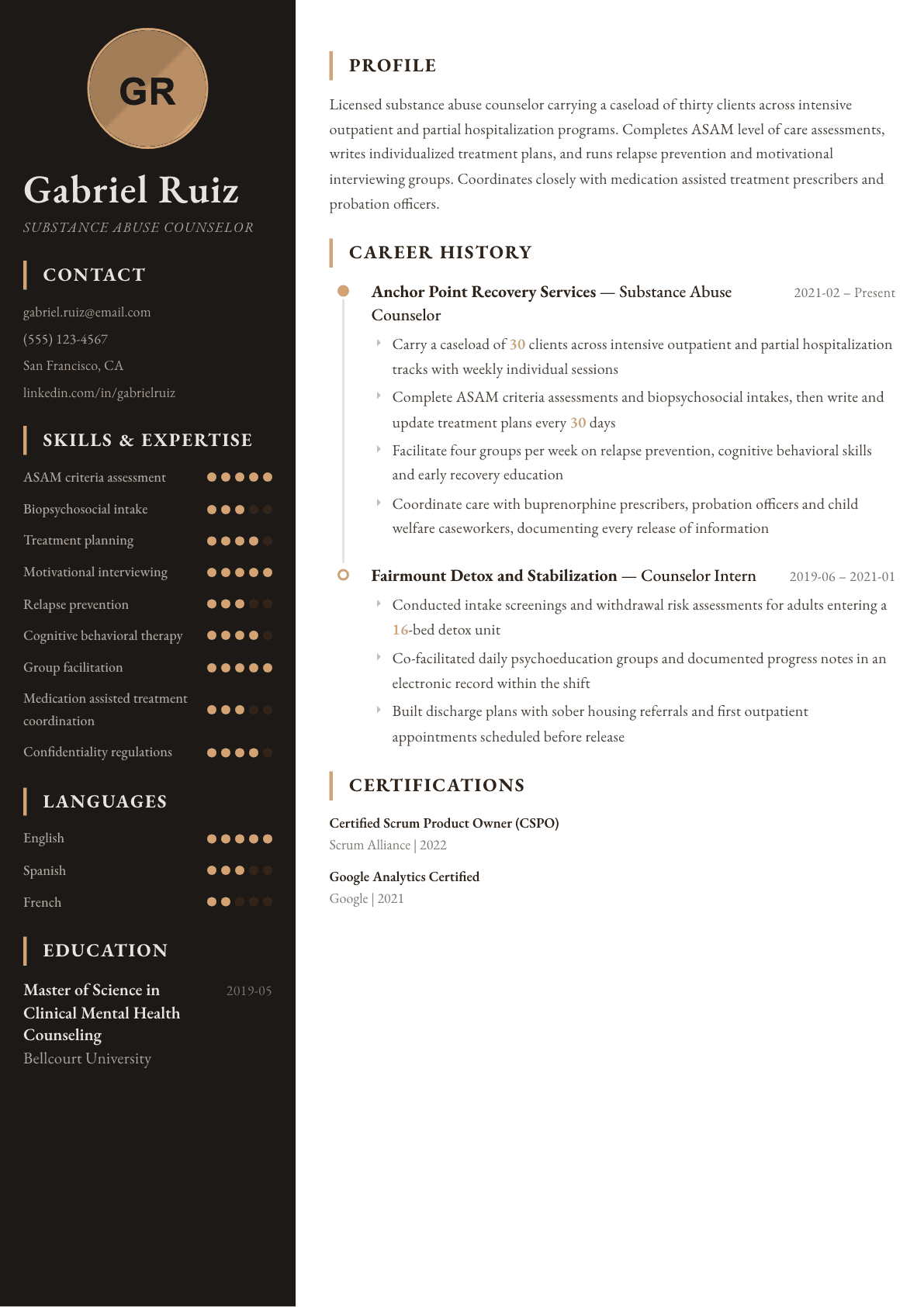
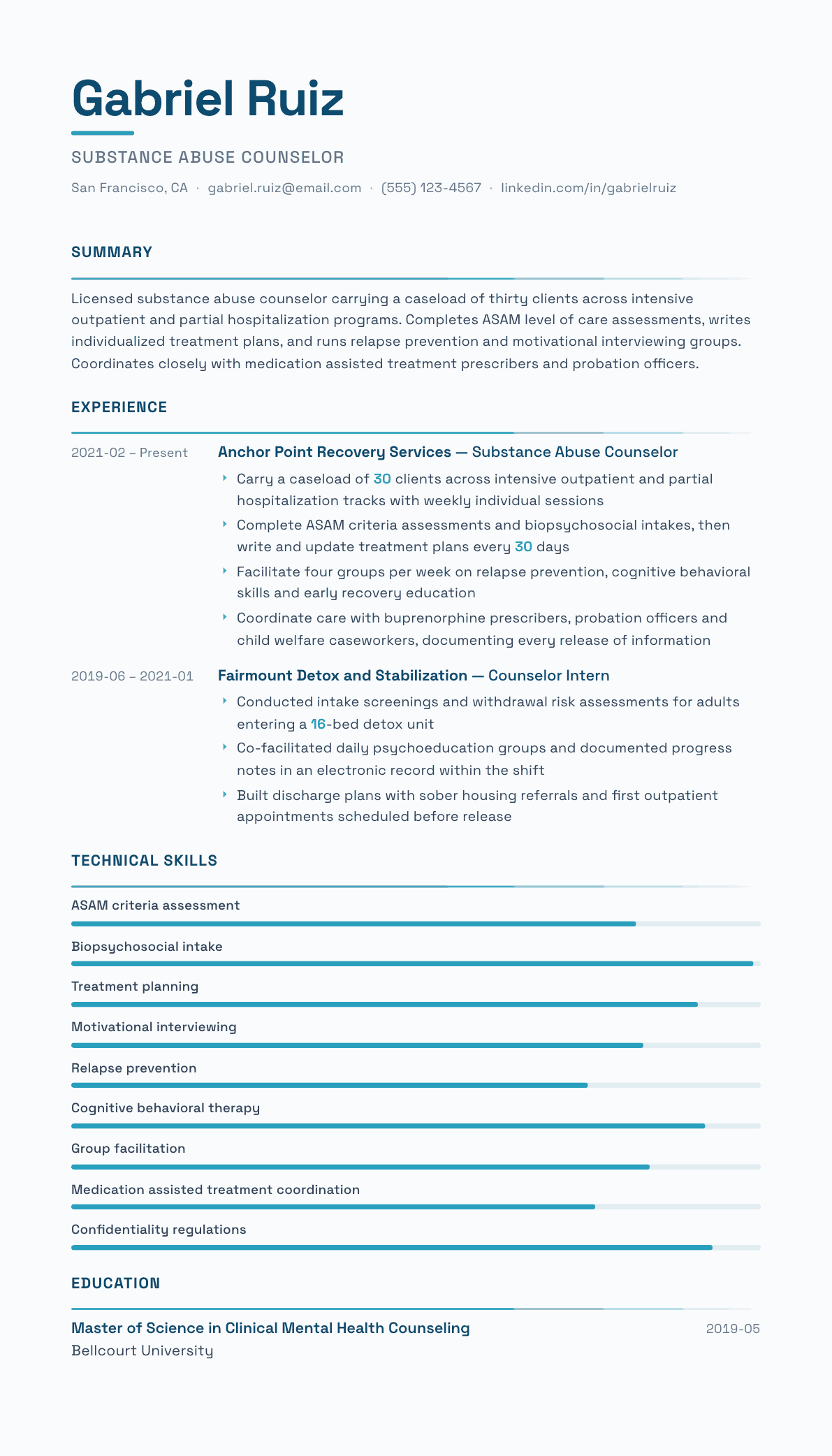
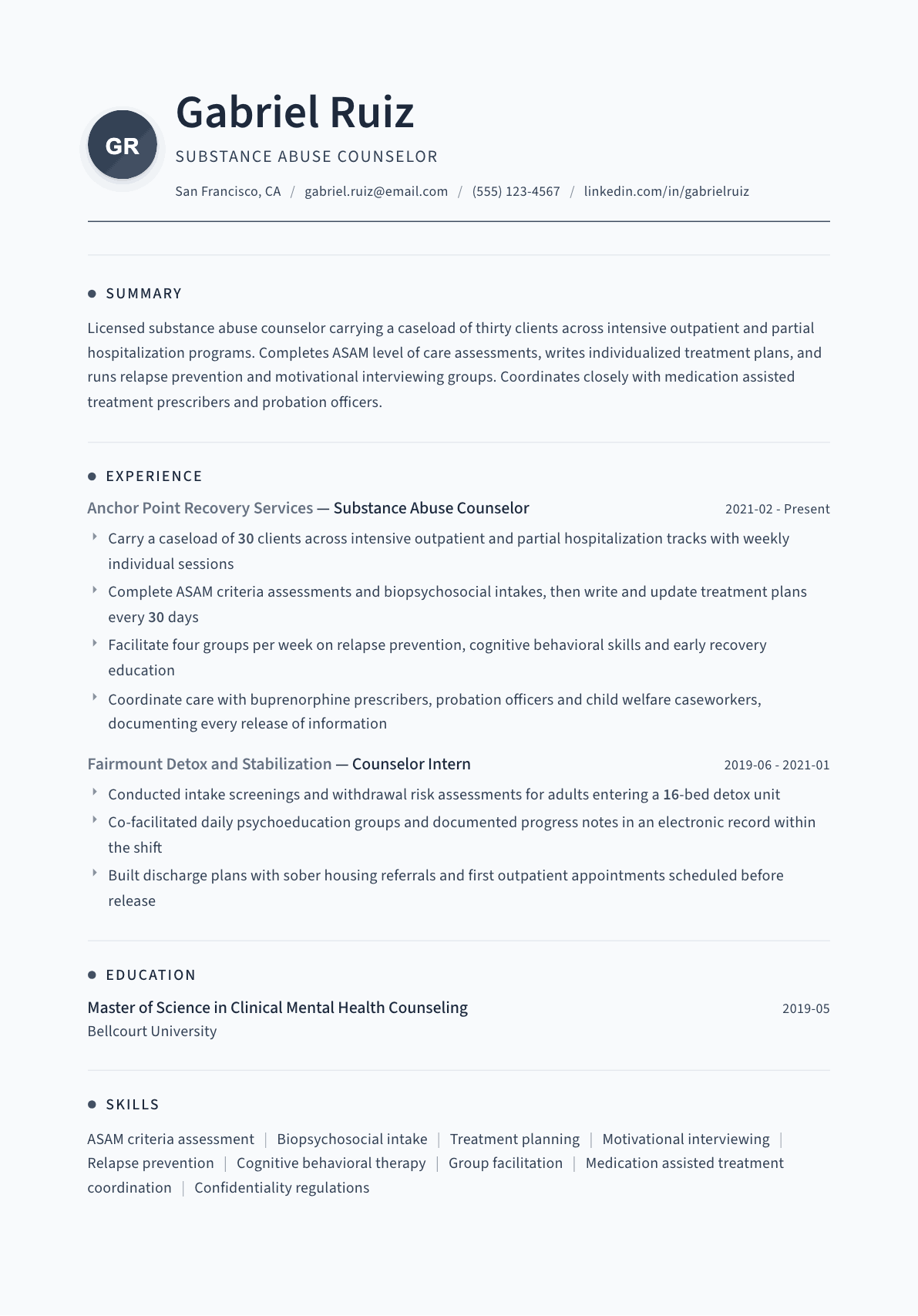
Example Substance Abuse Counselor summary
Licensed substance abuse counselor with five years across detox, intensive outpatient and partial hospitalization programs, currently carrying a caseload of thirty clients. Completes ASAM level of care assessments and biopsychosocial intakes, writes treatment plans on a thirty day cycle, and facilitates four groups a week. Coordinates daily with medication prescribers, probation officers and child welfare caseworkers.
Skills to list on a Substance Abuse Counselor resume
- Substance use assessment
- ASAM criteria
- Treatment planning
- Motivational interviewing
- Cognitive behavioral therapy
- Relapse prevention planning
- Group counseling
- Individual counseling
- Crisis intervention
- Medication assisted treatment coordination
- Case management
- Discharge planning
- Confidentiality compliance
- Court and probation reporting
- Family education
What actually gets this resume read
- Lead with your credential and license number status, since state boards and payers require it and screeners check it first.
- Give caseload size and the level of care, because outpatient, intensive outpatient, residential and detox are different jobs entirely.
- Name the modalities you actually deliver, such as motivational interviewing, cognitive behavioral therapy and contingency management.
- Show assessment work by name, including ASAM criteria placement, biopsychosocial intake and withdrawal scales you have administered.
- Include coordination with courts, child welfare and medication prescribers, because that referral web is most of the daily work.
- Mention documentation volume and timeliness, since audits and payer reviews turn on notes written within the required window.
How to write a substance abuse counselor resume
Treatment centers hire substance abuse counselors against two constraints they cannot bend: the credential their state and payers require, and the caseload the program has to cover. A clinical director opening your resume checks the license line first, then looks for the level of care you have worked in, then counts whether your caseload experience matches theirs. Everything else follows.
The work itself is documentation heavy in a way many candidates undersell. Assessments placed against recognized criteria, treatment plans updated on a schedule, group notes written the same day, releases of information kept current and reports going out to courts and child welfare. A program survives audits on that paperwork, so a resume that never mentions it worries an experienced director.
This guide covers how to present licensure honestly, how to describe levels of care and modalities, three summary examples from an intern through a clinical supervisor, bullet rewrites that replace generic counseling language with real practice, and the questions counselors ask when they change programs or populations.
Format: license status first, one to two pages
One page early in your career, two once you have supervision or program development history. Single column with clear dates. Behavioral health agencies use standard applicant systems and a plain file parses correctly every time.
Put credential and license status directly under your name with the state and the status: fully licensed, associate or provisional under supervision, or certified at a state defined level. Vagueness here is read as a problem, because payer billing depends on the exact credential.
- Header: name with credential, city and state, phone, professional email.
- Licensure: credential, state, license status, supervision arrangement if applicable.
- Sections: summary, licensure, clinical experience, modalities and assessments, education.
Summary: level of care, caseload, population, modality strength
Name the level of care because it defines the job: detox and withdrawal management, residential, partial hospitalization, intensive outpatient, standard outpatient, recovery housing or opioid treatment programs. Then caseload size, then the population, whether adults, adolescents, justice involved clients, veterans or families.
End with the modality the posting emphasizes. Motivational interviewing, cognitive behavioral relapse prevention, contingency management, trauma informed practice and family systems work are not interchangeable, and directors hire against the one their program runs.
Experience: assessment, treatment planning, groups, coordination
Lead with assessment work. Biopsychosocial intake, placement using recognized level of care criteria, withdrawal severity scales, screening for co-occurring disorders and suicide risk assessment. Say how many intakes you complete in a typical week, because assessment capacity is often the bottleneck in a program.
Then treatment planning and individual sessions. Caseload size, session frequency, the plan update cycle, and how goals are written so a payer reviewer can see medical necessity. A counselor who understands utilization review is worth more than one who writes beautiful but unbillable plans.
Group work deserves its own bullets. Number of groups per week, group size, curricula used and the topics you carry, from early recovery education to relapse prevention and family night. Note whether you built any curriculum yourself.
Close each job with coordination. Prescribers for medication assisted treatment, probation and drug courts, child welfare caseworkers, primary care and sober housing. Mention how you manage releases of information and confidentiality rules, since the regulations governing these records are stricter than general privacy law.
Documentation and compliance, written plainly
State the electronic record you use and your note turnaround. Same day group notes, individual notes closed within the shift and treatment plan reviews on schedule are things a director will ask about, so answer in advance.
Add any audit or review you have passed, any accreditation survey you supported, and any experience preparing documentation for a payer utilization review. This is unglamorous and it is exactly the part that keeps a program funded.
- Electronic record system and note completion timing.
- Treatment plan review cycle and medical necessity language.
- Confidentiality regulations for substance use records and release management.
- Audit, accreditation or utilization review experience.
Keywords programs put in their postings
Expect biopsychosocial assessment, level of care placement, treatment planning, individual and group counseling, relapse prevention, motivational interviewing, cognitive behavioral therapy, co-occurring disorders, medication assisted treatment, case management, discharge planning, crisis intervention and confidentiality compliance. Use the terms once near the top and again inside evidence.
Substance Abuse Counselor resume summary examples
Counselor intern
Counseling graduate completing supervised hours toward full licensure, based in a sixteen bed detox and stabilization unit. Conducts intake screenings and withdrawal risk assessments, co-facilitates daily psychoeducation groups, and builds discharge plans with sober housing referrals and outpatient appointments booked before release.
Five years in
Licensed substance abuse counselor carrying thirty clients across intensive outpatient and partial hospitalization tracks. Completes level of care assessments and biopsychosocial intakes, updates treatment plans on a thirty day cycle, and facilitates four groups weekly on relapse prevention and cognitive behavioral skills.
Clinical supervisor
Clinical supervisor for an outpatient addiction program with six counselors and a caseload of about two hundred clients. Reviews assessments and treatment plans for medical necessity, provides weekly individual and group supervision toward licensure, and led the documentation rework that cleared the last payer audit without findings.
Work experience bullets: before and after
Before: Counseled clients with substance use disorders.
After: Carried a caseload of 30 clients across intensive outpatient and partial hospitalization tracks, meeting each individually every week and adjusting the plan when attendance or use patterns changed.
Caseload size, level of care and session frequency give a director the workload picture they need.
Before: Completed assessments for new clients.
After: Completed biopsychosocial intakes and level of care placements using recognized criteria, screening every client for co-occurring conditions and suicide risk before the first group assignment.
Naming the placement framework and the screening steps demonstrates real assessment competence.
Before: Ran groups for clients in treatment.
After: Facilitated four groups per week of 8 to 12 clients on relapse prevention, cognitive behavioral skills and early recovery education, writing group notes the same day.
Group count, size, topics and note timing convert a routine line into a measurable workload.
Before: Worked with other agencies on client cases.
After: Coordinated care with buprenorphine prescribers, probation officers and child welfare caseworkers, keeping a current release of information on file for every contact.
Naming the partners and the release requirement shows command of the confidentiality rules that govern these records.
Before: Kept good records of client progress.
After: Updated treatment plans every 30 days with measurable goals tied to presenting problems, closing individual notes within the shift so utilization review had complete documentation.
A review cycle, goal structure and note timing show documentation that survives a payer audit.
Hard skills
- Biopsychosocial assessment
- Level of care placement criteria
- Withdrawal severity screening
- Treatment plan development
- Motivational interviewing
- Cognitive behavioral relapse prevention
- Group counseling facilitation
- Co-occurring disorder screening
- Medication assisted treatment coordination
- Discharge and continuing care planning
- Court and probation reporting
- Confidentiality and release management
Soft skills
- Nonjudgmental engagement
- Boundary setting
- Motivational listening
- Cultural responsiveness
- Composure during crisis
- Collaboration with prescribers
Certifications worth listing
- Licensed Alcohol and Drug Counselor (LADC) (State licensing board)
- Certified Alcohol and Drug Counselor (CADC) (State certification board)
- National Certified Addiction Counselor (NCAC) (NAADAC, the Association for Addiction Professionals)
- Master Addiction Counselor (MAC) (NAADAC, the Association for Addiction Professionals)
Mistakes that cost substance abuse counselor candidates the interview
- Writing the credential vaguely when payer billing and state rules turn on the exact license and its status.
- Never naming the level of care, so a director cannot tell detox experience from standard outpatient work.
- Listing modalities you have read about rather than delivered, which unravels in the first clinical interview question.
- Leaving documentation out entirely when audits, utilization review and court reporting are most of the administrative load.
- Describing personal recovery in place of clinical skill, which belongs in a disclosure conversation rather than a resume.
- Skipping coordination with prescribers and courts, which is the referral web that keeps clients engaged.
Substance Abuse Counselor resume questions
How do I list my license if I am still under supervision?
Write the exact credential, the state, the status such as associate or provisional, and the supervision you receive. Directors hire pre-licensed counselors routinely because they can be billed at defined rates, but only when the status is unmistakable on the page.
Should I disclose being in recovery on my resume?
It is not required and many counselors leave it off. Some programs value lived experience openly and some peer roles ask for it directly. If you include it, keep it to a single line about the perspective it brings rather than a personal history.
What caseload numbers should I include?
Give the number of clients you carried, the level of care, individual session frequency and how many groups you ran weekly. Those four numbers describe your capacity better than a job title, and a clinical director compares them directly across candidates.
How do I move from detox into outpatient counseling?
Emphasize the parts that carry over: assessment, engagement with ambivalent clients, crisis response and discharge planning. Then be explicit that you want longer term therapeutic work, and name the modality training you have completed for ongoing counseling.
Do I need to name the electronic record system?
Yes, because onboarding time drops when the platform matches and postings often name it. Add your note timing and any audit you passed, since documentation quality is the operational skill directors worry about most after clinical judgment.