Housing Case Manager Resume Examples: what gets the call
Write a Housing Case Manager Resume That Shows Placement Results
By Mustafa Tarabya, founder of CVBooster · Published · Updated
Housing case manager resume sample with placement and retention examples, HMIS keywords, voucher work and a full writing guide.
Sample resumes for a housing case manager
The same housing case manager content laid out in three CVBooster templates, so you can see what the finished document looks like before you write a word.
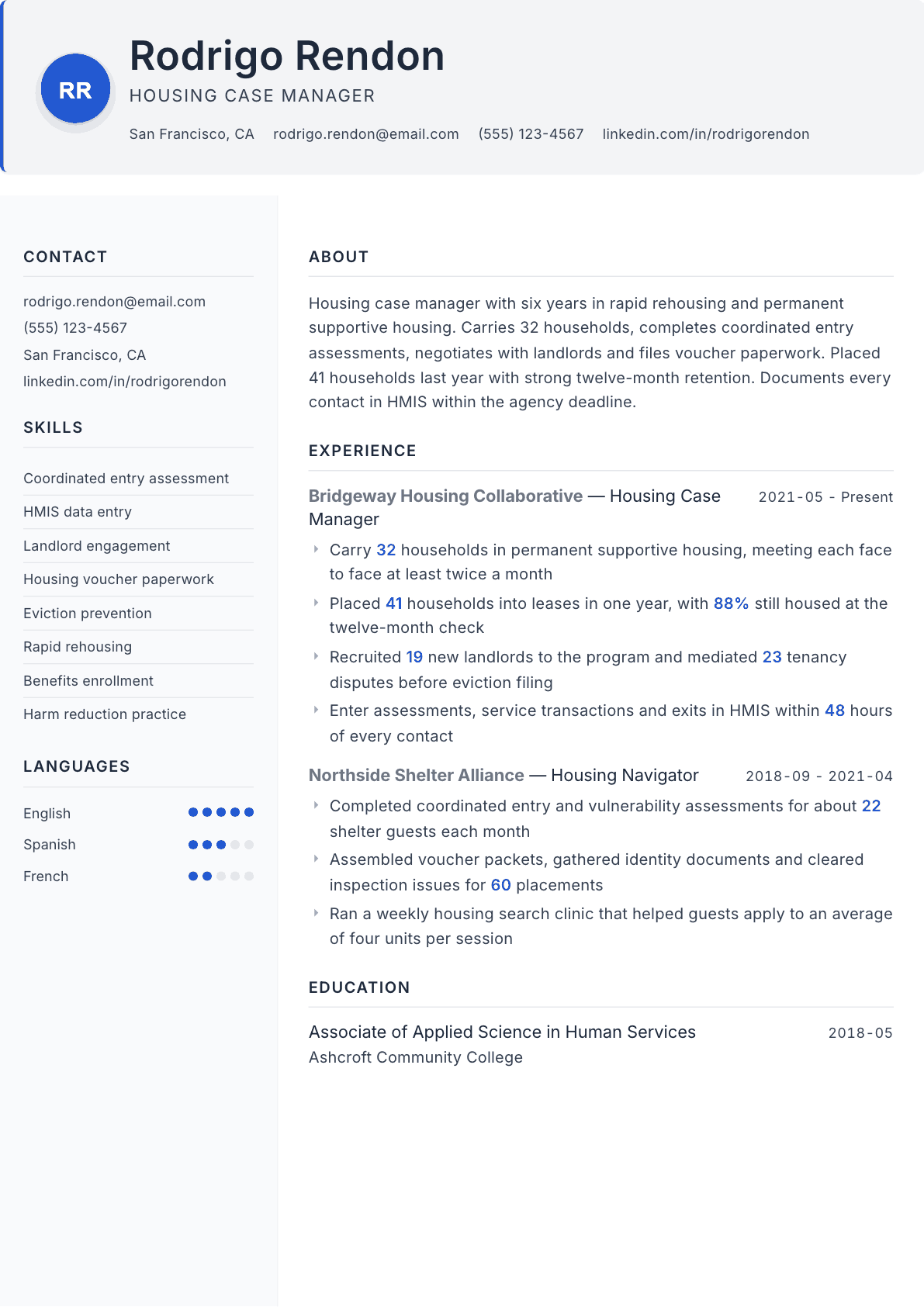
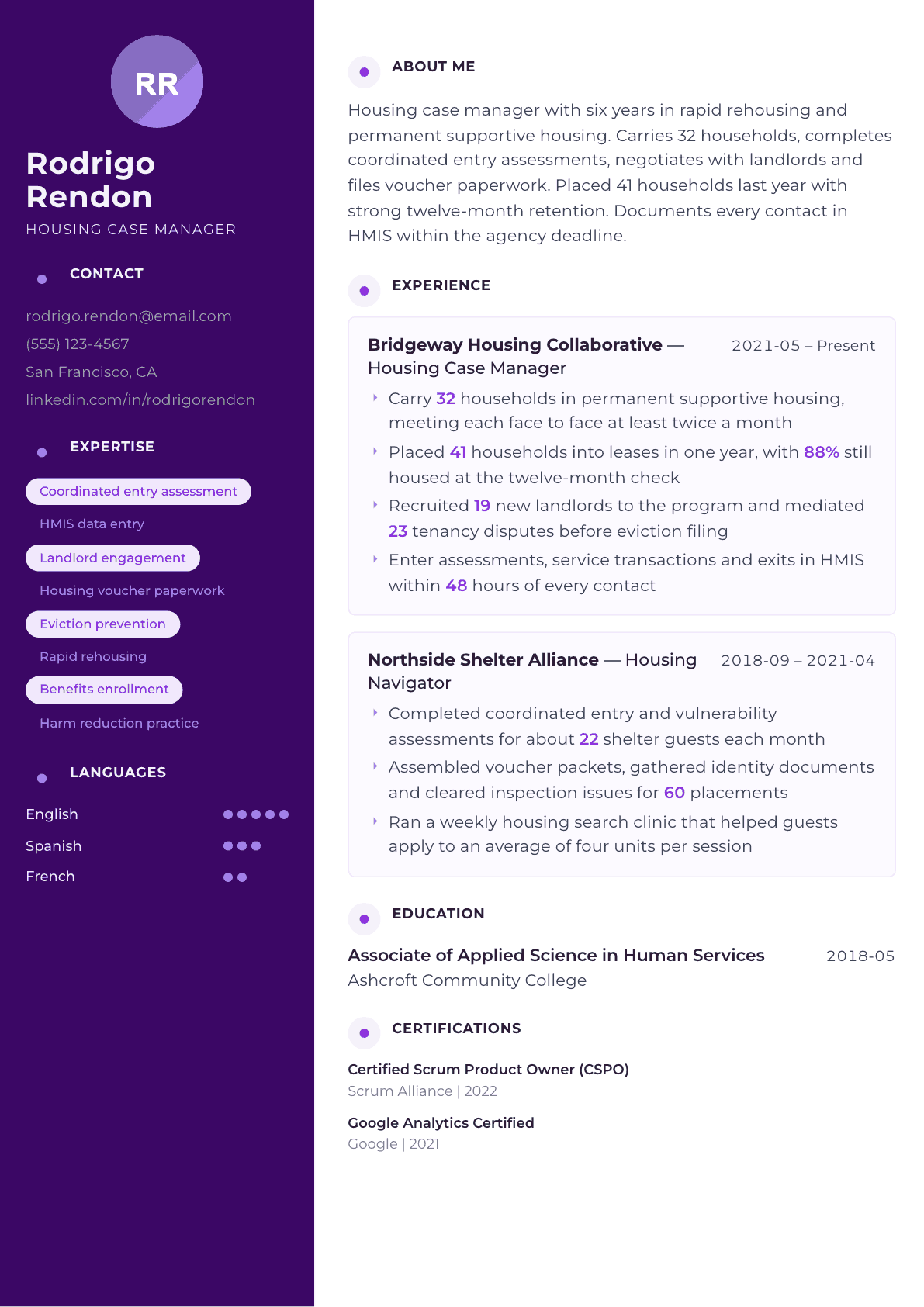
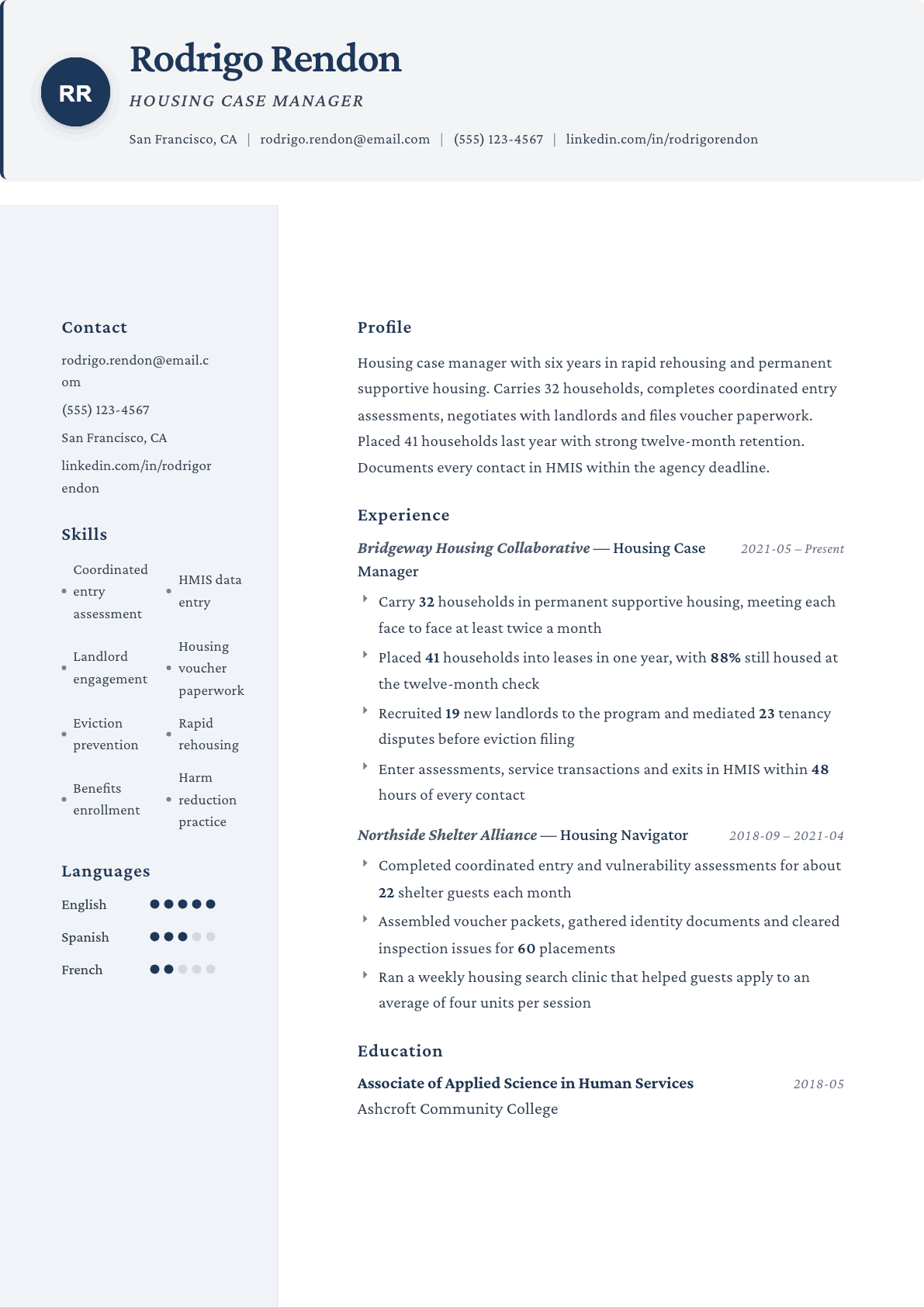
Example Housing Case Manager summary
Housing case manager with six years across shelter navigation, rapid rehousing and permanent supportive housing. Carries 32 households, completes coordinated entry assessments and closes HMIS documentation within two days. Placed 41 households into leases in a single year with strong twelve-month retention, and recruited new landlords to keep the unit pipeline open. Grounded in housing first practice.
Skills to list on a Housing Case Manager resume
- Housing case management
- Coordinated entry
- Vulnerability assessment
- HMIS
- Rapid rehousing
- Permanent supportive housing
- Housing Choice Voucher paperwork
- Landlord recruitment
- Eviction prevention
- Tenancy mediation
- Benefits enrollment
- Harm reduction
- Housing first practice
- Case documentation
What actually gets this resume read
- Lead with placements and retention, because housing funders measure programs on how many households stay housed.
- Name the program model you worked in: rapid rehousing, permanent supportive housing, transitional or diversion.
- Say which data system you used, HMIS or an agency case record, and how fast you close documentation.
- Give landlord recruitment and mediation numbers, since unit supply is the constraint most housing programs hire against.
- Show voucher fluency by naming the paperwork steps you handled, from packet assembly through inspection clearance.
- Include benefits enrollment work such as disability applications, because income stability drives housing retention.
How to write a housing case manager resume
Housing programs live and die on two numbers: how many households moved into a lease, and how many were still in it a year later. A housing case manager resume that never mentions either one is asking a program director to take the most important thing on faith, and directors under a funder contract do not have that kind of faith.
The other half of the job is unglamorous and entirely learnable, which is exactly why proof matters. Coordinated entry assessments, document gathering for a voucher packet, inspection failures, landlord phone calls that have to happen before an eviction filing, and data entry that has to be clean because the continuum of care reports on it. A hiring manager reads for whether you have done that work at volume or only heard it described.
What follows is how to build the page around placements, retention and program model, with summaries for a navigator, an experienced case manager and a program lead, before and after bullets, and the questions that come up when people move between shelter, rapid rehousing and permanent supportive housing.
Lead with the program model, because the models are different jobs
Diversion, shelter navigation, rapid rehousing, permanent supportive housing and transitional housing all sit under the same category and demand different daily work. Rapid rehousing runs on speed and landlord supply with a time-limited subsidy. Permanent supportive housing runs on tenancy sustainment for people with disabilities and no end date. Write the model into the job line so the reader stops guessing.
Add the funding stream if you know it, because it dictates the paperwork you already know how to complete. Continuum of care funded, emergency solutions funded, veteran specific or state funded programs each carry their own eligibility documentation and reporting rhythm.
- Job line: agency, program model, funding stream where relevant, and the households carried at once.
- Say whether the caseload was scattered site or single site, since building based work adds property staff coordination.
- Note the population served: families, single adults, veterans, youth, or people leaving institutional settings.
Placements and retention are the headline, not the footnote
Put move-ins first. Households placed in a year, average days from enrollment to lease signing, and the share still housed at six and twelve months are the metrics a director reports upward, so they are the metrics that get you interviewed. If your program measured returns to homelessness, use that number instead and name it correctly.
Where the number is weak, explain the constraint rather than hiding it. A case manager working a market with almost no affordable units who still placed households by building landlord relationships has a better story than a bare figure. Give the barrier and what you did about it.
Landlord work is the part most resumes leave out
Unit supply, not case management skill, is what limits most housing programs. A candidate who has recruited landlords, negotiated with a property manager after a late rent payment, or resolved a lease violation before it became a filing is solving the program's actual bottleneck. Count new landlords brought into the program, units accessed and disputes mediated.
Describe the tools you used: risk mitigation funds, holding fee agreements, move-in kits, direct payment arrangements and quick response when a landlord calls about noise or damage. Those specifics tell a director you have held the relationship side, which is the hardest part to train.
Assessments, vouchers and data that survives an audit
Coordinated entry is the front door in most communities, so say which assessment tool you administered, how many you completed and whether you sat on the case conferencing or prioritization committee. Then walk the voucher pipeline: packet assembly, identity and income documentation, interim recertifications, inspection scheduling and clearing failed items with a landlord.
Data is where housing case managers quietly get judged. Name the system, say how quickly you entered assessments, service transactions and exits, and mention any data quality cleanup you led. Programs that have failed a data quality review will hire the person who mentions it.
- Name the coordinated entry assessment tool and the volume you completed.
- List the voucher and subsidy types you have processed paperwork for, and the recertification cadence.
- Give your documentation turnaround and any file audit or data quality review you passed.
Tenancy support, benefits and the work that keeps people housed
Retention comes from income, health and neighbor relations, not from the lease itself. Show the benefits work you did: disability applications, general assistance, food benefits, income verification and connections to employment services. Show the health side: coordinating with a clinic, arranging a hoarding cleanup, or bringing a mobile team to a unit before a crisis reached the landlord.
Housing first and harm reduction are framing choices that programs screen for. Rather than naming them as beliefs, describe a decision that shows them: keeping someone housed while they were still using, or working a repayment plan instead of exiting a household from the program.
Housing Case Manager resume summary examples
Housing navigator
Housing navigator with one year in emergency shelter, completing about 22 coordinated entry assessments a month and assembling voucher packets for households moving toward placement. Runs a weekly housing search clinic, gathers identity and income documents, and keeps case notes current in the community data system.
Five years on a caseload
Housing case manager with five years in rapid rehousing and permanent supportive housing, carrying 32 households and meeting each twice monthly. Placed 41 households into leases in one year with strong twelve-month retention, recruited new landlords, and mediated tenancy disputes before eviction filings.
Housing program lead
Housing program lead with nine years across shelter, scattered site and single site portfolios, supervising six case managers and a landlord liaison. Cut average days from enrollment to lease signing by half, chairs community case conferencing, and passed the last two funder file audits without a finding.
Work experience bullets: before and after
Before: Helped clients find housing.
After: Placed 41 households into leases in one year across a scattered site portfolio, averaging 38 days from enrollment to move-in, with 88% still housed at the twelve-month check.
Placements, speed and retention are the three figures a housing director reports to funders, so lead with them.
Before: Worked with landlords in the community.
After: Recruited 19 new landlords into the program using a risk mitigation fund and same-day response guarantee, opening 27 additional units in a market with almost no vacancy.
Naming the incentive and the units gained shows you solved the supply problem rather than merely contacting owners.
Before: Entered client data into the system.
After: Entered assessments, service transactions and program exits within 48 hours of contact, and led a chart cleanup that closed 60 open records before the annual data quality review.
Turnaround and an audit outcome prove data discipline, which is the reason programs lose funding points.
Before: Prevented evictions for program participants.
After: Mediated 23 tenancy disputes before an eviction filing by arranging repayment plans, unit repairs and neighbor agreements, keeping 21 of those households in place.
The intervention count paired with the households retained shows a practiced process rather than an occasional save.
Before: Connected clients to benefits and other services.
After: Completed disability benefit applications with 14 tenants and secured approvals for nine, stabilizing rent portions and reducing the subsidy the program had to carry.
Applications, approvals and the program effect connect benefits work to housing retention instead of listing it as a referral.
Hard skills
- Coordinated entry assessment
- Housing case management
- Homeless management information system data entry
- Rapid rehousing practice
- Permanent supportive housing practice
- Subsidy and voucher paperwork
- Housing inspection coordination
- Landlord recruitment and mediation
- Eviction prevention
- Benefits application support
- Harm reduction practice
- Funder file and data quality audits
Soft skills
- Persistence with hard to reach clients
- Negotiation with property owners
- Nonjudgmental engagement
- Time management across a scattered caseload
- Clear written documentation
- De-escalation in the unit
Certifications worth listing
- HUD Certified Housing Counselor (US Department of Housing and Urban Development)
- Certified Case Manager (CCM) (Commission for Case Manager Certification)
- Mental Health First Aid (National Council for Mental Wellbeing)
Mistakes that cost housing case manager candidates the interview
- Writing a general case management resume with no move-in count, which leaves the reader unable to judge the only outcome the program is funded on.
- Naming the agency but not the program model, so a director cannot tell time-limited rapid rehousing work from permanent supportive housing.
- Skipping landlord engagement, the one skill that most directly relieves the unit shortage every housing program faces.
- Treating data entry as beneath mention when funders score programs on data quality and timeliness.
- Listing housing first as a value without a single decision on the page that demonstrates it.
- Describing referrals made instead of outcomes reached, which reads as paperwork rather than case management.
Housing Case Manager resume questions
What metrics belong on a housing case manager resume?
Households placed, average days from enrollment to move-in, retention at six and twelve months, returns to homelessness if your program tracked it, landlords recruited, and documentation turnaround. Those are the figures housing directors report to funders every quarter.
How do I move from shelter work to a housing case manager role?
Reframe your shelter experience around the housing pipeline: coordinated entry assessments completed, document gathering, housing search sessions run and placements you contributed to. Then name the subsidy paperwork you have touched, because that is the gap hiring managers worry about.
Should I list the data system I used by name?
Yes. Communities run different homeless management information systems and agency case records, and hiring managers filter for prior experience with theirs. Add your entry turnaround and any data quality review you helped the program pass.
How much detail should I give about difficult clients?
Describe the situation type and your intervention, never identifying details. A line about mediating a hoarding related lease violation or arranging a repayment plan shows exactly the judgment a supervisor needs, without exposing anyone in the file.
Do housing case managers need a social work degree?
Often no. Many programs hire on human services coursework or equivalent experience, and value a driver license, data discipline and landlord facing confidence more highly. A licensed clinical role is different, so read the credential line before assuming either way.
Related resume examples
- Case Manager Resume example
- Social Worker Resume example
- Caseworker Resume example
- Community Health Worker Resume example
- Refugee Resettlement Caseworker Resume example
- Peer Support Specialist Resume example