Humanitarian Worker Resume Examples: what gets the call
Write a Humanitarian Worker Resume for Field Deployment
By Mustafa Tarabya, founder of CVBooster · Published · Updated
Humanitarian worker resume example with cluster keywords, beneficiary numbers, security training and a guide to writing field deployments.
Sample resumes for a humanitarian worker
The same humanitarian worker content laid out in three CVBooster templates, so you can see what the finished document looks like before you write a word.
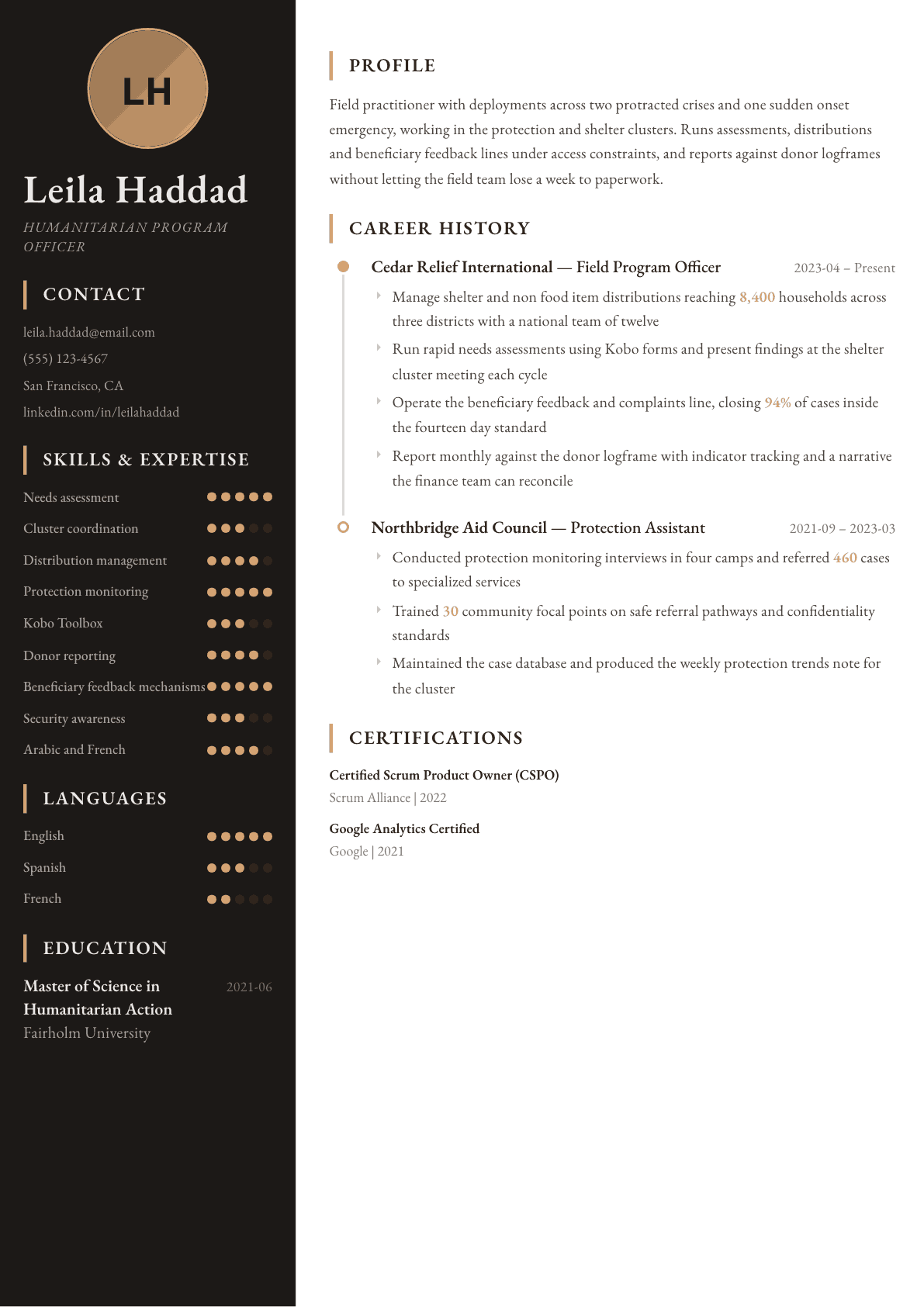
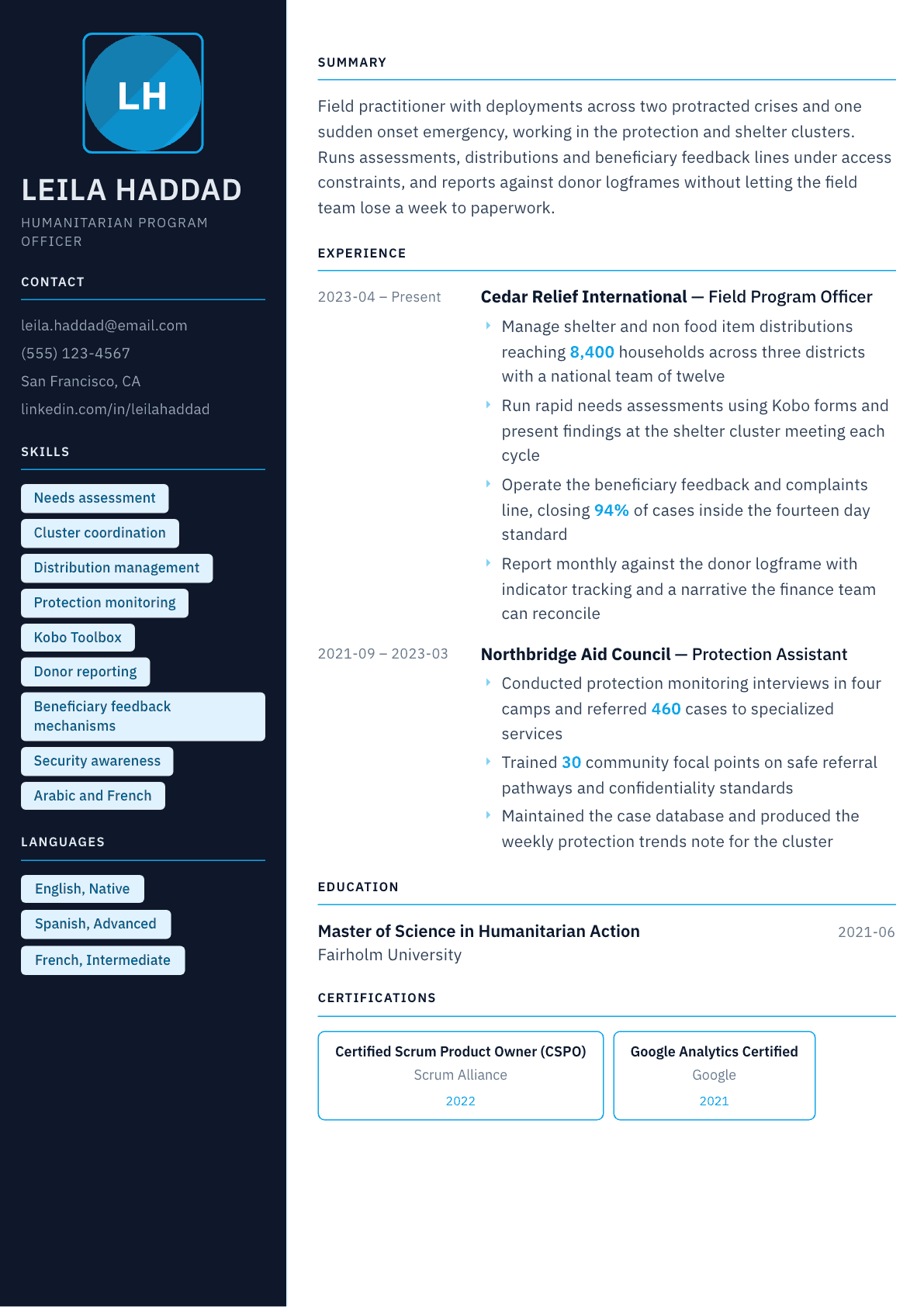
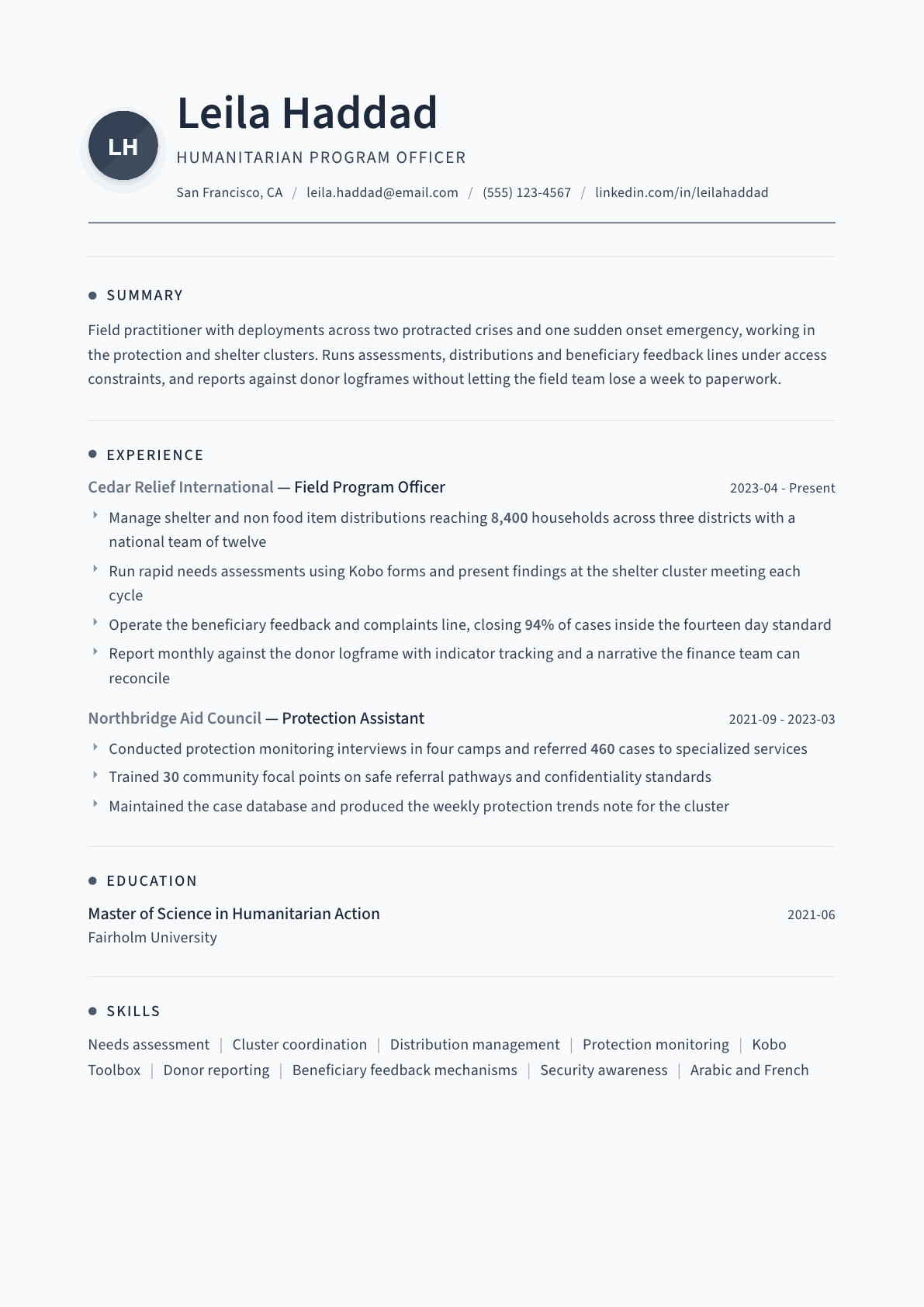
Example Humanitarian Worker summary
Humanitarian worker with deployments across protracted and sudden onset crises in the protection and shelter clusters. Runs assessments, distributions and the beneficiary feedback line under access constraints, supervises national teams, and reports against donor logframes that reconcile against finance. Trained in field security and works in Arabic and French alongside English.
Skills to list on a Humanitarian Worker resume
- Rapid needs assessment
- Shelter and non food item distribution
- Protection monitoring and referral
- Cluster coordination
- Donor logframe reporting
- Indicator tracking
- Kobo Toolbox and mobile data collection
- Beneficiary feedback mechanisms
- Accountability to affected populations
- Cash and voucher assistance
- Field security and access negotiation
- National staff supervision
- Do no harm analysis
- Sphere standards application
What actually gets this resume read
- List each deployment with the country, the crisis type, the cluster and whether the post was national or international.
- Give beneficiary reach as households or individuals and say over what period and how many districts.
- Name the donors whose rules you have worked under, since compliance experience is what a recruiter screens for.
- Show your security training and the access environment you worked in, because deployability is a real hiring criterion.
- Put your data tools on the page, including the mobile assessment forms and the case management system you used.
- Add language levels honestly, since a field team will test them in the first week of a posting.
How to write a humanitarian worker resume
Humanitarian recruitment is a matching exercise under deadline. A recruiter filling a field post has a job description written against a specific donor contract, a start date that is already late, and a security context that rules out half the applicants. Your resume is read for fit against those three constraints before anyone considers your motivation.
The applications that stall are the ones that describe a calling. Passion for helping vulnerable communities appears on nearly every resume in the pile and distinguishes none of them. What distinguishes a humanitarian worker is deployment history, sector, donor rules worked under, beneficiary reach, team size and the ability to produce a report that finance and the donor both accept.
This guide sets out how a humanitarian recruiter reads the page, with summaries for a first international post, a field officer with several deployments and a coordinator, before and after bullets from assessment, distribution and protection work, and the questions aid workers ask between contracts.
Format: deployment history as the spine, sector labels throughout
Organize by deployment. Each entry gives the organization, the country, the position, the contract dates, whether the post was national or international, and the sector or cluster you worked in. Aid contracts are short, so a recruiter expects a dense list and reads it for pattern rather than penalizing you for movement.
Two pages is standard, and many agencies still expect a longer format with a separate block for training, languages and country coverage. Put the country and sector coverage where a recruiter can see it in one glance, because that is the first filter applied to a shortlist.
- Deployment header: organization, country, position, contract dates, national or international post, and cluster.
- A coverage block listing countries worked, sectors covered, and languages with an honest working level.
- A training block for security, safeguarding and technical courses, with the provider named for each.
- A separate line for remote management or hub-based support work, which agencies treat differently from field presence.
Summary: sector, crisis types, donor rules, team size
Four lines: the sectors you deliver in, the crisis types you have worked, the donors whose rules you report under, and the size of the team you have supervised. If you have experience in both sudden onset emergencies and protracted crises, say so, because the operational tempo of the two is completely different and agencies staff them differently.
Add your deployability facts if they are strong. Passport and visa flexibility, willingness to serve in non-family duty stations, and completion of recognized security training all shorten the recruiter's risk calculation, and none of them are visible unless you write them.
Experience: reach, method and the reporting behind it
Every field role needs reach and method. How many households or individuals were served, over what period, across how many districts or camps, and through what modality: in-kind distribution, cash, vouchers, service provision or referral. Reach without modality is a number nobody can interpret.
Then show the machinery underneath. Assessment tools used and sample approach, the targeting criteria and who signed them off, the distribution plan and crowd management, post-distribution monitoring, and the feedback and complaints line. Agencies have been burned by staff who could reach people but could not evidence it, so the evidence trail is what earns the interview.
Protection and safeguarding work needs care rather than volume. Describe referral pathways, confidentiality standards, case management systems and training delivered to community focal points, and never write anything that could identify a survivor or a case.
Donor compliance, budgets and the reports that must reconcile
Name the donors whose rules you have worked under and be specific about the compliance work you personally did: eligibility of costs, procurement thresholds, asset registers, partner agreements and audit preparation. Recruiters screen hard on this because a field officer who cannot produce a compliant report creates a finance problem at headquarters.
On budgets, give the scale you managed as a band and describe the discipline: monthly budget versus actual review, forecast updates, and how you handled an underspend before it became a no-cost extension request. Indicator tracking against the logframe belongs here too, with the reporting cycle you owned.
- Name each donor and the specific compliance rules you applied on their funding.
- Give budget scale as a band and describe the budget versus actual review you ran.
- State the logframe indicators you tracked and the reporting cycle you delivered against.
- Describe one audit or verification exercise you prepared for and what the result was.
Security, safeguarding, tools and keywords
Access and security matter to every hiring decision in this field. State the security training you have completed and the provider, the access environment you worked in, and any role you held in movement planning, incident reporting or acceptance work with community leaders. Do not describe security procedures in detail on a public document.
List the tools you actually operate: mobile data collection forms, case management databases, commodity tracking systems, cash transfer platforms and the office suite you build your reports in. Add the standards vocabulary agencies recruit on: Sphere, core humanitarian standard, accountability to affected populations, do no harm, protection mainstreaming, cluster coordination and needs assessment.
Humanitarian Worker resume summary examples
First international post
Aid worker with two years of national staff experience in protection monitoring and camp-based service referral, moving into a first international post. Conducted 340 monitoring interviews in 2023, trained community focal points on referral pathways, and completed recognized field security training. Works in Arabic, French and English.
Several deployments in
Field program officer with deployments across two protracted crises and one sudden onset emergency in the shelter and protection clusters. Managed distributions reaching 8,400 households in 2024 with a national team of twelve, ran the feedback line, and reported monthly against donor logframes that reconciled to finance.
Area coordinator
Area coordinator managing a sub-office of 40 staff across three districts, holding budget responsibility, access negotiation and program quality for shelter, cash and protection portfolios. Opened a new field base in 2022, prepared two donor audits without findings, and mentored four national officers into management roles.
Work experience bullets: before and after
Before: Distributed relief items to affected communities.
After: Managed shelter and non food item distributions reaching 8,400 households across three districts, running targeting verification, crowd management and post-distribution monitoring for each cycle.
Reach, geography and the full distribution process show program management rather than presence at a handover.
Before: Carried out needs assessments.
After: Ran rapid needs assessments across nine sites using mobile data forms, trained six enumerators on the questionnaire, and presented findings at the shelter cluster meeting within four days of collection.
Tool, team, sites and turnaround time are what a cluster coordinator uses to judge assessment capacity.
Before: Handled beneficiary complaints.
After: Operated the feedback and complaints line across three districts, closing 94% of cases inside the fourteen day standard and referring sensitive cases to the protection focal point the same day.
A closure rate against a stated standard, plus a safe referral route, evidences accountability rather than claiming it.
Before: Reported to donors on program progress.
After: Delivered monthly indicator tracking and narrative reports against the donor logframe, reconciling activity data with finance before submission and clearing two verification visits without findings.
The reconciliation step and the verification result are the specifics a compliance-minded recruiter looks for.
Before: Supervised local staff in the field.
After: Supervised a national team of twelve across two field bases, set weekly work plans, ran performance conversations in Arabic, and developed three team members into supervisory roles.
Team size, working language and staff development turn supervision into evidence of management capacity.
Hard skills
- Rapid and in-depth needs assessment
- Distribution planning and post-distribution monitoring
- Cash and voucher assistance
- Protection monitoring and safe referral
- Cluster coordination and representation
- Donor logframe and indicator reporting
- Budget management and forecast review
- Mobile data collection tools
- Case management databases
- Procurement and asset management in the field
- National staff supervision and development
- Access negotiation and acceptance work
- Audit and verification preparation
Soft skills
- Steadiness in an environment that changes every week
- Saying no to a request that would compromise targeting criteria
- Working through interpreters without losing the thread
- Living and working with the same small team for months
- Handling distress without carrying it into the next site visit
Certifications worth listing
- Core Humanitarian Standard on Quality and Accountability (CHS Alliance)
- Sphere Handbook Training (Sphere Association)
- Project Management for Development Professionals (PMD Pro) (PM4NGOs)
Mistakes that cost humanitarian worker candidates the interview
- Opening with a statement of personal calling instead of sector, crisis type and deployment history.
- Giving beneficiary reach with no modality, no period and no geography, which makes the number impossible to read.
- Leaving donors unnamed when compliance experience is the sharpest filter a recruiter applies.
- Writing protection work in a way that could identify a case or a survivor.
- Omitting security training and duty station flexibility, which decide whether you are deployable at all.
- Listing tools you have seen rather than the ones you can build a form or a report in unsupervised.
Humanitarian Worker resume questions
How do I move from national staff to an international post?
Lead with the technical depth national staff usually have more of: assessment, community engagement, language and context knowledge. Then evidence the parts agencies worry about, such as donor reporting, budget handling and working across an office you did not grow up in.
How long should a humanitarian resume be?
Two pages for most field roles, three when you have many short deployments and a long training list. Many agencies also require their own application form, so keep a master document with full detail and cut it down for each specific vacancy.
Do I need to name the donors I have worked with?
Yes, because donor rules differ enough that experience with one does not transfer automatically to another. Name them and say what you personally handled under each, whether that was procurement thresholds, cost eligibility, partner agreements or audit preparation.
How should I handle short contracts and gaps between deployments?
List short contracts normally and let the pattern speak, since everyone in the sector recognizes it. For gaps, a one-line entry naming recovery time, study, a home country role or a rest period is far better than an unexplained hole in the dates.
What if my experience is development rather than emergency response?
Say so plainly and highlight the transferable machinery: assessment, targeting, partner management, donor compliance and monitoring. Then be specific about any surge, rapid onset or displacement work you have done, since agencies want to know you can operate at emergency tempo.
Related resume examples
- International Development Consultant Resume example
- NGO Program Officer Resume example
- Social Worker Resume example
- Executive Director (Nonprofit) Resume example
- Public Health Director Resume example
- Emergency Management Coordinator Resume example