International Development Consultant Resume Examples
Build an International Development Consultant Resume for Donor Bids
By Mustafa Tarabya, founder of CVBooster · Published · Updated
International development consultant resume example with evaluation keywords, donor experience and a guide to writing assignments and results.
Sample resumes for a international development consultant
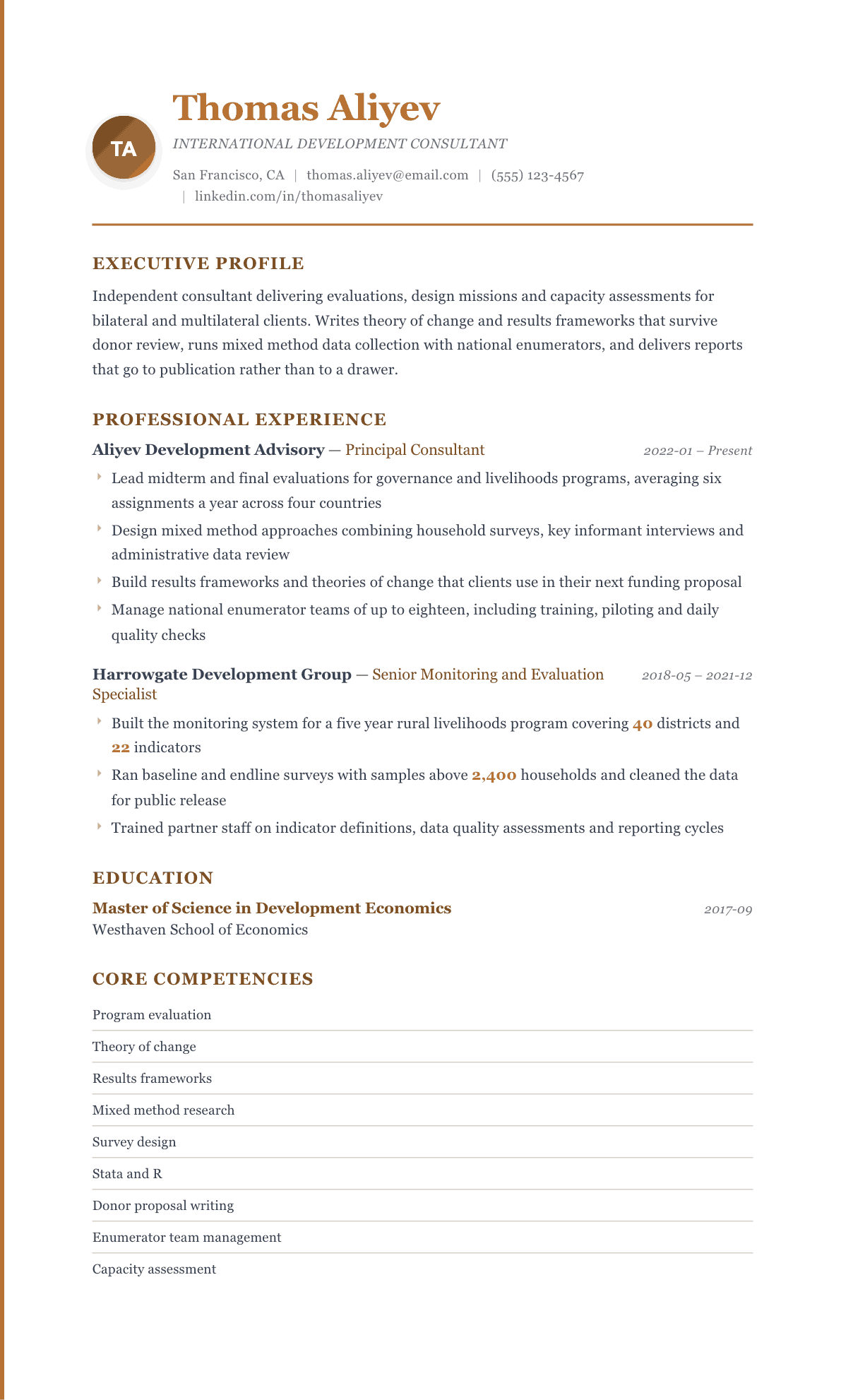
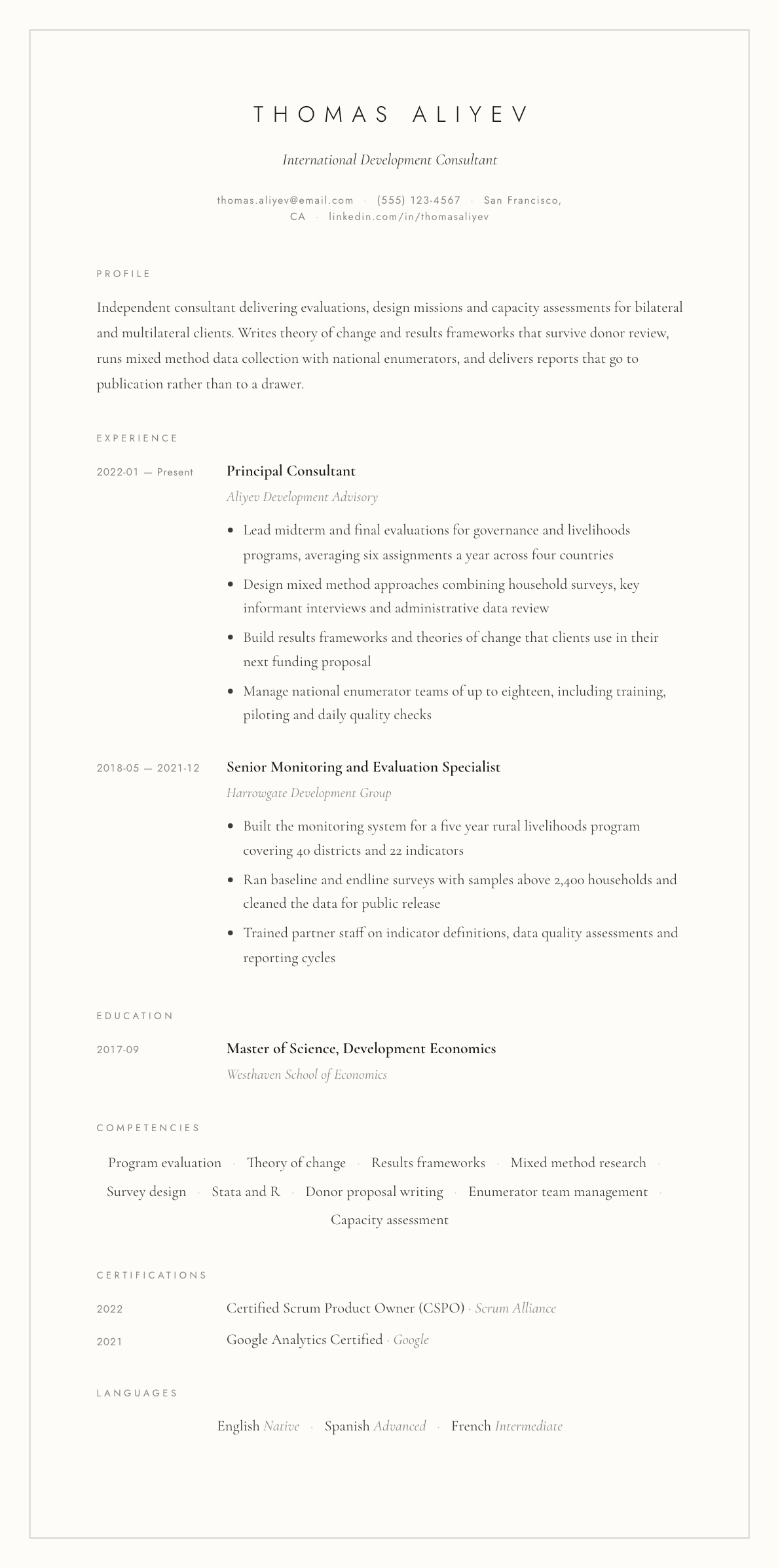
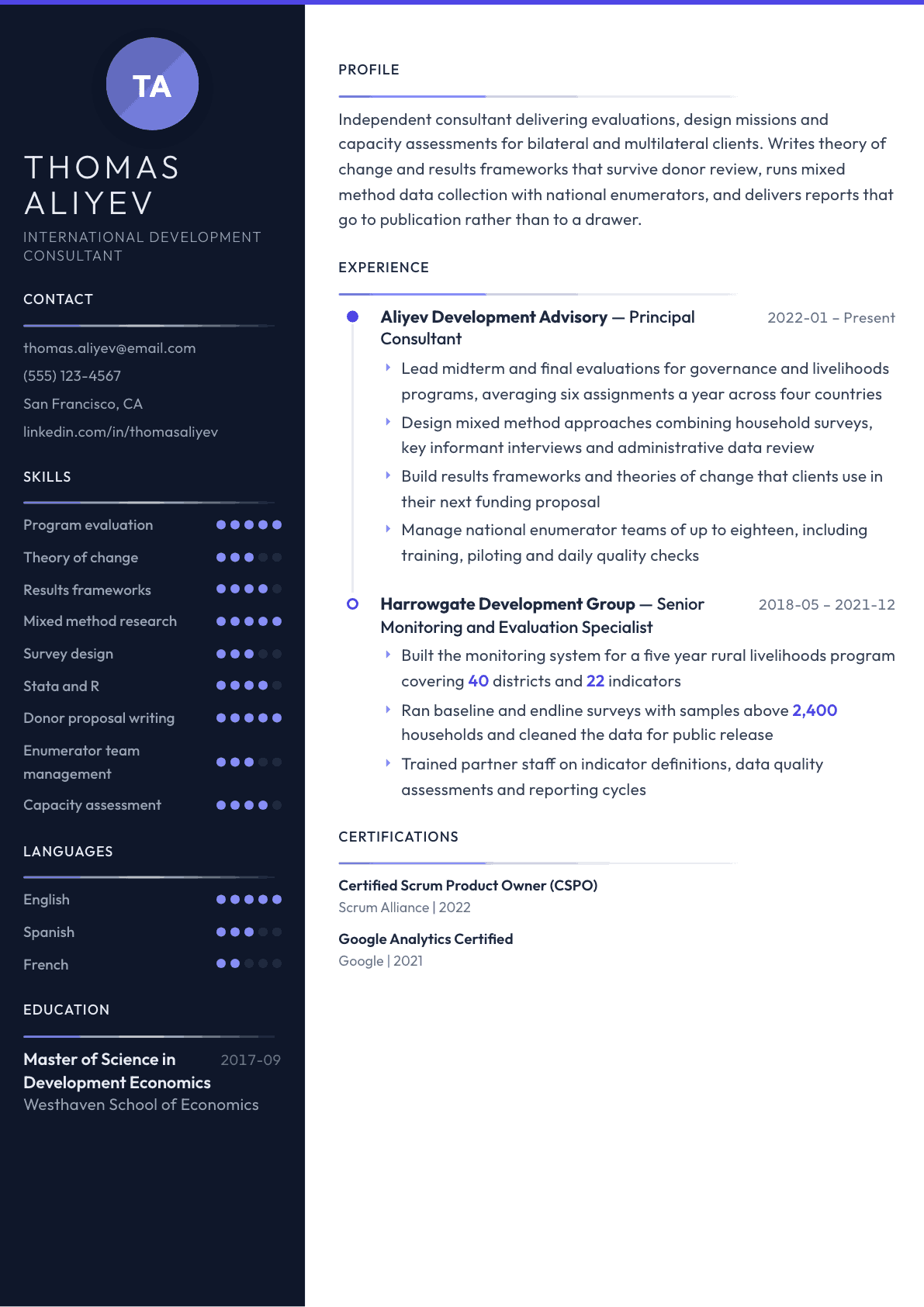
The same international development consultant content laid out in three CVBooster templates, so you can see what the finished document looks like before you write a word.
Example International Development Consultant summary
International development consultant delivering evaluations, design missions and capacity assessments for bilateral and multilateral clients across governance and livelihoods portfolios. Builds theories of change and results frameworks that survive donor technical review, runs mixed method data collection with trained national enumerator teams, and writes reports clients publish. Works in Russian and French alongside English.
Skills to list on a International Development Consultant resume
- Midterm and final evaluation
- Theory of change design
- Results framework development
- Mixed method data collection
- Household survey design
- Key informant interviews
- Data quality assessment
- Stata, R and SPSS analysis
- Donor proposal and bid writing
- Enumerator training and supervision
- Institutional capacity assessment
- Value for money analysis
- Gender and inclusion analysis
- Workshop facilitation
What actually gets this resume read
- Structure the resume by assignment, giving the client, the country, the sector and the deliverable for each one.
- Name the evaluation type for every job, whether midterm, final, process, impact or a design mission.
- List the donors and multilateral clients you have delivered for, since bid teams score exactly that experience.
- Give sample sizes, district counts and indicator counts so a technical reviewer can judge the scale of your work.
- Show your analysis software and whether you clean and code the data yourself or supervise someone who does.
- Add country and language coverage in one block, because proposal managers screen consultants on geography first.
How to write a international development consultant resume
An international development consultant resume rarely gets read the way other resumes do. It is pasted into a proposal, scored against a terms of reference by a technical evaluator, and compared line by line against two other candidates for the same key expert position. The scoring grid usually rewards years of relevant experience, country coverage, methodology and degree level, in that order.
That changes how the page should be built. A narrative about a career serving communities scores nothing. What scores is a legible assignment record with client, country, sector, dates, your role and the deliverable, plus a methods block a technical reviewer can check against the evaluation approach the terms of reference demands.
This guide explains how to write for both the proposal manager and the technical evaluator, with summaries at three points in a consulting career, before and after bullets from evaluation and monitoring assignments, and the questions consultants ask when moving from a staff job into independent work.
Format: assignment record, not employment history
Organize by assignment. Each entry names the client, the funding source, the country, the sector, the dates, your position on the team and the deliverable produced. Proposal managers copy this straight into a personnel annex, and an assignment record that is already in that shape gets used more often than one they have to rewrite.
Length is not the constraint it is elsewhere. Development consultants commonly run several pages because evaluators score coverage. Keep it long but disciplined: every assignment carries the same fields in the same order so a reviewer can scan a column rather than read prose.
- Assignment header: client, funder, country, sector, dates, your role, and the deliverable.
- A country and language block near the top, since geographic coverage is often a scored criterion.
- A methods block naming the evaluation designs and analysis techniques you have personally applied.
- A publications and public reports list, because a published evaluation is the strongest evidence you can offer.
Summary: sector depth, methods, funders and languages
Four things in the first lines: the sectors you are technically credible in, the evaluation and research methods you use, the funders whose procedures you know, and your working languages. A consultant who is genuinely strong in two sectors will always score better than one claiming eight, because a technical evaluator reads breadth as thinness.
Then state your position level honestly. Team leader, key expert, senior specialist and junior researcher are scored categories, and claiming a level you have not held is caught quickly when the evaluator recognizes the assignment or the client.
Assignments: role, method, scale and what the client did with it
For each assignment, say what kind of study it was: baseline, midterm, final evaluation, process evaluation, impact evaluation, design mission, capacity assessment or strategy review. Then give the method and the scale: sampling approach, sample size, number of districts, number of key informant interviews and focus groups, and how data quality was checked.
The strongest closing line for an assignment is what happened next. A results framework adopted into the next phase of a program, recommendations taken into a country strategy, a report published by the commissioning agency, or a methodology reused across a portfolio. Evaluators read use as the difference between a report and a deliverable.
Be exact about your role on team assignments. Team leader, methodology lead, sector specialist, quality assurance reviewer and national expert are different jobs, and a proposal manager needs to know which one you can be scored for.
Methods: the block a technical evaluator actually reads
Build a dedicated methods block rather than scattering technique through the assignment list. Name the qualitative approaches, the quantitative designs, the sampling strategies, the analysis software and the frameworks you apply, and be honest about which ones you have led versus supported.
Include the things clients increasingly ask for by name: theory of change reconstruction, contribution analysis, outcome harvesting, most significant change, difference in differences, propensity score matching, value for money assessment and gender and social inclusion analysis. Only list what you can defend in an inception meeting.
- Separate qualitative and quantitative methods so an evaluator can score both.
- Name analysis software and say whether you clean and code data yourself.
- List the evaluation criteria frameworks you write against and the standards you follow.
- State your experience training and supervising national enumerator teams, including pilot and quality checks.
Business of consulting, ethics and keywords
Independent consulting is a business, and the resume should show that you can run one: multiple concurrent assignments, contracting through prime implementers as well as direct, day rate structures negotiated professionally, and delivery to deadline. A proposal manager is choosing someone who will not disappear mid-inception.
Ethics deserve a line. Informed consent procedures, data protection for respondents, safeguarding during fieldwork and conflict of interest declarations are all things clients now check, and a consultant who names them looks like someone who has been through an ethical review rather than around it.
Keywords that carry into procurement searches: evaluation, monitoring, results framework, theory of change, mixed methods, key informant interviews, focus group discussions, data quality assessment, capacity assessment, value for money, gender analysis, inception report, terms of reference and key expert.
International Development Consultant resume summary examples
Research analyst moving independent
Monitoring and evaluation analyst with four years on implementer teams, supporting baseline and endline surveys and cleaning household data for public release. Contributed to two published evaluations in 2023 and 2024, works in Stata and R, and is bidding for junior expert positions on governance and livelihoods assignments.
Key expert on assignments
Development consultant delivering six evaluation and design assignments a year across four countries as key expert or methodology lead. Builds theories of change and results frameworks that clients carry into the next funding phase, and manages national enumerator teams of up to eighteen through training, piloting and daily quality checks.
Team leader
Team leader on multi-country evaluations since 2019, responsible for inception design, quality assurance and client engagement across governance, livelihoods and public financial management portfolios. Published five commissioned evaluations, trains junior consultants, and works in Russian, French and English.
Work experience bullets: before and after
Before: Conducted evaluations for development programs.
After: Served as team leader on a final evaluation of a five year rural livelihoods program, designing a mixed method approach across 40 districts and delivering an inception report accepted without revision.
Role, evaluation type, scale and an inception outcome give a technical evaluator something to score.
Before: Collected data in the field.
After: Designed and supervised a household survey of 2,400 respondents, trained eighteen enumerators, piloted the instrument over three days and ran daily consistency checks before upload.
Sample size, team, piloting and quality control describe a survey a reviewer can trust.
Before: Built monitoring systems for a client.
After: Rebuilt a program monitoring system around 22 indicators with written definitions, data source mapping and a quarterly data quality assessment routine partner staff still run independently.
Indicator count, definition discipline and continued use prove the system was adopted rather than delivered.
Before: Wrote reports with recommendations.
After: Delivered an evaluation whose theory of change reconstruction and eight prioritized recommendations were carried directly into the client's next country strategy and published on their evaluation portal.
Publication and downstream use are the strongest evidence a consultant can put on a page.
Before: Worked with local partners during assignments.
After: Ran capacity assessments with four national partners using an institutional scoring tool, then facilitated action planning workshops that produced signed improvement plans for each organization.
A named tool, a facilitated process and a signed output turn partner work into a deliverable.
Hard skills
- Baseline, midterm and final evaluation design
- Theory of change reconstruction
- Results framework and indicator development
- Mixed method research design
- Household survey sampling and instrument design
- Key informant interviews and focus group facilitation
- Data quality assessment routines
- Stata, R and SPSS analysis
- Qualitative coding software
- Value for money assessment
- Gender and social inclusion analysis
- Institutional capacity assessment
- Enumerator training and field supervision
- Proposal and expression of interest writing
Soft skills
- Delivering findings a client did not want to hear
- Facilitating a workshop where partners disagree openly
- Working through a fixer and an interpreter in an unfamiliar district
- Holding an inception deadline while three assignments overlap
- Building trust with national experts who know the context better
Certifications worth listing
- Project Management for Development Professionals (PMD Pro) (PM4NGOs)
- Credentialed Evaluator (Canadian Evaluation Society)
- Project Management Professional (PMP) (Project Management Institute)
Mistakes that cost international development consultant candidates the interview
- Writing an employment history when proposal managers need an assignment record with client, country, dates and deliverable.
- Claiming sector coverage across eight fields, which a technical evaluator reads as thin rather than versatile.
- Overstating your team position on an assignment the evaluator may well have commissioned.
- Listing methods you have read about instead of the ones you can defend in an inception meeting.
- Leaving out sample sizes, district counts and indicator counts, so nobody can judge the scale of your work.
- Omitting published reports and adopted frameworks, which are the only third-party evidence a consultant has.
International Development Consultant resume questions
How long should an international development consultant resume be?
Longer than a standard resume. Three to six pages is normal because technical evaluators score coverage of countries, sectors and methods. Keep every assignment in an identical format so length never turns into density a reviewer has to fight through.
What does a proposal manager need from my resume?
Fields they can lift straight into a personnel annex: position title, years of relevant experience, degrees, languages, country list and assignment detail with dates. Supply a version already in that structure and you will be put forward more often.
How do I move from an implementer staff role to consulting?
Reframe your staff work as assignments with clients, deliverables and methods, then take a first subcontracted role on someone else's team to build a citable record. A named deliverable under a recognized funder matters more than the job title you left behind.
Should I list the funders behind my assignments?
Yes, because procedures, reporting formats and evaluation standards differ by funder and evaluators screen on that familiarity. Name the funder alongside the contracting client, since consultants are often engaged through a prime implementer rather than directly.
How do I handle confidential or unpublished evaluations?
List the assignment, the client, the country and the type of study, and describe the method without quoting findings. Note that the report is unpublished, which is common and understood, and offer references who can speak to the quality of the work.
Related resume examples
- NGO Program Officer Resume example
- Humanitarian Worker Resume example
- Policy Analyst Resume example
- Program Director Resume example
- Public Policy Analyst Resume example
- Government Contractor Resume example