NGO Program Officer Resume Examples: what gets the call
Write an NGO Program Officer Resume That Shows Portfolio Ownership
By Mustafa Tarabya, founder of CVBooster · Published · Updated
NGO program officer resume example with grant management keywords, partner oversight tips and a guide to writing budgets and program results.
Sample resumes for a ngo program officer
The same ngo program officer content laid out in three CVBooster templates, so you can see what the finished document looks like before you write a word.
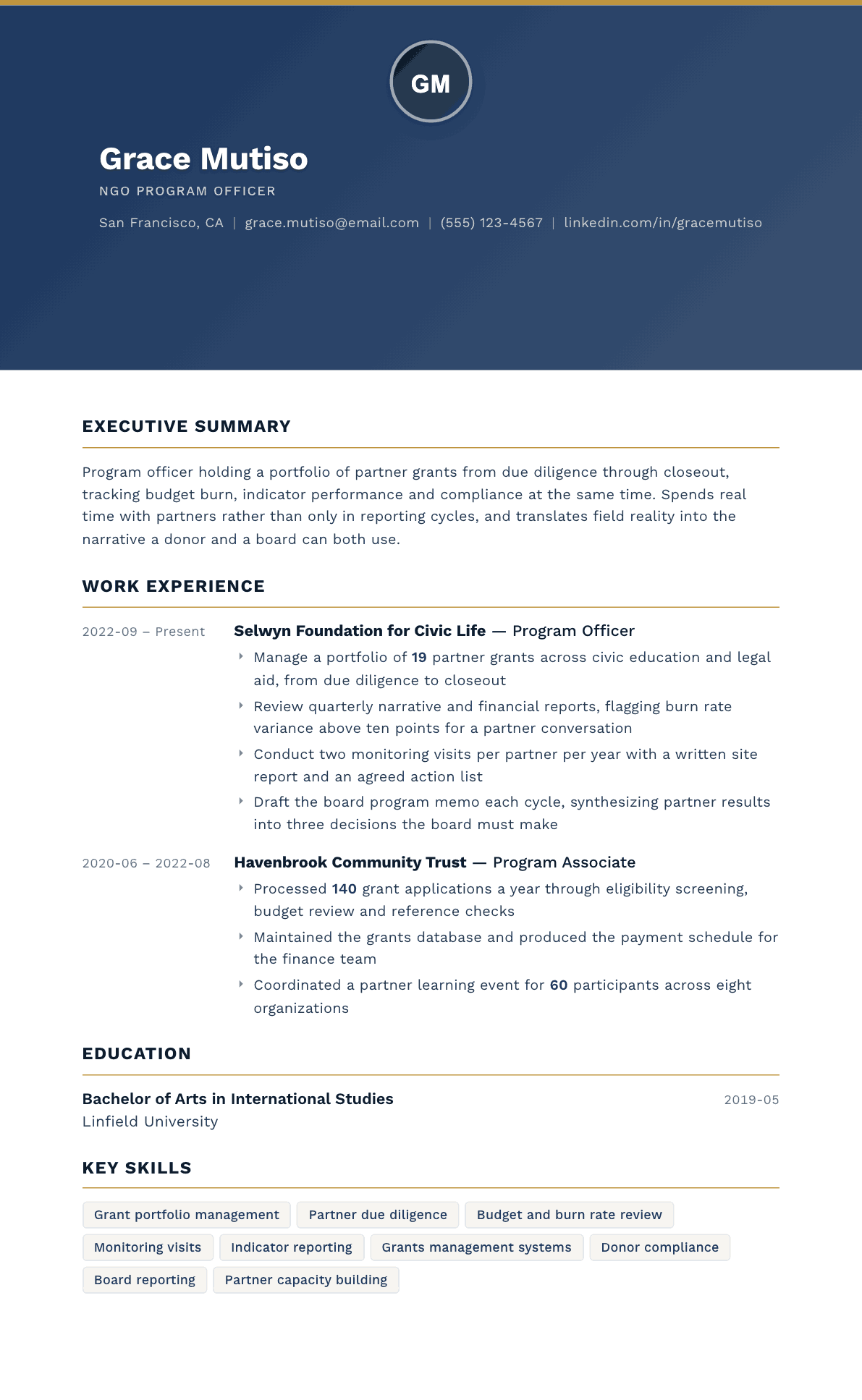
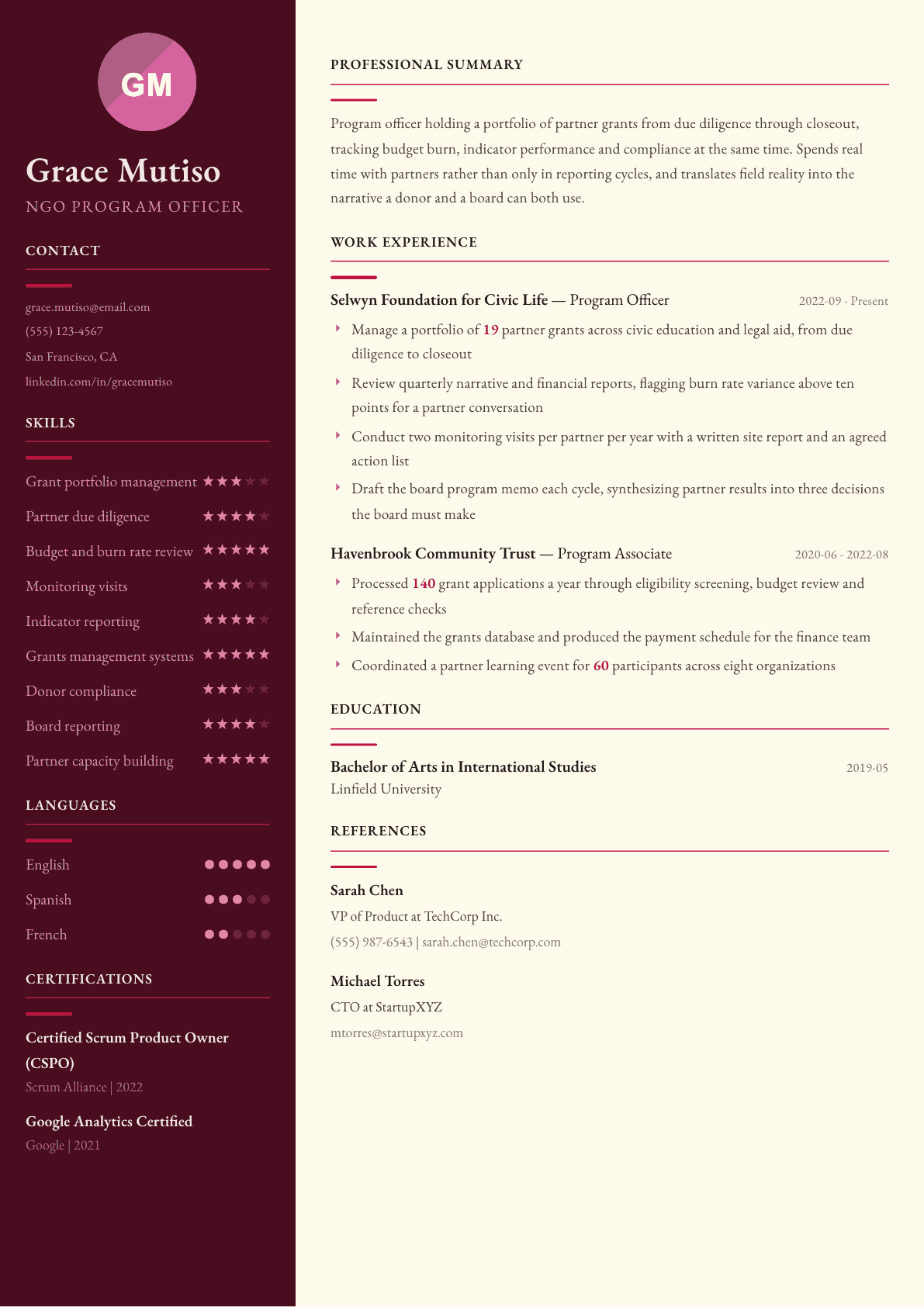
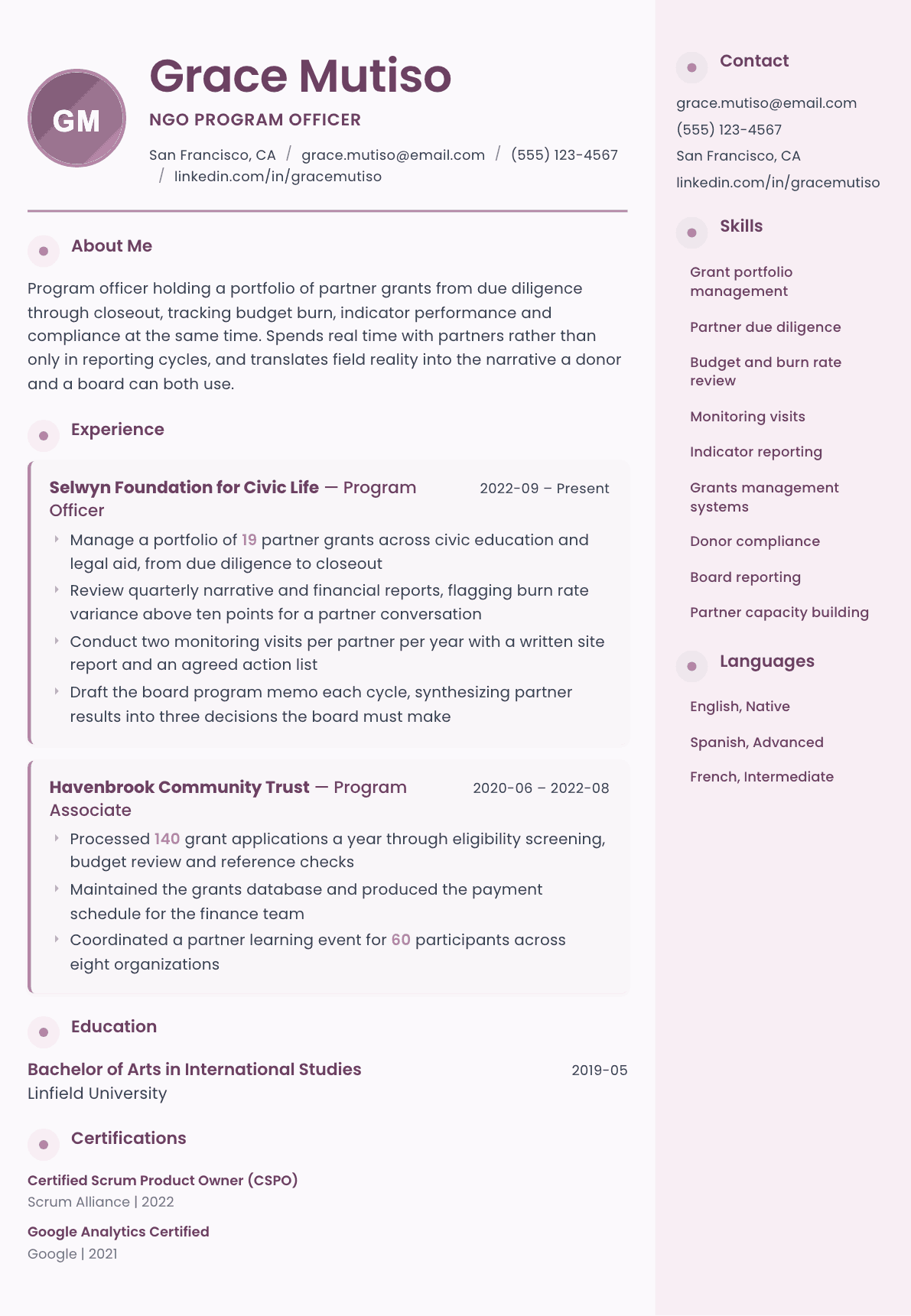
Example NGO Program Officer summary
NGO program officer carrying a portfolio of partner grants across civic education and legal aid from due diligence through closeout. Reviews narrative and financial reports together, spots burn rate variance early, and runs monitoring visits that produce agreed action lists rather than trip notes. Writes the board program memo each cycle and strengthens partner systems between reporting deadlines.
Skills to list on a NGO Program Officer resume
- Grant portfolio management
- Partner due diligence and vetting
- Budget review and burn rate analysis
- Monitoring and site visits
- Indicator and results reporting
- Grants management databases
- Donor compliance review
- Subaward agreements
- Board and committee memos
- Partner capacity strengthening
- Risk rating and mitigation plans
- Grant closeout and audit support
- Learning and evaluation cycles
- Cross team coordination
What actually gets this resume read
- Say how many active grants you carry and the total value band of the portfolio, without naming exact award figures.
- Describe the full grant cycle you own, from due diligence and budget review through monitoring visits to closeout.
- Name the grants management system you work in, because a new officer who knows it starts producing much faster.
- Show how you handle a partner in trouble, since managing a struggling grant is the hardest part of the job.
- Give the donor rules you report under, whether public funder, foundation or multilateral, and be exact about it.
- Include the writing you do for boards and donors, because a program officer lives in memos more than spreadsheets.
How to write a ngo program officer resume
The program officer title covers two related jobs, and a resume that does not pick one confuses everybody. On the funder side, a program officer manages a portfolio of grants: due diligence, award, monitoring, closeout and the memo that goes to a board. On the implementer side, a program officer runs delivery: workplans, budgets, partners, indicators and donor reports. Both are real, and the hiring managers screen for different things.
What they share is portfolio ownership. The reader wants to know how many grants or projects you carried at once, what you were trusted to decide alone, how you spotted a problem before it reached the audit, and whether your writing is good enough to put in front of a board or a donor without a rewrite.
This guide sets out how to build the page for either side of the desk, with summaries for an associate, an officer holding a full portfolio and a senior officer, before and after bullets on grant monitoring and budget work, and the questions program staff ask when they move between funders and implementers.
Format: state your side of the grant relationship first
Put a single line under your name saying whether you sit on the funder side or the implementer side, and the sectors you work in. Everything after that is read through that lens, and a reader who has to infer it from context will guess wrong at least half the time.
One to two pages, reverse chronological. Under each job, give the portfolio size in the header rather than burying it in a bullet: the number of active grants or projects, the sectors, the geography and the team you worked with. That header is what a hiring manager compares across candidates.
- Header line: funder side or implementer side, sectors, and the geography you cover.
- Each job opens with active grant or project count, sectors, geography and reporting line.
- A separate block for the grant systems and databases you have administered.
- A short writing block naming the products you own: board memos, donor reports, site visit reports, learning briefs.
Summary: portfolio size, decision authority, sector, writing
Say how many grants or projects you hold, what you decide without escalation, which sectors you know well and what you write regularly. Decision authority is the most underused line on these resumes. An officer who can approve a budget revision within a threshold, or recommend a renewal without a supervisor rewriting the memo, is doing a materially different job from one who prepares packets for someone else.
Keep the sector claim narrow. Two or three areas where you can hold a real conversation with a partner beats a list of ten. Program officers are hired to have judgment about a field, and judgment does not stretch that far.
Experience: the full grant cycle, including the ugly parts
Walk the cycle. Due diligence and vetting, budget review, award structuring, disbursement schedule, monitoring visits, report review, amendment or restructure, closeout. Say which pieces you owned outright and which you supported, because the gap between preparing a due diligence packet and signing off on risk rating is the gap between an associate and an officer.
The strongest bullets are about grants that went wrong. A partner missing targets, a burn rate far behind plan, a leadership change mid-grant, an audit finding, a safeguarding concern. Describe what you noticed, what you did, and how the grant ended. Hiring managers know every portfolio has these, and a page without one reads as a portfolio somebody else was actually managing.
Report review deserves its own bullet. Reading a narrative report against the financial report and the indicator table, and noticing when the three do not agree, is the core technical skill of the job and almost nobody writes it down.
Money, compliance and partner capacity
Give budget scale as a band rather than exact award values, and describe the review you run: budget versus actual, variance thresholds that trigger a conversation, forecast updates and the no-cost extension decision. On the implementer side, add procurement and subaward oversight if you handled them.
Compliance work should be specific to the funder type. Public funders, foundations and multilateral donors have different rules on eligible costs, indirect recovery, reporting formats and audit expectations. Name the ones you have worked under and what you personally reviewed.
Partner capacity strengthening is where funder-side officers show their value. Describe assessments run, the improvement plans agreed, and any partner that measurably improved its financial or program systems while you held the relationship.
- Give portfolio value as a band and the variance threshold that triggers your intervention.
- Name the funder types whose compliance rules you have applied and what you reviewed.
- Describe a capacity assessment and the improvement plan that came out of it.
- Say how many monitoring visits you conduct a year and what the written output looks like.
Systems, writing and keywords
Name the grants management system you work in and what you do inside it: application intake, review workflow, payment scheduling, report tracking and reporting to leadership. Organizations run different platforms, and someone who has administered one rather than only entered data into it starts producing far sooner.
Writing is half this job, so evidence it. Board memos, docket write-ups, funding recommendations, site visit reports and learning briefs are all products a hiring manager can ask to see. Say how often you produce them and who the audience is.
Keywords that appear in program officer postings: grant portfolio, due diligence, risk rating, subaward, disbursement schedule, burn rate, budget revision, monitoring visit, indicator tracking, closeout, capacity strengthening, docket, board memo and learning agenda.
NGO Program Officer resume summary examples
Program associate
Program associate processing 140 grant applications a year through eligibility screening, budget review and reference checks, and maintaining the grants database and payment schedule. Coordinated a partner learning event for 60 participants in 2023. Moving toward officer-level portfolio ownership in civic engagement funding.
Officer with a full portfolio
Program officer holding 19 active partner grants across civic education and legal aid, from due diligence through closeout. Reviews narrative and financial reports together, flags burn rate variance early, conducts two monitoring visits per partner a year, and drafts the board program memo each docket cycle.
Senior program officer
Senior program officer leading a strategy area with a portfolio of 30 grants and two associates. Sets the funding docket, chairs the risk review, restructured four underperforming grants in 2024 rather than terminating them, and represents the foundation in two national funder collaboratives.
Work experience bullets: before and after
Before: Managed a portfolio of grants.
After: Managed 19 active partner grants across civic education and legal aid, owning due diligence, award structuring, disbursement scheduling, monitoring and closeout for each.
The count, the sectors and the named stages show what portfolio ownership actually involved.
Before: Reviewed partner reports.
After: Reviewed quarterly narrative reports against financial reports and indicator tables, flagging burn rate variance above ten points and opening a documented conversation with the partner within a week.
Reading three documents against each other with a trigger threshold is the technical core of the job.
Before: Visited partners in the field.
After: Conducted two monitoring visits per partner each year, producing a written site report with an agreed action list and a follow-up date logged in the grants system.
Frequency plus a documented output and a tracked follow-up separates monitoring from a courtesy visit.
Before: Helped a struggling partner improve.
After: Restructured a grant with a partner that had lost its finance lead, moving to a milestone disbursement schedule and a monthly check-in, and the partner closed the grant against revised targets.
Naming the problem, the mechanism used and the outcome shows judgment on the hardest part of the role.
Before: Wrote memos for leadership.
After: Drafted the board program memo each docket cycle, synthesizing partner results into three decisions the board needed to make and the trade-off attached to each.
Framing a memo around decisions rather than updates is what makes a program officer useful to a board.
Hard skills
- Grant portfolio management
- Partner due diligence and vetting
- Risk rating and mitigation planning
- Budget review and variance analysis
- Disbursement scheduling
- Monitoring and site visit reporting
- Indicator and results tracking
- Grants management databases
- Subaward and partner agreements
- Donor and funder compliance review
- Grant restructuring and closeout
- Board and docket memo writing
- Partner capacity assessment
Soft skills
- Raising a hard question with a partner without damaging the relationship
- Reading between the lines of a report that is too smooth
- Balancing advocacy for a partner with duty to the institution
- Writing for a board that has ten minutes and one decision
- Holding a portfolio calendar without losing the small grants
Certifications worth listing
- Grants Management Certificate (National Grants Management Association)
- Certified Nonprofit Professional (Nonprofit Leadership Alliance)
- Project Management for Development Professionals (PMD Pro) (PM4NGOs)
Mistakes that cost ngo program officer candidates the interview
- Not saying whether you sit on the funder side or the implementer side, which changes how every bullet is read.
- Describing the job as supporting programs without ever giving the number of grants or projects you held.
- Leaving out decision authority, so a reader cannot tell whether you recommended or approved.
- Presenting only successful grants and never the one that had to be restructured or closed early.
- Skipping the report review skill, which is the quiet technical center of the role.
- Claiming expertise across many sectors when program officers are hired for judgment in a few.
NGO Program Officer resume questions
How do I move from an implementer to a funder as a program officer?
Emphasize the parts of your work that look like grantmaking: managing subawards, assessing partner capacity, reviewing budgets and reports, and making recommendations. Then be explicit that you understand the shift from delivering programs to stewarding money someone else delivers.
Should I put the value of the grants I managed on my resume?
Use a band rather than exact figures, since award amounts are often confidential and precision adds nothing. What matters more is the number of active grants, their complexity, and what you were authorized to decide without escalating.
What writing samples do program officer interviews ask for?
Usually a board or docket memo, a funding recommendation, or a site visit report with the partner details removed. Prepare a redacted sample before you apply, because being asked and having nothing ready costs candidates the round more often than weak writing does.
How much monitoring and evaluation knowledge does the role require?
Enough to read an indicator table critically, question a target that never moves, and tell a partner when the data does not support the narrative. You are not expected to design an impact evaluation, but you are expected to notice when the numbers do not add up.
Does field experience matter for a program officer job?
It helps considerably, because partners can tell within one conversation whether you have run a program yourself. If your experience is entirely at headquarters, lean on the depth of your monitoring visits and the specificity of what you noticed on them.
Related resume examples
- Nonprofit Program Manager Resume example
- Grant Writer Resume example
- International Development Consultant Resume example
- Program Coordinator Resume example
- Grants Manager Government Resume example
- Government Contractor Resume example