Implementation Specialist Resume Examples: free score
Write an Implementation Specialist Resume That Shows Go-Live Results
By Mustafa Tarabya, founder of CVBooster · Published · Updated
Implementation specialist resume examples, onboarding keywords and a writing guide covering configuration, data migration, training and go-live handover.
Sample resumes for a implementation specialist
The same implementation specialist content laid out in three CVBooster templates, so you can see what the finished document looks like before you write a word.
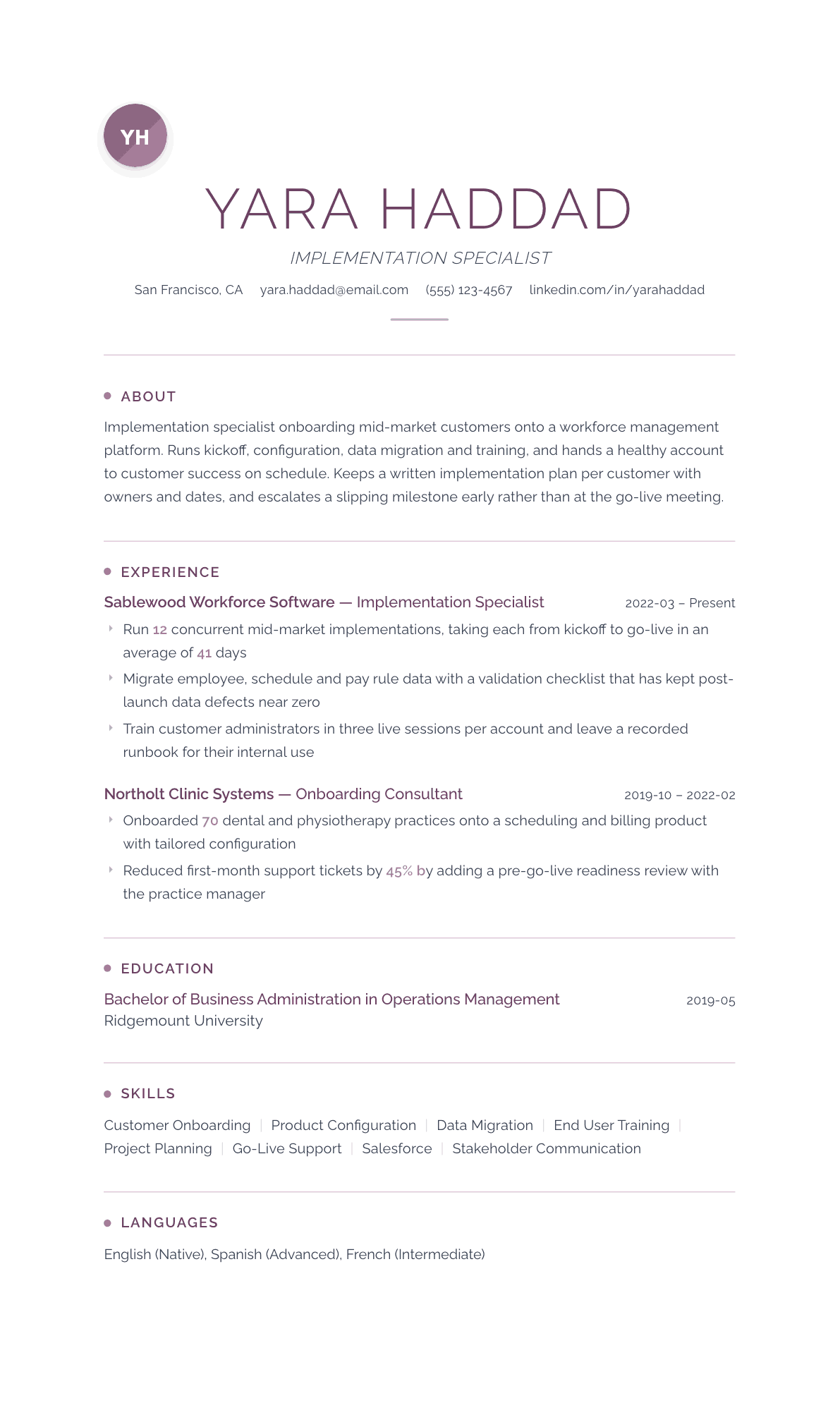
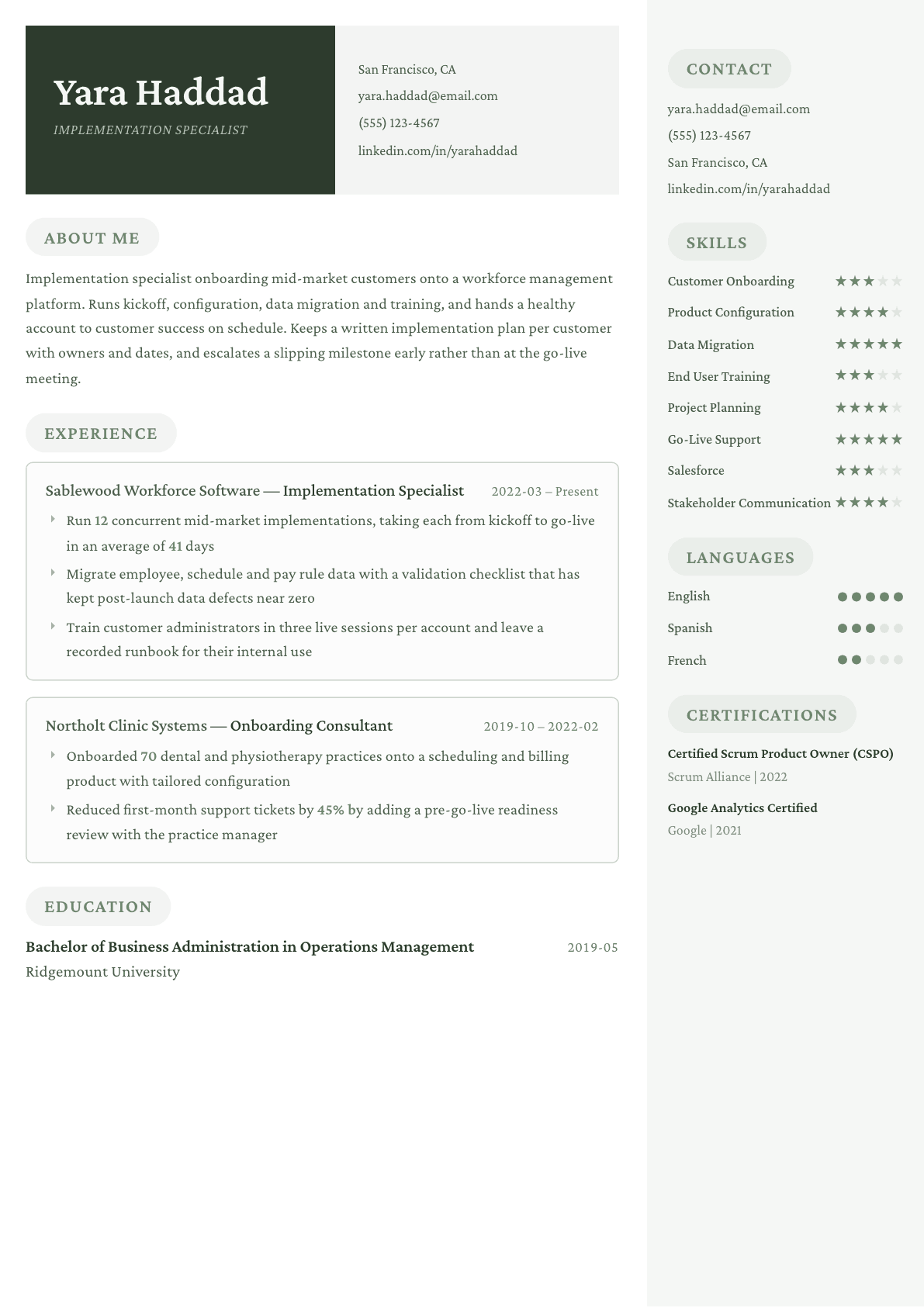
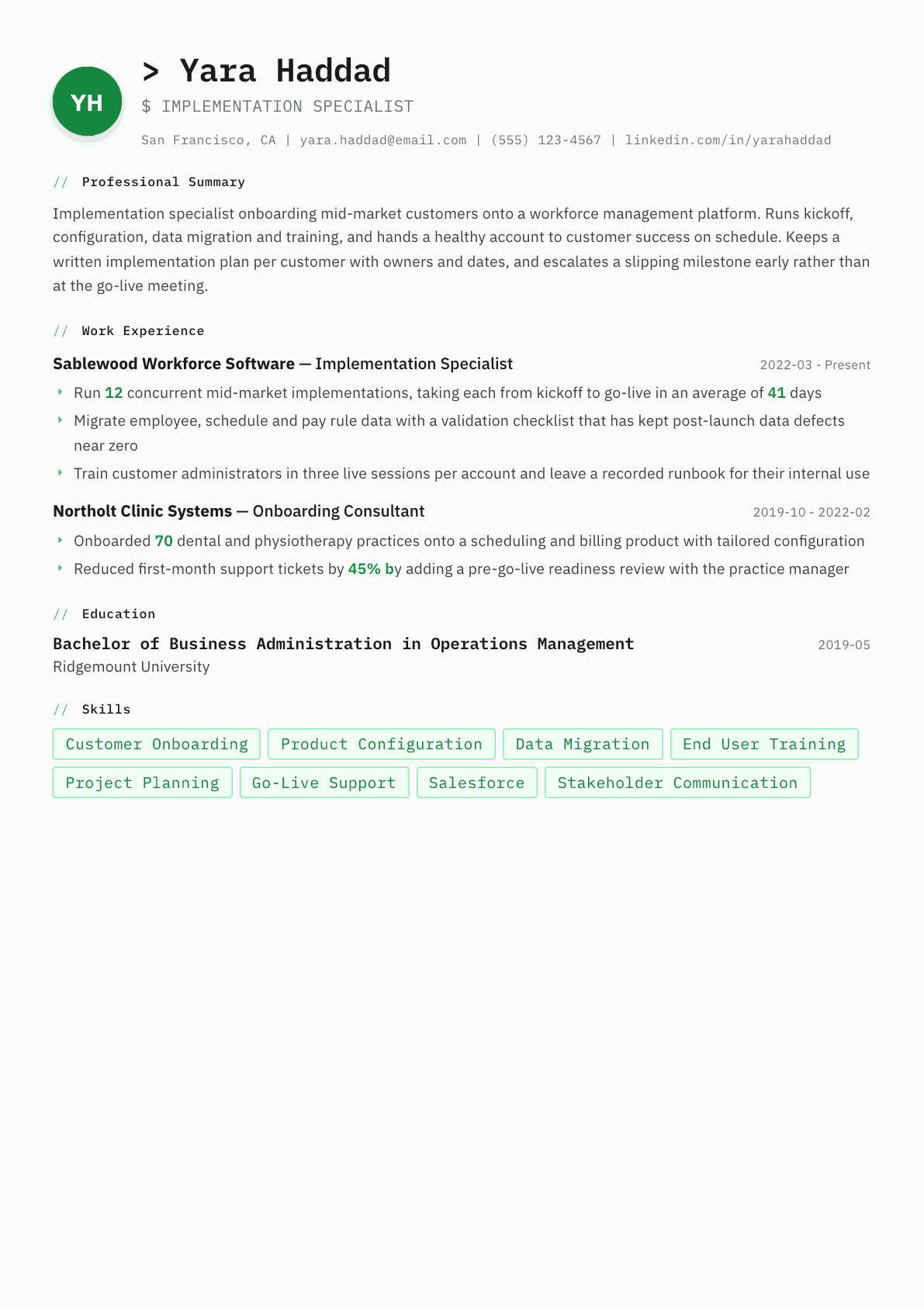
Example Implementation Specialist summary
Implementation specialist with five years taking mid-market customers from contract signature to a working system. Handles kickoff, configuration, data migration and administrator training, running a dozen accounts at once against a written plan with owners and dates. Recent work shortened average go-live time and cut first-month support volume through a readiness review before launch.
Skills to list on a Implementation Specialist resume
- Customer Onboarding
- Product Configuration
- Data Migration
- Requirements Gathering
- End User Training
- Project Planning
- Go-Live Support
- Integration Setup
- Salesforce
- Asana
- SQL Basics
- Process Mapping
- Escalation Management
- Documentation and Runbooks
- Customer Success Handover
- Change Adoption
What actually gets this resume read
- Give the number of accounts you run at once and the average time from kickoff to go-live in days or weeks.
- Split configuration, data migration and training, because employers weight those three parts very differently.
- Show post-launch quality with support ticket volume, adoption at 30 days or a clean handover to customer success.
- Name the product category you implement, since payroll, clinical and financial systems each carry their own rules.
- Describe how you handle a slipping customer, because escalation judgment is what separates senior candidates.
- List the systems you work in daily, such as the CRM, the project tracker and the migration or import tooling.
How to write a implementation specialist resume
An implementation specialist is hired to close the gap between a signed contract and a customer who actually uses the product. So the resume is read for one thing above all: evidence that your accounts go live on time and stay healthy afterward. Everything else on the page is supporting material for that claim.
The two numbers that carry the most weight are how many accounts you run at once and how long a typical implementation takes from kickoff to go-live. Almost no applicant includes either. A candidate who says she runs a dozen concurrent mid-market projects with an average of forty one days to launch has answered the manager first two questions before the call starts.
This guide covers the section order for the role, how to describe configuration, migration and training as distinct skills, three summaries across career stages, before and after bullets, and the questions that come up when candidates move from support, consulting or operations into implementation work.
Format: one page, with a portfolio line per role
One page for most candidates, two once you have led a program of implementations or managed other specialists. Plain single column, standard headings, and a tools block under the summary naming the customer relationship system, the project tracker and any import or migration tooling you use.
Under each employer add a portfolio line: the product category, the customer segment, how many accounts you carry at once, and the typical implementation length. That line does the work of five vague bullets.
- Header: name, title, city, phone, email, and languages if you onboard customers across regions.
- Order: summary, tools and methods, experience, certifications, education.
- Portfolio line per role: product, segment, concurrent accounts, average time to go-live.
Summary: segment, product type, and your launch record
Three lines. Name the segment, the product category and the outcome you are known for. Onboarding enterprise customers onto a payroll platform is a different job from onboarding small clinics onto a scheduling product, and hiring managers screen for the match.
Add the discipline that keeps launches on track: a written plan per customer with owners and dates, a readiness review before go-live, or an escalation rule you follow when a milestone slips. Managers hire for that discipline because it is what prevents a stalled account.
Experience: configuration, data, training, go-live
Split the work into its four real parts, because employers weight them differently. Configuration is what you set up in the product and how much of it is genuinely tailored rather than a template. Data covers the migration objects, the validation you run, and the reconciliation you do with the customer before anything goes live.
Training is where many candidates undersell themselves. Say how many sessions per account, who attends, whether you train administrators or end users, and what you leave behind as documentation. A recorded runbook that a customer reuses when a new administrator joins is a real deliverable.
Go-live and the weeks after are where the quality shows. Describe your readiness review, the cutover steps, hypercare coverage, and the handover to customer success or support. Post-launch support ticket volume and adoption at thirty days are the two most persuasive numbers on this part of the page.
Add one bullet about a difficult account. A customer who slipped, why, what you changed, and how it landed. That single bullet does more for a senior application than three about smooth launches.
Domain knowledge: name the rules you had to learn
Implementation work is domain work. Payroll rules, clinical scheduling constraints, financial reconciliation, warehouse workflows and workforce regulations each take months to absorb, and a candidate who already knows the domain shortens the ramp dramatically. Put the domain in the summary and repeat it in the experience block.
Where the product integrates with other systems, list the integrations you configured. Directory synchronization, payment providers, accounting platforms and file based imports are the ones that most often decide whether an implementation is a week or a month.
Skills and keywords screeners look for
Recurring terms include customer onboarding, product configuration, data migration, requirements gathering, end user training, go-live support, project plan, stakeholder communication, escalation and handover. Use each where you can back it with a specific account situation.
Include the soft edge that is genuinely technical: writing a validation checklist, running a query to confirm a load, mapping a customer process before configuring anything. Those turn a friendly onboarding profile into a specialist profile.
Implementation Specialist resume summary examples
Moving from support
Customer support specialist with two years on a scheduling product, moving into implementation after configuring 15 new practices alongside the onboarding team. Runs kickoff calls, maps customer booking rules before configuring, and trains practice managers. Comfortable validating imported data with simple queries before launch.
Five years, mid-market
Implementation specialist with five years onboarding mid-market customers onto workforce management software. Runs 12 concurrent projects from kickoff to go-live in an average of 41 days, migrates employee, schedule and pay rule data against a validation checklist, and trains administrators in three live sessions per account.
Implementation lead
Implementation lead with nine years across clinical and workforce platforms, managing four specialists and the enterprise onboarding queue. Rebuilt the launch methodology around a readiness review and a written owner and date plan, then cut average time to go-live while lowering first-month support volume.
Work experience bullets: before and after
Before: Onboarded new customers onto the platform.
After: Ran 12 concurrent mid-market implementations, taking each from kickoff to go-live in an average of 41 days against a written plan with named owners and dates.
Concurrency and average duration are the two figures a hiring manager uses to size an implementation candidate.
Before: Handled data migration for new accounts.
After: Migrated employee, schedule and pay rule data for every account using a validation checklist and a reconciliation review with the customer before launch.
Naming the data objects and the reconciliation step shows a repeatable method rather than a one-off import.
Before: Trained customers to use the system.
After: Trained customer administrators in three live sessions per account and left a recorded runbook the customer reuses whenever a new administrator joins.
A durable artifact means the training keeps working after you leave the account, which is what reduces support load.
Before: Reduced support tickets after launch.
After: Cut first-month support tickets by 45% by adding a pre-go-live readiness review with the practice manager covering data, access and the first week schedule.
Attaching the reduction to the specific process change makes the improvement repeatable rather than lucky.
Before: Managed difficult customer situations.
After: Escalated a slipping enterprise launch three weeks before the target date, renegotiated a two-phase go-live with the sponsor, and delivered the first phase on the original date.
Early escalation with a concrete alternative plan is the behavior senior implementation managers screen for.
Hard skills
- Customer onboarding methodology
- Product configuration
- Data migration and validation
- Requirements gathering and process mapping
- End user and administrator training
- Project planning with owners and dates
- Integration setup
- Go-live and hypercare support
- Runbook and documentation writing
- Customer relationship system administration
- Escalation and risk handling
- Handover to customer success
Soft skills
- Setting expectations at kickoff
- Explaining a delay before it becomes a surprise
- Patience with non-technical administrators
- Managing many accounts without dropping one
- Reading customer readiness accurately
- Building trust with a project sponsor
Certifications worth listing
- Project Management Professional (PMP) (Project Management Institute)
- Certified Associate in Project Management (CAPM) (Project Management Institute)
- Salesforce Certified Administrator (Salesforce)
- Professional Scrum Master I (Scrum.org)
Mistakes that cost implementation specialist candidates the interview
- Leaving out how many accounts you carry at once, which is the first thing an implementation manager wants to know.
- Giving no average time to go-live, so the reader cannot judge whether your launches are fast or stalled.
- Blending configuration, migration and training into one vague onboarding claim.
- Ignoring the post-launch period, when adoption and early support volume are the real quality measures.
- Describing only smooth accounts, leaving no evidence of how you handle a slipping customer.
- Omitting the domain, when payroll, clinical or financial rules are often the reason one candidate ramps faster.
Implementation Specialist resume questions
What numbers should an implementation specialist put on a resume?
Concurrent accounts, average days from kickoff to go-live, accounts launched in total, first-month support volume, and adoption at thirty days. Those five let a hiring manager compare you against her current team immediately.
How is an implementation specialist different from a customer success manager?
Implementation owns the period from contract to a working system: configuration, migration, training and launch. Customer success owns the relationship afterward, covering adoption, renewal and expansion. Say which side you want, since the interviews differ.
Do I need technical skills for an implementation role?
Some. Reading a data file, running a verification query, configuring an integration and understanding access permissions all make you independent of engineering. Deep coding is rarely required, but a purely non-technical profile struggles in software implementation.
How do I move into implementation from a support role?
Highlight the configuration and onboarding work you already do, ask to shadow launches, and describe a customer you took from setup to steady use. Support experience is an advantage because you know exactly what goes wrong after launch.
Should I list every customer I have implemented?
No. Give the segment, the volume and two or three representative accounts by industry rather than by name. Confidentiality matters, and a hiring manager cares about pattern and scale rather than a client roster.
Related resume examples
- IT Consultant Resume example
- IT Project Manager Resume example
- Technical Account Manager Resume example
- Salesforce Administrator Resume example
- Systems Analyst Resume example
- SAP Consultant Resume example