IT Project Manager Resume Examples: the lines they read
IT Project Management Resume Examples and Samples
By Mustafa Tarabya, founder of CVBooster · Published · Updated
IT project management resume examples and samples, including a technical project manager resume: project blocks, cutover bullets and delivery keywords.
Sample resumes for a it project manager
The same it project manager content laid out in three CVBooster templates, so you can see what the finished document looks like before you write a word.
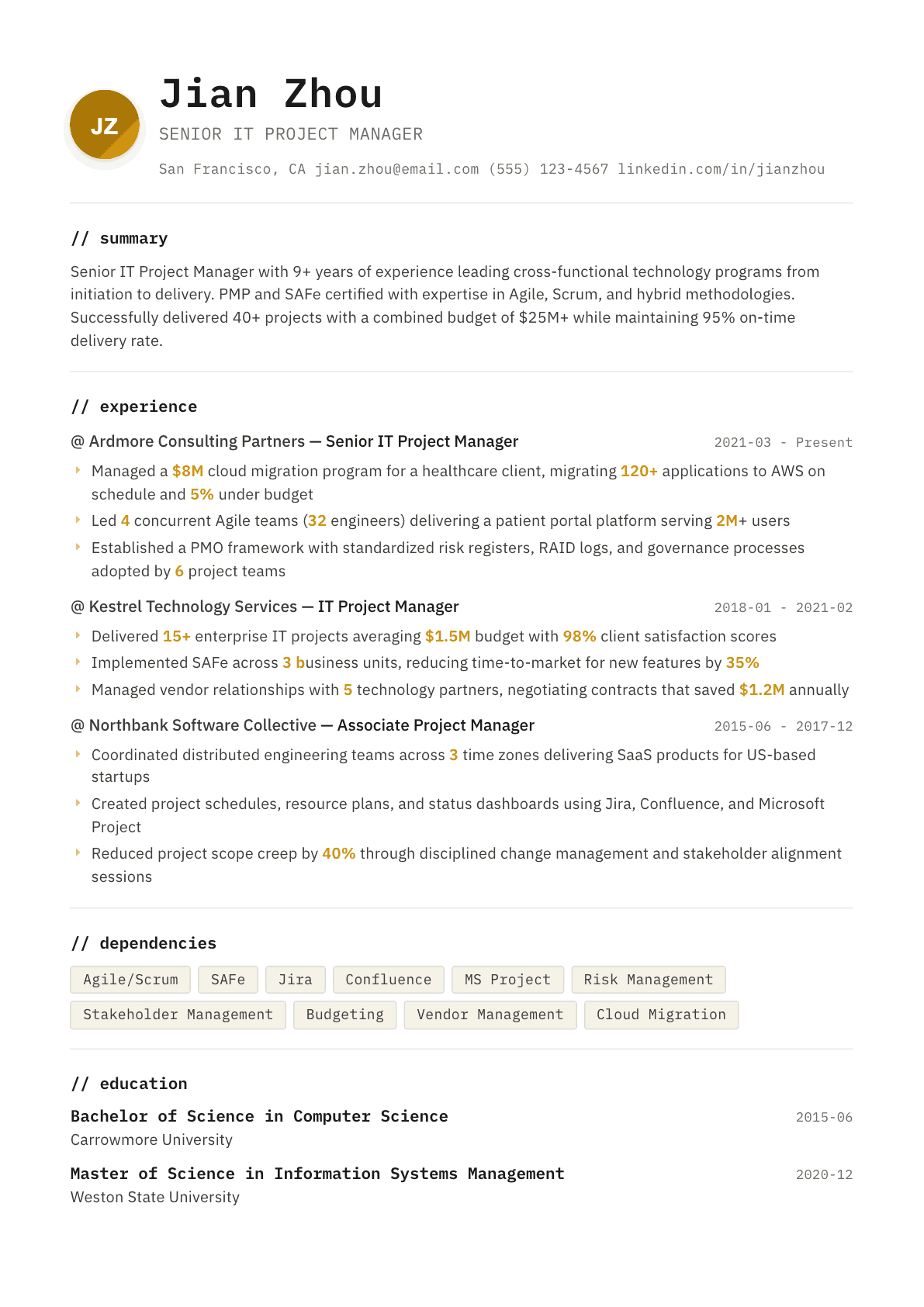
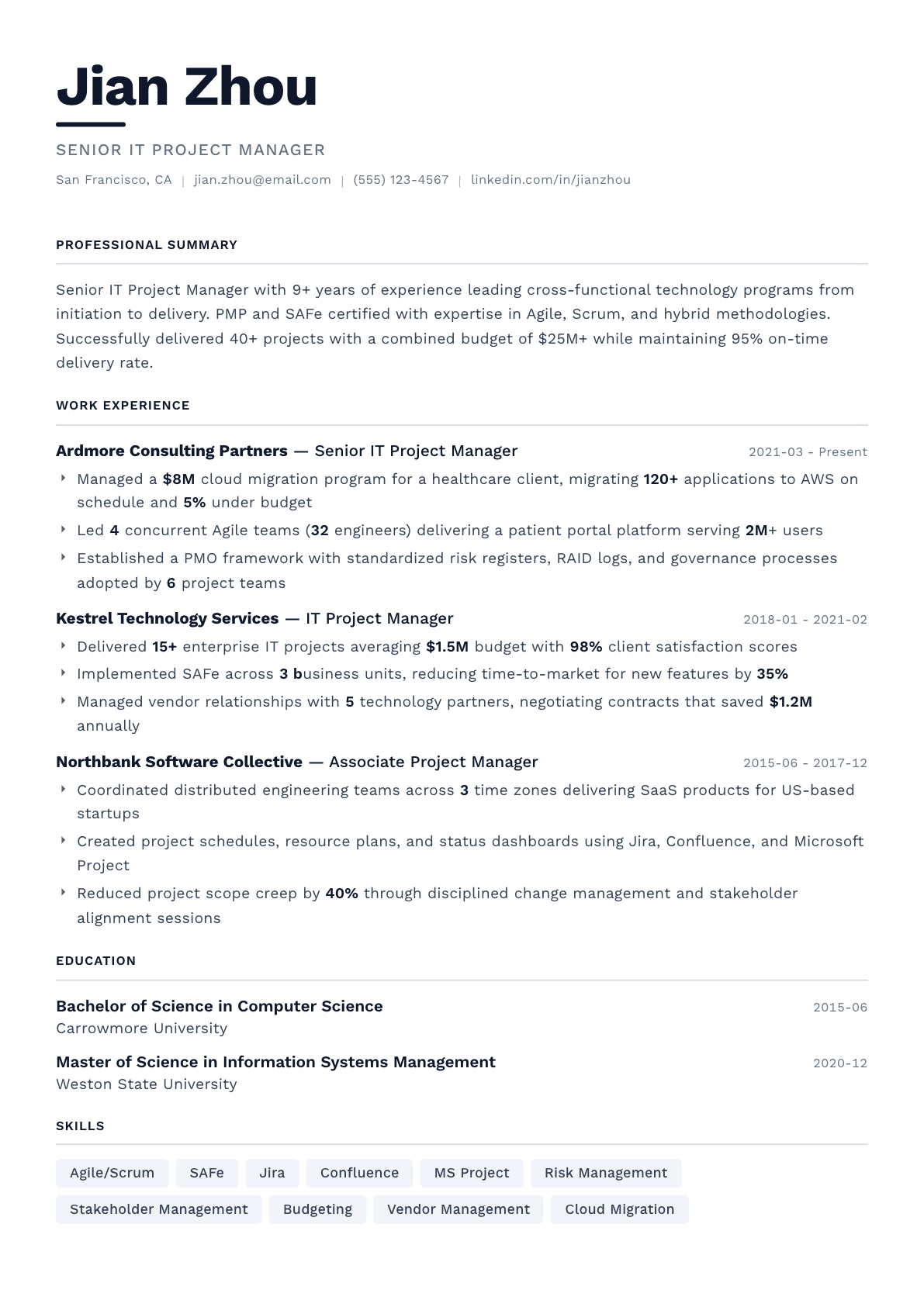
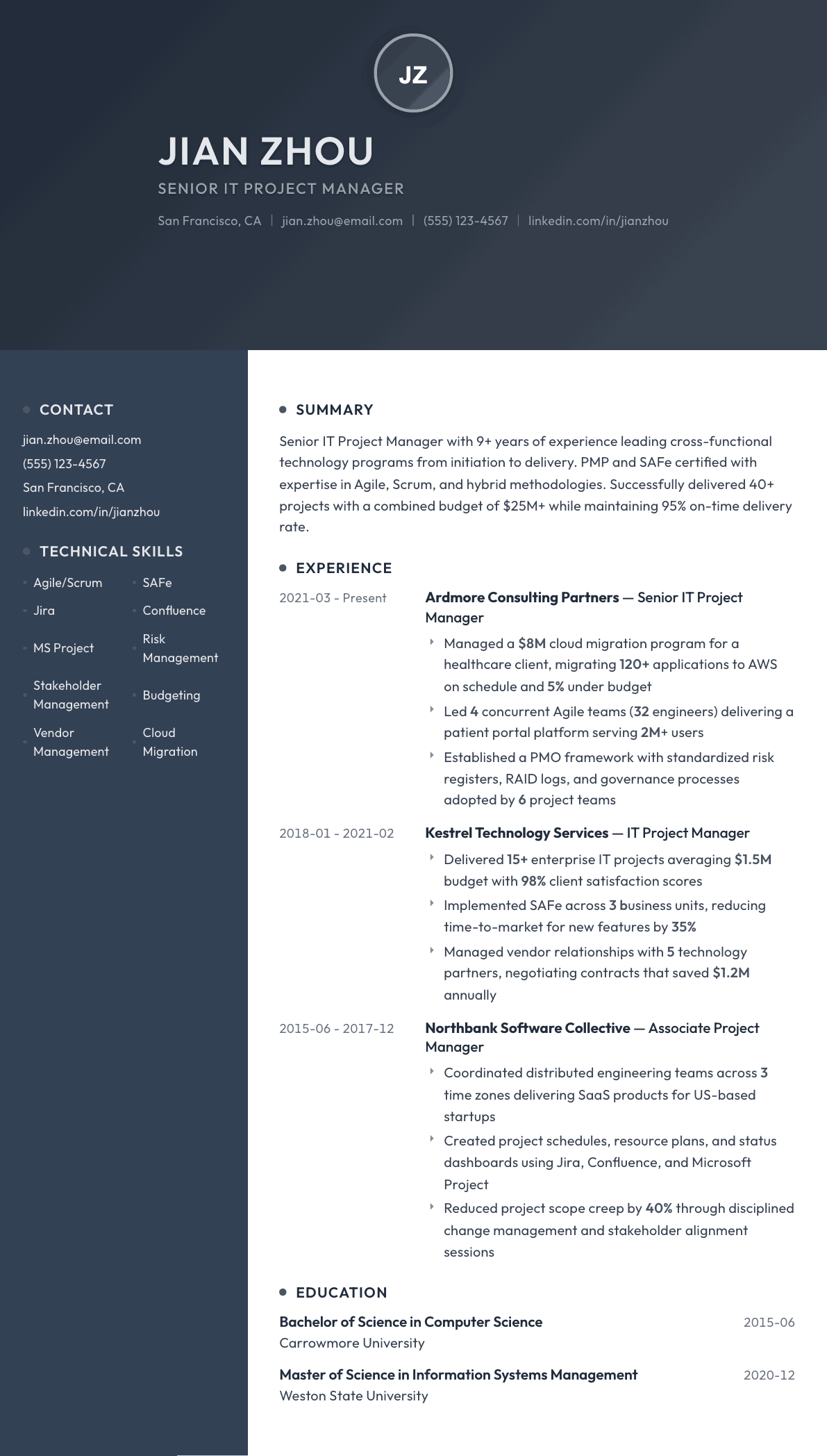
Example IT Project Manager summary
PMP-certified IT project manager with 9 years delivering application implementations and cloud migrations across healthcare and financial services, typically leading teams of 30 across three or four workstreams with two or three suppliers. Runs stage-gated governance over agile delivery teams, owns vendor milestones and the integrated plan, and has recovered two programs that entered amber before go-live.
Skills to list on a IT Project Manager resume
- Agile/Scrum
- SAFe
- PMP
- Jira
- Confluence
- MS Project
- Risk Management
- Stakeholder Management
- Budgeting
- Vendor Management
- SDLC
- Change Management
What actually gets this resume read
- Give every project a one-line header before the bullets: what it was, the duration, the team size, the delivery method and the scale.
- Scale projects with figures that are safe to state: team size, workstreams, applications or sites in scope, users affected, countries and vendors.
- Say which method honestly, including the hybrid of a stage-gated wrapper over agile delivery teams, because most large organizations run exactly that mix.
- Name the tools you actually ran the project in, such as Jira, Confluence, Azure DevOps, ServiceNow, Microsoft Project or Smartsheet.
- Write one recovery story: a project that was behind, a scope negotiation that protected a date, or a go-live you recommended against.
How to write a it project manager resume
An IT project manager resume is judged on delivery evidence, and delivery evidence has a shape: what you were given, what constrained it, what you delivered, and what happened when it went wrong. The reviewer, usually a delivery lead or a portfolio manager, has read hundreds of resumes claiming on-time and on-budget delivery. What she cannot find easily is a candidate who describes a project that got into trouble and explains how it was recovered.
The second thing she needs is the type of project. Infrastructure migration, application implementation, a software product build, a regulatory program, and an end-user rollout demand different skills and different governance. A generic project manager resume without project types is unplaceable, because staffing decisions are made on domain fit as much as on method.
This guide covers IT project management resume examples and samples from coordinator to program level: the layout that lets a portfolio manager scan your projects in seconds, how to write about scope, risk and stakeholders credibly, a technical project manager resume example, three summaries from coordinator to program level, before and after bullets, and the certification question every IT project manager asks.
Format: two pages, projects listed as their own units
Two pages is normal once you have several delivered projects. Reverse chronological by employer, with projects nested underneath each role. Single column, plain, no charts. A visual timeline of your projects looks appealing and disappears in the parser, taking the dates with it.
Give each project a one-line header before the bullets: what it was, the duration, the team size, the delivery method, and the scale. That header lets a reviewer compare you against the role she is filling without reading the detail, and it is the single highest-value formatting decision on this resume.
The IT project management resume examples and samples that work all share that skeleton. A coordinator sample leads with the projects supported and the artifacts owned, such as the schedule, the RAID log and the status report. A mid-level sample leads with two or three project blocks and the governance used. A program sample leads with the portfolio: the number of projects, the suppliers and the board it reports to. Copy the structure from a sample, never the numbers.
- Header: name, city, email, professional profile link, and certifications after your name if you hold PMP or a comparable credential.
- Order: summary, certifications, experience with project blocks, tools, education.
- Coordinators and analysts moving up should show the parts they owned inside a larger project rather than implying they ran it.
Summary: project type, size, method, and the environment
Three lines. Name the projects you deliver, the typical team and duration, the method you work in, and the kind of organization. Delivering inside a regulated bank with a formal change advisory board is a different craft from delivering in a product company where the team ships continuously, and both employers want to know you have done their version.
Say which method honestly. Many IT project managers work in a hybrid: a stage-gated program wrapper with agile delivery teams underneath. Describing that accurately reads as more experienced than claiming pure agile, because most large organizations are exactly that mix.
Scope, schedule, risk: write the mechanics, not the adjectives
Replace phrases like managed multiple projects with the mechanics of how you managed them. A prioritized backlog and a release plan, a work breakdown structure and a critical path, a risk register with named owners and mitigations, a RAID log reviewed weekly, a change control process with a board, and dependency management across teams.
Scale the projects in the numbers that are safe to state: team size, number of workstreams, applications or sites in scope, users affected, countries, duration, and the number of vendors involved. These let a reader size the job without needing figures you may not be free to disclose.
Then write the recovery. A project that was behind and got back on track, a scope negotiation that protected a launch date, a vendor that missed a milestone and what you did, or a go-live decision you recommended against. This is the most persuasive material available to a project manager and it is nearly always missing.
Stakeholders, vendors and governance
Name the forums you ran and who sat in them: steering committee, program board, change advisory board, daily stand-up, sprint review, and the reporting pack you produced. Say which level of stakeholder you handled, from team leads to an executive sponsor, since managing upward is the skill that separates senior project managers.
Vendor and third-party management deserves its own attention because so many IT projects are delivered partly by suppliers. Statement of work, milestone acceptance, service credits, escalation, and holding a supplier to a date are all real work and they carry weight with employers who have been burned.
- Name the tools you actually ran the project in, such as Jira, Confluence, Azure DevOps, ServiceNow, Microsoft Project or Smartsheet.
- Mention the operational handover: runbooks, support model, hypercare period and the point where the service desk took over.
- If you managed budget, describe the responsibility level rather than an amount, such as owning the forecast and reporting variance monthly.
Technical project management resume or CV: how it differs, with an example
Technical project manager and IT project manager are often the same job under two titles, and recruiters search for both. The technical title usually signals that the hiring team wants someone who can read an architecture diagram, size work with engineers and sit in a design review without a translator. If the posting says technical project manager, use that phrase in your headline and summary, and prove it with the systems you delivered, not with a list of languages you once used.
The difference shows in the bullets. A general project manager writes milestones and status reports. A technical project manager writes the release plan, the environments, the dependencies between teams, the cutover and the defects that held it up. The sample below is invented: keep the order and replace every system, team size and result with your own.
Outside the US the same document is a technical project manager CV, usually two pages, with a short profile and the projects in the same blocks. A profile, written out: Technical project manager, cloud and data platforms, six years running engineering led releases for a payments company. Owns the technical plan with the architects, runs the release calendar for four teams and writes the cutover runbooks herself.
- Headline: Technical Project Manager, cloud migration and platform delivery, PMP and Certified ScrumMaster.
- Summary: Technical project manager with eight years delivering infrastructure and application projects for a regional bank and a software company. Runs plans across four to six engineering teams, owns release and cutover planning, and reports to a steering group of directors.
- Project block: Data center exit to public cloud, 14 months, 6 teams, 140 applications. Built the migration waves with the architects, ran the dependency map and the weekly cutover rehearsal, and moved the last wave two weeks early after a failed first rehearsal changed the rollback plan.
- Project block: Customer portal rebuild, 9 months, 3 Scrum teams and an outside design agency. Ran the release train and the integration test plan with the payments team; launch held its date after scope for two features moved to the next release with the sponsor's sign off.
- Skills line: release planning, cutover and rollback, dependency management, Jira and Confluence, AWS fundamentals, API integration testing, vendor management, RAID log, steering reports.
Keywords in IT project manager postings
These postings recycle a stable vocabulary: project lifecycle, agile and Scrum, waterfall and hybrid, stakeholder management, risk and issue management, RAID log, change control, resource planning, vendor management, budget tracking, governance, and the specific tool names. Mirror the posting language once in a skills or method line and once inside a project bullet. Write both the credential acronym and the full name once, since recruiters search on either.
IT Project Manager resume summary examples
Project coordinator moving up
IT project coordinator with two years supporting infrastructure and rollout projects, owning the schedule, the RAID log and weekly reporting for teams of up to fifteen. Ran the deployment tracking for a device refresh across four sites and is now leading small projects independently.
Six years in
IT project manager with six years delivering application implementations and cloud migrations in hybrid environments, typically leading teams of twenty across three workstreams. Runs stage-gated governance over agile delivery, owns vendor milestones, and has recovered two projects that entered amber before go-live.
Senior or program manager
Senior IT project manager with twelve years across banking and healthcare, currently running a regulatory program of four projects and sixty people with three suppliers. Reports to the executive sponsor monthly, owns the integrated plan and dependencies, and has delivered two core system replacements without a rollback.
Work experience bullets: before and after
Before: Managed IT projects from start to finish.
After: Delivered a Microsoft 365 migration for 4,000 users across six sites over eight months, leading a team of eighteen with two suppliers and completing every wave inside the agreed weekend windows.
Users, sites, duration, team and vendor count let a reader size the project instead of guessing from a generic claim.
Before: Managed project risks and issues.
After: Kept a risk register with named owners reviewed weekly, escalating the supplier capacity risk to the program board two months early, which released contract resource in time to protect the go-live date.
An early escalation that changed the outcome is far stronger evidence of risk management than saying a register existed.
Before: Worked with stakeholders across the business.
After: Ran a biweekly steering committee with the finance and operations directors, and negotiated a scope reduction of two reporting features so the core payroll cutover kept its date.
Naming the forum and the tradeoff you brokered shows real stakeholder management rather than attendance at meetings.
Before: Used Agile methodologies to deliver software.
After: Ran a hybrid delivery with three Scrum teams inside a stage-gated program, translating sprint outputs into gate evidence so the change advisory board could approve each release without stopping the teams.
Describing how agile delivery met formal governance is specific to real organizations and shows practical judgment.
Before: Delivered a project that was behind schedule.
After: Took over a data center migration running eleven weeks late, rebaselined the plan with the sponsor, moved two non-critical workstreams to a later phase, and completed the remaining migration inside the revised date.
A recovery told honestly, including what was deferred, is more convincing than an unbroken record of untroubled projects.
Hard skills
- Project planning and scheduling
- Agile and Scrum delivery
- Waterfall and stage-gate governance
- Risk and issue management
- RAID log ownership
- Change control
- Resource and capacity planning
- Budget forecasting and variance reporting
- Vendor and contract management
- Dependency management across teams
- Jira and Confluence
- Azure DevOps and ServiceNow
- Microsoft Project and Smartsheet
- Cutover and hypercare planning
Soft skills
- Stakeholder negotiation
- Escalation judgment
- Clear written reporting
- Running a difficult meeting
- Holding suppliers to account
- Keeping a team calm near a cutover
Certifications worth listing
- Project Management Professional (PMP) (Project Management Institute)
- Certified Associate in Project Management (CAPM) (Project Management Institute)
- PRINCE2 Practitioner (PeopleCert)
- Professional Scrum Master (Scrum.org)
- Certified ScrumMaster (Scrum Alliance)
- SAFe Practice Consultant (Scaled Agile)
- ITIL 4 Foundation (PeopleCert)
- PMI Agile Certified Practitioner (PMI-ACP) (Project Management Institute)
Mistakes that cost it project manager candidates the interview
- Claiming on time and within budget on every project with nothing else attached, which reads as a template rather than a record.
- Omitting team size, duration and scope, leaving a reader unable to tell a two-person upgrade from a sixty-person program.
- Describing only smooth deliveries, when the recovery stories are what a portfolio manager most wants to hear about.
- Listing methods as keywords without saying how governance and delivery actually fit together in your organization.
- Leaving out vendor management, when a large share of IT delivery depends on holding a supplier to a milestone.
- Using a visual timeline or a chart of projects, which parses badly and costs you the dates and scope detail.
IT Project Manager resume questions
Do I need a PMP to work as an IT project manager?
Not always, but it clears recruiter filters and many enterprise and public sector postings require it or an equivalent. Employers running agile delivery may weigh a Scrum credential equally, so match the credential to the environment you are targeting.
Should I list project budgets on my resume?
Only if you genuinely owned the budget and the figures are not confidential. Team size, duration, applications in scope and users affected communicate scale just as well and rarely create a disclosure problem.
How do I show delivery when the project was canceled?
Say what was delivered before the stop, why the decision was made, and what you did to close it down cleanly. Handling a controlled cancellation is a real project management skill and hiding the project is worse than explaining it.
Is a technical project manager resume the same as an IT project manager resume?
Mostly yes. Both have to prove technical context: migrations, environments, releases, cutovers and integrations. Use the exact title from the posting in your headline, and for technical project manager roles give more detail on architecture, engineering dependencies and release planning, because the reviewer wants proof you can challenge a technical lead on a plan.
What do good IT project management resume examples have in common?
Each project has a header with type, duration, team size and method, followed by three or four bullets on scope, risk, stakeholders and the result. The summary names the project types and environments, and the tools line uses the exact terms from the posting. Recovery stories appear alongside the clean deliveries.
Related resume examples
- Scrum Master Resume example
- Solutions Architect Resume example
- IT Consultant Resume example
- Technical Program Manager Resume example
- IT Business Analyst Resume example
- IT Manager Resume example