Salesforce Administrator Resume Examples: free ATS score
Build a Salesforce Administrator Resume That Proves Org Ownership
By Mustafa Tarabya, founder of CVBooster · Published · Updated
Salesforce administrator resume examples, admin keywords and a writing guide covering flows, permission sets, reports, data quality and release testing.
Sample resumes for a salesforce administrator
The same salesforce administrator content laid out in three CVBooster templates, so you can see what the finished document looks like before you write a word.
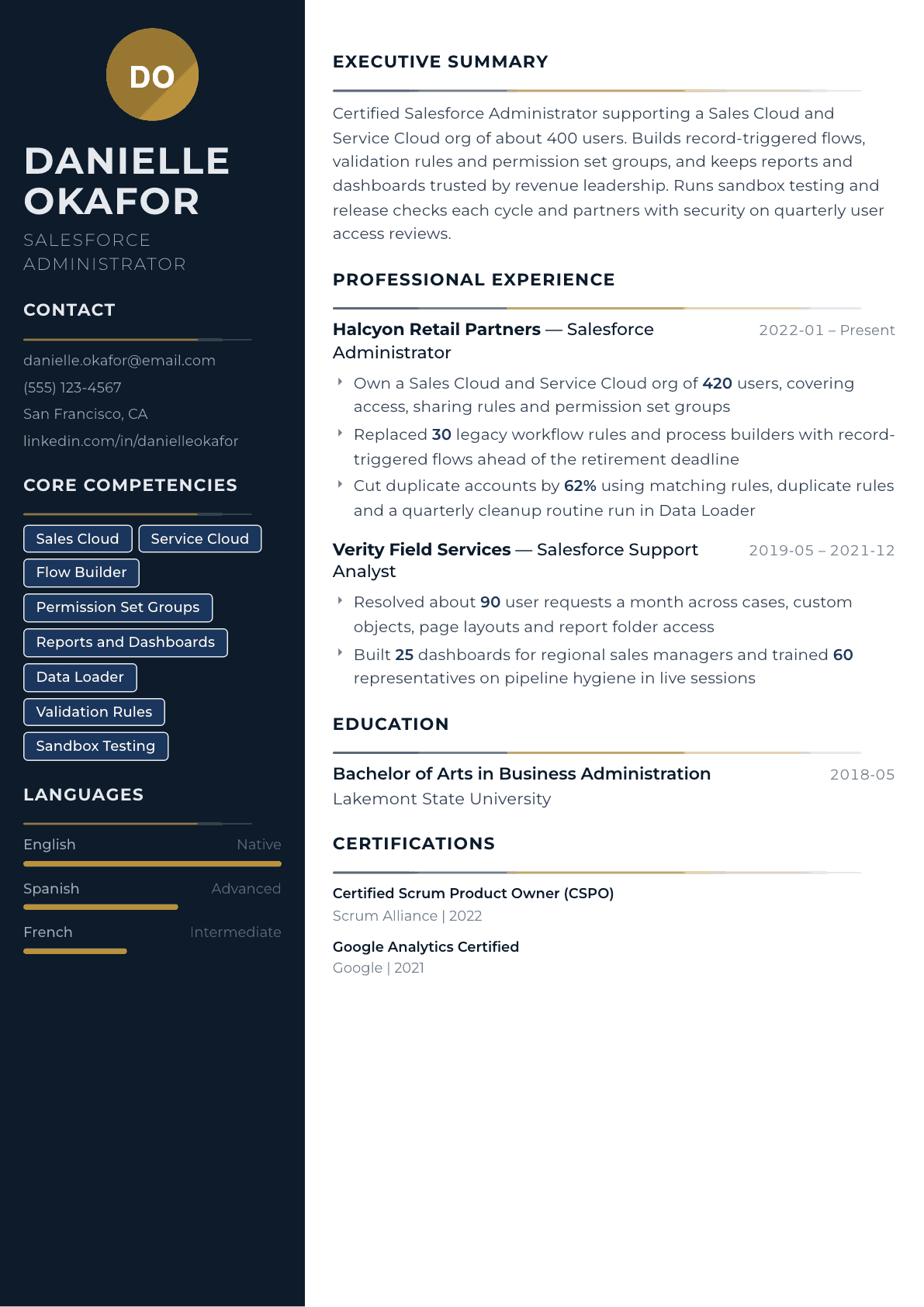
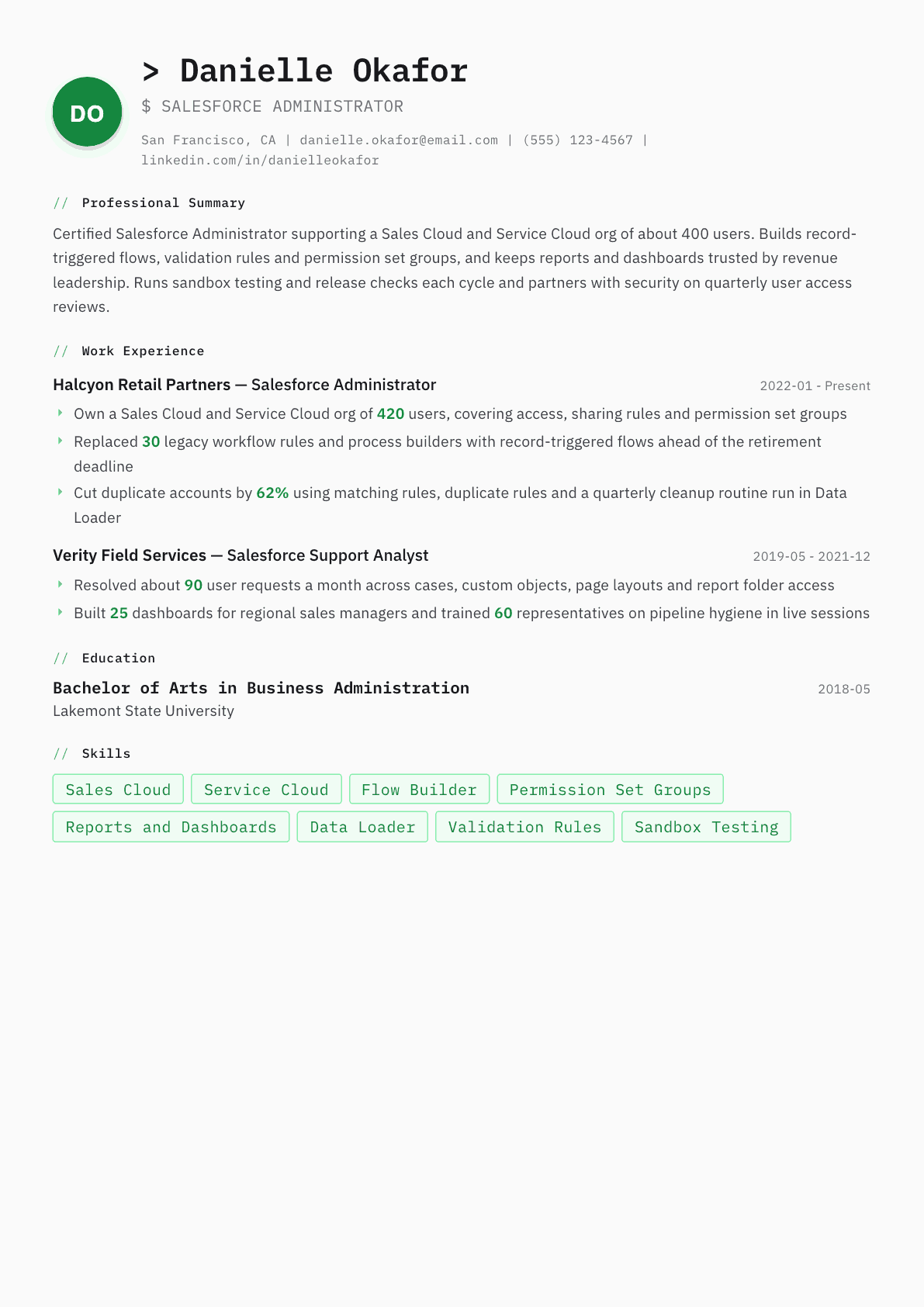
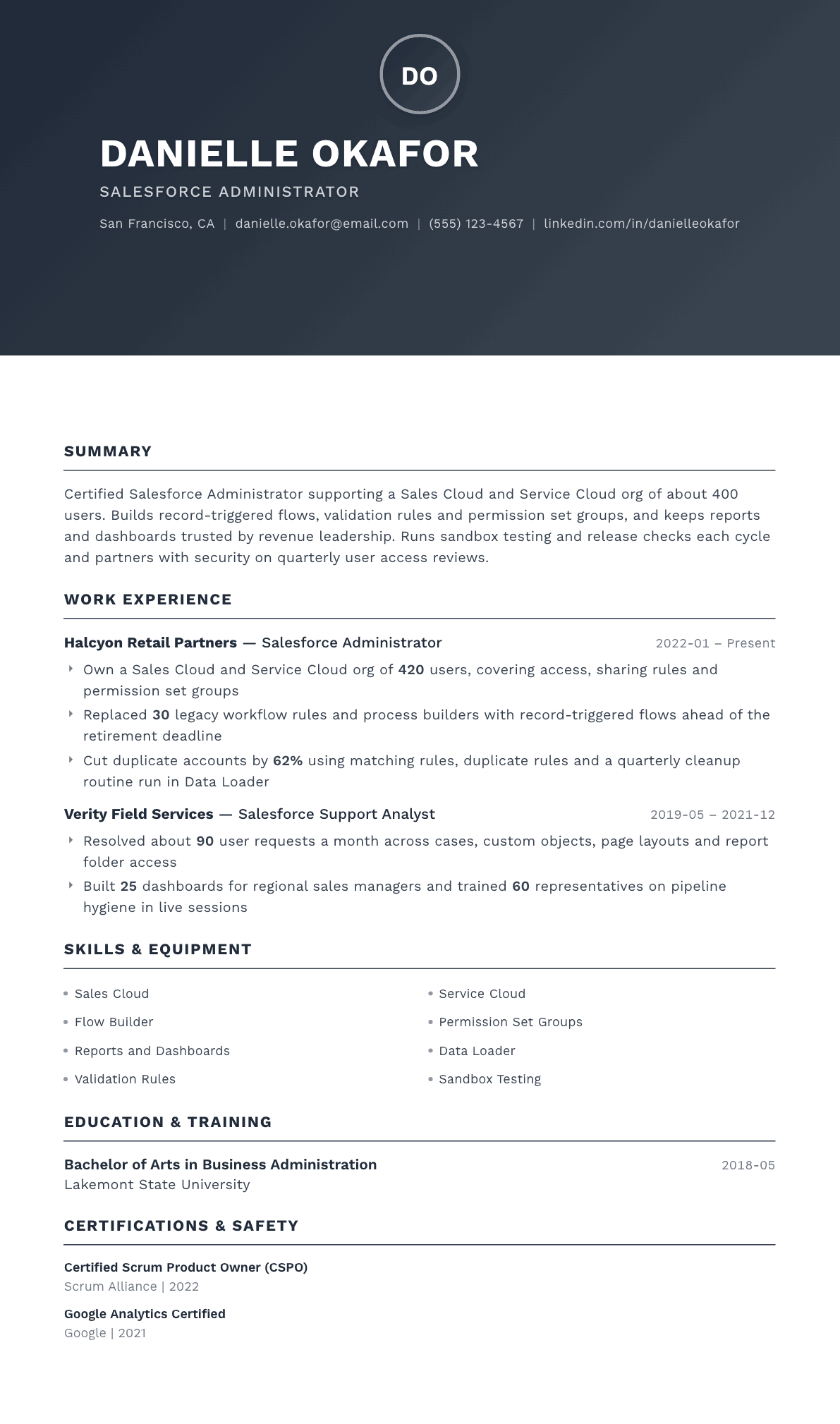
Example Salesforce Administrator summary
Salesforce Administrator with five years running a Sales Cloud and Service Cloud org of roughly 400 users. Rebuilt legacy workflow automation in Flow Builder, tightened access with permission set groups, and cut duplicate records through matching and duplicate rules. Holds the Administrator and Advanced Administrator credentials and is moving toward a platform owner role at a larger organization.
Skills to list on a Salesforce Administrator resume
- Sales Cloud
- Service Cloud
- Flow Builder
- Validation Rules
- Permission Set Groups
- Profiles and Roles
- Sharing Rules
- Reports and Dashboards
- Data Loader
- Duplicate Management
- Sandbox Management
- Change Sets
- Lightning App Builder
- User Onboarding
- Release Testing
- AppExchange Administration
What actually gets this resume read
- Put your Salesforce certification names in the header block so a recruiter sees them without scrolling.
- Give the org size in users, the clouds in use, and whether the org runs on Lightning or still on Classic.
- Name the automation you build today: Flow Builder, validation rules, approval processes, and any legacy migration you finished.
- Show data quality work through duplicate rules, matching rules and cleanup routines, because managers ask about it in interviews.
- Describe your release path: sandbox refreshes, change sets or a deployment tool, and who signs off before production.
- Name the reporting audience by role, since a dashboard for a sales director differs from a support queue report.
How to write a salesforce administrator resume
A Salesforce administrator resume has one job on first read: prove that you have owned a real org rather than clicked around in a trailhead playground. The hiring manager is looking for org size, the clouds in use, the automation you build today, and whether anyone had to clean up after your last release.
Most applications fail on vagueness. Managed users and created reports describes the trial version of the job. The candidate who writes that she owns a Service Cloud org of four hundred users, replaced legacy workflow rules with record triggered flows, and runs access reviews with the security team is describing the job as it is actually staffed.
Below is the section order that works, how to write about automation and data quality without sounding like a certification syllabus, three summaries for different career stages, before and after bullets, and the questions administrators ask when they move from an internal role to the open market.
Format: one page until you have owned two orgs
Reverse chronological, one page for the first five years, two pages once you have multiple orgs or a platform owner title. Keep it single column with plain headings, because many recruiting systems in this market parse badly and drop a sidebar entirely.
Certifications belong in the header area or immediately under the summary. They are the first filter a recruiter applies and hiding them under education at the bottom costs you screens.
- Header: name, title, city, phone, email, and your Salesforce credential list on one line.
- Order: summary, certifications, technical skills, experience, education, community involvement.
- Keep a short line per role stating org size, clouds, and whether you were the sole administrator.
Summary: org size, clouds, and what you are known for fixing
Three lines. Give the number of users, the clouds, the industry, and the one thing you are consistently trusted with, whether that is automation cleanup, reporting for revenue leadership, or access governance during an audit.
If you were the only administrator, say so. Sole ownership of a mid sized org is a stronger signal than being one of six administrators in an enterprise, and hiring managers read it that way.
Experience: automation, access, data, reporting, release
Structure each role around the five things a manager will ask about. Automation covers flows, validation rules and approval processes, and any migration off retired tools. Access covers profiles, permission sets, permission set groups, sharing rules and periodic reviews. Data covers imports, duplicate and matching rules, and cleanup routines. Reporting covers who the audience is and what decisions the dashboards feed. Release covers sandboxes, deployments and who signs off.
Write the automation bullet with the trigger type and the business rule, not just the tool name. Built a record triggered flow that routes renewal cases to the assigned account team and posts a chatter alert at seventy days is a bullet a manager can picture. Built flows is not.
Volume matters here because it stands in for scale. Users supported, requests handled per month, records cleaned, dashboards owned, and the size of the object model you maintain all help a reader place you.
Skills: name the features, not the buzzwords
A skills block should read like a feature inventory a Salesforce professional recognizes: Flow Builder, validation rules, permission set groups, sharing rules, Data Loader, duplicate management, deployment pipelines, and the analytics surface you use. Add the adjacent tools your org runs, because integration knowledge often decides between two similar candidates.
Leave out generic lines such as strong problem solving. Those words are on every resume in the stack and they crowd out the keywords a recruiter is actually searching.
Certifications and community: what the market checks
The administrator credential is the entry ticket, and the advanced administrator credential is what separates the shortlist. Platform App Builder and Business Analyst credentials help when a posting mentions declarative development or requirement gathering. List the credential name exactly and keep them current, since expired credentials are visible.
Community activity is worth a short line if it is real: user group participation, mentoring, or a superbadge trail that maps to the job. Keep it to two lines so it does not compete with your work history.
Salesforce Administrator resume summary examples
First administrator role
Certified Salesforce Administrator supporting a Sales Cloud org of 90 users after two years in sales operations. Builds validation rules, page layouts and reports, handles user provisioning, and completed the flow and security superbadges. Looking for a role where I can own automation cleanup end to end.
Five years, sole administrator
Salesforce Administrator and sole owner of a Sales Cloud and Service Cloud org of 420 users. Replaced 30 legacy workflow rules with record triggered flows, tightened access with permission set groups, and cut duplicate accounts by 62% through matching rules and a quarterly cleanup routine.
Platform owner
Salesforce platform owner with ten years across two enterprise orgs and 3,000 combined users. Leads a team of three administrators, runs the release board with the development team, and owns the access review evidence pack the security audit relies on each year.
Work experience bullets: before and after
Before: Managed users and permissions in Salesforce.
After: Administered access for 420 users through profiles, permission set groups and sharing rules, and ran a quarterly access review with the security team.
The user count and the review cadence turn routine administration into evidence of governance ownership.
Before: Created flows to automate processes.
After: Replaced 30 workflow rules and process builders with record triggered flows ahead of the retirement deadline, with a rollback plan tested in a full sandbox.
Naming the migration, the count and the rollback plan shows judgment rather than familiarity with a builder.
Before: Improved data quality in the org.
After: Cut duplicate accounts by 62% using matching and duplicate rules, then held the gain with a quarterly Data Loader cleanup routine and a documented merge policy.
A one time cleanup impresses nobody; the routine and the policy prove the improvement survived.
Before: Built reports and dashboards for management.
After: Built 25 dashboards for regional sales directors covering pipeline coverage, stage aging and forecast accuracy, and retired 40 unused reports to keep folders navigable.
The audience and the retired clutter tell a manager you think about report governance, not just report creation.
Before: Trained users on Salesforce.
After: Trained 60 sales representatives on pipeline hygiene in live sessions and wrote a short in-app guidance path that reduced repeat questions in the support queue.
Attaching the training to a measurable follow-on effect makes it an outcome rather than an activity.
Hard skills
- Flow Builder and record triggered flows
- Validation rules and approval processes
- Profiles, roles and permission set groups
- Sharing rules and org-wide defaults
- Reports, dashboards and report types
- Data Loader and data imports
- Duplicate and matching rules
- Sandbox management and change sets
- Lightning App Builder
- Custom objects and field architecture
- Service Cloud case management
- User provisioning and deactivation
Soft skills
- Requirement gathering from non-technical users
- Prioritizing a shared request queue
- Change communication
- Training delivery
- Documentation habit
- Saying no to unscalable requests
Certifications worth listing
- Salesforce Certified Administrator (Salesforce)
- Salesforce Certified Advanced Administrator (Salesforce)
- Salesforce Certified Platform App Builder (Salesforce)
- Salesforce Certified Business Analyst (Salesforce)
- Salesforce Certified Sales Cloud Consultant (Salesforce)
Mistakes that cost salesforce administrator candidates the interview
- Leaving out org size and cloud mix, so a manager cannot tell a 40 user startup org from an enterprise platform.
- Listing trailhead badge counts in place of work outcomes, which reads as study time rather than ownership.
- Describing automation by tool name only, with no trigger, business rule or migration context.
- Hiding certifications at the bottom of page two when they are the first thing a recruiter filters on.
- Claiming development skills from a handful of formula fields, which collapses in a technical screen.
- Using a two column template with icons, which many recruiting systems parse out of order and truncate.
Salesforce Administrator resume questions
Do I need the Advanced Administrator certification to get interviews?
Not for a first role, where the Administrator credential plus real org exposure is enough. For senior or sole administrator postings the advanced credential is frequently listed as required, and holding it moves you past the automated filter.
How do I show Salesforce experience if I administered the org as part of another job?
Give the administration work its own subheading inside that role with the org size, the clouds and your responsibilities. Recruiters accept a hybrid title as long as the platform ownership is described in its own block.
Should I list every object and field I have created?
No. Give the shape of the object model instead: how many custom objects you maintain, the most complex one, and any architecture decision you made. Field level lists eat space and prove nothing about judgment.
Is trailhead worth mentioning on a Salesforce resume?
Superbadges relevant to the posting are worth one line, particularly for career changers with limited org history. Raw badge or point totals are not useful and can suggest study activity is standing in for delivery experience.
How do I move from administrator toward a developer or architect track?
Show declarative depth first, then add the technical evidence: flows with complex logic, integration setup you configured, and any Apex or Lightning work you supported. Name the track you want in the summary so the reader routes you correctly.
Related resume examples
- Salesforce Developer Resume example
- IT Specialist Resume example
- Technical Account Manager Resume example
- Implementation Specialist Resume example
- Solutions Architect Resume example
- IT Business Analyst Resume example