Systems Analyst Resume Examples: the lines they read
Write a Systems Analyst Resume That Bridges Business and Build
By Mustafa Tarabya, founder of CVBooster · Published · Updated
A systems analyst resume example with integration, configuration and analysis keywords, plus a guide to writing about systems you own.
Sample resumes for a systems analyst
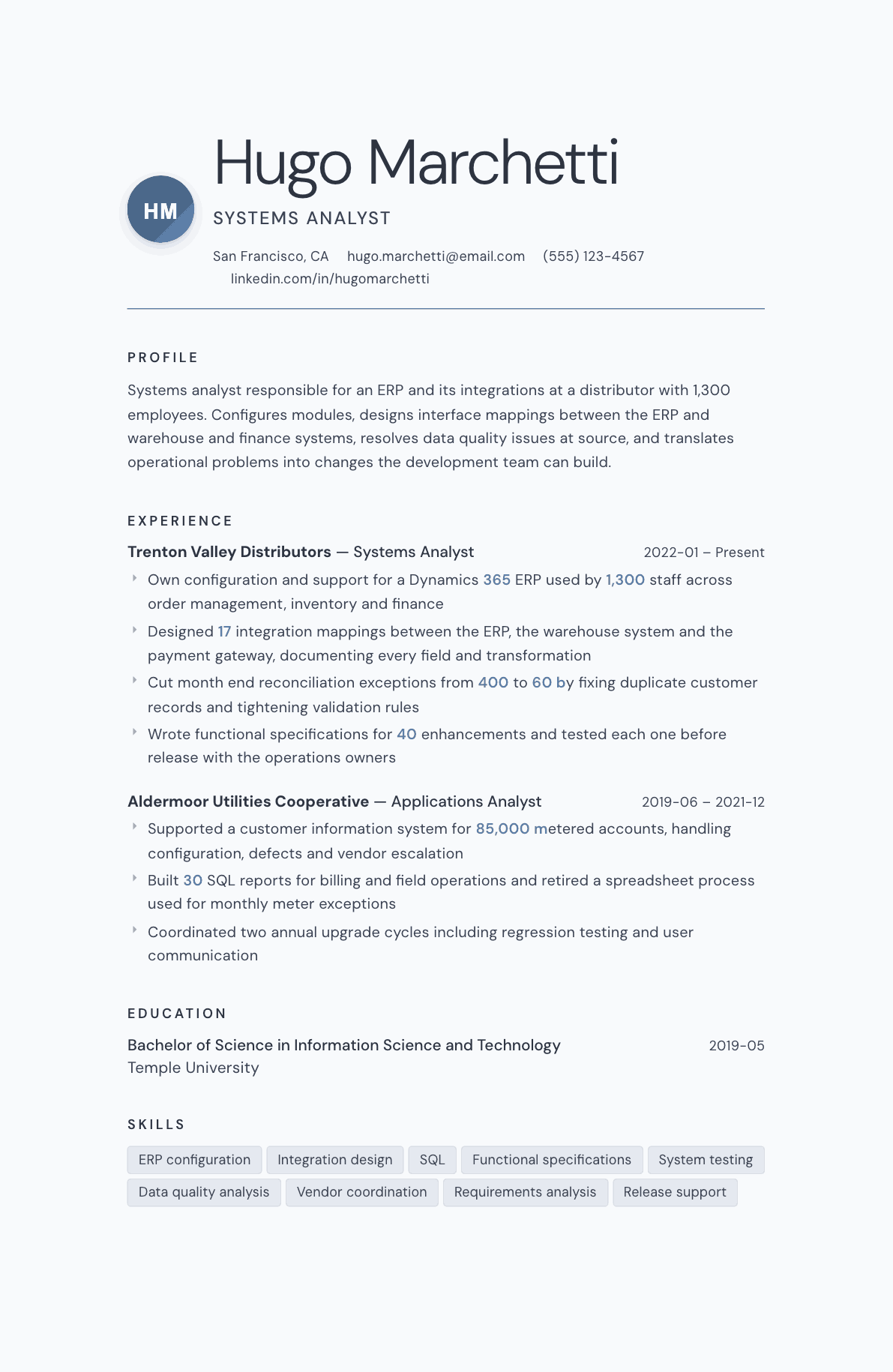
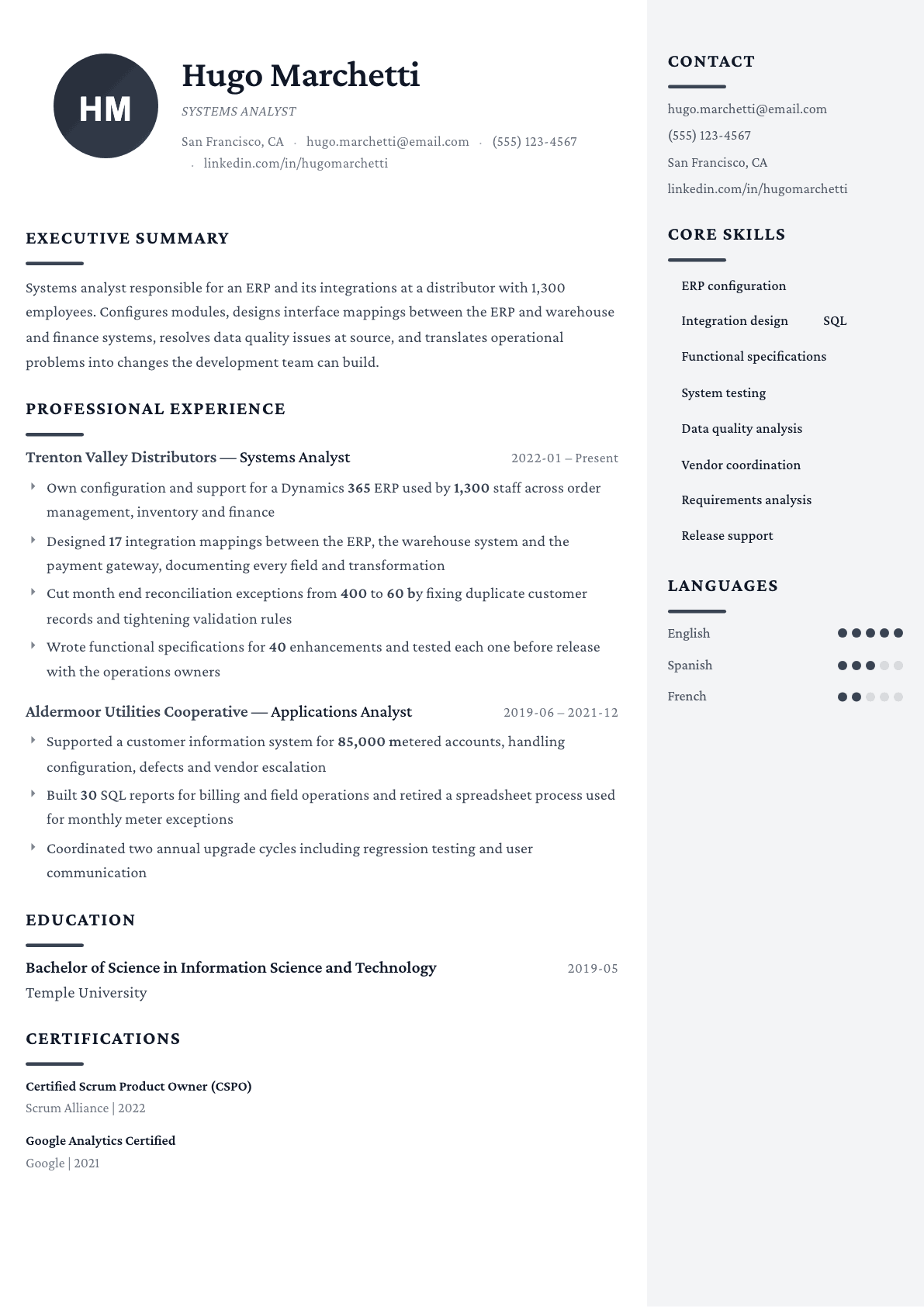
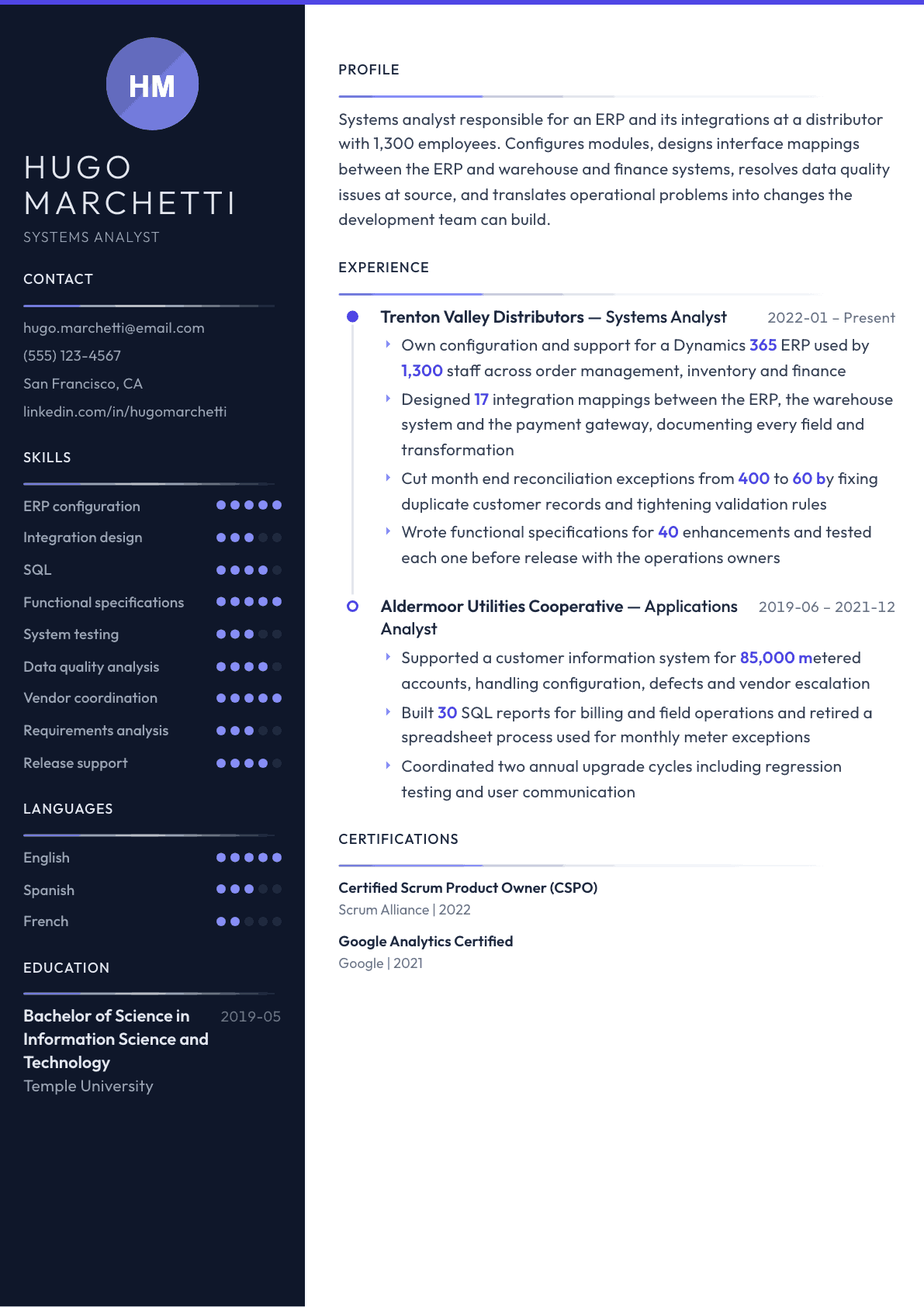
The same systems analyst content laid out in three CVBooster templates, so you can see what the finished document looks like before you write a word.
Example Systems Analyst summary
Systems analyst with six years owning enterprise applications and their integrations, currently supporting a Dynamics 365 ERP used by 1,300 staff. Designed 17 interface mappings across warehouse, finance and payment systems, cut month end reconciliation exceptions from 400 to 60, and wrote functional specifications for 40 enhancements. Looking for a senior systems analyst role on an ERP modernization program.
Skills to list on a Systems Analyst resume
- Systems analysis
- ERP configuration
- Integration and interface design
- Functional specification writing
- SQL querying and reporting
- Data mapping and transformation
- System and regression testing
- Requirements analysis
- Data quality remediation
- Vendor and release coordination
- Process documentation
- API and file based integrations
- Incident and defect triage
- User training and handover
What actually gets this resume read
- Name the systems you own by product and say how many users and transactions they carry.
- Describe integration work by the interfaces you designed, the direction of the data, and what breaks when it fails.
- Separate configuration from development, because employers want to know which side of the line you sit on.
- Show a data quality win with before and after counts, since that is the work most systems analysts actually do.
- Include upgrade and regression testing cycles, which prove you can carry a system through vendor releases.
- Write functional specification and test case work as deliverables with counts, not as a list of duties.
How to write a systems analyst resume
A systems analyst owns a running system rather than a project. When the month end reconciliation throws four hundred exceptions, when an interface silently drops records for two days, when the vendor releases an upgrade that changes a screen the warehouse depends on, the systems analyst is the person who has to understand it end to end and decide what happens next.
The resume has to show that ownership. Hiring managers for this role are wary of two failure modes: the candidate who is really a business analyst and has never touched configuration, and the candidate who is really a developer and has no patience for the business conversation. Both exist in the applicant pool, and both are visible within ten lines.
This guide covers how to write about systems you own rather than projects you joined, how to describe integrations and data quality work convincingly, three example summaries across the career, before and after bullets, and the questions systems analysts ask when the job title means five different things across five employers.
Format: two pages, systems named before anything else
One page early, two once you have owned more than one system. Reverse chronological, with a summary, a systems block, then experience. The systems block lists each platform with its user population and your role on it: configuration, support, integration, or all three. Recruiters search on platform names, and this block is what makes you findable.
State clearly whether you write code. Some employers expect a systems analyst to build reports and small scripts, others expect specification and testing only. Saying which side you sit on saves both parties an interview and stops you being screened out by an assumption.
- Header: name, city and state, phone, email, and any vendor certification after your name when the platform is a common one.
- Order: summary, systems block, experience, certifications, education, technical skills.
- Give each system a user or transaction volume, since a platform with 80 users and one with 1,300 are different jobs.
Summary: the systems you own and what they carry
Three or four lines. Name the platforms, the user population, the business processes they support, and the parts of the lifecycle you own. A summary that says experienced systems analyst with strong analytical skills has told the reader nothing that distinguishes you from four hundred other applications.
Add the integration picture. A system that stands alone is a support job. A system with seventeen interfaces into finance, warehouse and payments is an analysis job, and the difference is what determines your band.
Experience: configuration, integration, data, and release
Open each role with the system, its size and your scope. Then bullets across the four things systems analysts actually do. Configuration and functional change with counts. Integration design with interface numbers and what flows across them. Data quality work with before and after figures. Release and upgrade work with the testing you ran.
Integration bullets should name the direction, the systems at each end, and the failure mode. A mapping between the order system and the warehouse is more informative when you add that it carries stock adjustments both ways and that a failed message parks in an error queue you monitor. That level of detail is how a hiring manager tells real integration work from a diagram someone was shown once.
Data quality is the underrated half of this job and the easiest to quantify. Duplicate records removed, validation rules tightened, month end exceptions cut from a large number to a small one. These are the results a finance or operations manager will remember about you, so they belong high in the bullet order.
- Configuration: modules or areas you own, changes delivered, functional specifications written.
- Integration: interface count, direction, transformation logic, error handling and monitoring.
- Release: upgrade cycles supported, regression packs run, defects found before users saw them.
Specifications and testing: the evidence you can be trusted alone
Functional specifications are the deliverable that proves a systems analyst can be left with a problem. Say how many you wrote, who built from them, and whether the built result matched without rework. A specification that a developer implemented without a single clarification question is a strong quiet claim.
Testing belongs beside it. Regression packs you maintain, the scenarios you run after every vendor release, and the defects you catch before users do. Employers who have been burned by an upgrade that broke picking on a Monday morning read this section carefully.
Vendors, certifications and the keywords the filter wants
Most systems analysts sit between their business and a software vendor. Describe that relationship as work: raising and escalating defects with reproducible evidence, testing patches before they reach production, influencing the vendor roadmap, and managing the annual upgrade window. It is a skill and almost nobody writes it down.
Put platform certifications in a visible block with the issuer, since they are frequently a hard filter. Then mirror the vocabulary these postings recycle: functional specification, configuration, interface mapping, data migration, regression testing, defect triage, user training, release support, system documentation. Name the tracker, the query language and the reporting tool you use.
Systems Analyst resume summary examples
Applications analyst, first system
Applications analyst supporting a customer information system for a utility cooperative with eighty five thousand metered accounts. Handles configuration, defect triage and vendor escalation, built 30 structured queries for billing and field operations, and supported two annual upgrade cycles including regression testing and user communication.
Owning an enterprise system
Systems analyst owning configuration and support for a Dynamics 365 platform used by 1,300 staff across order management, inventory and finance. Designed 17 integration mappings to the warehouse system and payment gateway, and cut month end reconciliation exceptions from 400 to 60 by fixing duplicate records and tightening validation.
Senior analyst across a landscape
Senior systems analyst responsible for four connected platforms across manufacturing, logistics and finance, including the integration layer between them. Leads the annual upgrade program, owns the regression pack, mentors two analysts, and rebuilt the master data governance rules that removed a recurring order routing failure.
Work experience bullets: before and after
Before: Supported the company ERP system.
After: Owned configuration and support for a Dynamics 365 platform used by 1,300 staff across order management, inventory and finance, covering functional change, defect triage and vendor escalation.
Naming the platform, the user population and the modules shows real ownership instead of a support presence.
Before: Worked on system integrations.
After: Designed 17 interface mappings between the enterprise platform, the warehouse system and the payment gateway, documenting every field, transformation and error path, with failed messages parked in a queue reviewed daily.
Interface count, the systems at each end and the error handling prove hands-on integration design.
Before: Improved data quality in the system.
After: Cut month end reconciliation exceptions from 400 to 60 by merging duplicate customer records, tightening address validation at entry, and adding a weekly report that flags new duplicates before they reach finance.
A before and after figure with the three specific fixes shows a durable solution rather than a one-time cleanup.
Before: Wrote specifications for developers.
After: Wrote functional specifications for 40 enhancements covering screen behavior, validation rules and downstream effects, and tested each build against the specification with the operations owner before release.
Volume plus what the specification contained plus who verified it shows the work was complete rather than indicative.
Before: Helped with system upgrades.
After: Coordinated two annual vendor upgrade cycles, ran a regression pack of 120 scenarios across order entry, picking and invoicing, and raised nine defects with the vendor before the release reached production.
The regression scope and the defects caught early show you protected users rather than just attending the upgrade.
Hard skills
- Enterprise system configuration
- Functional specification writing
- Interface and integration design
- Data mapping and transformation logic
- Structured query writing and reporting
- Regression and system testing
- Defect triage and vendor escalation
- Data quality analysis and remediation
- Master data governance
- Release and upgrade coordination
- Process documentation
- User training and handover
- Application programming interface and file based integrations
Soft skills
- Translating an operational symptom into a system cause
- Working with a vendor without losing leverage
- Explaining a limitation to a frustrated user
- Documentation discipline
- Prioritizing defects against enhancements
- Patience with intermittent faults
Certifications worth listing
- Microsoft Certified: Dynamics 365 Fundamentals (Microsoft)
- Salesforce Certified Administrator (Salesforce)
- ITIL 4 Foundation (PeopleCert)
- Certified Business Analysis Professional (CBAP) (International Institute of Business Analysis)
- Oracle Cloud Infrastructure Foundations Associate (Oracle)
Mistakes that cost systems analyst candidates the interview
- Describing a project you were part of instead of a system you owned and still had to answer for afterward.
- Saying you worked on integrations without naming the interfaces, the direction of the data or what happens on failure.
- Leaving data quality work off the page when it is the most quantifiable result this role produces.
- Being unclear about whether you configure, specify or write code, which gets you screened out by assumption.
- Omitting user and transaction volumes, so a small departmental tool looks the same as an enterprise platform.
- Ignoring upgrade and regression work, which is exactly the risk employers hire this role to manage.
- Writing vendor management as attending calls rather than as escalations evidenced, tested and closed.
Systems Analyst resume questions
What is the difference between a systems analyst and a business analyst?
A business analyst works forward from a business need to a requirement. A systems analyst works from an existing platform outward: configuration, interfaces, data and releases. Many jobs blend both, so mirror the emphasis of the posting you are answering.
Do systems analysts need to write code?
It varies by employer, which is why you should state your level explicitly. Structured queries and report building are commonly expected, while application development usually is not. Saying where you stop prevents both an unfair screen out and an interview you cannot pass.
How do I describe an integration on my resume?
Name the systems at each end, the direction of the data, the volume or frequency, the transformation involved, and what happens when a message fails. Those five facts distinguish someone who designed the interface from someone who was shown a diagram.
What metrics work on a systems analyst resume?
Users and transactions the system carries, interfaces owned, enhancements specified, exceptions or defects reduced with before and after figures, and regression scenarios run per upgrade. Pick figures you can reconstruct if an interviewer asks how you got them.
How do I show vendor management experience?
Write it as evidence rather than attendance. Defects raised with reproducible steps, patches tested before production, escalations that changed a vendor commitment, and upgrade windows negotiated around a business calendar all show you held the supplier to account.
Related resume examples
- Business Analyst Resume example
- IT Specialist Resume example
- IT Business Analyst Resume example
- Data Analyst Resume example
- SAP Consultant Resume example
- GIS Analyst Resume example