Translator Resume Examples: free ATS score and gap list
Translator Resume and Curriculum Vitae Built Around Language Pairs
By Mustafa Tarabya, founder of CVBooster · Published · Updated
Translator resume examples with a guide to language pairs, daily word output, CAT tools, terminology bases and certification bodies.
Sample resumes for a translator
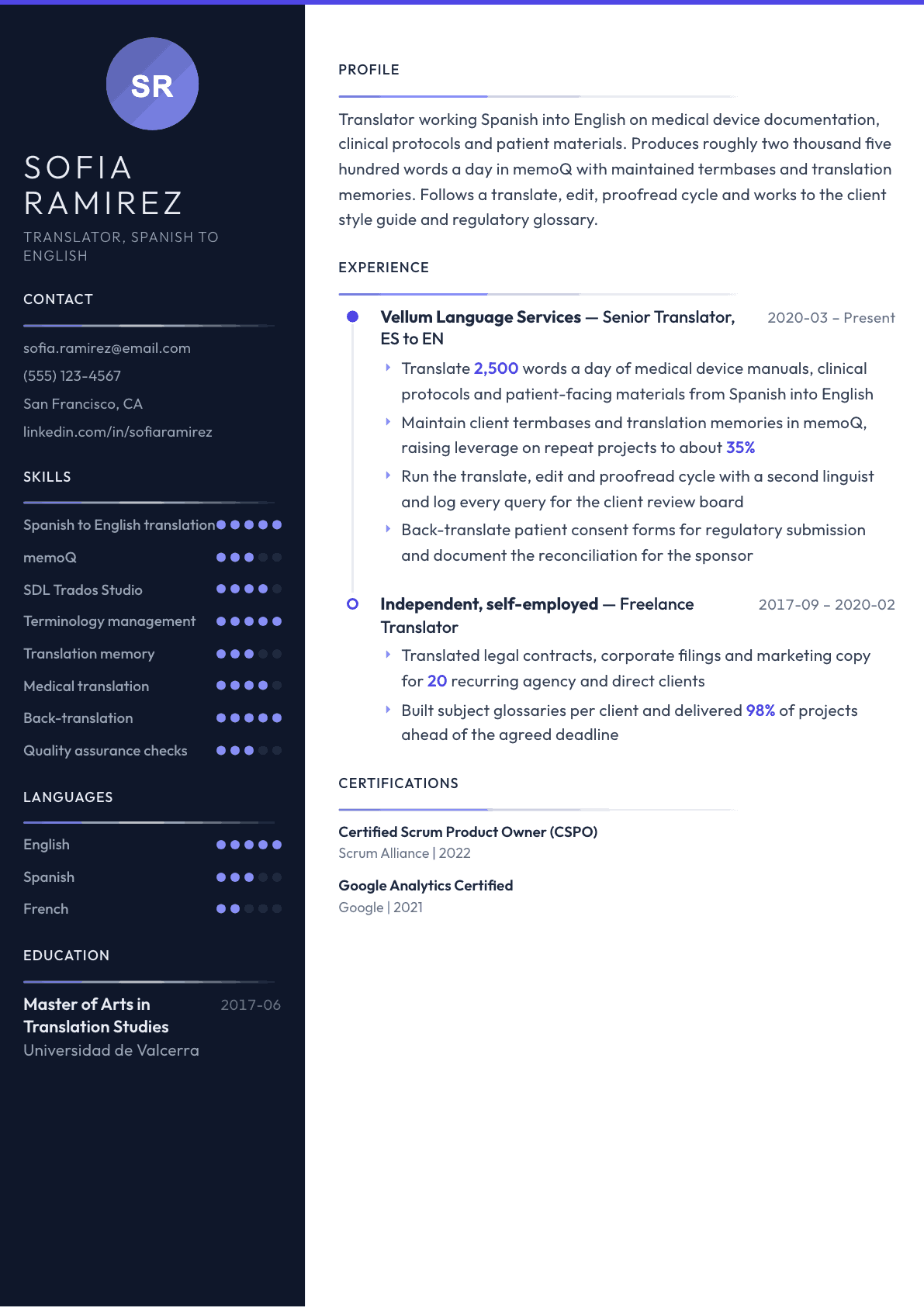
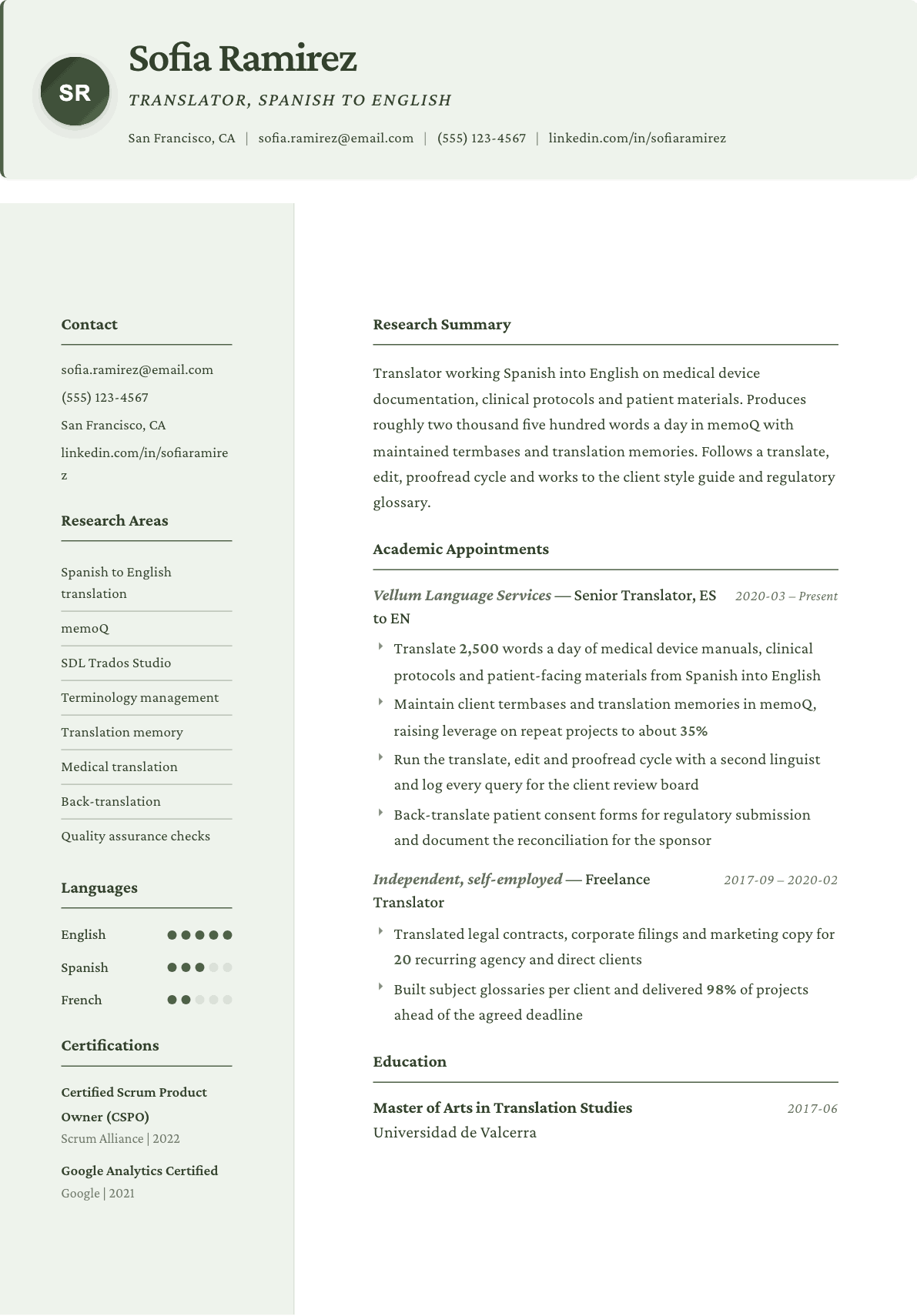
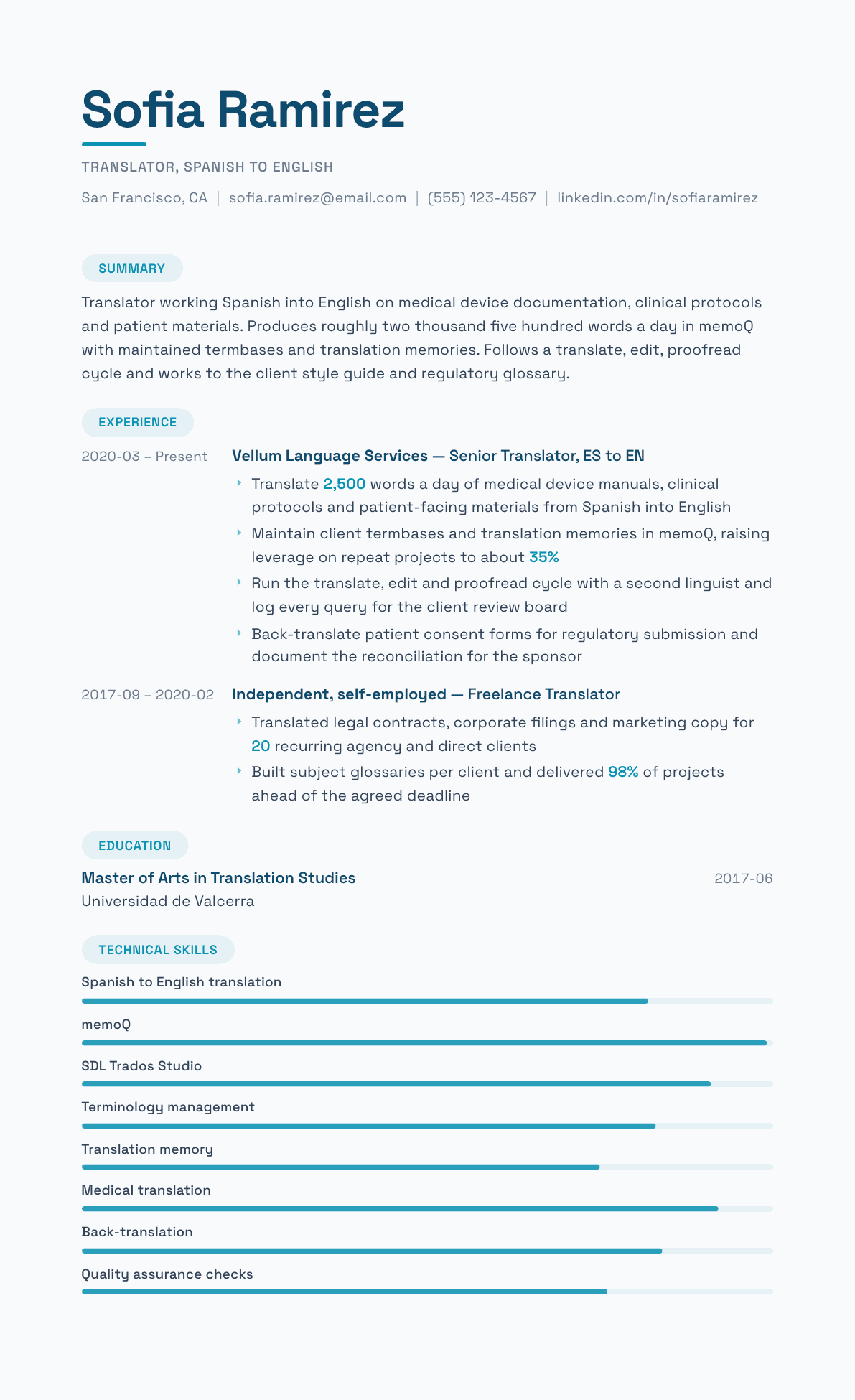
The same translator content laid out in three CVBooster templates, so you can see what the finished document looks like before you write a word.
Example Translator summary
Translator working Spanish into English on medical device documentation, clinical protocols and patient materials, producing about two thousand five hundred words a day in memoQ. Maintains client termbases and translation memories, follows a translate, edit and proofread cycle with a second linguist, and back-translates consent forms for regulatory submission. Repeat-project leverage now runs near 35%.
Skills to list on a Translator resume
- Translation
- Language pair specialization
- memoQ
- SDL Trados Studio
- Phrase
- Translation memory management
- Terminology and termbases
- Post-editing machine translation
- Back-translation
- Quality assurance checks
- Medical translation
- Legal translation
- Style guide adherence
- Transcreation
What actually gets this resume read
- Put the language pair and direction in your job title, since agencies filter on the exact pair before anything else.
- Name one or two specialisms such as medical device, legal or financial, because generalists lose to specialists.
- Give daily word output and your normal turnaround, as project managers schedule work from those two numbers.
- List CAT tools by name and version family: memoQ, Trados Studio, Phrase, and any client-mandated platform.
- Show terminology work, including the termbases and glossaries you maintain and the leverage they produce.
- Include real credentials only, such as ATA certification, with the issuing body written out in full.
How to write a translator resume
Translation resumes are filtered before a human sees them, and the filter is brutally narrow. A project manager at an agency searches for a language pair, a direction, a subject field and a tool, in that order. If the pair and direction are not in your headline, the rest of the document never gets read, however good the prose inside it is.
Once you clear that filter, the reader is scheduling rather than admiring. Daily word output, normal turnaround, availability, and whether you work into your native language decide whether you fit next week. Quality is assumed until a test proves otherwise, and almost every agency and direct client runs a test.
This guide covers how to build the file around pair, field and throughput, how to describe terminology and quality work that clients pay for without seeing, three summaries from first agency work to senior specialist, and the mistakes that keep good translators out of good rosters. Outside the United States most agencies ask for a translator curriculum vitae rather than a resume; it is the same file, usually with a short profile at the top and memberships listed in full.
Format: pair and direction in the job title line
Write the title as the pair with the direction: Translator, Spanish into English. Never leave it as translator alone and never write the pair without direction, because working into a language and out of it are different competencies and clients care intensely about which one you are claiming.
One page is normal for freelance profiles, since agencies read them as vendor records rather than career histories. Reverse chronological for staff roles, but for freelance work use one practice entry with a date range and group clients by sector underneath rather than listing every project.
Translator curriculum vitae example, the top third written out: Elena Rossi, Italian to English Translator, Legal and Financial. Profile: Freelance translator into English from Italian and French, working on contracts, company filings and fund documentation, with a separate review pass on every file. Credentials and memberships: Diploma in Translation from the Chartered Institute of Linguists, member of the Institute of Translation and Interpreting. Tools: Trados Studio, memoQ, client termbases. The experience section follows, listed by agency and direct client with the document types translated.
- Header: name, pair and direction, native language, city and time zone, phone and email.
- Section order: summary, fields of specialization, throughput and availability, experience, tools, terminology work, credentials.
- State the time zone, because turnaround promises across continents are a scheduling fact, not a detail.
Summary: field, throughput, and the quality cycle you follow
Name one or two subject fields immediately. Medical device documentation, clinical protocols, patent filings, corporate contracts, financial statements, subtitling: a generalist loses to a specialist on almost every roster, because the specialist needs less review. Two adjacent fields are credible; six are not.
Then give daily word output and the quality cycle you work in. Producing about two thousand five hundred words a day within a translate, edit and proofread cycle with a second linguist tells a project manager exactly how to build a schedule around you, and signals that you do not consider a first pass a delivery.
Experience: documents, domains and regulated work
Describe document types rather than clients where confidentiality allows. Instructions for use, clinical protocols, informed consent forms, patient-facing materials, supply agreements, annual reports, patent claims and technical manuals each carry their own conventions, and naming them proves you have handled the format rather than the general subject.
If your field is regulated, say what that means in practice. Back-translation of consent forms for submission, reconciliation documented for the sponsor, in-country review handled with the client review board, and query logs kept for audit are the parts a life sciences or legal client actually buys. Those bullets are worth more than any adjective about accuracy.
Give throughput at each stage. Words translated a day, words revised a day when you work as a reviser, and the largest single project you have delivered on schedule. Revision speed matters because agencies staff both roles from the same roster and a translator who can also revise is scheduled more often.
Tools, memories and terminology
List the computer-assisted translation environments you actually own or have licensed access to, by name: memoQ, Trados Studio, Phrase, and any client-mandated platform you have been trained on. Say which files you can accept and return, since a translator who can handle a package from any of the major environments is easier to schedule than one who can only work in a browser.
Terminology work is what turns a translator into a long-term supplier. Describe the termbases and glossaries you build and maintain per client, how you handle disputed terms, and the leverage that repeat projects gain from a well-kept translation memory. Add the quality assurance checks you run before delivery, covering numbers, tags, consistency, terminology and forbidden terms, because those checks are the difference between a clean file and a returned one.
- Say whether you offer post-editing of machine translation, and at what level, since the rate and workflow differ.
- Note transcreation separately, because marketing adaptation is judged on effect rather than fidelity.
- Mention style guide adherence and any locale conventions you apply for regional variants.
Credentials, tests and the keywords a project manager searches
Include real credentials with the issuing body written out in full, and leave out anything you cannot evidence. A translation degree, a recognized association certification in your exact pair and direction, and any subject qualification such as a background in law, medicine or engineering all carry weight. A subject degree paired with a language pair is a strong combination and belongs high on the page.
The searched terms are predictable: the pair, translation memory, terminology management, termbase, quality assurance, post-editing, back-translation, transcreation, and the tool names. Put them where a database will index them, in a skills block and in the experience bullets, and expect a short unpaid or paid test in your field before a first assignment.
Translator resume summary examples
First agency roster
Translator working Spanish into English with a translation studies degree and 18 months of agency work on marketing and general business documents. Delivers about 1,800 words a day in memoQ, builds a glossary for every client, and has met the agreed deadline on every project so far.
Five years, specialized
Translator working Spanish into English on medical device documentation, clinical protocols and patient materials, producing about 2,500 words a day in memoQ. Maintains client termbases and translation memories, follows a translate, edit and proofread cycle with a second linguist, and back-translates consent forms for regulatory submission.
Senior translator and reviser
Senior translator and reviser in Spanish into English life sciences work, translating 2,500 words a day and revising 6,000. Owns terminology for four accounts, chairs client review board calls on disputed terms, and mentors two junior linguists through the quality cycle on regulated submissions.
Work experience bullets: before and after
Before: Translated documents from Spanish to English.
After: Translated 2,500 words a day of medical device manuals, clinical protocols and patient-facing materials from Spanish into English for a regulated client portfolio.
Daily output plus the document types tells a project manager both what you can carry and what field you own.
Before: Used CAT tools including memoQ.
After: Maintained client termbases and translation memories in memoQ, lifting leverage on repeat projects to about 35% and cutting query volume on new files.
Tool ownership shown through leverage and query reduction is a commercial argument, not a software list.
Before: Checked my translations for quality.
After: Ran the translate, edit and proofread cycle with a second linguist and logged every unresolved query for the client review board before delivery.
A named quality cycle and a query trail prove a process rather than an assurance of care.
Before: Did back-translation for a medical client.
After: Back-translated patient consent forms for regulatory submission and documented the reconciliation with the forward translator for the sponsor file.
Reconciliation and the sponsor file are the details that show you have worked inside a real submission process.
Before: Met deadlines for agency clients.
After: Delivered 98% of projects for 20 recurring agency and direct clients ahead of the agreed deadline across three years.
A delivery rate across a named client count is the reliability figure a scheduler is trying to estimate.
Hard skills
- Translation into a native language
- Subject field specialization
- memoQ
- Trados Studio
- Phrase
- Translation memory management
- Terminology management and termbases
- Quality assurance checks
- Post-editing of machine translation
- Back-translation and reconciliation
- Transcreation
- Style guide and locale conventions
- Revision and second-linguist review
Soft skills
- Query discipline with clients
- Consistency across long projects
- Research into unfamiliar subject matter
- Schedule reliability
- Comfort defending a term choice
- Confidentiality with client documents
Certifications worth listing
- ATA Certification (American Translators Association)
- Certified Translator (Canadian Translators, Terminologists and Interpreters Council)
- Diploma in Translation (DipTrans) (Chartered Institute of Linguists)
- RWS Trados Studio Certification (RWS)
Mistakes that cost translator candidates the interview
- Writing translator without the pair and direction, which removes you from the only search a project manager runs.
- Claiming six subject fields, which reads as a generalist and loses every specialized roster.
- Leaving out daily word output and turnaround, the two facts that decide whether you fit next week.
- Listing tools you have only seen in a course, which collapses the first time a package arrives.
- Claiming a certification without the exact pair and direction it covers, since the certification is pair-specific.
- Offering translation into a language you did not grow up in without saying so, when clients treat direction as a hard rule.
- Describing quality as a personal value instead of a named cycle with a second linguist and a query log.
Translator resume questions
What should a translator curriculum vitae include?
Your language pair and direction in the title line, subject fields, daily output, CAT tools, credentials and memberships, then experience by client type with the documents you translated. One page suits a freelance vendor profile and two pages suits staff roles or published work. Agencies in the UK and Europe usually call this file a CV.
Do I need certification to work as a translator?
Not everywhere, but it clears filters and is required for some regulated and sworn work. If you pursue one, choose the body recognized in your market and confirm the certification covers your exact pair and direction, since certifications are not transferable across pairs.
How do I list CAT tools if I use several?
Put your primary environment first with the strongest evidence of use, such as the termbases and memories you maintain in it, then list the others as tools you can receive and return packages in. Ownership of a license is worth stating.
Should I include post-editing of machine translation?
Include it if you genuinely offer it, and say at what level, because full post-editing and light post-editing are priced and scheduled differently. Leaving it out entirely is also a valid positioning choice for a specialist in regulated content.
How do I get on an agency roster with no experience?
Pick one subject field you already know from prior study or work, translate sample document types from that field, and apply with a resume built around the pair and that field. Expect a test, and treat the terminology and query notes you return as part of the audition.