Accounting Intern Resume Examples: the lines they read
Accounting Intern Resume and Accounting Internship CV Sample
By Mustafa Tarabya, founder of CVBooster · Published · Updated
Accounting intern resume examples and a one-page accounting internship CV sample using coursework, bookkeeping work and CPA exam progress.
Sample resumes for a accounting intern
The same accounting intern content laid out in three CVBooster templates, so you can see what the finished document looks like before you write a word.
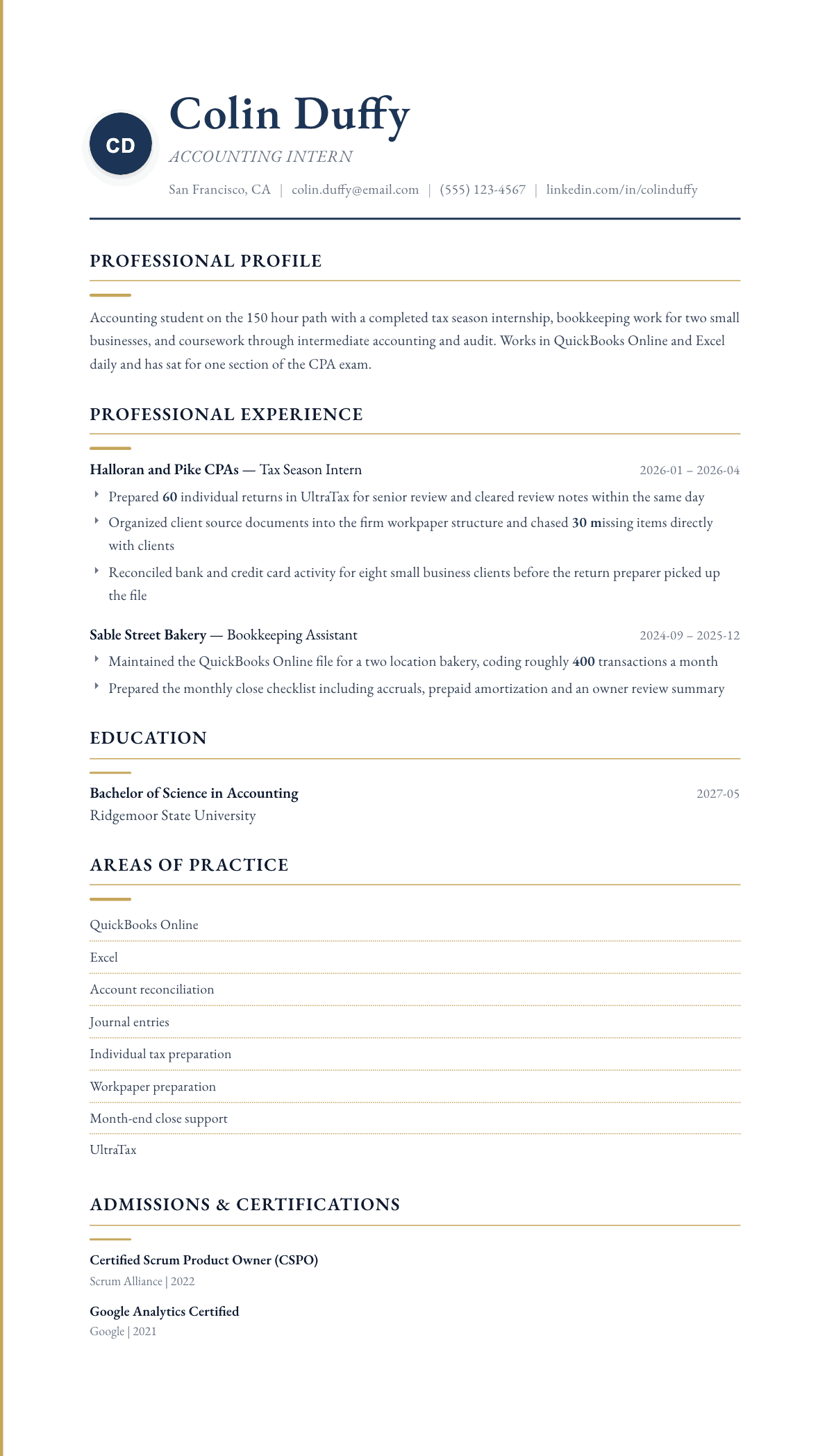
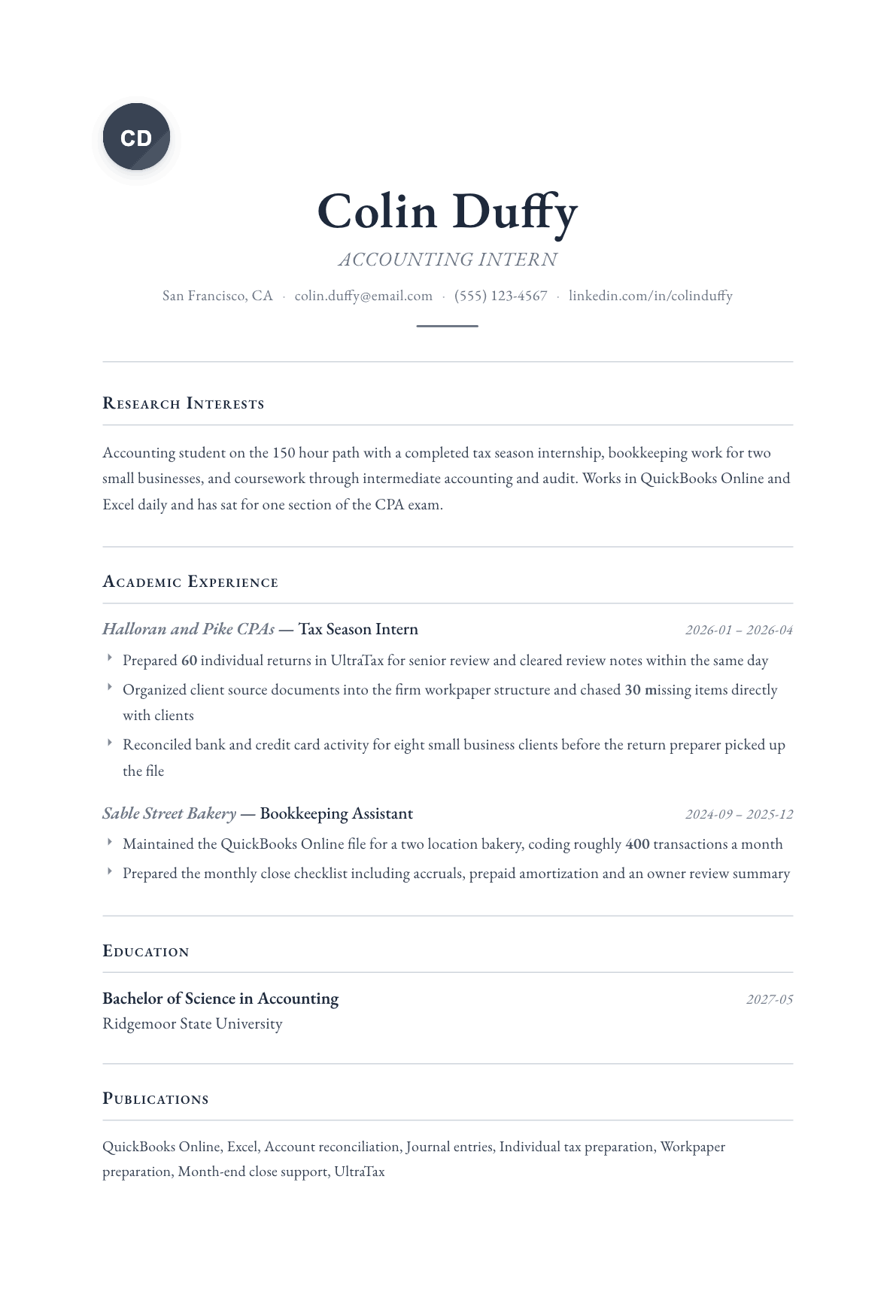
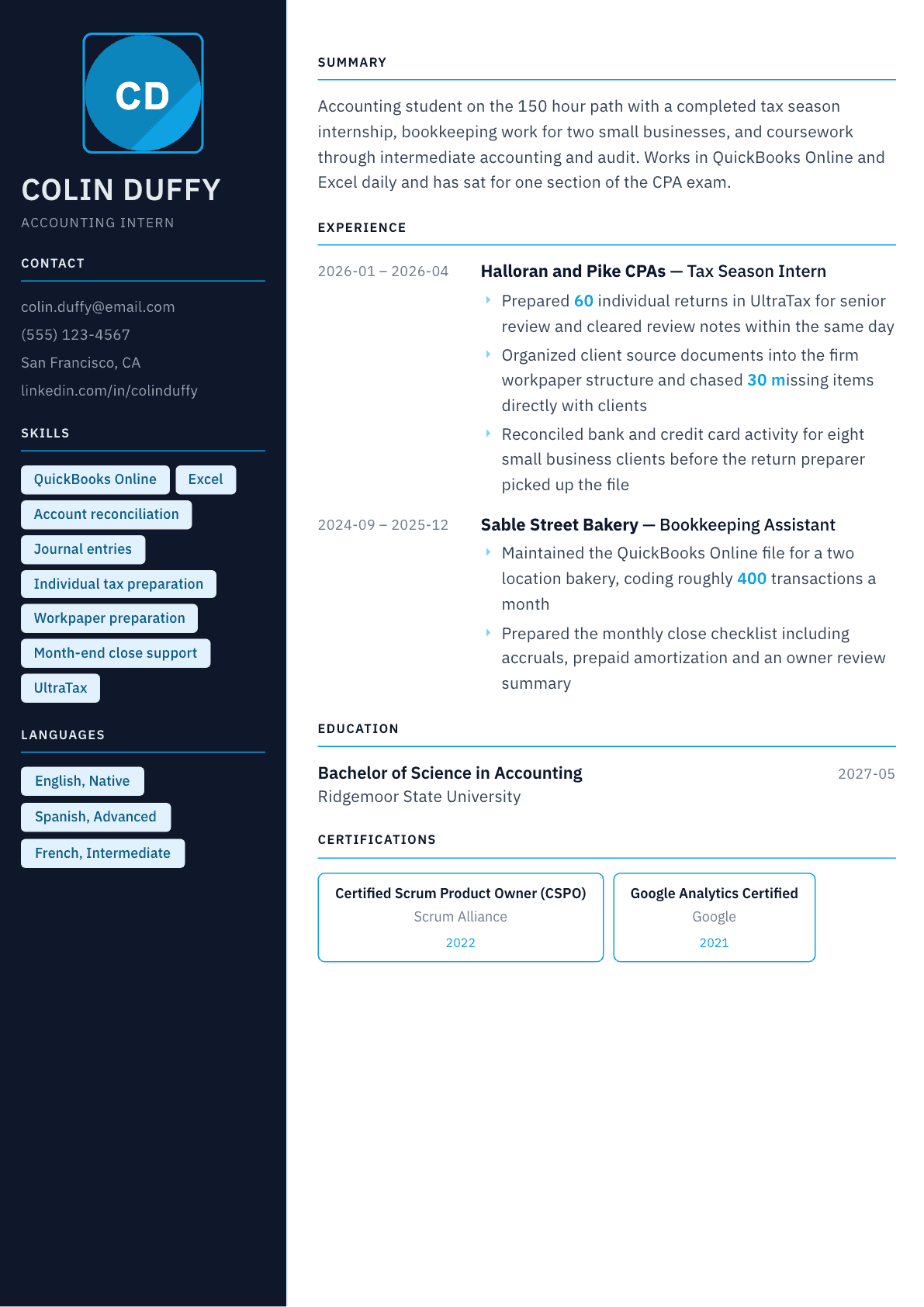
Example Accounting Intern summary
Accounting student on the 150 hour path seeking a public accounting internship in tax. Completed a busy season internship preparing 60 individual returns in UltraTax and clearing review notes same day, and keeps the books for a two location bakery in QuickBooks Online. One CPA exam section passed and the second scheduled. Strongest on reconciliations and clean workpapers.
Skills to list on a Accounting Intern resume
- QuickBooks Online
- Excel
- Journal entries
- Account reconciliation
- Month-end close support
- Accounts payable
- Accounts receivable
- Individual tax preparation
- Workpaper preparation
- General ledger maintenance
- Trial balance review
- Accrual accounting
What actually gets this resume read
- Lead with education, expected graduation and your progress toward the 150 credit hour requirement, which recruiters check first.
- State your CPA exam status plainly: sections passed, sections scheduled, or eligibility date if you have not started.
- Name the software you have used, since QuickBooks, UltraTax, CCH Axcess and NetSuite all appear in internship postings.
- Describe bookkeeping or campus work in accounting verbs like reconciled, accrued, coded and closed rather than helped and assisted.
- Keep tax and audit interests distinct, because firms recruit into separate lines and a vague resume gets sorted into neither.
- Add volunteer income tax assistance experience if you have it, because it proves client contact and return preparation together.
How to write a accounting intern resume
Public accounting recruiting is unusually mechanical. Before anyone assesses your judgment, a campus recruiter confirms three facts: your expected graduation, your progress toward the credit hour requirement for licensure in your state, and whether your academic record clears the firm threshold. An accounting intern resume that makes those three facts easy to find has already outperformed half the pile.
After that the reader wants to know whether you can be given a workpaper without supervision collapsing. That is proved by verbs, not adjectives. Reconciled, accrued, coded, tied out, cleared review notes and closed all describe things a first year staff member does, and a student who already writes that way looks like less training work.
Below is the section order accounting recruiters expect, three summaries for different points in a student career, before and after bullets that convert bookkeeping and campus work into firm-legible experience, and answers to the questions students ask about the exam, the credit hours and the tax against audit choice.
Format: one page with the licensure facts visible
One page, single column, education first. The education block should carry your institution, degree, major, expected graduation, and a line stating your credit hour position relative to the licensure requirement in the state you intend to sit in. Firms plan headcount around when you become eligible, so leaving that out makes their planning harder and your file less convenient.
Keep relevant coursework to a single line and use the course names that map onto firm work: intermediate accounting, auditing, individual and entity taxation, accounting information systems and analytics. A long block of every class you have taken buries the ones that matter.
- Header: name, city, phone, email, professional profile link.
- Sections: education with credit hour status, experience, skills and systems, certifications and involvement.
- State exam status plainly: sections passed, sections scheduled, or eligibility date.
Summary: line of service, exam status, systems
Keep it to three lines and make the first one commit to a line of service. Tax and audit are recruited separately, staffed separately and interviewed on different questions, so a resume that stays neutral to seem flexible usually reads as undecided to both teams.
The remaining two lines carry your exam progress and the systems you have actually worked in. A student who has already closed a month in a general ledger package is describing something a firm can use immediately, which is a stronger opening than any statement about attention to detail.
Experience: write like a first year staff member
Bookkeeping work is the most valuable thing most accounting students have, and it is routinely wasted through vague description. Say how many transactions you coded a month, what the close checklist contained, which accounts you reconciled and what you did when something did not tie. Those details are the entire job of a first year staff member.
A busy season internship should show volume, review discipline and client contact. Returns prepared for review, review notes cleared and turnaround, source documents chased directly with clients, and reconciliations completed before the preparer picked up the file are all specific enough to test in an interview, which is exactly why they carry weight.
Volunteer tax assistance experience belongs on the page if you have it. It proves return preparation and client contact together, and it is one of the few student experiences that maps almost exactly onto the first weeks of a tax internship.
If your only work has been outside accounting, keep it and write it around accuracy, cash handling, inventory counting or schedule reliability. A recruiter will accept unrelated work described precisely far more readily than an empty experience section.
Systems and skills: name the packages
List the accounting and tax software you have used, because firm postings name them and campus recruiters use them to sort candidates who can start faster. General ledger packages, tax preparation software, and any workpaper or engagement platform all count, and so does a data tool if you use it for real work rather than a single class exercise.
For Excel, describe capability rather than familiarity. Pivot tables, lookups, index and match, text functions for cleaning imported data, and any experience linking a trial balance into a working schedule are all things an engagement team will use you for in the first month.
- General ledger and bookkeeping packages you have posted in yourself.
- Tax preparation or engagement software from an internship or a volunteer program.
- Excel functions you use unaided, plus any data analytics tool with an honest depth note.
Keywords accounting internship postings use
The recurring terms are journal entries, account reconciliation, month-end close, general ledger, trial balance, accounts payable and receivable, accrual accounting, workpapers, audit support, and tax return preparation. Use the ones you have genuinely done, placed inside a bullet where the evidence sits alongside the phrase. Accounting reviewers are trained to check whether a claim is supported, so an unbacked keyword is more visible here than in most fields.
Accounting internship CV: a complete one-page sample
In the United States, an accounting internship CV and an accounting internship resume are the same document: one page, education first, with credit hours and exam plans visible. Firms only want an academic curriculum vitae if the internship is a research post. The sample below is for a junior applying to a summer audit internship; the student, school and firms are invented, so keep the order and replace every line with your own facts.
Two things make this page work. The education block answers the licensure questions before a recruiter has to ask them, and every experience bullet carries a count a first year staff member would recognize. If you are applying for tax, swap the summary line of service and move the volunteer tax program entry to the top of the experience section.
- Header: Maya Chen, Columbus, OH, phone, email, professional profile link.
- Summary: Accounting junior targeting a summer audit internship, 96 credit hours completed with a plan to reach 150 through a combined master program, comfortable reconciling bank and payroll accounts in QuickBooks Online and building lookup-based schedules in Excel.
- Education: Bachelor of Science in Accounting, expected graduation in spring of senior year, GPA 3.6. Relevant coursework: intermediate accounting I and II, auditing, individual taxation, accounting information systems.
- Experience, Bookkeeping Assistant, Green Street Dental, part time since sophomore year: codes about 220 transactions a month, reconciles two bank accounts and the payroll clearing account before the 5th of each month, and keeps a close checklist the owner and the outside CPA both sign off.
- Volunteer: Volunteer Preparer, IRS Volunteer Income Tax Assistance (VITA) clinic on campus, one season: prepared 31 federal and state returns for review, interviewed clients to confirm dependents and income documents, and cleared reviewer notes within one day.
- Skills and systems: QuickBooks Online, Excel (pivot tables, XLOOKUP, index and match), tax preparation software from the clinic, Power Query at a beginner level.
- Involvement: Treasurer, Accounting Student Association, managing a budget and reimbursement log for an organization of 80 members.
Accounting Intern resume summary examples
Second year student
Second year accounting student on the 150 hour path, seeking a first internship in audit. Coursework through intermediate accounting, and I keep the books for a small retail client in a cloud general ledger package. Comfortable with reconciliations, journal entries and a monthly close checklist.
One busy season completed
Accounting student with a completed tax season internship preparing 60 individual returns for senior review and clearing review notes same day, plus ongoing bookkeeping for a two location bakery. One CPA exam section passed and the second scheduled. Strongest on reconciliations and clean workpapers.
Final year, offer in hand
Final year accounting student completing the 150 credit hour requirement, with two internships across tax preparation and audit support. Prepared entity returns, tied out lead schedules to the trial balance and documented three testing procedures. Two exam sections passed and the remainder scheduled before the start date.
Work experience bullets: before and after
Before: Helped prepare tax returns during my internship.
After: Prepared 60 individual returns in the firm tax software for senior review, clearing review notes the same day and tracking open items on the engagement checklist.
Volume, review turnaround and checklist discipline describe the actual rhythm of busy season rather than participation in it.
Before: Did bookkeeping for a small business.
After: Maintain the cloud general ledger for a two location bakery, coding roughly 400 transactions a month and preparing accruals and prepaid amortization for the monthly close.
Transaction volume and named close procedures show you have done the work a first year staff member is assigned.
Before: Organized client documents.
After: Organized client source documents into the firm workpaper structure and chased 30 missing items directly with clients until every open request was closed.
Client contact and a closed-loop follow-up habit are what engagement seniors most want to stop doing themselves.
Before: Reconciled accounts for clients.
After: Reconciled bank and credit card activity for eight small business clients each month, investigating unmatched items before the return preparer picked up the file.
Client count, frequency and the investigation step turn a routine claim into evidence of independent working.
Before: Good with Excel and QuickBooks.
After: Rebuilt a client expense schedule in Excel using index and match against the general ledger export, replacing a manual retype that had introduced coding errors twice.
A specific task with a named function and a problem solved proves capability that a software list only asserts.
Hard skills
- Journal entries
- Account reconciliation
- Month-end close support
- General ledger maintenance
- Trial balance review
- Accrual and prepaid accounting
- Accounts payable processing
- Accounts receivable and collections support
- Individual tax return preparation
- Workpaper preparation
- Cloud accounting software
- Excel lookups and pivot tables
Soft skills
- Accuracy on repetitive work
- Clearing review notes without defensiveness
- Client follow-up persistence
- Deadline discipline in busy season
- Asking before assuming
- Confidentiality with client records
Certifications worth listing
- QuickBooks Online ProAdvisor (Intuit)
- Microsoft Office Specialist: Excel Associate (Microsoft)
Mistakes that cost accounting intern candidates the interview
- Omitting credit hour progress toward licensure, which recruiters use for headcount planning before they read your bullets.
- Staying neutral between tax and audit in the hope of seeming flexible, which reads as undecided to both teams.
- Describing bookkeeping with helped and assisted instead of the posting verbs that appear on a staff job description.
- Listing software without saying what you did in it, when the specific task is the only part an interviewer can test.
- Leaving off volunteer tax assistance work, which is the closest student analogue to a real tax internship.
- Being ambiguous about exam progress, which invites the assumption that you have not started and will not soon.
Accounting Intern resume questions
Do I need 150 credit hours before applying for an accounting internship?
No, internships are recruited well before licensure eligibility. What matters is showing a credible path: your current credit total, your planned route to the requirement, and your expected completion timing. Firms plan start dates around that information, so state it clearly.
Should I put CPA exam progress on my resume as a student?
Yes, whenever there is something factual to report. Sections passed, sections scheduled with dates, or your eligibility date all read as commitment. Vague phrasing like pursuing the credential without any detail attached tends to be discounted entirely by campus recruiters.
How do I choose between tax and audit on my resume?
Pick the one your evidence supports and commit the summary to it. Bookkeeping and return preparation point toward tax. Reconciliations, testing support and documentation point toward audit. You can still apply to both, but tailor each file rather than sending one neutral version.
Does small business bookkeeping count as real accounting experience?
It counts more than most students believe, because it involves the same ledger, the same reconciliations and the same close discipline that a first year staff member handles. Describe the volume, the accounts and the close steps and it will read as directly relevant.
Is an accounting internship CV different from a resume?
Not in the United States. Firms use the words interchangeably for internships and expect one page with education first, credit hours toward licensure, exam plans, and bullets with counts. An academic curriculum vitae with publications and teaching only makes sense for a research post. Abroad, a CV may run to two pages.
Related resume examples
- Accountant Resume example
- Bookkeeper Resume example
- Finance Intern Resume example
- Staff Accountant Resume example
- Tax Preparer Resume example
- Senior Accountant Resume example