Print Designer Resume Examples: the lines they read
Write a Print Designer Resume That Shows Real Production Skill
By Mustafa Tarabya, founder of CVBooster · Published · Updated
Print designer resume example with prepress detail, InDesign skills, paper and press knowledge, keywords and a writing guide.
Sample resumes for a print designer
The same print designer content laid out in three CVBooster templates, so you can see what the finished document looks like before you write a word.
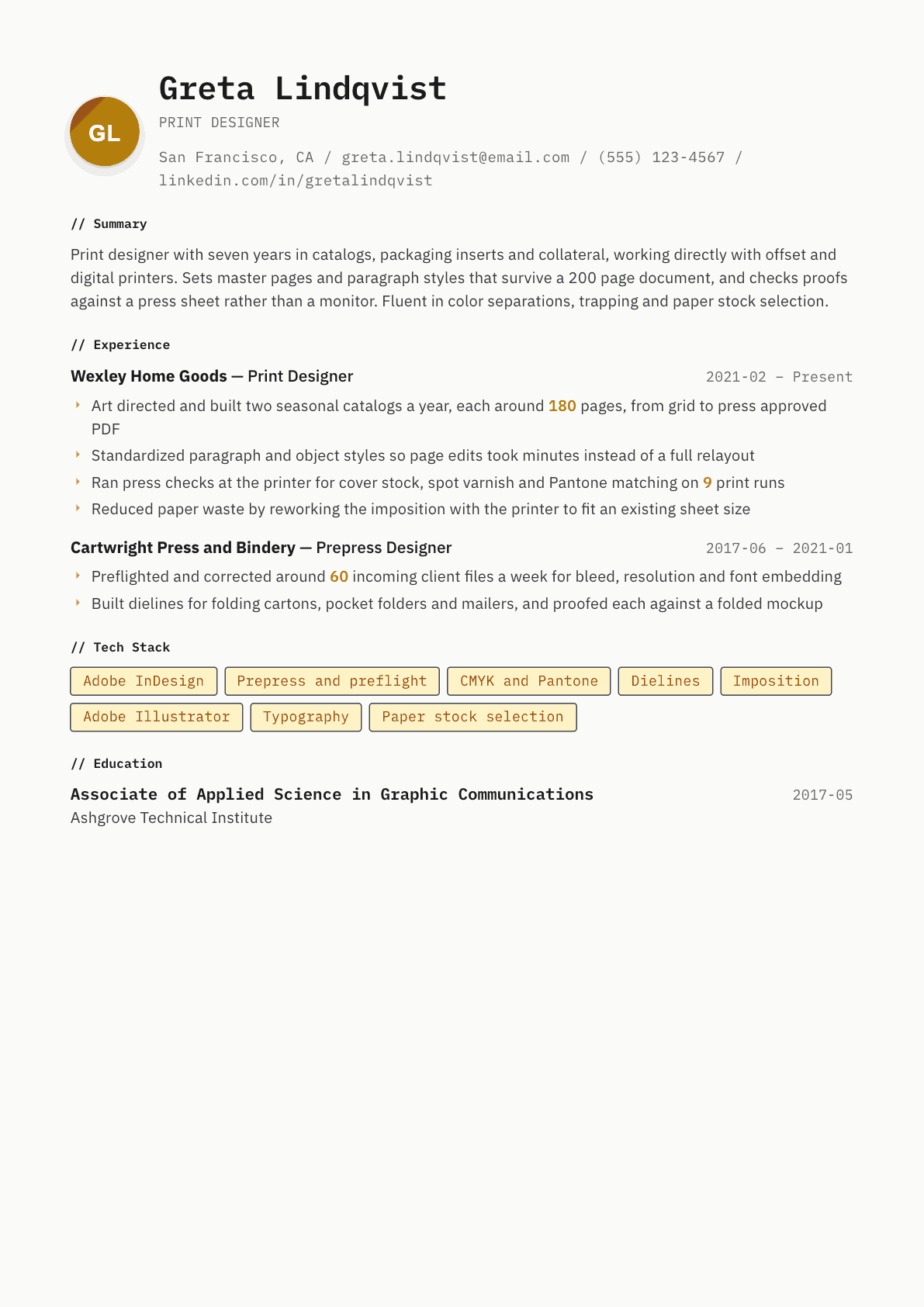
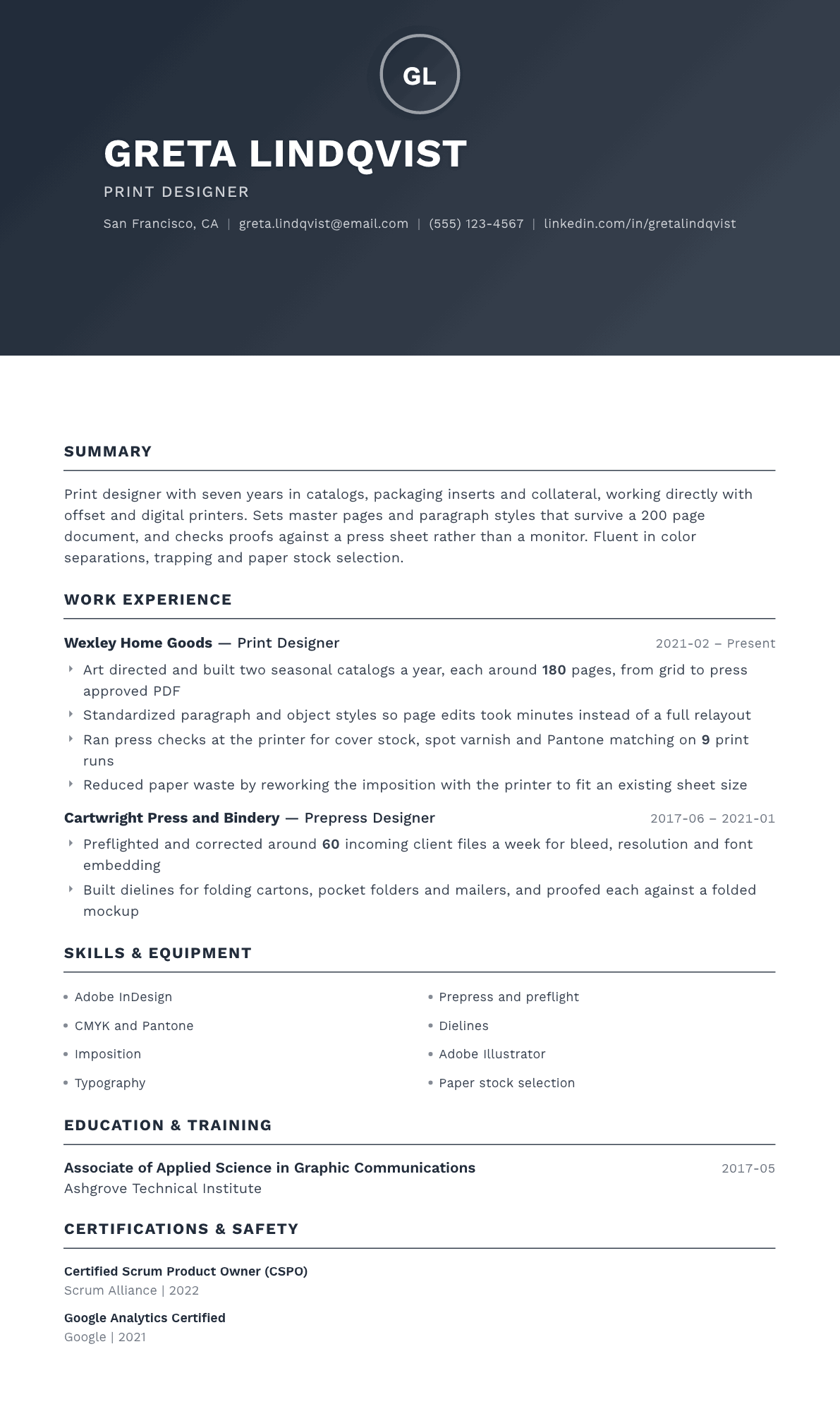
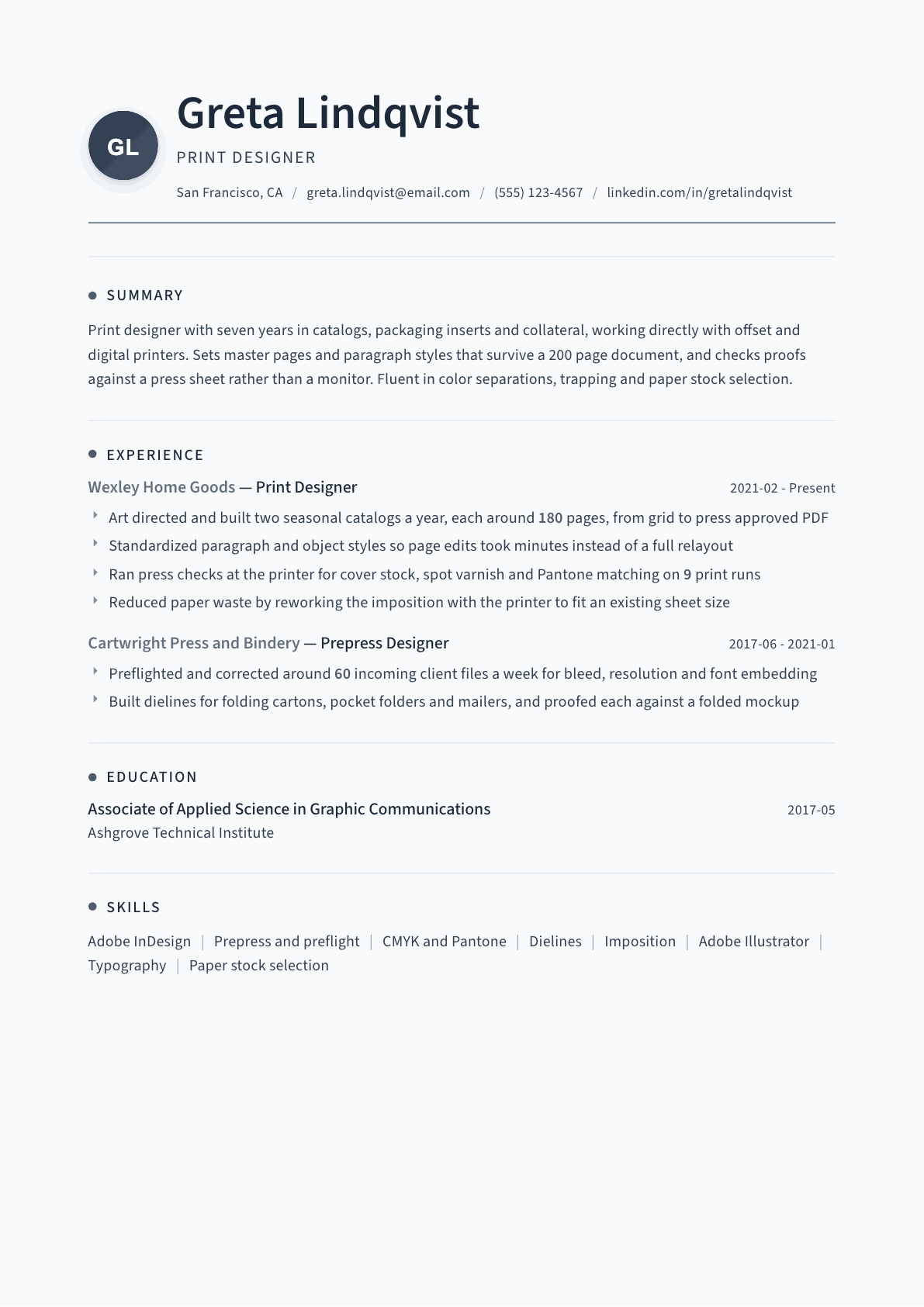
Example Print Designer summary
Print designer with seven years producing catalogs, packaging inserts and marketing collateral for offset and digital presses. Builds long documents on disciplined master pages and style sheets, prepares clean separations, and approves proofs at the press rather than on a screen. Works with printers on stock, imposition and finishing to keep a job on budget. Looking for in house catalog and packaging work.
Skills to list on a Print Designer resume
- Adobe InDesign
- Adobe Illustrator
- Adobe Photoshop
- Prepress
- Preflight
- Color separation
- CMYK and spot color
- Pantone matching
- Dielines
- Imposition
- Typography
- Master pages and styles
- Paper stock selection
- Binding and finishing
- Press checks
What actually gets this resume read
- Name the press processes you have worked with: offset, digital, screen, foil, letterpress, spot varnish.
- Show document scale, since a designer who has built a 200 page catalog is a different hire from a flyer designer.
- Include prepress vocabulary such as bleed, trapping, imposition, overprint and preflight in your skills section.
- Say whether you attend press checks, because a printer relationship is worth as much as software fluency.
- List paper and finishing knowledge, including stock weights, coatings, binding methods and folding formats.
- Keep a print portfolio with photographs of the finished piece in hand, not only flat artwork on screen.
How to write a print designer resume
Print design is one of the few creative jobs where a mistake costs money in a way everyone can count. A missing bleed, a rich black set wrong, an image at screen resolution or a spot color left in a file bound for four color process turns into a reprint invoice. That is why the people hiring a print designer read the resume for production vocabulary before they look at a single layout.
The other thing they look for is document scale. A designer who has built a 180 page seasonal catalog on disciplined master pages and paragraph styles is solving a different problem from one who lays out flyers, and both are legitimate, but they are not interchangeable. Say which one you are in the first three lines, and the rest of the resume will be read correctly.
This guide covers the section order a studio or in house team expects, how to write prepress and press check experience so it is believable, which paper and finishing knowledge belongs on the page, and how to present a print portfolio when the work only really exists in the hand.
Format: one page early, two once the production credits earn it
Reverse chronological, set on a real grid, with typography that shows you know what you are doing. A print designer whose resume has inconsistent spacing, mixed quote marks or a widow at the top of a column has already answered a question about attention to detail. Set proper hyphenation and check the trailing lines before sending it.
Two pages are normal once you have long document credits and press experience worth listing. Use the second page for a production credits block: the publications, the catalogs, the packaging lines and the presses. Do not use it for another paragraph about your design philosophy.
- Header: name, title, city, phone, email, portfolio address.
- Sections: summary, experience, production and prepress skills, software, education, selected print credits.
- A short line noting that printed samples are available to view at interview.
Summary: the formats, the presses, the document scale
Name the categories you produce: catalogs, packaging inserts, collateral, direct mail, signage, books. Then the print processes you have worked with, then the scale of the documents you build. A summary that includes offset and digital, plus a page count, tells a hiring manager more in one line than a paragraph of adjectives.
If you attend press checks, put that in the summary rather than burying it. Approving a proof against a press sheet instead of a monitor is the single clearest signal that a designer has worked in real production, and studios treat it as a shortcut for a whole set of skills.
Experience: build discipline, prepress detail, press relationships
For each job, name what you built, how big it was, and what came out the other end. Art directing and building two seasonal catalogs a year, from grid through feature pages to a press approved file, is a complete description of a role. Add the structural work underneath it: master pages, paragraph and object styles, linked content, and what those choices did to edit turnaround.
Prepress work deserves its own bullets. Preflighting incoming files for bleed, resolution and font embedding, correcting separations, building dielines for folding cartons and pocket folders, and proofing against a folded mockup are concrete tasks a production manager understands immediately.
Then the printer relationship. Press checks for cover stock, varnish and color matching, and any work you did with a printer on imposition or sheet size to reduce waste, show that you treat the press as a collaborator instead of a black box that returns boxes.
Production skills: the vocabulary a screener is scanning for
This section carries the keywords. Bleed, trim, slug, imposition, trapping, overprint, preflight, color separation, spot color and process, ink limits, resolution at final size, rich black, and packaged links. Use the terms the posting uses, and use them once more inside a bullet so a human reader sees them in context.
Add the material knowledge alongside them. Stock weights and finishes, coated and uncoated behavior, binding methods such as saddle stitch, perfect bound and wire O, folding formats, die cutting, foil and embossing. A designer who can specify a job as well as design it saves the production manager a conversation on every project.
- Software: InDesign, Illustrator, Photoshop, Acrobat preflight profiles.
- Prepress: bleed and trim setup, separations, trapping, overprint, imposition, packaged files.
- Materials: stock selection, coatings, binding, folding, die cutting and specialty finishes.
Portfolio: photograph the finished piece, not the artboard
A print portfolio full of flat artwork on a white background loses everything that makes print worth doing. Photograph the finished object: the folded piece in hand, the spot varnish catching light, the spine of the bound catalog, the die cut opened. Say in the resume that physical samples are available, and then actually bring them.
Include one spread from a long document with the grid visible if you can, because it shows the structure a reviewer cannot see in a hero shot. For packaging, show the flat dieline next to the built mockup so the reader follows how the piece was constructed.
Print Designer resume summary examples
Prepress or production start
Print production designer with 3 years at a commercial press, preflighting around 60 incoming client files a week for bleed, resolution and font embedding. Builds dielines for folding cartons, pocket folders and mailers, and proofs each against a folded mockup. Moving into a design led role with in house catalog work.
Seven years in
Print designer with 7 years in catalogs, packaging inserts and collateral for offset and digital presses. Builds 180 page documents on master pages and style sheets that keep edits to minutes, prepares clean separations, and attends press checks for cover stock, spot varnish and color matching on every major run.
Senior or art director level
Senior print designer and art director with 14 years producing seasonal catalogs, packaging systems and retail collateral. Owns the grid, the type system and the press relationship, negotiates imposition and sheet size with printers to control paper waste, and directs two designers plus a production artist through each season.
Work experience bullets: before and after
Before: Designed the company catalog each season.
After: Art directed and built two seasonal catalogs a year of around 180 pages each, from grid and flatplan through product pages to the press approved PDF.
Page count, frequency and the full range from grid to press file define the scope a manager needs to picture.
Before: Set up files correctly for print.
After: Preflighted around 60 client files a week against a printer profile, correcting bleed, image resolution at final size, unembedded fonts and stray spot colors before plates were made.
Volume plus the specific faults caught proves prepress competence rather than a general claim of accuracy.
Before: Worked with printers on production.
After: Attended press checks on 9 runs for cover stock, spot varnish and Pantone matching, approving sheets on press rather than signing off a monitor proof.
The contrast between press sheet and monitor is the detail that shows genuine production experience.
Before: Made the catalog easier to update.
After: Standardized paragraph, character and object styles across the catalog so a price or copy change propagated in minutes instead of forcing a page relayout.
Naming the document structure explains why the improvement happened, which a production lead can verify in conversation.
Before: Helped reduce printing costs.
After: Reworked the imposition with the printer to fit an existing sheet size, cutting paper waste on a repeat run without changing the trim size of the piece.
A cost claim becomes credible when the mechanism and the constraint are both stated.
Hard skills
- Adobe InDesign
- Adobe Illustrator
- Adobe Photoshop
- Prepress and preflight
- Color separation and ink limits
- CMYK and spot color
- Pantone matching
- Trapping and overprint
- Dieline construction
- Imposition
- Master pages and style sheets
- Long document layout
- Paper stock selection
- Binding and finishing
- Press checks
Soft skills
- Printer and vendor communication
- Deadline reliability
- Precision under repetition
- Budget awareness
- Clear file handoff
Certifications worth listing
- Adobe Certified Professional: Print & Digital Media Publication (InDesign) (Adobe)
- G7 Expert (Idealliance)
- Color Management Professional (CMP) (Idealliance)
Mistakes that cost print designer candidates the interview
- Writing the resume without prepress vocabulary, so a production manager cannot tell how much you know.
- Omitting document scale, which makes a catalog designer read like a flyer designer.
- Showing only flat artwork in the portfolio instead of photographs of the printed piece.
- Listing software without the file preparation practices that make the software useful.
- Saying you know print without naming a single press process, stock or binding method.
- Letting typographic sloppiness into your own resume, which contradicts everything the document claims.
Print Designer resume questions
Is print design still worth building a resume around?
Yes, in packaging, catalogs, publishing, retail environments and premium collateral, where physical production knowledge is hard to hire. Add digital skills alongside it so you can work across a brand, but do not hide the production depth that makes you scarce.
How do I show prepress skill if I was never in a press shop?
Describe the file preparation you own: preflight profiles, bleed and trim setup, resolution checks, packaged links and the printer specification sheets you work against. Then name the printers you have delivered to and any proof approval you handled.
Should I list paper stocks and finishing methods?
Yes, in a materials line inside your skills section. Coated and uncoated behavior, weights, saddle stitch and perfect binding, folding formats, foil and die cutting all tell a hiring manager you can specify a job rather than only design it.
What belongs in a print design portfolio?
Photographs of finished pieces in hand or in place, one long document spread with the grid visible, and a packaging project shown as both flat dieline and built mockup. Bring the physical samples to interview, since print is judged by touch.
How do I move from print into a broader design role?
Keep the production credibility as your differentiator and add digital evidence next to it: a brand system, a set of digital assets derived from print artwork, or layout work in a design tool teams use for screens. Reframe the summary toward the combination.