Key Account Manager Resume Examples: what gets the call
Build a Key Account Manager Resume That Retains Top Clients
By Mustafa Tarabya, founder of CVBooster · Published · Updated
Create a strategic key account manager resume with retention metrics, expansion revenue, and executive relationship skills that enterprise clients demand.
Sample resumes for a key account manager
The same key account manager content laid out in three CVBooster templates, so you can see what the finished document looks like before you write a word.
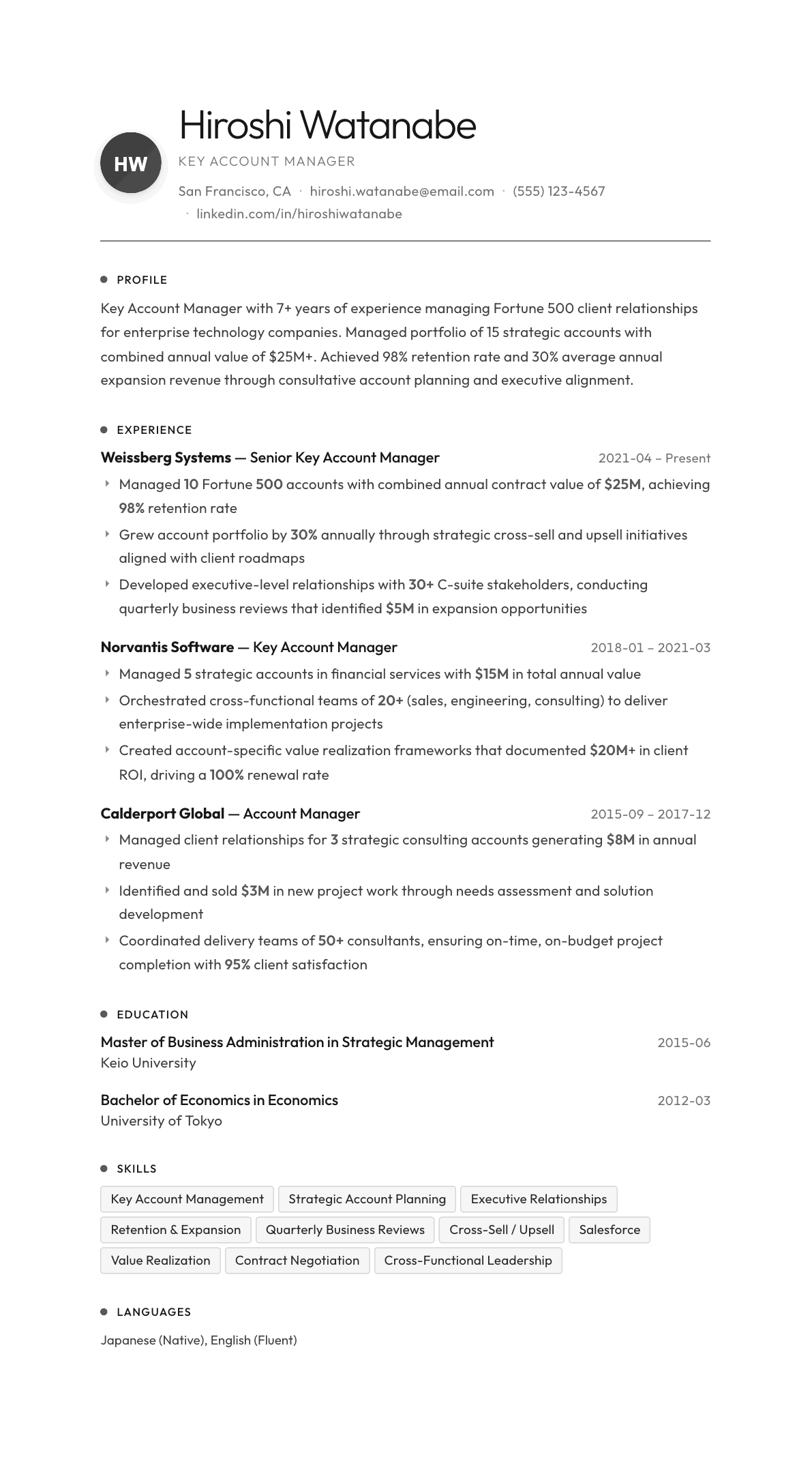
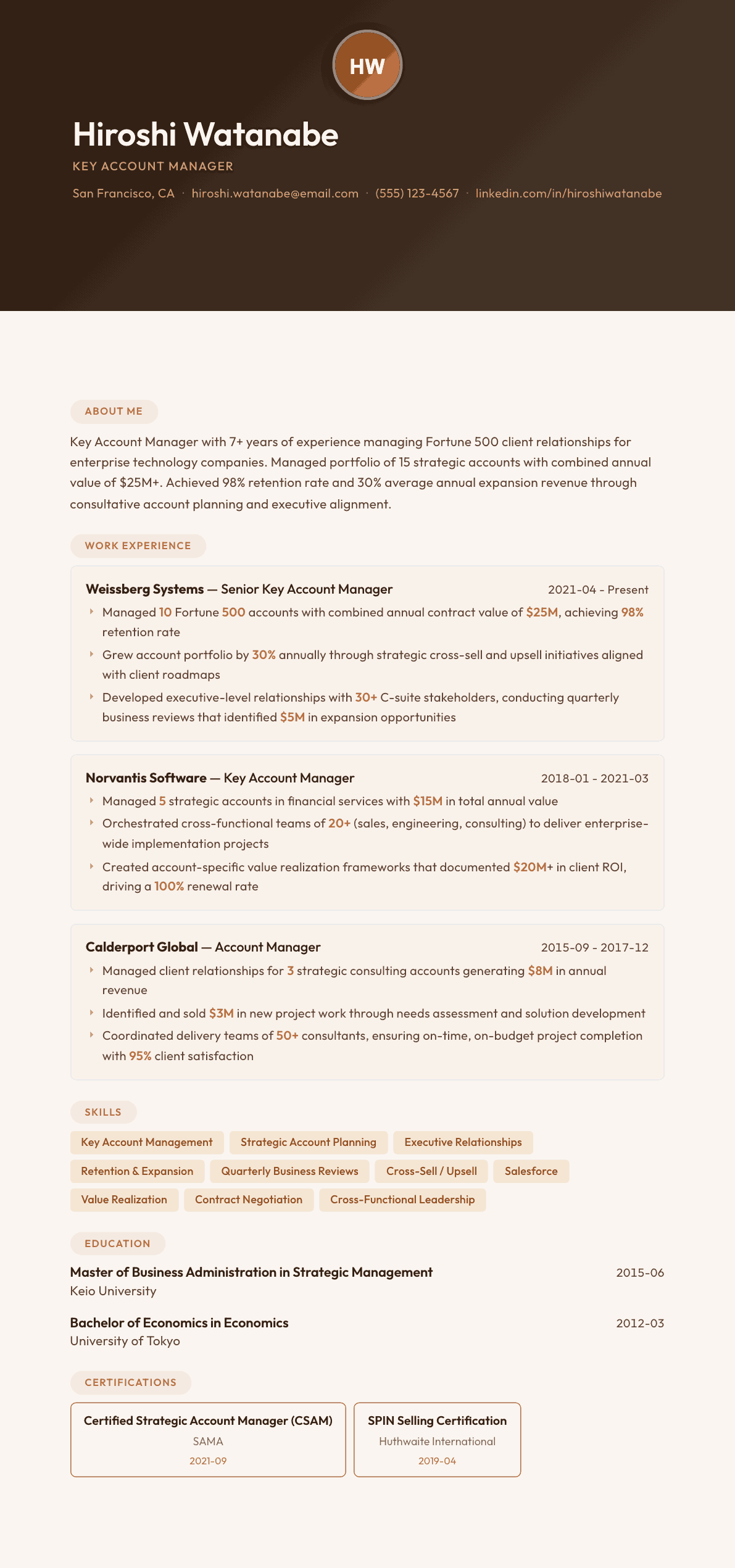
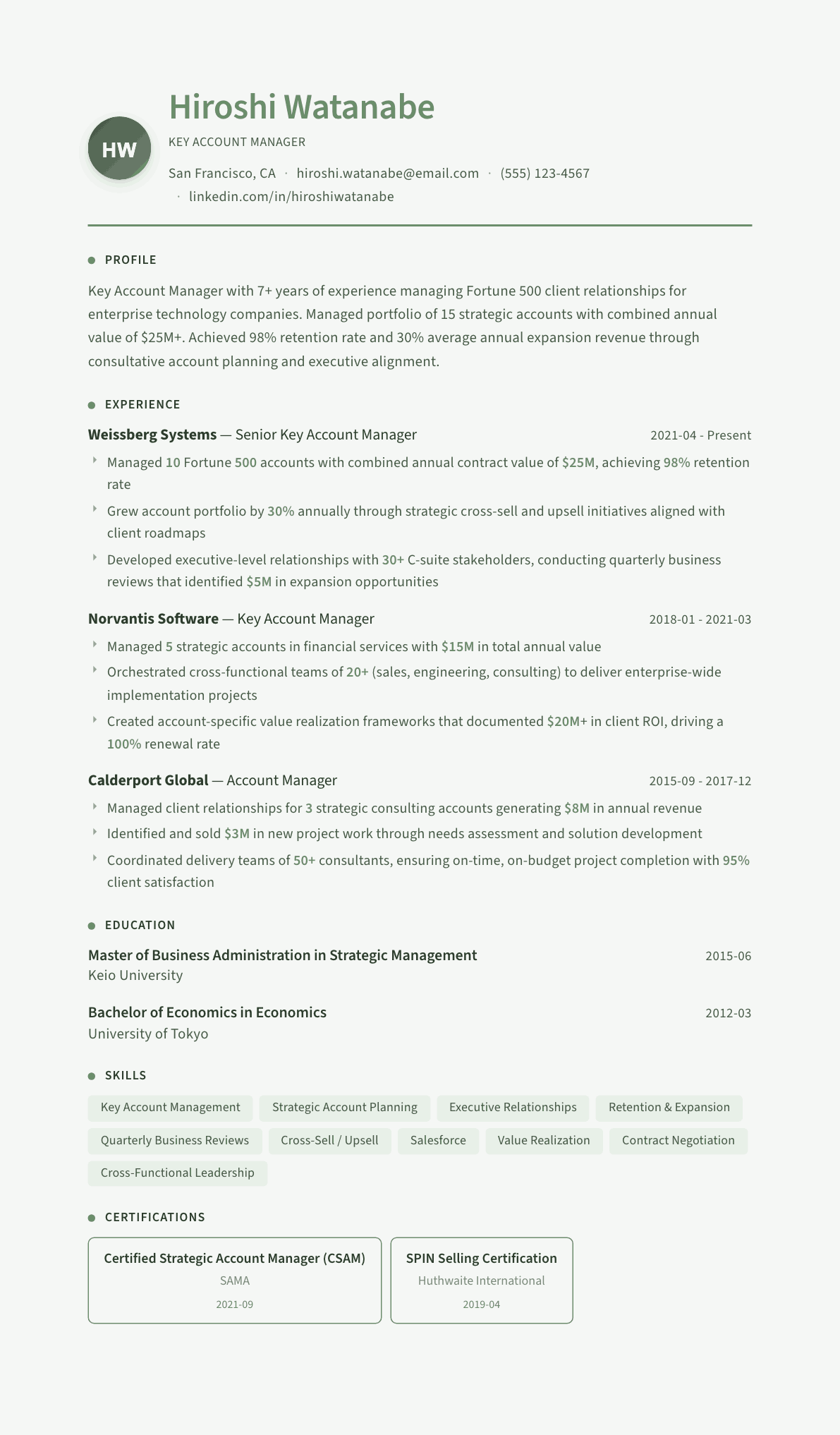
Example Key Account Manager summary
Strategic Key Account Manager with 7 years managing Fortune 500 accounts with $25M+ in combined annual value. Achieved 98% retention and 30% annual expansion at Weissberg Systems through executive alignment and consultative account planning. MBA with expertise in cross-functional orchestration and value realization for enterprise technology clients.
Skills to list on a Key Account Manager resume
- Key Account Management
- Strategic Account Planning
- Executive Relationship Management
- Retention & Renewal
- Expansion Revenue
- Quarterly Business Reviews
- Cross-Sell / Upsell
- Value Realization
- Contract Negotiation
- Salesforce CRM
- Cross-Functional Leadership
- Enterprise Sales
- Consultative Selling
What actually gets this resume read
- Lead with retention rate, expansion revenue, and total portfolio value -- these are the key KAM metrics.
- Showcase executive relationship management: C-suite engagement, QBR leadership, and strategic alignment.
- Demonstrate account planning methodology: how you identify expansion opportunities and align with client goals.
- Include cross-functional orchestration: how you coordinate sales, engineering, support, and consulting teams.
- Highlight value realization: how you proved ROI to clients and used it to drive renewals and growth.
- Mention industry vertical expertise to help recruiters match you to relevant accounts.
How to write a key account manager resume
A key account manager resume is judged on whether you can keep and grow a small number of large customers. The hiring leader is not looking for prospecting volume. They want the portfolio: how many accounts, what they were worth, what the retention rate looked like, how much you expanded them, and whether you held relationships above the day to day contact who signs the invoices.
The trap is writing this resume like an account executive resume. New business hunting numbers do not answer the questions a key account leader has, which are about renewal risk, account planning, executive alignment and the ability to run a joint plan with a customer over years rather than quarters. If your accounts renewed, say what you did that made them renew, since renewals happen quietly and are easy to under claim.
This guide covers the structure a key account leader expects, how to write a summary around portfolio value and retention, how to write bullets about expansion and saves, which planning and system skills to name, and the questions account managers ask when they move between industries or step up to strategic accounts.
Format: two pages, portfolio scope before achievements
Two pages once you have several years of account ownership. Open each role with a portfolio line before any bullet: the number of accounts, the industries they sat in, the combined annual value band, and whether the accounts were inherited or built. That line is what the reader uses to calibrate everything below it, because managing four global accounts and managing forty regional ones are different jobs with the same title.
Keep the layout simple and put a retention and growth block near the top. Retention rate, gross and net revenue retention if your company measured them, and expansion growth are the three figures a key account leader looks for first.
- Header: name, city and state, phone, email, professional profile link.
- Order: summary, portfolio results, experience with scope lines, account planning skills, systems, education.
- Scope line: account count, industries, combined value band, inherited or built.
- Name the seniority of the relationships you held, not just the company names.
Summary: portfolio, retention, expansion, relationship level
Say how many accounts you carried, in what industry, what they were worth as a band, and what you did with them. A key account manager holding a portfolio of large manufacturing customers with a strong retention record and consistent expansion has said something a leader can use. Descriptions built on being a trusted advisor who builds strong relationships appear on almost every competing resume.
Name the level you operated at. Working with a procurement contact is a different job from running a joint business plan with a customer vice president, and the resumes that stand out say which one, because senior relationship access is the hardest part of the role to teach.
Experience: retention, expansion, and the saves
Retention bullets need a mechanism. Naming a retention rate is a start, but the leader wants to know what produced it: a quarterly business review cadence, an adoption plan tied to the customer own targets, an executive sponsor pairing, a documented value review before every renewal. Renewal work is invisible when it goes well, so the resume has to make the work visible.
Expansion is where account managers separate themselves. Show the path: a new department, a new geography, a new product line, a services attach, a multi year commitment traded for a better rate. Give the starting point and the end point of at least one account so the reader can see growth over time rather than a single number.
Include at least one save. An account that was at genuine risk, what the root cause was, what you changed, and whether it renewed is the most persuasive bullet on a key account resume, because every leader has lost an account and knows how hard the recovery is.
- Portfolio value at the start and end of your tenure on the accounts.
- Retention rate, and separately any account lost with the reason.
- Expansion revenue and the specific route it came through.
- Cadence you ran: business reviews, joint planning sessions, executive meetings.
- Cross functional coordination: delivery, support, product, legal, finance.
Account planning and the systems behind it
Account planning is a documented discipline and naming the method helps. Whitespace mapping, relationship maps, stakeholder power mapping, joint success plans, mutual action plans, and value realization reviews are all concrete artifacts, and a leader who runs any of them wants a manager who has built them before.
On systems, name the customer relationship platform, the customer success or account planning tool if you used one (Gainsight, Planhat, Altify, Salesforce Account Plans), the reporting stack you built account dashboards in, and the contract and renewal tracking process. Add forecasting for renewals, since renewal forecasting behaves differently from new business forecasting and leaders notice when a candidate understands the difference.
Keywords a key account leader scans for
Strategic account management, portfolio ownership, retention, net revenue retention, expansion, cross sell and upsell, quarterly business review, joint business plan, executive alignment, stakeholder mapping, escalation management, contract renewal, service level agreement, and value realization. Use the posting wording once near the top and again beside a result, because the second reader is an account leader who will test whether the words are backed by anything.
Key Account Manager resume summary examples
First account portfolio
Account manager two years into a portfolio of fifteen mid-market customers in business services, running renewals, quarterly check ins and upsell conversations. Retained every account through the last cycle and grew three of them into additional product lines. Moving toward larger strategic accounts.
Five years in
Key Account Manager holding ten enterprise manufacturing accounts with a combined annual value in the eight figure band. Run quarterly business reviews and joint success plans with operations and finance leaders, retained the full portfolio through two renewal cycles, and grew it through services attach and a new regional rollout.
Strategic accounts
Strategic account director with nine years managing global customers in financial services, carrying four accounts and a virtual team of delivery, support and product contacts. Hold relationships at executive level, negotiated multi year agreements with procurement, and recovered two accounts that entered the year at renewal risk.
Work experience bullets: before and after
Before: Managed a portfolio of key accounts and built strong relationships.
After: Carried ten enterprise manufacturing accounts across four countries, holding quarterly business reviews with operations directors and an annual planning session with the customer executive sponsor.
Account count, geography, seniority and cadence describe the actual relationship work instead of asserting that it was strong.
Before: Achieved a high customer retention rate.
After: Retained all ten accounts across two renewal cycles by running a value review 90 days before each renewal, using adoption data and the outcomes agreed in the joint success plan.
Retention becomes credible when the resume names the pre-renewal mechanism that produced it.
Before: Grew accounts through upselling and cross selling.
After: Grew one account from a single site pilot to a rollout across eleven sites in two years by mapping whitespace with the operations team and sequencing each site against their capital planning cycle.
A start point, an end point and the method turn a growth claim into a story a leader can question in an interview.
Before: Resolved customer issues and escalations.
After: Recovered an account that had opened a formal escalation after a failed rollout, by agreeing a corrective plan with the customer program lead, adding weekly checkpoints, and closing the year with a renewed multi year agreement.
A named save with a root cause and an outcome is the most persuasive evidence an account manager can offer.
Before: Worked with internal teams to support customers.
After: Coordinated a virtual account team of eight across delivery, support, product and finance, chairing a monthly account call and owning a single escalation path for the customer.
Team size, functions and the meeting you owned show orchestration rather than passive collaboration.
Hard skills
- Strategic account planning
- Renewal and contract management
- Expansion and cross-sell strategy
- Quarterly business reviews
- Stakeholder and whitespace mapping
- Value realization reporting
- Escalation management
- Commercial negotiation
- Salesforce account management
- Gainsight or Planhat
- Renewal forecasting
- Joint business planning
Soft skills
- Executive relationship building
- Diplomacy under conflict
- Long term thinking
- Internal advocacy
- Structured listening
- Follow through
Certifications worth listing
- Certified Strategic Account Manager (CSAM) (Strategic Account Management Association)
- Salesforce Certified Administrator (Salesforce)
- Certified Customer Success Manager (CCSM) (SuccessCOACHING)
Mistakes that cost key account manager candidates the interview
- Writing the resume like a new business hunter, when the leader is hiring for retention and growth inside a fixed portfolio.
- Giving a portfolio value with no account count, so the reader cannot tell four large customers from forty small ones.
- Claiming high retention without naming a single mechanism that produced it.
- Leaving out the seniority of the relationships you held, which is the hardest part of the job to teach and the easiest to prove.
- Omitting any account you lost, when a candidate who can explain a loss reads as more experienced than one whose record looks perfect.
- Describing collaboration with internal teams without naming the functions, the cadence or your role in coordinating them.
Key Account Manager resume questions
What is the difference between a key account manager and an account executive resume?
An account executive resume is built on new business: pipeline, win rate and quota against fresh logos. A key account manager resume is built on a fixed portfolio: retention, expansion, relationship depth and the planning cadence you ran. Leading with the wrong set of numbers is the fastest way to lose the screen.
How do I show retention when almost everyone renews in my industry?
Show growth and depth instead. If renewal is close to automatic, the differentiators are expansion revenue, additional departments won, contract length extended, and the seniority of the relationships you built. Name the accounts that grew rather than repeating a retention figure the reader will discount.
Should I name my customer accounts on the resume?
Name them only where the account is recognizable and there is no confidentiality issue, and describe the rest by industry and size band. A leader cares more about the shape of the portfolio and the work you did inside it than about a list of customer logos.
How do I write a key account resume after an internal move from support?
Lead with the customer facing judgment you already exercised: escalations you owned, adoption you drove, renewals you influenced, and executives you presented to. Then show the commercial side you have picked up, since the gap a hiring leader worries about is negotiation and expansion rather than customer knowledge.
Is net revenue retention worth putting on the resume?
Yes if your company actually measured it and you can defend the definition, since it captures churn, contraction and expansion in one figure. If it was never tracked, use retention rate plus expansion revenue separately rather than inventing a number you cannot explain in the interview.