Pediatric Nurse Resume Examples: the lines they read
Pediatric Registered Nurse Resume Sample That Shows Age-Range Skill
By Mustafa Tarabya, founder of CVBooster · Published · Updated
Pediatric registered nurse resume sample and examples with weight-based dosing, CPN and PALS credentials, family-centered care and a full writing guide.
Sample resumes for a pediatric nurse
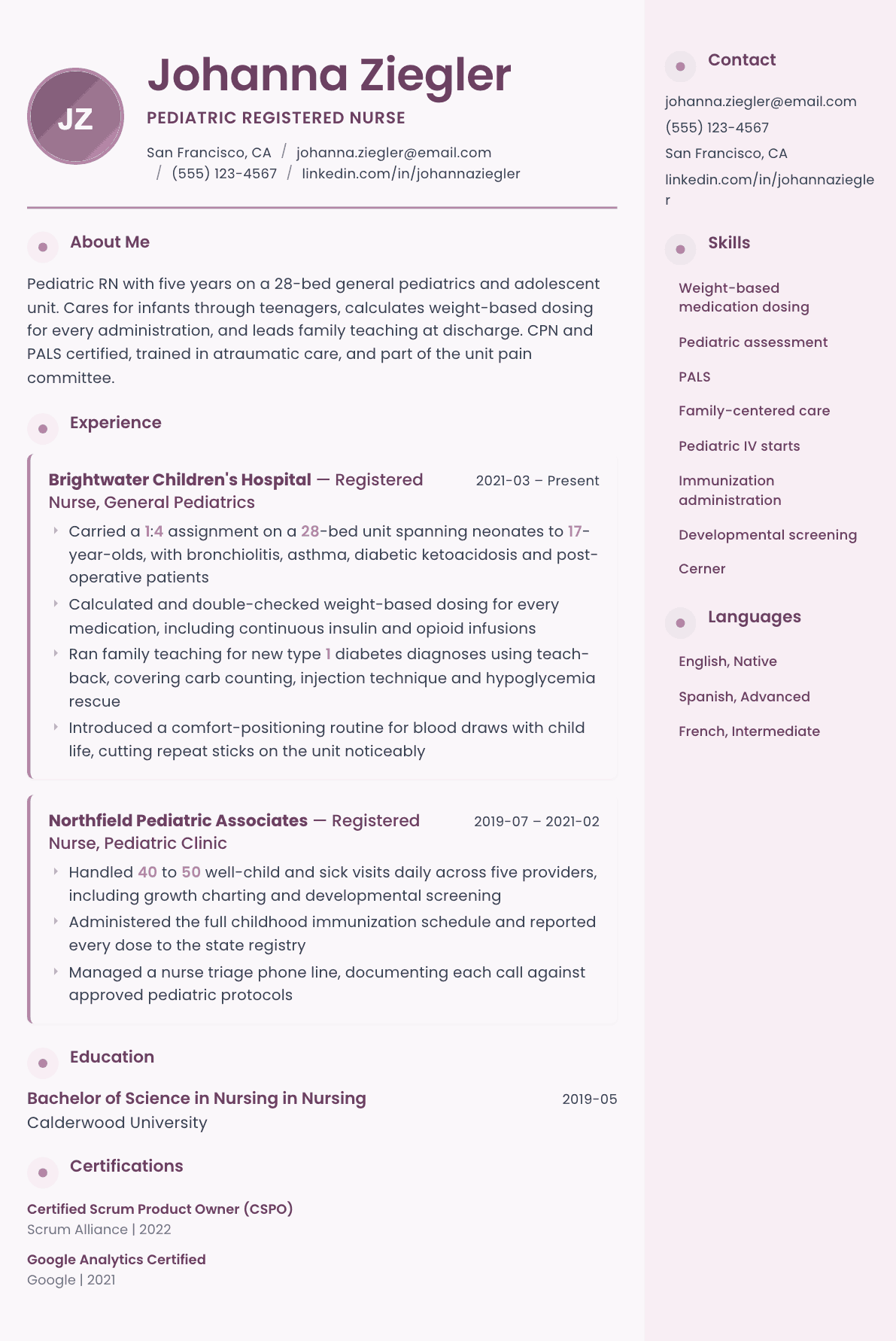
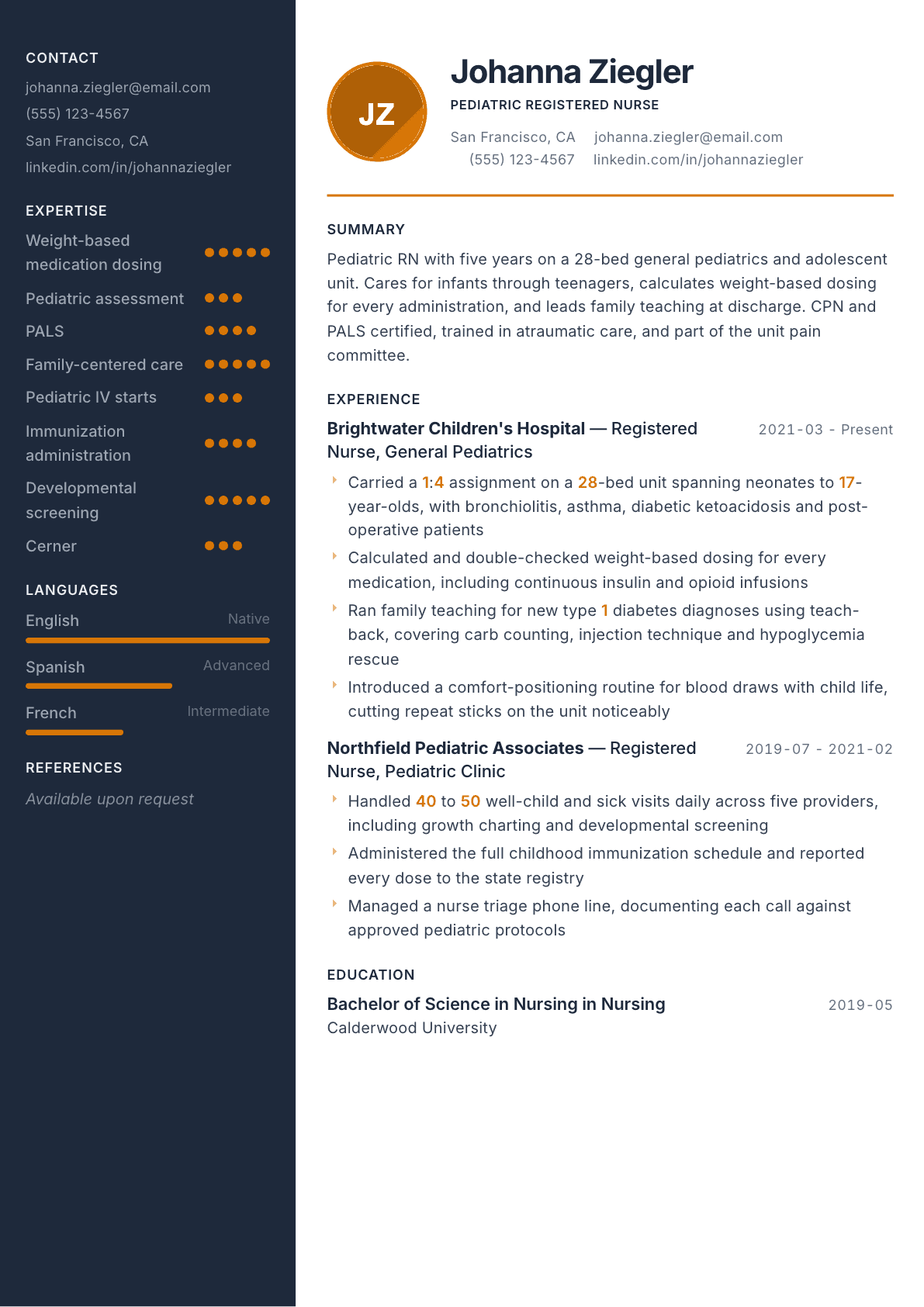
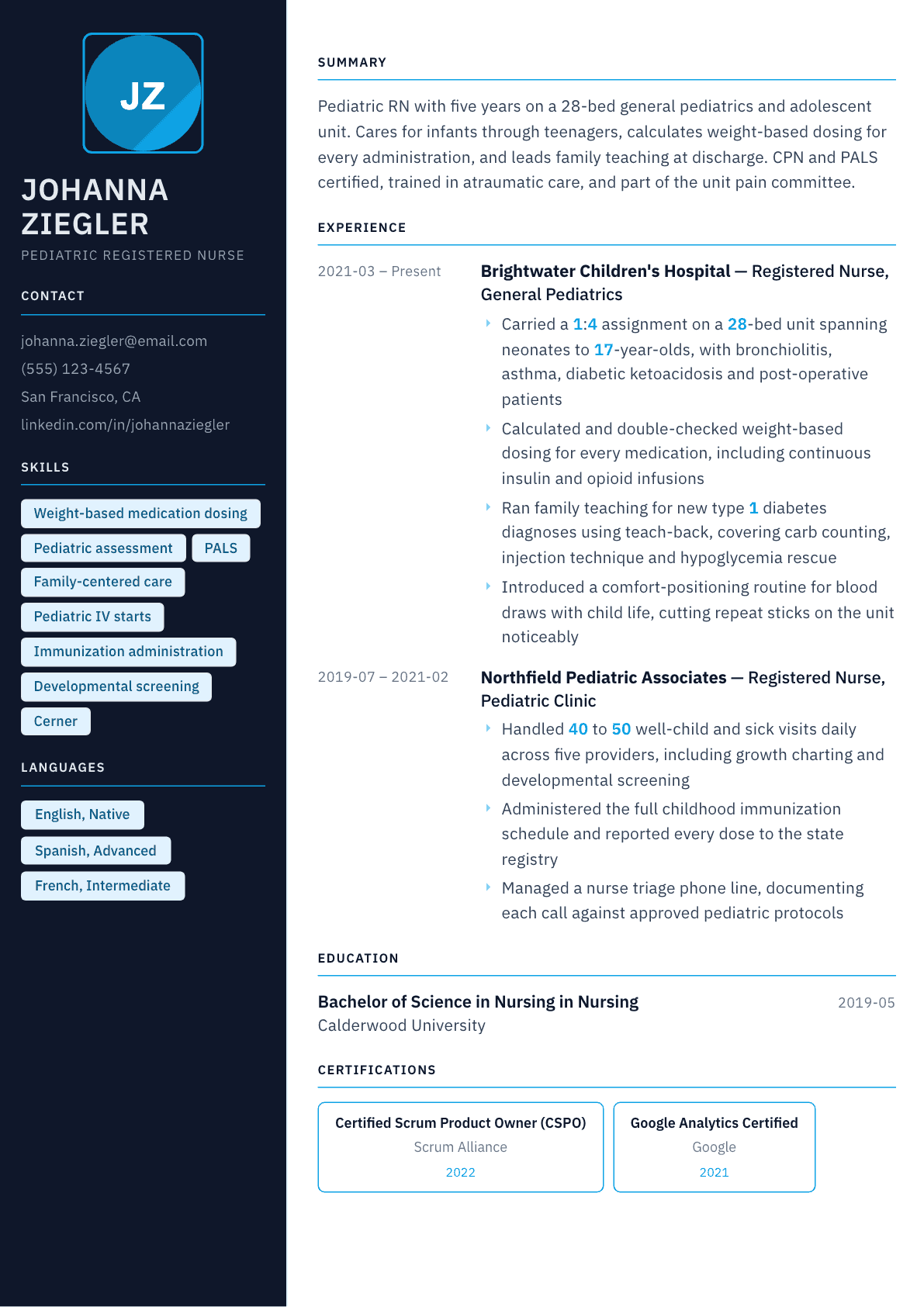
The same pediatric nurse content laid out in three CVBooster templates, so you can see what the finished document looks like before you write a word.
Example Pediatric Nurse summary
Pediatric registered nurse with five years on a 28-bed general pediatrics unit caring for neonates through adolescents. Calculates weight-based dosing for every administration, starts pediatric IVs with comfort positioning, and leads family teaching for new diabetes and asthma diagnoses. CPN and PALS certified and active on the unit pain committee. Seeking a pediatric intensive care residency.
Skills to list on a Pediatric Nurse resume
- Pediatric assessment
- Weight-based dosing
- Pediatric IV insertion
- Family-centered care
- Growth and development charting
- Immunization schedules
- Asthma and respiratory care
- Diabetic education for families
- Pain scales for nonverbal children
- Atraumatic care techniques
- Child abuse recognition and reporting
- Nasogastric and gastrostomy feeding
- Cerner charting
- PALS resuscitation
What actually gets this resume read
- Give the age range you have actually cared for, because neonate to adolescent is four different skill sets in one job title.
- Say that you calculate weight-based dosing and that a second nurse verifies high-alert drips before administration.
- Name your pediatric IV and lab draw success habits, since small veins are the skill managers ask about at interview.
- Show family teaching with a concrete diagnosis, such as new diabetes, asthma action plans or gastrostomy tube care.
- Put PALS, CPN and any Broselow or car seat safety training in a certifications block near the top of the page.
- If you are moving from adult care, name your pediatric clinical hours, float shifts or camp nursing experience explicitly.
How to write a pediatric nurse resume
Children are not small adults, and a pediatric nurse resume has to prove that the writer knows it. The manager reading the file is checking three things: the age range you have actually cared for, whether you calculate and verify weight-based dosing as a reflex, and how you work with parents who are frightened and present for every hour of the admission. A resume that reads like an adult medical-surgical resume with the word child swapped in does not survive that check.
The second reality is that pediatrics is many jobs under one title. A general pediatrics floor, a pediatric emergency department, a specialty clinic, a school, a neonatal unit and a pediatric intensive care unit all hire pediatric nurses, and each wants evidence of a different daily rhythm. Say which one you did, and say it in the first line of every job.
This guide walks through the header, summary, experience bullets, skills and certifications for pediatric roles, with a complete pediatric nursing resume sample, example summaries at three career stages and before-and-after bullets drawn from the parts of the work that only happen with children. Postings often shorten the title to pediatric RN, and a pediatric RN resume puts the RN license, PALS and the age range in the first lines, exactly as below.
Format and header: credentials, license, and the age range you cover
Use reverse-chronological order and put your credentials after your name in the order degree, license, certification. Directly below, list your RN license and state, then a certifications block with PALS, BLS, CPN if you hold it, and any specialty course such as neonatal resuscitation or trauma nursing for children.
Add one short line naming the age range you have practiced across, because it is the single most useful fact on a pediatric resume. Neonate through adolescent is a wider claim than infant and toddler, and a manager staffing an adolescent medical unit needs to know which one you are.
On a pediatric registered nurse resume, the RN line carries weight that an LPN or medical assistant resume cannot: independent assessment, care planning, IV and central line management and family teaching are within your scope, so say so in the summary. Write the title the way the hospital posts it, Pediatric Registered Nurse or RN, Pediatrics, so the applicant tracking system matches it exactly.
- Name with credentials, city and state, phone, email.
- License and state, then certifications: PALS, BLS, CPN, neonatal resuscitation.
- Order: summary, certifications, clinical experience, education, skills.
- New graduates add pediatric clinical rotations with hours and the unit type.
Pediatric RN resume summary: setting, ages and the family work
Three lines. Give the unit type and bed count, the years, the age range, and one thing you are known for. A pediatric nurse who says she covers neonates through seventeen-year-olds on a 28-bed unit and leads family teaching for new diabetes diagnoses has drawn a picture the reader can staff.
Family-centered care is not a slogan in pediatrics, it is a workload. Say what you do with parents: teach-back at discharge, sibling and caregiver education, coaching a family through a first insulin injection, or holding a difficult conversation about a nonaccidental injury referral.
Experience: dosing, procedures, and the developmental range
Start each job with the unit description, the bed count and the ratio, then write bullets around the parts of pediatric practice that adult nurses never do. Weight-based dosing calculated and independently double-checked for every administration is the first of them, and it belongs in a bullet rather than a skills column, because the calculation and the verification process are the skill.
Then cover procedures with a pediatric twist: intravenous starts on infants and small children with comfort positioning and child life support, nasogastric and gastrostomy feeding, nebulized therapy and asthma action plans, continuous insulin infusions in diabetic ketoacidosis, and pain assessment using scales built for nonverbal or preverbal children.
Name the diagnoses your unit sees. Bronchiolitis, asthma exacerbation, diabetic ketoacidosis, failure to thrive, post-operative tonsillectomy and appendectomy, seizure disorders and oncology admissions each carry their own protocols, and listing them tells the manager which order sets you already know.
If your pediatric work is outpatient, lead each entry with volume and breadth instead of bed count: well-child visits per day, immunizations given, the developmental screening tools you use, and the triage protocols you follow on the nurse phone line. Then name any urgent care, infusion or procedural work that shows higher acuity.
Safety and mandated reporting: say it plainly
Pediatric nurses carry safeguarding responsibilities that adult nurses meet less often. If you have recognized and reported suspected abuse or neglect, worked with a child protection team, or handled custody and visitation restrictions on an admission, put one measured line about it in the experience section. Describe the process rather than the case.
Add the safety systems that are specific to children: length-based emergency tape for resuscitation dosing, crib and bed safety standards, car seat checks before discharge, elopement precautions for adolescents, and two-nurse verification for high-alert infusions.
Skills, certifications and keywords
Pediatric postings repeat a small set of phrases: pediatric assessment, weight-based dosing, family-centered care, growth and development, immunization schedules, atraumatic care, pediatric intravenous access, PALS. Mirror those words in the skills section and demonstrate them once in a bullet so the human reader sees them in context.
The Certified Pediatric Nurse credential from the Pediatric Nursing Certification Board is the one hiring managers look for, and neonatal resuscitation matters for anyone near a delivery room or newborn nursery. List each credential with its issuing body.
Pediatric nursing resume sample: one complete page
Strong pediatric nursing resumes all follow the same order: credentials and license in the header, a summary that names setting and age range, then each job opening with the unit profile before any bullet. The pediatric nursing resume sample below is invented. Keep the order and replace every detail with your own unit, ages and skills.
- Header: Grace Holloway, BSN, RN, CPN. Active RN license with the state named, PALS and BLS current.
- Summary: Pediatric registered nurse with four years on a general pediatrics unit caring for infants through adolescents with respiratory, surgical and oncology diagnoses; double checks every weight-based dose, leads discharge teaching for parents and precepts new graduate nurses.
- Experience: Registered Nurse, Pediatric Medical-Surgical Unit, a regional children's hospital. Care for four to five patients per shift from newborn to seventeen; manage IV therapy, central lines and pain assessment with age appropriate scales; use child life techniques and distraction during procedures; complete mandated reporting training each year and escalate safety concerns through the proper channel.
- Earlier experience or clinical rotation: Pediatric clinical rotation or nurse residency, with the unit type and the skills you practiced.
- Education: Bachelor of Science in Nursing, university named, with a pediatric capstone or preceptorship if you had one.
Pediatric Nurse resume summary examples
New graduate
BSN graduate with a 180-hour capstone on a general pediatrics unit and rotations through a pediatric emergency department and a well-child clinic. Practiced in weight-based dosing calculation, pediatric vital sign ranges and family teaching. PALS and BLS certified, seeking a pediatric nurse residency with structured preceptorship.
Five years in
Pediatric registered nurse with five years on a 28-bed unit caring for neonates through adolescents with bronchiolitis, asthma, diabetic ketoacidosis and post-operative recovery. Calculates weight-based dosing for every administration, starts intravenous lines with comfort positioning, and leads family teaching for new diagnoses. CPN and PALS certified.
Charge nurse
Charge nurse on a 34-bed pediatric medical unit with eleven years of practice, running assignments, admissions and the float relationship with the pediatric intensive care unit. Chairs the unit pain and comfort committee, precepts residency cohorts, and holds CPN certification alongside neonatal resuscitation and pediatric advanced life support.
Work experience bullets: before and after
Before: Gave medications to pediatric patients.
After: Calculated and independently double-checked weight-based dosing for every administration, including continuous insulin and opioid infusions verified by a second nurse before the pump was started.
The calculation and the two-nurse verification are the actual pediatric safety practice, and naming them proves you work that way.
Before: Cared for children with different conditions.
After: Carried a 1:4 assignment on a 28-bed unit spanning neonates to seventeen-year-olds, with bronchiolitis, asthma exacerbation, diabetic ketoacidosis and post-operative surgical patients.
Ratio, age span and named diagnoses tell the manager which order sets and developmental skills you already have.
Before: Taught families about their child's condition.
After: Ran family teaching for new type 1 diabetes diagnoses using teach-back, covering carbohydrate counting, injection technique and hypoglycemia rescue before discharge.
A specific diagnosis and the teaching method make family-centered care something you can be questioned on and defend.
Before: Started IVs on kids.
After: Placed peripheral intravenous lines in infants and toddlers using comfort positioning, sucrose and child life distraction, reducing repeat sticks on the unit's hardest access patients.
Technique and support resources show atraumatic care practice rather than a bare procedural claim.
Before: Followed hospital safety policies.
After: Recognized and reported two suspected nonaccidental injuries through the child protection team, documenting objective findings and supporting the family through the assessment process.
Describing the process, not the case, demonstrates mandated reporting competence without breaching confidentiality.
Hard skills
- Pediatric assessment across developmental stages
- Weight-based medication dosing
- Pediatric intravenous insertion
- Growth and development charting
- Immunization schedules and registry reporting
- Asthma and respiratory therapy support
- Diabetic education for children and caregivers
- Nasogastric and gastrostomy feeding
- Pain scales for preverbal children
- Length-based emergency dosing tape
- Child abuse recognition and reporting
- Cerner and Epic pediatric charting
Soft skills
- Explaining procedures at a child's level
- Calming frightened parents
- Play-based distraction
- Teach-back discharge education
- Collaboration with child life specialists
- Patience with repeated refusals
Certifications worth listing
- Certified Pediatric Nurse (CPN) (Pediatric Nursing Certification Board)
- Pediatric Advanced Life Support (PALS) (American Heart Association)
- Basic Life Support (BLS) (American Heart Association)
- Neonatal Resuscitation Program (NRP) (American Academy of Pediatrics)
- Pediatric Nursing Certification (PED-BC) (American Nurses Credentialing Center)
- Emergency Nursing Pediatric Course (ENPC) (Emergency Nurses Association)
Mistakes that cost pediatric nurse candidates the interview
- Leaving out the age range, so the reader cannot tell an infant nurse from an adolescent unit nurse.
- Treating weight-based dosing as a skills-column entry instead of showing the calculation and verification in a bullet.
- Describing family communication in adjectives when a single teaching example would prove it.
- Omitting PALS or letting it lapse, which stops a pediatric application before a human ever reads it.
- Listing adult diagnoses and equipment that will never appear on a children's unit, which wastes the reader's attention.
- Forgetting the clinic, camp or school nursing work that shows well-child and developmental experience.
Pediatric Nurse resume questions
Can I move into pediatrics from adult medical-surgical nursing?
Yes, and the resume should carry the bridge. Lead with your pediatric clinical hours, float shifts, camp or school nursing, and any PALS certification, then reframe adult bullets around assessment, escalation and family teaching rather than adult-specific equipment.
What should a pediatric nursing resume sample show?
Your license, credentials such as CPN, PALS and BLS in the header, a summary naming setting and age range, and job entries that open with the unit profile. Then the skills only pediatric work has: weight-based dosing checks, age appropriate pain scales, procedural support, family teaching and mandated reporting. If you hold the CPN credential, put it after your name.
How do I write about caring for parents as well as patients?
Give one concrete teaching or support example per job rather than a general claim. Naming a diagnosis, the teaching method such as teach-back, and what the family could do afterward turns family-centered care from a slogan into demonstrated work.
Should new graduates list pediatric clinical rotations?
Yes, for the first two years. Give each rotation the facility type, the unit, the hours completed and one line on the patients you cared for, then remove them once you have a full year of paid pediatric practice on the resume.
What makes a pediatric registered nurse resume different from a general RN resume?
The age range, the dosing and the family. A pediatric registered nurse resume names the ages you have cared for, shows weight-based dose calculation and double checks as routine, lists PALS and CPN beside the RN license, and gives family teaching its own bullet. A general RN resume can leave all four out.