Land Surveyor Resume Examples: free ATS score and gap list
Build a Land Surveyor Resume Around Boundary and Licensure
By Mustafa Tarabya, founder of CVBooster · Published · Updated
Land surveyor resume example with boundary and plat bullets, licensure guidance, software keywords and a full resume writing guide.
Sample resumes for a land surveyor
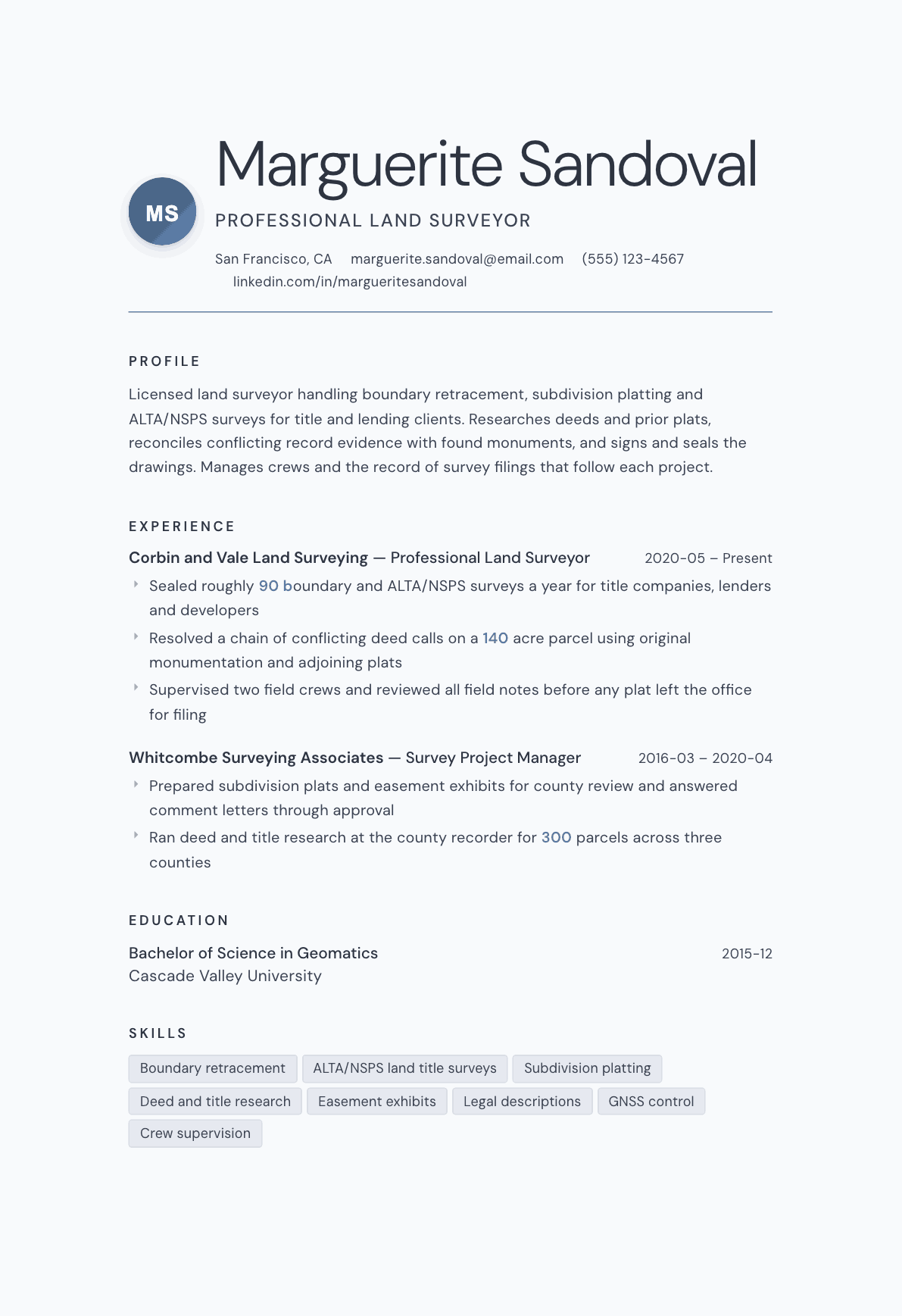
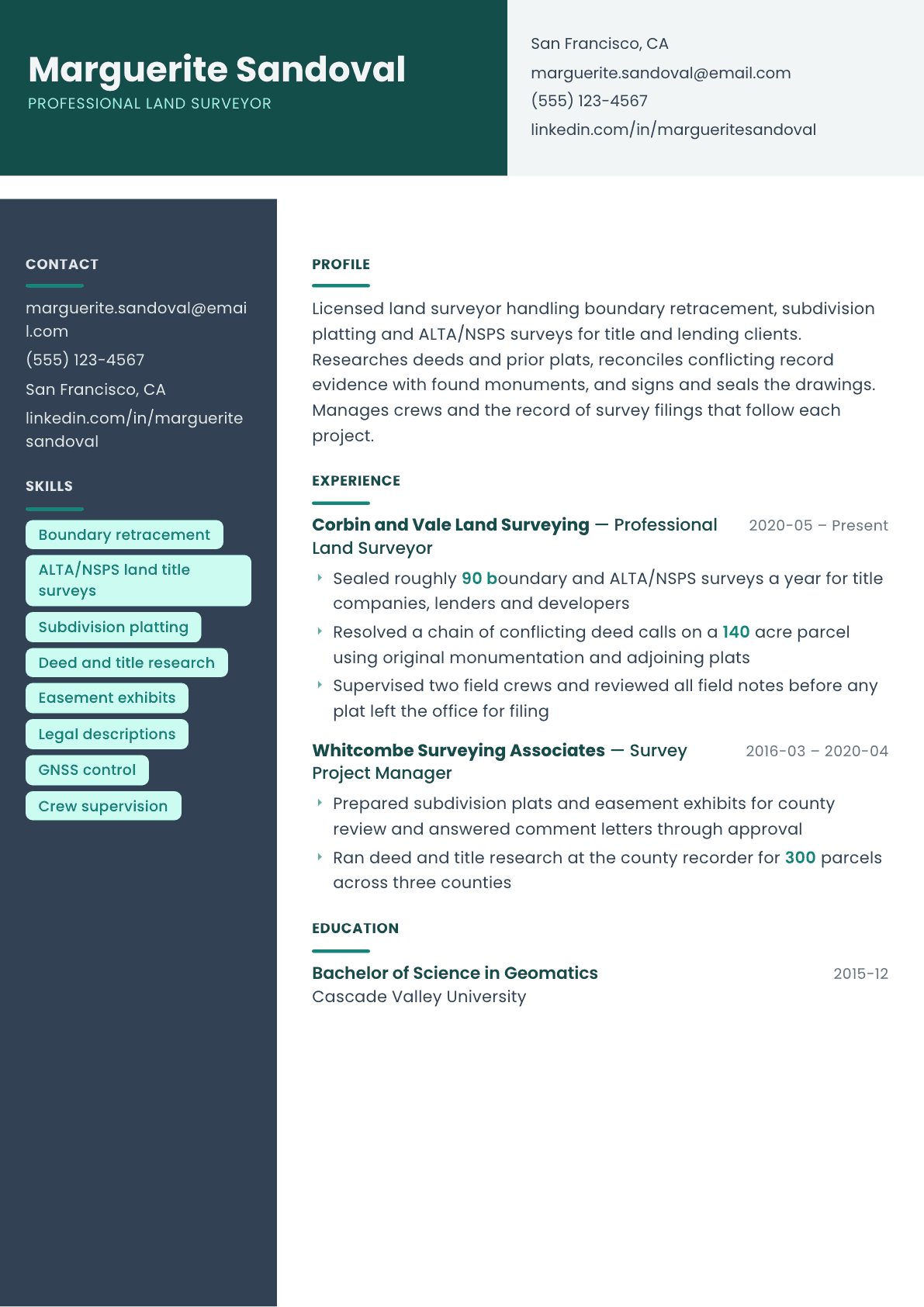
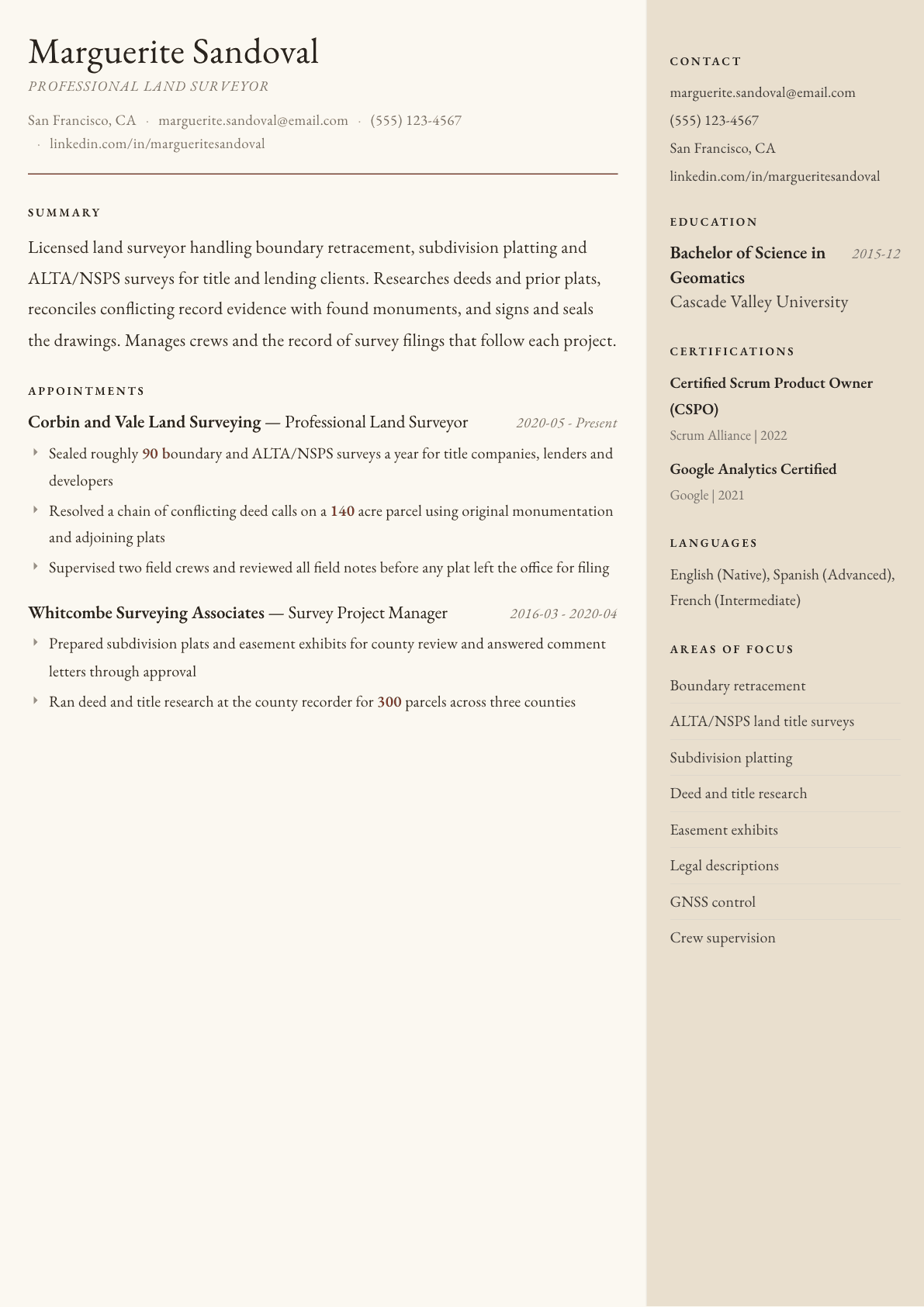
The same land surveyor content laid out in three CVBooster templates, so you can see what the finished document looks like before you write a word.
Example Land Surveyor summary
Licensed land surveyor with nine years in boundary retracement, subdivision platting and ALTA/NSPS work for title and lending clients. Seals roughly 90 surveys a year, researches deeds and recovers original monumentation, and carries plats through county review. Supervises two field crews. Looking for a senior surveyor role with a firm doing land development and title work.
Skills to list on a Land Surveyor resume
- Boundary retracement
- ALTA/NSPS surveys
- Subdivision platting
- Legal description writing
- Deed and title research
- Monument recovery
- Record of survey filing
- Easement exhibits
- GNSS and static control
- Robotic total station
- Civil 3D
- Trimble Business Center
- Least squares adjustment
- Crew supervision
- County review coordination
What actually gets this resume read
- Put your license type, state and number area near the top, because boundary work cannot be signed without it.
- Say whether you seal drawings yourself, review under another licensee, or work toward licensure as a surveyor in training.
- Name the survey products you deliver: boundary, ALTA/NSPS, topographic, subdivision plat, easement exhibit, record of survey.
- Show evidence work, not just measurement: deed research, monument recovery and how you resolve conflicting record calls.
- Include the agencies you file with, since county review and comment response is a large part of the job.
- Quantify volume in surveys sealed or parcels researched per year rather than describing duties in general terms.
How to write a land surveyor resume
A land surveyor resume is a licensure document before it is anything else. Boundary opinions get sealed, and a firm cannot bill a sealed product without a licensee, so the first question the reader asks is whether you hold a license, in which states, and whether you sign your own work. Put that answer in the first three lines or the rest of the page will not be read carefully.
The second question is about evidence. Boundary work is a legal argument built from deeds, prior plats, found monuments and measurement, and the surveyors firms want are the ones who can explain how they reconciled a conflicting call rather than the ones who only report coordinates. A resume that shows research at the recorder office, monument recovery and a resolved conflict reads like a professional. One that lists only equipment reads like a technician.
What follows is how to order the page, three summary examples across licensure stages, before and after bullets from boundary and platting work, the credentials that actually exist, and the questions land surveyors ask when they update the resume for a senior role.
Format: license block near the top, products next
Reverse chronological, one page early in a career and two once you have sealed work, staff and filings to describe. Directly under the header put a licensure block: license type, each state, and whether you seal. Reciprocity or comity in additional states belongs there too, because multi state firms screen on exactly that.
Follow it with a survey products line rather than a software list. Boundary, ALTA and NSPS land title surveys, subdivision plats, easement exhibits, record of survey filings, topographic and construction support. Products tell a principal what he can assign you. Software tells him almost nothing at this level.
- Header: name and license designation, city and state, phone, email.
- Order: summary, licensure, survey products, experience, education, professional membership.
- Give the degree field when it is geomatics or surveying, since some state boards require it.
Summary: what you seal, for whom, at what volume
Name the license, the product mix and the client type in one breath. A licensed surveyor handling boundary retracement, subdivision platting and title surveys for title companies, lenders and developers has told a hiring principal what kind of practice he can drop you into.
Then add volume and staff. Surveys sealed in a year, crews supervised and counties filed in. Boundary firms are production businesses under professional liability, so a number that shows steady throughput under your own seal is the most reassuring thing on the page.
Experience: research, evidence and the resolved conflict
Each role starts with the practice type and its clients, then moves to the products you delivered. But the bullets that separate land surveyors from everyone else are about evidence. Deeds and prior plats pulled, adjoining descriptions read, original monumentation recovered, and how record calls that disagreed with the ground were reconciled.
Write at least one bullet as a small case. A chain of conflicting deed calls on a large parcel, resolved using original monuments and adjoining plats, is exactly the reasoning a principal wants to see because it is the part of the work that carries liability. Keep the client anonymous and describe the problem and the method.
Then the filing and review side. Plats prepared for county review, comment letters answered, records of survey filed, legal descriptions written and checked. A surveyor who has carried plats through a county approval cycle saves a firm months, and that belongs in bullets with counts rather than in a duties list.
If you supervise, say what supervision means in your office. Reviewing field notes before a plat leaves, checking junior calculations, assigning crews, and being the person whose seal covers the output. Review responsibility is the promotion signal that principals read.
Licensure and continuing education: be precise
State the license by its proper name in your jurisdiction, list every state you hold, and say whether any are pending. If you are still working toward it, say surveyor in training and name the examination you have passed and the experience you are accumulating, since firms hire deliberately at that stage.
Continuing education and professional membership are worth two lines, not more. What they show is that you keep current with statute and board rule changes, which is a real part of practicing under a seal, and they give an interviewer an easy question you will enjoy answering.
Technical depth and the keywords in boundary postings
The recurring phrases are boundary survey, retracement, ALTA and NSPS land title survey, subdivision plat, legal description, deed research, monument recovery, record of survey, easement exhibit, control, least squares adjustment and county review. Use the posting wording once in a skills block and once in a bullet where it is demonstrated.
Keep the measurement technology present but subordinate. Static and network GNSS control, robotic total stations, least squares adjustment and the office package you compute in all matter, but they support the boundary opinion rather than replacing it. A resume that leads with equipment reads junior no matter how many years it lists.
Land Surveyor resume summary examples
Surveyor in training
Geomatics graduate and surveyor in training with two years supporting boundary work: recovering monuments, plotting deeds, and preparing easement exhibits under a licensee. Has passed the fundamentals examination, runs GNSS control and total station work, and is accumulating experience toward the professional examination.
Newly licensed
Licensed land surveyor sealing boundary and title surveys for lenders and developers, with earlier experience preparing subdivision plats and easement exhibits for county review. Ran deed and title research at the recorder office for 300 parcels across three counties and answered comment letters through approval.
Senior licensee
Professional land surveyor with nine years in boundary retracement, subdivision platting and title work, sealing roughly 90 surveys a year for title companies, lenders and developers. Supervises two field crews, reviews all field notes before filing, and resolves conflicting record evidence with original monumentation.
Work experience bullets: before and after
Before: Performed boundary surveys for clients.
After: Sealed roughly 90 boundary and title surveys a year for title companies, lenders and developers, from research through monument setting and final plat.
Annual volume under your own seal and the client mix show the practice you can carry, not just the task you can perform.
Before: Researched deeds and property records.
After: Ran deed and title research at the county recorder for 300 parcels across three counties, plotting record calls and adjoining descriptions before any crew went to the field.
Parcel and county counts plus the sequence show a research discipline that precedes measurement rather than following it.
Before: Resolved a difficult boundary issue.
After: Reconciled a chain of conflicting deed calls on a 140 acre parcel by recovering original stone monuments and comparing adjoining plats, then documented the reasoning in the survey report.
The method and the written record turn a vague claim into the professional judgment a principal is hiring.
Before: Prepared plats for county submission.
After: Prepared subdivision plats and easement exhibits for county review, answered three rounds of comment letters, and carried every plat through to recording without a resubmission for form.
The approval cycle and the clean outcome prove you can finish filings, which is where firms usually lose time.
Before: Supervised survey crews.
After: Supervised two field crews, reviewed every set of field notes and calculation sheet before a plat left the office, and trained two technicians on monument recovery practice.
Naming the review step and the training shows supervision as quality control rather than as a headcount.
Hard skills
- Boundary retracement
- ALTA and NSPS land title surveys
- Subdivision platting
- Legal description writing
- Deed and title research
- Monument recovery and setting
- Record of survey filing
- Easement exhibits
- Static and network GNSS control
- Robotic total station
- Least squares adjustment
- Civil 3D
- Trimble Business Center
- County review coordination
- Crew supervision and note review
Soft skills
- Professional judgment under liability
- Explaining a boundary opinion to a client
- Working with title officers and attorneys
- Patience with archival research
- Mentoring technicians
- Clear written survey reports
Certifications worth listing
- Professional Land Surveyor licensure (State board of licensure for professional surveyors)
- Principles and Practice of Surveying examination (National Council of Examiners for Engineering and Surveying)
- Fundamentals of Surveying examination (National Council of Examiners for Engineering and Surveying)
- Certified Federal Surveyor (CFedS) (Bureau of Land Management)
- Certified Survey Technician (CST) (National Society of Professional Surveyors)
Mistakes that cost land surveyor candidates the interview
- Burying licensure at the bottom of the page when it is the first thing a principal needs to confirm.
- Listing equipment before survey products, which makes an experienced licensee read as a field technician.
- Never describing a resolved conflict, so nothing on the page shows boundary reasoning.
- Omitting the counties and agencies you file with, even though review and comment response consumes much of the schedule.
- Giving duties instead of volume, so a reader cannot tell whether you seal a few surveys a year or dozens.
- Naming clients or parcels in ways that expose confidential work rather than describing the problem generically.
Land Surveyor resume questions
Where should licensure go on a land surveyor resume?
Immediately under the header, before experience. List the license designation, each state, and whether any application is pending. Firms cannot bill sealed work without a licensee, so this is the screening fact everything else depends on.
How do I show boundary judgment rather than measurement skill?
Write one bullet as a short case: the conflicting evidence you faced, the research and monuments you used, and how the opinion was documented. That paragraph tells a principal more than any list of instruments or software could.
Should a surveyor in training apply for licensed positions?
Apply for roles written at your stage and be exact about status. Name the examination passed, the state board, and the experience being accumulated. Firms hire deliberately at the training stage, but only when the resume states it plainly.
Do I list every state where I hold a license?
Yes, and note the ones obtained by comity. Multi state firms screen on geographic coverage, and a second or third license is often the single reason one candidate is interviewed ahead of an equally experienced one.
How much detail should I give about survey volume?
Give annual counts of sealed surveys, parcels researched and plats filed. Those three numbers describe a boundary practice accurately without revealing client names, and they let a principal compare your throughput to the workload he needs covered.
Related resume examples
- Civil Engineer Resume example
- Environmental Engineer Resume example
- Surveyor Resume example
- Geotechnical Engineer Resume example
- Transportation Engineer Resume example
- Electrical Design Engineer Resume example