Electrical Design Engineer Resume Examples: free score
Write an Electrical Design Engineer Resume That Shows Sealed Drawings
By Mustafa Tarabya, founder of CVBooster · Published · Updated
Electrical design engineer resume example with power distribution, panel schedules, lighting design, keywords and a complete writing guide.
Sample resumes for a electrical design engineer
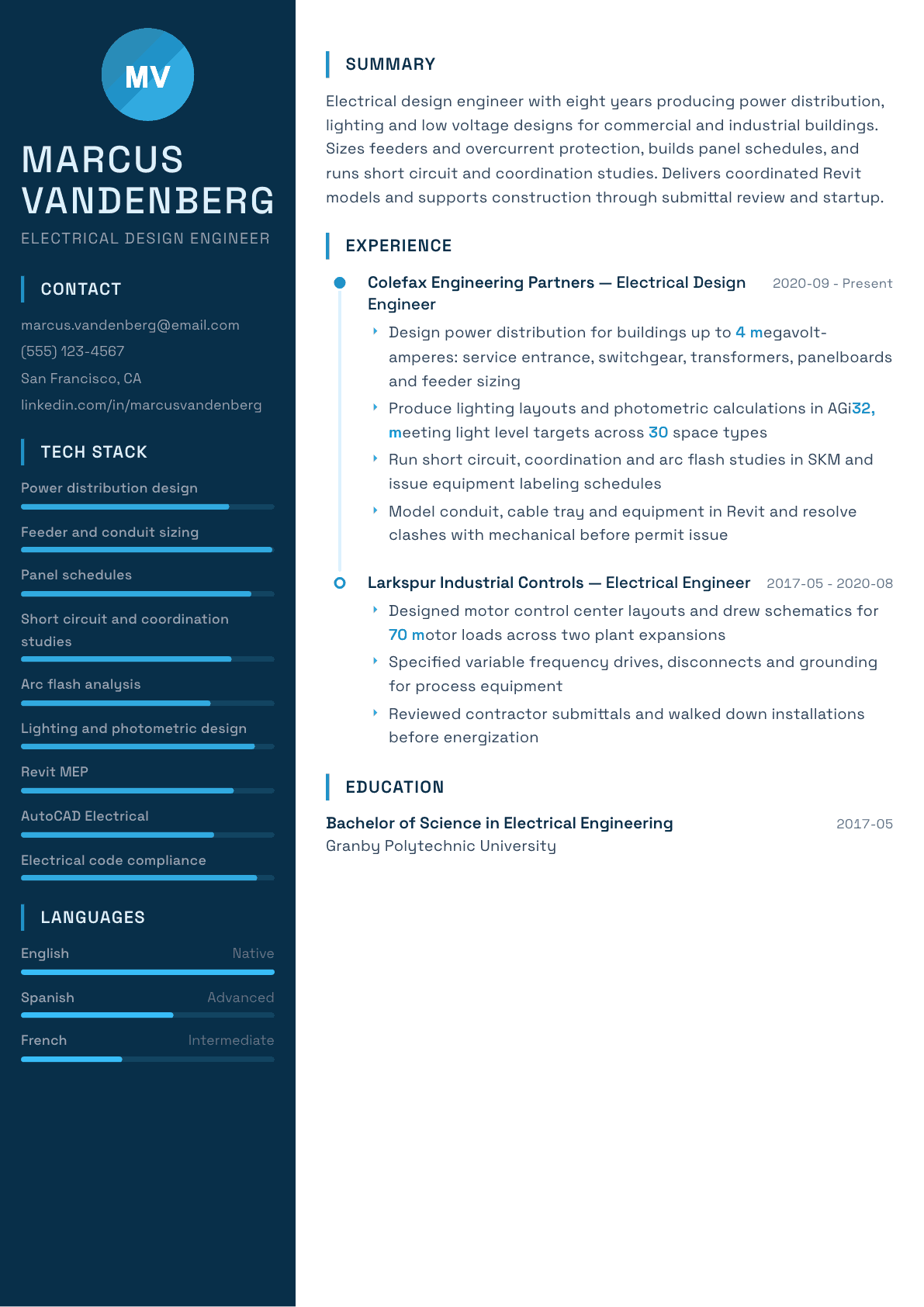
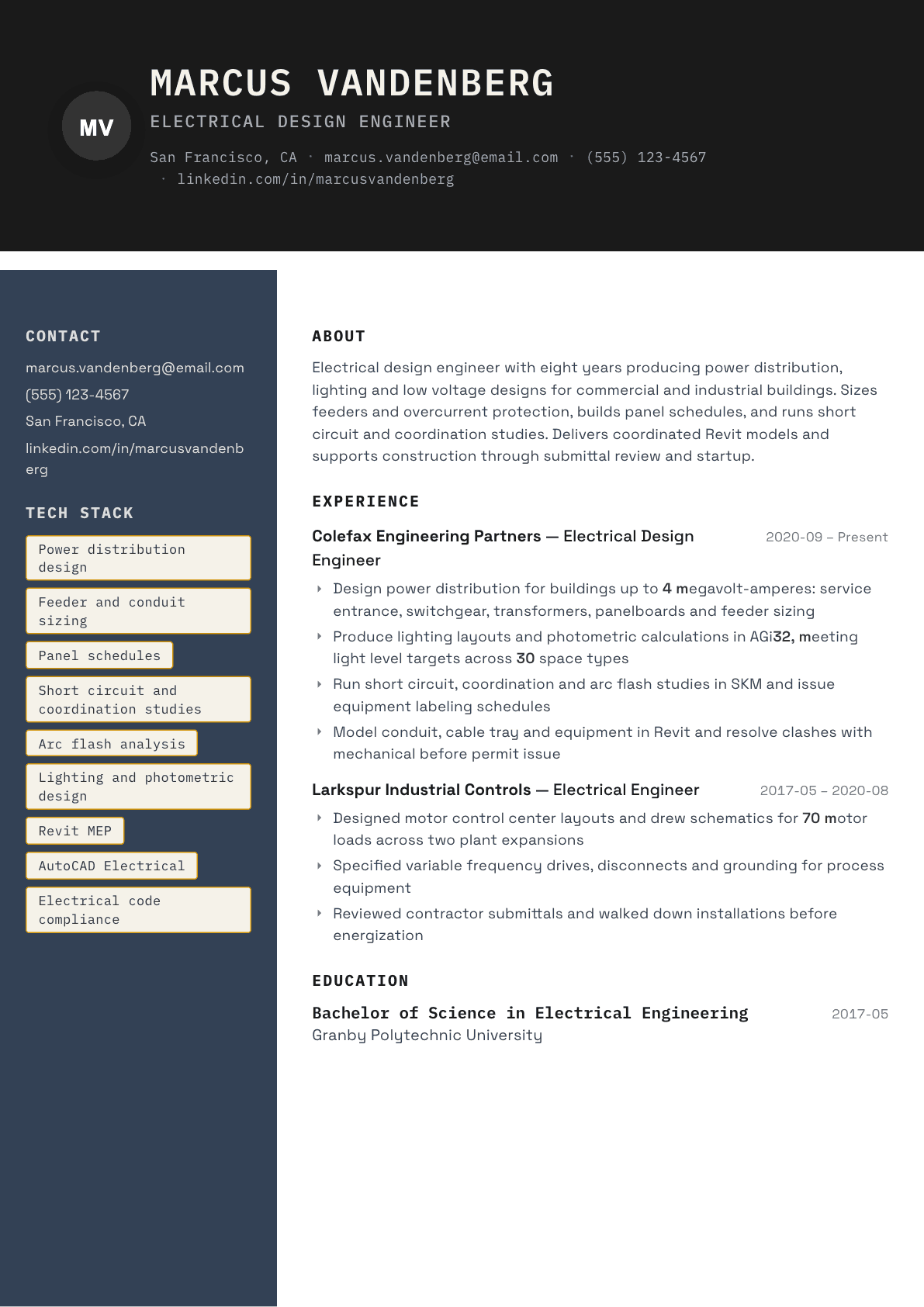
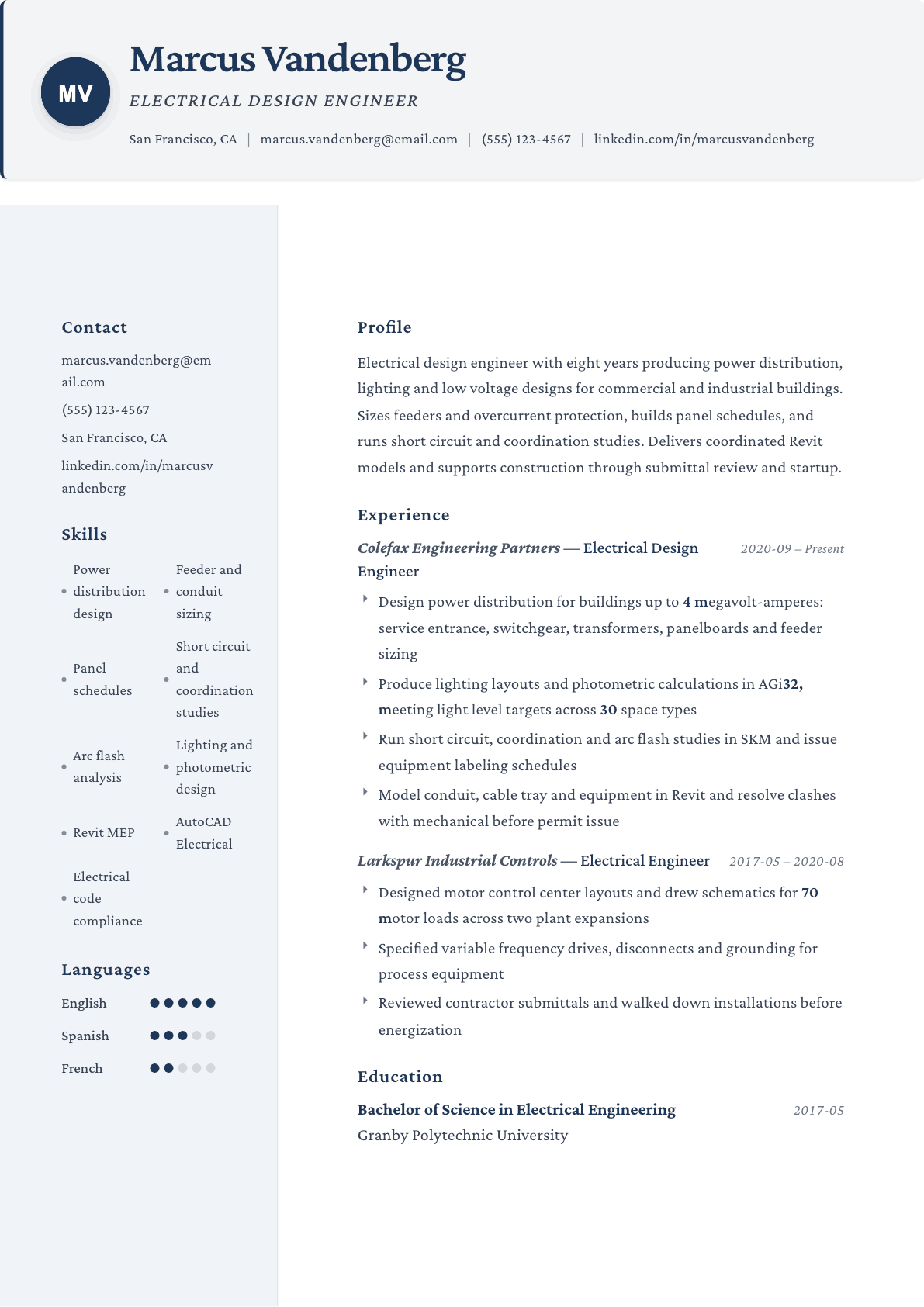
The same electrical design engineer content laid out in three CVBooster templates, so you can see what the finished document looks like before you write a word.
Example Electrical Design Engineer summary
Electrical design engineer with eight years producing power, lighting and low voltage designs for commercial buildings and industrial plants. Sizes services, feeders and protective devices, builds panel schedules, and runs short circuit, coordination and arc flash studies. Delivers coordinated Revit models through permit, then reviews submittals and walks down installations before energization.
Skills to list on a Electrical Design Engineer resume
- Power distribution design
- Load calculations
- Feeder and conduit sizing
- Panelboard and switchgear specification
- Short circuit study
- Protective device coordination
- Arc flash analysis
- Grounding and bonding design
- Lighting design and photometrics
- Emergency and standby power
- Motor control center design
- Revit MEP
- AutoCAD Electrical
- SKM and ETAP
- Submittal review
- Construction administration
What actually gets this resume read
- State the voltage levels and service sizes you have designed, because that number sorts candidates faster than years.
- Separate building power design from industrial control design; they are different hiring tracks.
- Name the study software you use for short circuit, coordination and arc flash work.
- Show code fluency by describing calculations you defended in plan review, not by claiming code knowledge.
- List lighting and photometric tools if you produce those drawings, since many firms need both skill sets.
- Put license status and states in the header, along with any electrical safety training you hold.
How to write a electrical design engineer resume
The title electrical design engineer covers two distinct careers. In building services it means power distribution, lighting and low voltage systems drawn to a permit set and sealed by a licensed engineer. In industrial and equipment work it means control panels, motor circuits, wiring schematics and machine power. Both are electrical design, and a resume that does not declare which one it is will be sorted into the wrong pile.
Whichever track you are on, the reviewer is checking for calculations. Anyone can place a panel symbol on a plan. Sizing a service, running a load calculation, coordinating protective devices and defending an arc flash boundary is engineering, and it is what firms are short of.
This guide covers section order for both tracks, how to write about studies and calculations so a principal believes you ran them, what code fluency looks like on paper, and the questions that come up around licensure and construction phase work.
Format: state the track, then list projects with service sizes
Reverse chronological with a project list. For building work, give building type, area, service size and voltage, and the phases you carried. For industrial work, give the plant, the equipment, the panel count and the voltage classes. Both readers use those figures to size you against their own projects.
Two pages is normal past five years. Licensure, exam status and states go in the header, because sealed drawings govern who can be assigned what.
- Header: name, credentials, city, phone, email, license states and status.
- Sections: summary, licenses, software and study tools, project experience, education.
- Add an electrical safety training line if you have worked on or near energized equipment.
Power distribution: sizes, calculations and equipment
The distribution narrative should run from service to load. Say what you have sized: service entrance, main switchboard or switchgear, transformers, distribution and branch panelboards, feeders, and branch circuits. Give voltage classes and the largest service you have designed, because that number tells a principal which projects you are ready for.
Calculations are the substance. Connected and demand load calculations, voltage drop, conduit fill, transformer sizing, short circuit current available, and generator and transfer scheme sizing for standby power are the ones that come up in interviews. Say which you have produced and defended in review.
Studies: short circuit, coordination and arc flash
Power system studies are a specialty inside electrical design and a strong differentiator. If you have built a model of a distribution system, gathered nameplate data, run fault current calculations, set protective device curves for selectivity, and produced incident energy results with equipment labeling, describe it as its own body of work.
Be precise about your part. Building the model, setting the devices and issuing the label schedule is different from receiving a study from a vendor and stamping it. Reviewers ask, so answer in advance.
- Name the study package you use and the size of the systems you modeled.
- Say whether you set relay and breaker curves yourself or reviewed a vendor submittal.
- Mention field data collection, which is the hardest part of any real study.
Lighting, low voltage and specialty systems
Lighting is often the entry point for a building electrical design engineer. Photometric layouts, fixture selection and schedules, control zoning and code-driven power allowances are worth listing when you produce those sheets. Emergency lighting and egress path calculations belong here as well, since plan reviewers focus on them.
Low voltage and specialty systems are frequently the difference between two similar candidates. Fire alarm, security and access control, structured cabling, nurse call and audiovisual infrastructure each carry their own standards, and naming the ones you have coordinated shows breadth.
Code fluency and construction phase evidence
Claiming code knowledge is worthless; demonstrating it is not. Describe a plan review comment you closed, a calculation you defended, a clearance conflict you resolved, or a grounding and bonding scheme you designed for a difficult service. One concrete example outweighs a list of standards.
Construction phase work rounds out the picture. Submittal and shop drawing review, contractor questions, coordination with the mechanical and structural models, site observation, and witnessing energization all show an electrical design engineer who understands what a drawing becomes.
Electrical Design Engineer resume summary examples
Graduate engineer
Electrical engineering graduate with an internship at a building systems consultancy, where I produced panel schedules, lighting layouts and conduit routing for two school renovations. Comfortable with load calculations and photometric software. Fundamentals of Engineering exam passed and seeking a design role with licensure mentorship.
Six years in
Electrical design engineer with six years producing power, lighting and low voltage designs for office and clinical buildings. Sizes services, feeders and protective devices, runs short circuit and coordination studies, and delivers coordinated Revit models through permit and construction administration.
Licensed lead engineer
Licensed electrical engineer with thirteen years across commercial buildings and industrial plants, including services to 4 megavolt-amperes and medium voltage distribution. Leads arc flash and coordination studies, writes specifications, mentors three designers and manages agency review through project turnover.
Work experience bullets: before and after
Before: Designed electrical systems for buildings.
After: Designed power distribution for buildings up to 4 megavolt-amperes, covering service entrance, switchgear, transformers, panelboards and feeder sizing.
A service size and the equipment chain tell a principal exactly which projects you can be assigned.
Before: Performed load calculations.
After: Produced connected and demand load calculations, voltage drop checks and transformer sizing for a mixed occupancy building, and defended the service size in plan review.
The defense in review shows the calculation reached a regulator rather than staying in a spreadsheet.
Before: Did an arc flash study.
After: Collected nameplate data across 90 pieces of equipment, modeled the system in SKM, set protective device curves for selectivity and issued the incident energy label schedule.
Data collection, model building and device settings prove ownership of the study rather than review of one.
Before: Created lighting plans.
After: Produced photometric layouts in AGi32 for 30 space types, selected fixtures and controls zoning, and met the required light levels while staying inside the energy power allowance.
Space count and the two competing constraints show real lighting design judgment.
Before: Worked with contractors during construction.
After: Reviewed equipment submittals, answered contractor questions on conduit routing conflicts, and witnessed energization of two switchboards during startup.
Specific construction activities show field understanding that plan-only designers cannot claim.
Hard skills
- Power distribution design
- Connected and demand load calculations
- Feeder and conduit sizing
- Voltage drop calculations
- Panelboard and switchgear specification
- Short circuit study
- Protective device coordination
- Arc flash incident energy analysis
- Grounding and bonding design
- Emergency and standby power design
- Lighting and photometric design
- Fire alarm and low voltage coordination
- Revit MEP and AutoCAD Electrical
- Specification writing
Soft skills
- Plan review defense
- Contractor communication
- Discipline coordination
- Documentation accuracy
- Field safety awareness
- Mentoring designers
Certifications worth listing
- Professional Engineer (PE), Electrical (State board of professional engineers)
- Fundamentals of Engineering (FE) (National Council of Examiners for Engineering and Surveying)
- Lighting Certified (LC) (National Council on Qualifications for the Lighting Professions)
- NICET Certification in Electrical Power Testing (National Institute for Certification in Engineering Technologies)
- LEED Accredited Professional, Building Design and Construction (US Green Building Council)
Mistakes that cost electrical design engineer candidates the interview
- Failing to say whether your work is building services or industrial control design, which is the first sort a recruiter makes.
- Listing drafting software as the achievement while never naming a service size or a calculation you produced.
- Claiming study experience when you only reviewed a vendor report, which the technical interview exposes quickly.
- Skipping grounding, bonding and emergency power, the areas plan reviewers question most often.
- Omitting license and exam status, so a firm cannot see the path toward sealing drawings.
- Leaving low voltage and specialty systems off, when they are often the coordination burden on a real project.
- Writing about teamwork rather than the conduit conflict, the fault current problem or the review comment you closed.
Electrical Design Engineer resume questions
Do I need a professional engineer license for electrical design work?
For building design, yes, because construction documents must be sealed and career progress depends on it. Industrial equipment and panel design often does not require a seal, so many capable engineers on that track never pursue licensure.
How do I show code experience without sounding generic?
Replace the claim with an incident. Describe a review comment about available fault current, a working clearance conflict you resolved by relocating equipment, or a bonding scheme you designed for a service with multiple grounding electrodes.
Is study software experience worth listing separately?
Yes. Short circuit, coordination and arc flash work is a distinct skill that many electrical design engineers never touch, and firms that need it will screen for the software name and for whether you gathered the field data yourself.
How do I move from an electrical technician role into design?
Field installation knowledge is a real asset, so keep it, but lead with design output: calculations you produced, drawings you drew, and any formal engineering education. Employers need to see the analysis side before the field side helps you.
Should I include projects where I only did part of the design?
Yes, as long as you state your scope. Saying you produced lighting and branch circuit sheets while a senior engineer designed the service is honest and still useful, because it tells the reviewer exactly what you can already deliver.
Related resume examples
- Electrical Engineer Resume example
- Electrical Power Engineer Resume example
- Electronics Engineer Resume example
- Power Systems Engineer Resume example
- HVAC Engineer Resume example
- Land Surveyor Resume example