Transportation Engineer Resume Examples: free ATS score
Build a Transportation Engineer Resume That Reads Like a Corridor Study
By Mustafa Tarabya, founder of CVBooster · Published · Updated
Transportation engineer resume example with traffic studies, roadway design, intersection analysis, keywords and a complete writing guide.
Sample resumes for a transportation engineer
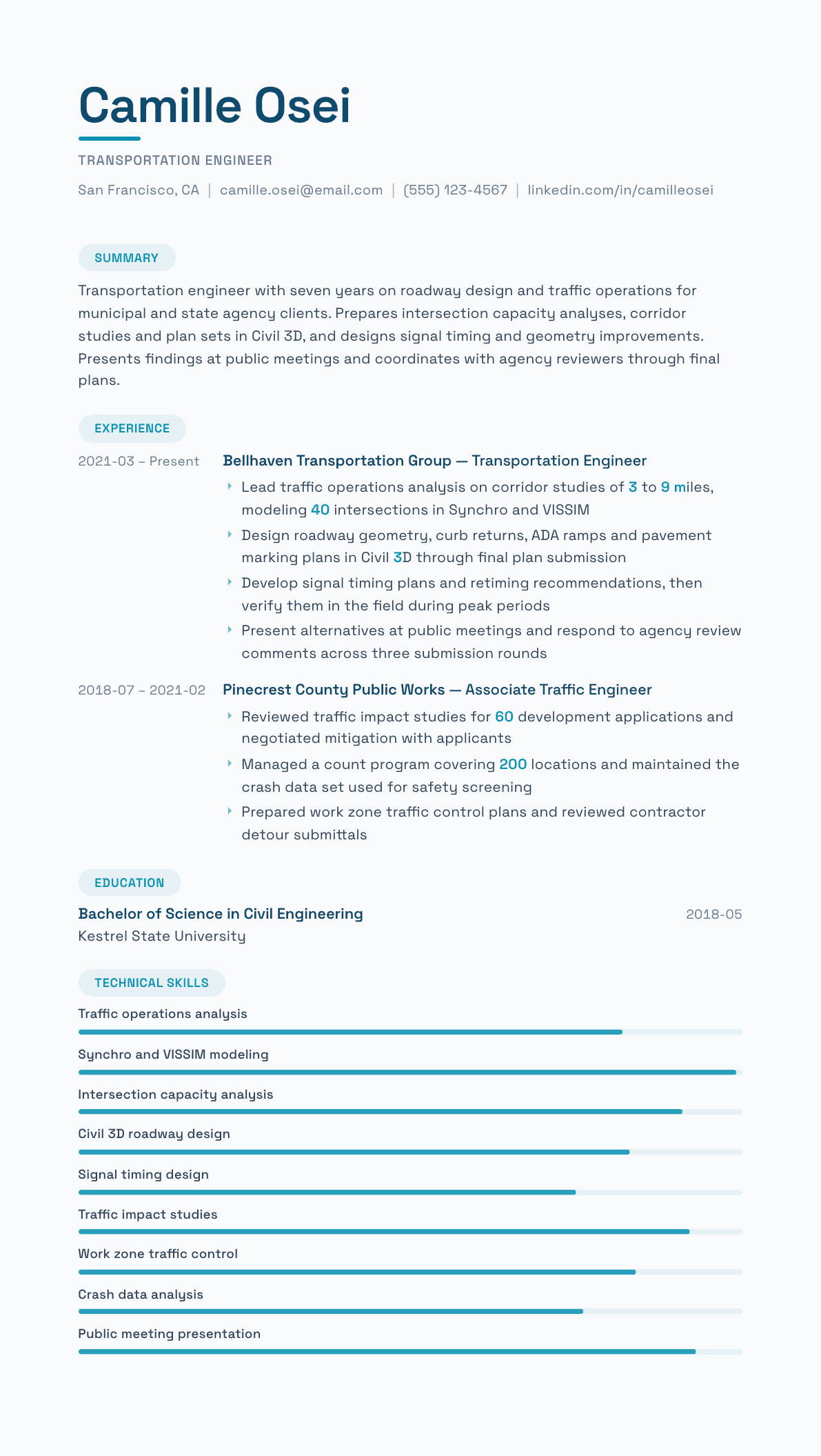
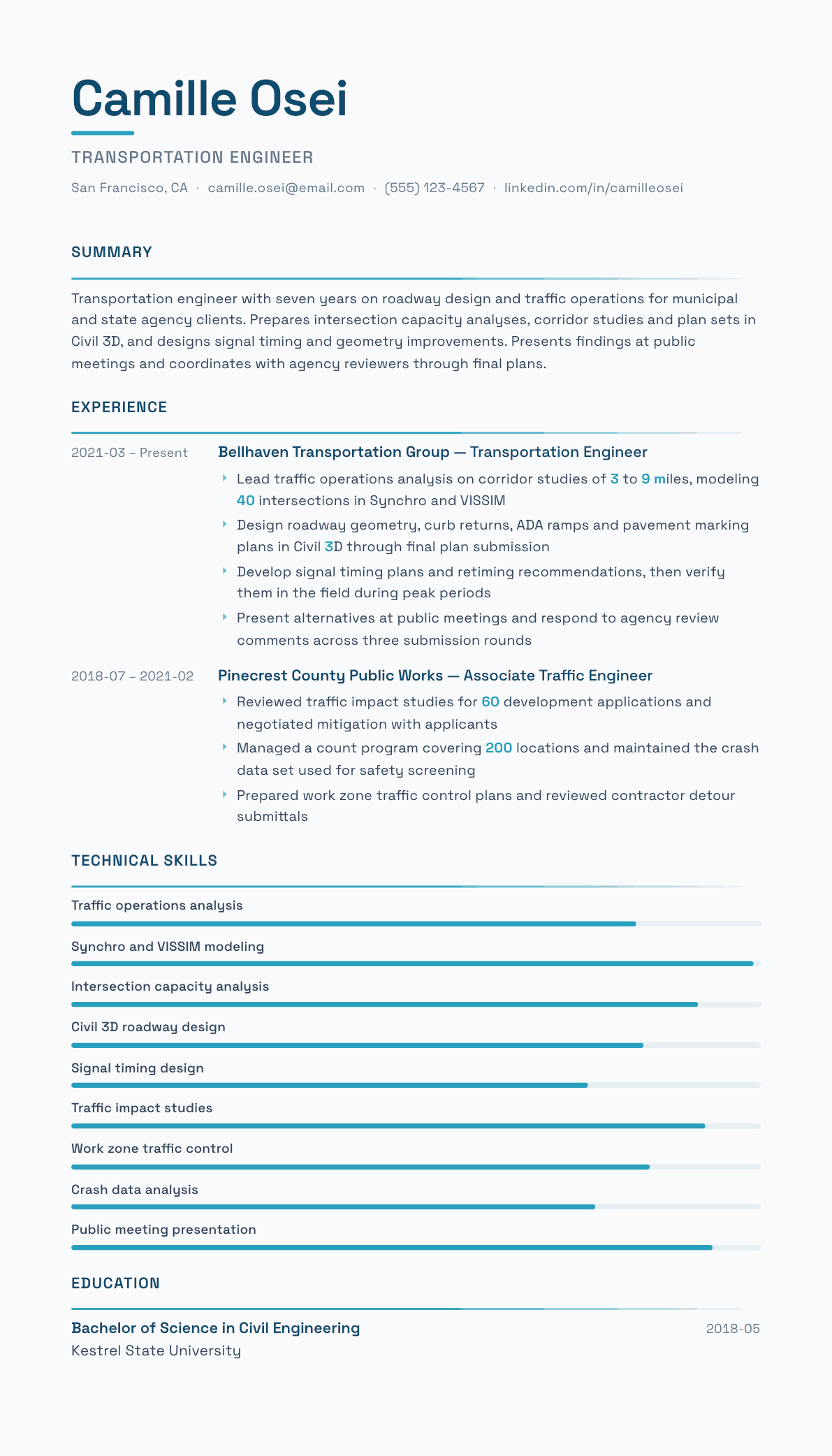
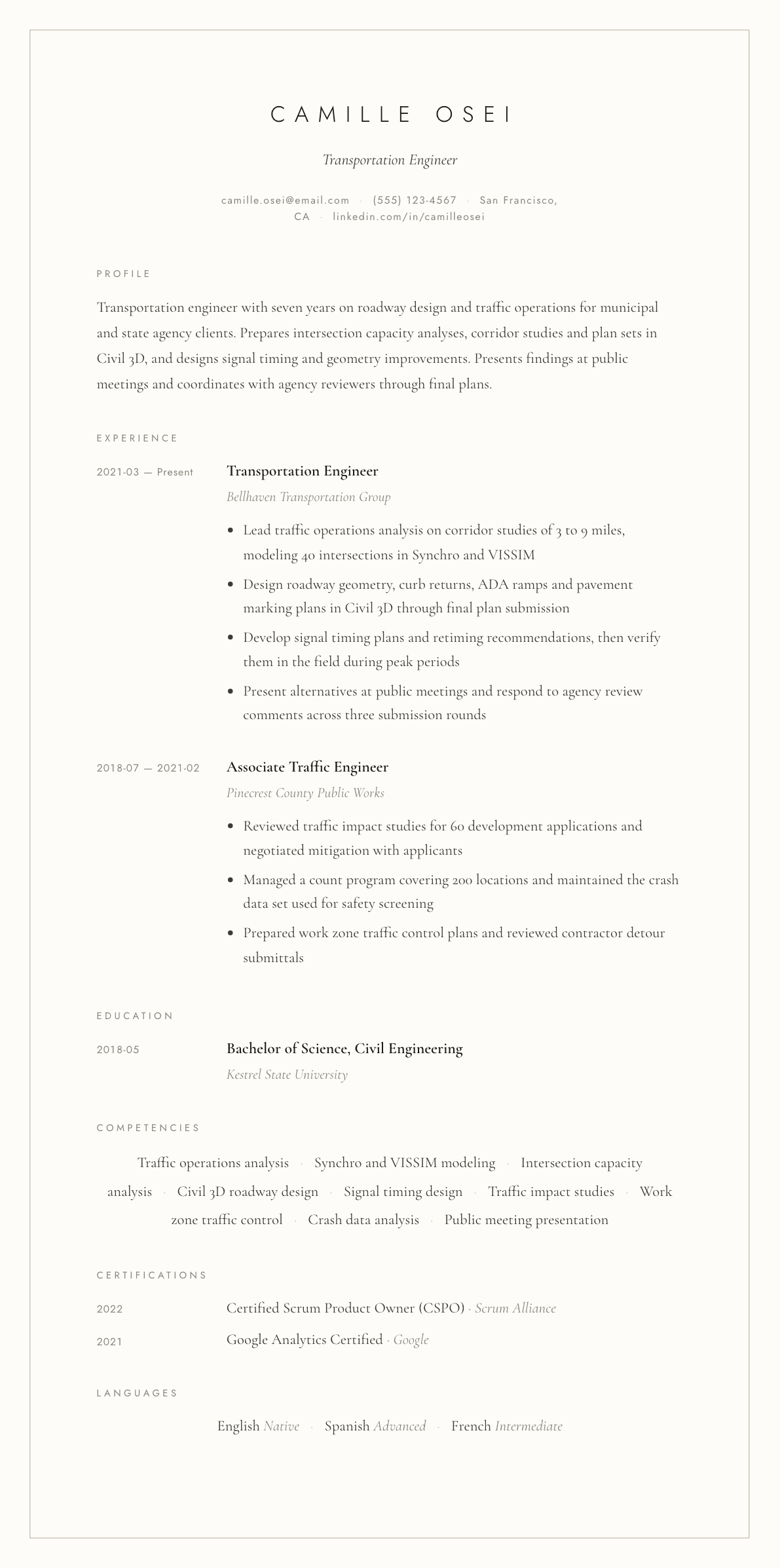
The same transportation engineer content laid out in three CVBooster templates, so you can see what the finished document looks like before you write a word.
Example Transportation Engineer summary
Transportation engineer with seven years splitting time between traffic operations analysis and roadway plan production for city and state clients. Models corridors in Synchro and VISSIM, designs geometry and marking plans in Civil 3D, and develops signal timing that gets verified in the field. Regularly presents alternatives at public meetings and closes agency review comments through final submission.
Skills to list on a Transportation Engineer resume
- Traffic operations analysis
- Intersection capacity analysis
- Synchro
- VISSIM microsimulation
- Highway Capacity Manual methods
- Civil 3D
- Roadway geometric design
- Signal timing and coordination
- Traffic impact studies
- Crash data analysis
- Road safety audits
- Work zone traffic control
- Pedestrian and bicycle facility design
- Travel demand forecasting
- Public involvement
- Agency plan review
What actually gets this resume read
- Separate traffic operations work from roadway design work, because most postings lean hard toward one of them.
- Name the modeling packages you run and the level of analysis you produce with each.
- Give corridor length, intersection counts and study area size so a reviewer can gauge project scale.
- Show agency experience: which department of transportation manuals and design standards you worked under.
- Include public involvement, since transportation projects live or die in the community meeting.
- List your license and any professional traffic operations credential in the header, not buried at the end.
How to write a transportation engineer resume
Transportation engineering job postings look interchangeable until you notice which verbs they use. One set says analyze, model, forecast and study. The other says design, detail, plot and submit. The first is traffic operations and planning work. The second is roadway plan production. A transportation engineer who is strong at one and weak at the other will be found out in the first project, so hiring managers screen hard for the difference.
The second screen is the agency. Public work runs on a specific set of design manuals, submittal milestones and review cultures, and a candidate who has closed comments with a state department of transportation is easier to staff than one who has only done private site work. Naming the agencies you have worked under is one of the highest value lines on the page.
This guide covers how to organize the resume around that split, how to write about modeling and design work so a reviewer trusts it, and the questions that come up around licensure, public involvement and moving between the consultant and agency sides.
Format: declare your track in the first three lines
Reverse chronological, two pages once you have several projects, with a project list under each employer. In the summary and the skills block, make the operations versus design split obvious. If you do both, say so and give proportions, because a firm hiring for a plans production seat will otherwise assume you are a study engineer.
List agency experience where it will be seen. Which department of transportation, which counties and cities, and which design manuals you worked to. A reviewer treats that as a shortcut for knowing how your submittals will be received.
- Header: name, credentials, city, phone, email, license and exam status.
- Sections: summary, licenses, software, agency experience, project experience, education.
- Include a short line on public meeting and stakeholder experience if you have it.
Traffic operations: name the analysis, the method and the horizon
Operations work is judged on rigor. Say what you analyze, how many intersections, which methodology, and what horizon years you built. Capacity analysis at signalized and unsignalized intersections, arterial and network simulation, queue and delay reporting, and sensitivity testing of alternatives all belong here.
Then say what came out of the analysis. Recommending a left turn phase change, adding a turn lane, converting a corridor to a different control type, or showing that a proposed development needs no mitigation are the outputs a client paid for. Reviewers value the recommendation more than the model.
Signal work is worth separating out. Timing plan development, coordination along a corridor, field observation during peak periods and retiming after implementation is a specialty in its own right, and postings that want it are explicit.
Roadway design: phases carried and plan sheets produced
For design work, list the sheet types you have produced and the phases you carried. Horizontal and vertical alignment, typical sections, grading and drainage coordination, curb ramps and pedestrian facilities, pavement marking and sign plans, and traffic control staging are all distinct deliverables.
Say how far you took each project: concept, preliminary, final plans, bid documents, construction support. A transportation engineer who has closed three rounds of agency comments and reached a signed plan set is a different hire from one who has only produced concept exhibits.
Safety and data: the fastest growing part of the work
Safety analysis has become a distinct hiring area. If you have screened a network for crash patterns, run a road safety audit, applied predictive methods, or built a countermeasure recommendation with a benefit estimate, put it in its own block. Many transportation engineer applicants have none of this, so a little goes a long way.
Data work is similar. Managing a count program, working with permanent detector data, cleaning and joining crash records, and mapping results in a geographic information system are all lines that make you more useful on day one.
Public involvement and agency review
Transportation projects are public, so the ability to explain a recommendation to residents at a meeting is a job requirement rather than a bonus. Say how many meetings you have presented at, what materials you produced, and whether you handled comment response.
Agency review is the other half. Describe the submittal rounds you managed, the comment volumes you closed and the reviewers you worked with. A firm hires a transportation engineer partly to keep projects moving through review, and evidence that you can do it is scarce on most resumes.
Transportation Engineer resume summary examples
Graduate engineer
Civil engineering graduate focused on transportation, with coursework in traffic operations and a capstone corridor study of 6 intersections analyzed in Synchro. Internship experience collecting turning movement counts and drafting pavement marking exhibits in Civil 3D. Fundamentals of Engineering exam passed.
Six years in
Transportation engineer with six years split between traffic operations analysis and roadway plan production for municipal clients. Models corridors of up to 40 intersections in Synchro and VISSIM, produces final plan sets in Civil 3D, and develops signal timing that is verified in the field after implementation.
Licensed project manager
Licensed transportation engineer with thirteen years leading corridor studies, safety analyses and roadway improvement design for state and county agencies. Manages multidiscipline teams through final design, presents alternatives at public meetings, and owns agency comment resolution across submittal rounds.
Work experience bullets: before and after
Before: Performed traffic analysis for corridor projects.
After: Analyzed 40 signalized and unsignalized intersections along corridors of 3 to 9 miles in Synchro, with VISSIM simulation for two constrained arterial segments.
Intersection counts, corridor length and the split between analysis methods let a reviewer judge the technical depth.
Before: Worked on signal timing.
After: Developed coordinated timing plans for a 12 intersection arterial, then observed morning and evening peaks in the field and adjusted offsets to clear standing queues.
Field verification after implementation is the part most candidates skip and the part agencies remember.
Before: Prepared roadway plans.
After: Produced final plan sets in Civil 3D including alignments, typical sections, curb ramp details and pavement marking sheets, closing agency comments across three submittal rounds.
Naming sheet types and review rounds proves you reached a signed set rather than a concept exhibit.
Before: Reviewed traffic impact studies.
After: Reviewed traffic impact studies for 60 development applications and negotiated mitigation, including two site access relocations that removed left turn conflicts.
Volume plus a concrete negotiated outcome shows judgment rather than a checklist review.
Before: Helped with safety projects.
After: Screened 200 count and crash locations to rank corridors by severity pattern, then led a road safety audit that produced a lighting and access management countermeasure package.
The screening method and the resulting countermeasure package show a complete safety workflow.
Hard skills
- Intersection capacity analysis
- Highway Capacity Manual methods
- Synchro and SimTraffic
- VISSIM microsimulation
- Traffic impact studies
- Signal timing and coordination
- Civil 3D roadway design
- Geometric design and alignments
- Pavement marking and sign plans
- Work zone traffic control
- Crash data analysis
- Road safety audits
- Travel demand forecasting
- GIS mapping and analysis
Soft skills
- Public presentation
- Agency negotiation
- Comment response discipline
- Multidiscipline coordination
- Client management
- Clear technical writing
Certifications worth listing
- Professional Engineer (PE), Civil (State board of professional engineers)
- Professional Traffic Operations Engineer (PTOE) (Transportation Professional Certification Board)
- Road Safety Professional (RSP1) (Transportation Professional Certification Board)
- Fundamentals of Engineering (FE) (National Council of Examiners for Engineering and Surveying)
- Certified Floodplain Manager (CFM) (Association of State Floodplain Managers)
Mistakes that cost transportation engineer candidates the interview
- Blending operations and design work into one blur, so a hiring manager cannot tell which seat to interview you for.
- Naming modeling software without the intersection counts, methods or horizon conditions behind the runs.
- Leaving out the agencies and design manuals you have worked under, which is the fastest signal of transferable experience.
- Stopping at analysis and never stating the recommendation the client actually bought.
- Omitting public meeting experience on projects where community response drove the outcome.
- Treating safety analysis as part of general traffic work instead of giving it a block a reviewer can find.
- Listing every small site access review while burying the corridor study that shows your real range.
Transportation Engineer resume questions
Do I need a professional engineer license as a transportation engineer?
For consulting and agency design work, yes, because plans and studies are sealed. Analysis staff can work productively before licensure, but promotion past project engineer usually stops without it, so show your exam progress clearly.
Is the traffic operations credential worth pursuing?
For operations-focused careers it carries real weight, since many agency contracts list it in staffing requirements. It is less relevant if your work is roadway plan production, where the professional engineer license and plan set experience matter more.
How do I move from a consultant to an agency role?
Reframe the resume around review and program work rather than production. Highlight studies you have reviewed, standards you have applied, budgets and schedules you have tracked, and public communication, because that is what the agency side spends its week doing.
What modeling experience do employers ask for most?
Capacity analysis in a package like Synchro is the baseline, and microsimulation is the differentiator for congested corridors and complex geometry. If you have built and calibrated a simulation network, describe the calibration targets you matched.
How should I describe projects that were never built?
Describe the study and the decision it informed, which is the real product. A corridor alternatives analysis that led an agency to defer a widening and program a signal upgrade instead is a successful project even though nothing was constructed.
Related resume examples
- Civil Engineer Resume example
- Urban Planner Resume example
- Geotechnical Engineer Resume example
- Project Engineer Resume example
- Fire Protection Engineer Resume example
- Land Surveyor Resume example