Geotechnical Engineer Resume Examples: read this first
Write a Geotechnical Engineer Resume Grounded in Real Site Data
By Mustafa Tarabya, founder of CVBooster · Published · Updated
Geotechnical engineer resume example with borings, lab testing, foundation recommendations, keywords and a section by section guide.
Sample resumes for a geotechnical engineer
The same geotechnical engineer content laid out in three CVBooster templates, so you can see what the finished document looks like before you write a word.
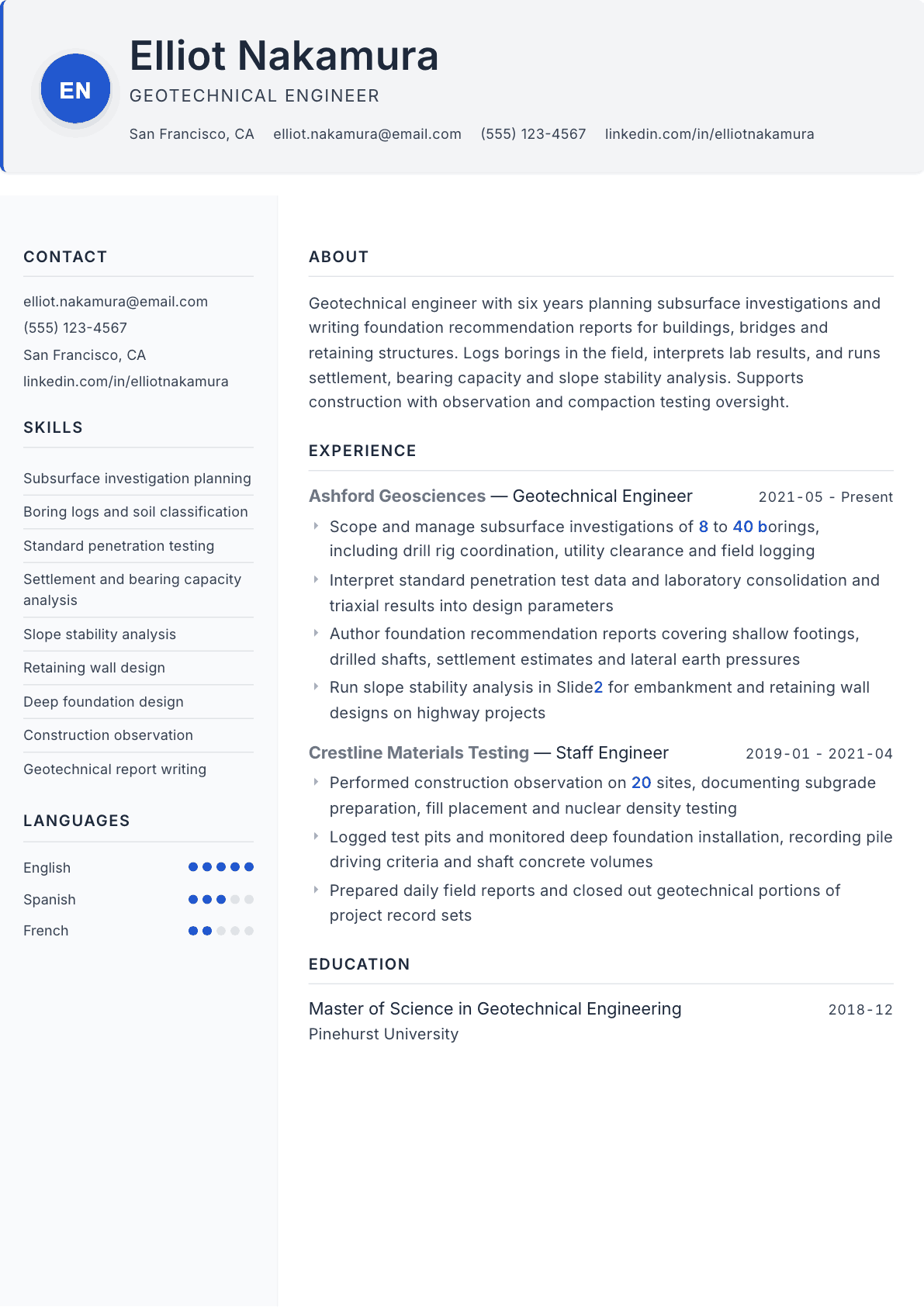
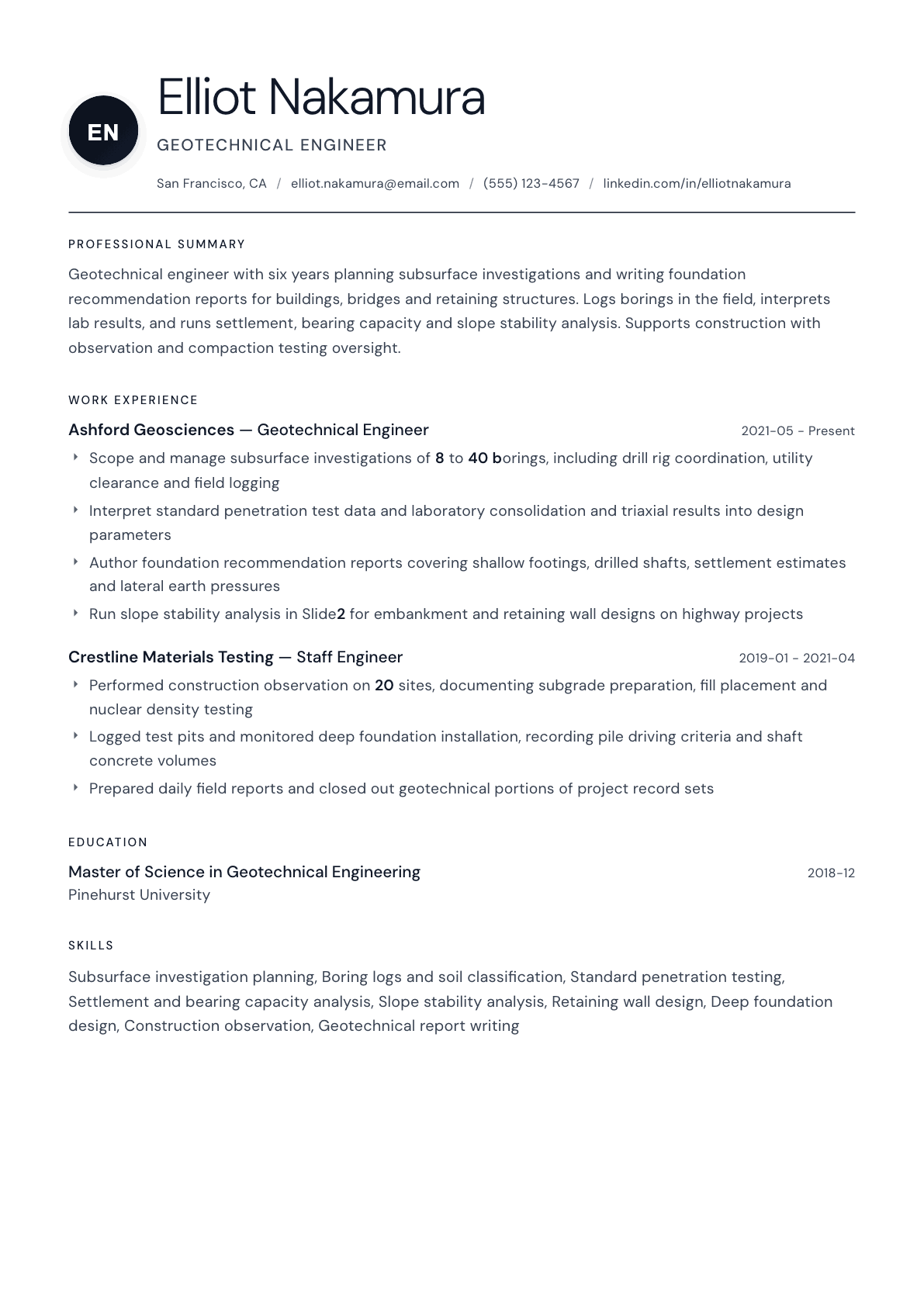
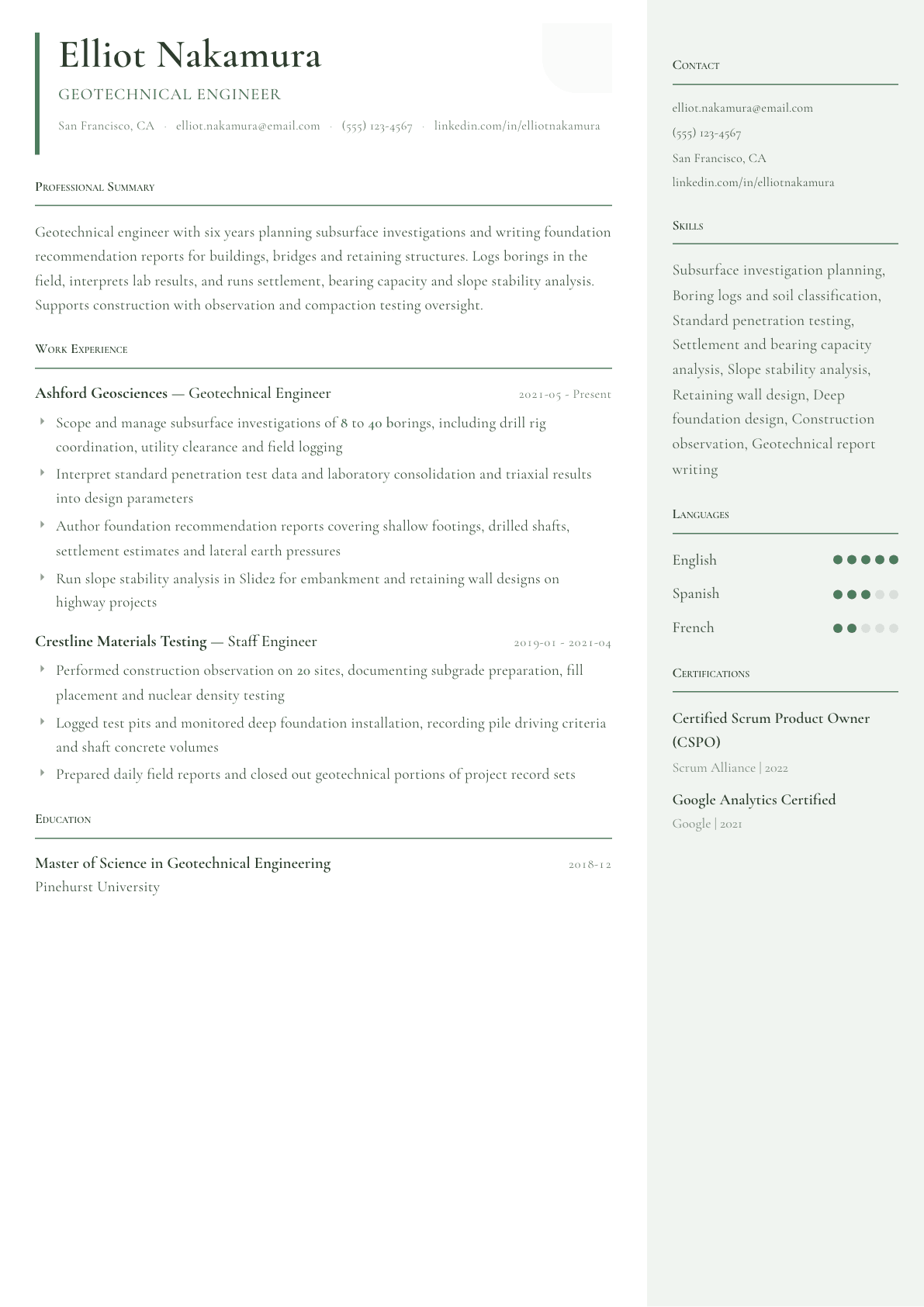
Example Geotechnical Engineer summary
Geotechnical engineer with six years scoping subsurface investigations and turning boring logs and laboratory results into foundation recommendations. Handles bearing capacity, settlement and slope stability analysis for buildings, walls and highway embankments, and writes the reports that carry those numbers. Also covers construction observation, from subgrade approval through deep foundation installation records.
Skills to list on a Geotechnical Engineer resume
- Subsurface investigation planning
- Soil classification and boring logs
- Standard penetration testing
- Cone penetration testing
- Laboratory soil testing
- Bearing capacity analysis
- Settlement analysis
- Slope stability analysis
- Lateral earth pressure design
- Retaining wall design
- Deep foundation design
- Ground improvement
- Seismic site classification
- Construction observation
- Compaction and density testing
- Geotechnical report writing
What actually gets this resume read
- Lead with the structures you provided recommendations for: buildings, bridges, walls, embankments, tanks.
- Give investigation scale in borings and depth rather than in vague words like large or complex.
- Separate design analysis from field observation, because firms staff those two tracks differently.
- Name the analysis software you use for stability, settlement and lateral earth pressure work.
- Show that you have written the report, not only produced the numbers that went into it.
- State your license and exam progress, since sealed geotechnical reports depend on it.
How to write a geotechnical engineer resume
Geotechnical hiring splits along a line that most applicants never address. One track is design: scoping an investigation, interpreting the data, and writing a report that recommends foundations someone will build on. The other is construction services: standing on a site logging fill placement, observing pile installation and signing daily reports. Both are essential, both are geotechnical engineering, and firms staff them separately.
A geotechnical engineer resume therefore has to declare which side it comes from, then show enough of the other to be flexible. The principal reading it is checking whether you can carry a report to a seal, or whether you need someone to interpret the boring logs for you.
This guide covers section order, how to describe an investigation so a reviewer can judge its complexity, how to write about analysis without overclaiming, and the questions that come up around licensure and moving between design and field roles.
Format: project types first, because staffing follows them
Reverse chronological with a project block under each employer. For each project give the structure, the site conditions and your role. A bridge widening over soft alluvial soils where you scoped the borings and wrote the drilled shaft recommendation reads immediately. A line about performing geotechnical engineering services does not.
Keep it to two pages. Put licensure and exam status in the header, because a geotechnical report needs a seal and the firm is planning several years ahead when it hires.
- Header: name, degree level, city, phone, email, license or exam status.
- Sections: summary, licenses, software, project experience, field services, education and research.
- A master's thesis in soil mechanics belongs on the resume for the first several years.
Summary: structures, soils, and the deliverable you own
Name the structures you have supported, the ground conditions you have worked in, and the deliverable you produce. Buildings on shallow footings in glacial till is a different professional history from bridge foundations in soft clay or retaining walls in weathered rock, and a hiring principal is sorting for exactly that.
State the deliverable plainly. Writing the geotechnical report, including the recommendation section, is the mark of a design engineer. If you have contributed sections but not authored one, say that instead and it will still count.
Investigations: scope them in numbers a reviewer recognizes
Describe an exploration program the way you would scope it: number of borings, depth range, sampling method, in situ testing, and the laboratory suite you specified. Adding utility clearance, permits, access coordination and drill rig scheduling shows you have run a program rather than watched one.
Field logging deserves a sentence of its own. Classifying soils by hand, recording penetration resistance, describing recovery and groundwater observations, and calling the driller to change the plan when the ground is not what the desktop study predicted, that is the craft, and it separates candidates fast.
- Sampling and testing methods you have specified or performed in the field.
- Laboratory tests you interpret: classification, consolidation, shear strength, compaction.
- Instrumentation you have installed or read: piezometers, inclinometers, settlement plates.
Analysis and recommendations: name the failure mode
A geotechnical engineer earns trust by naming the mode being checked, not the software. Bearing capacity and settlement for shallow foundations, axial and lateral capacity for deep foundations, global stability for slopes and walls, liquefaction potential where the seismic setting demands it, lateral earth pressures for a shored excavation, and seepage where water controls the design.
Then show the recommendation that came out of it. Allowable bearing pressure, minimum embedment, estimated settlement, shaft tip elevation, wall drainage requirements and subgrade preparation criteria are the lines a structural engineer actually reads out of your report.
Construction services and the license path
Field observation is where most geotechnical careers begin, so present it as engineering rather than as inspection. Approving subgrade after proof rolling, evaluating fill against the specified compaction criteria, observing pile driving against the driving criteria, and documenting shaft concrete volumes against theoretical are all judgment calls with real consequences.
On licensure, be explicit. Say when you passed the fundamentals exam, how many qualifying years you have, and whether you are scheduled for the professional exam. Some states also offer a geotechnical depth or a separate structural style credential, and any state-specific standing is worth naming, since it shapes which offices can use you.
Geotechnical Engineer resume summary examples
Graduate engineer
Geotechnical engineering graduate with a thesis on the shear strength of compacted fill and a summer logging borings for a materials testing firm. Comfortable classifying soils in the field, reducing laboratory data and drafting report figures. Fundamentals of Engineering exam passed.
Five years in
Geotechnical engineer with five years scoping investigations of 8 to 40 borings and authoring foundation recommendation reports for buildings and retaining walls. Runs settlement, bearing capacity and slope stability analysis, and has covered construction observation on 20 sites through subgrade approval and fill placement.
Licensed project engineer
Licensed geotechnical engineer with twelve years on bridge, highway embankment and deep foundation projects in soft ground. Seals foundation reports, leads ground improvement evaluations, directs two staff engineers on field programs, and testifies to design assumptions in agency review meetings.
Work experience bullets: before and after
Before: Managed geotechnical investigations for clients.
After: Scoped and managed investigations of 8 to 40 borings to depths of 100 feet, including drill rig coordination, utility clearance and field logging.
Boring counts, depths and the logistics you handled let a principal size the programs you can run alone.
Before: Analyzed soil data.
After: Reduced standard penetration and consolidation test data into design parameters, then estimated total and differential settlement for a three-story structure on compressible silt.
The path from raw data to a specific settlement estimate shows interpretation rather than data handling.
Before: Wrote geotechnical reports.
After: Authored foundation recommendation reports covering allowable bearing pressure, drilled shaft capacity curves, lateral earth pressures and subgrade preparation criteria.
Listing the recommendation sections proves you produced the parts a structural engineer designs from.
Before: Did slope stability work.
After: Modeled global stability for a 30 foot highway embankment under long term and rapid drawdown conditions and recommended a toe berm to reach the required factor of safety.
Height, load cases and the mitigation chosen show a completed engineering judgment.
Before: Performed construction observation on job sites.
After: Observed subgrade preparation, fill placement and nuclear density testing across 20 sites, rejecting two lifts that failed the specified compaction criteria before the next lift was placed.
A rejection you actually made is the clearest evidence of field engineering authority.
Hard skills
- Subsurface investigation scoping
- Soil classification and boring logs
- Standard penetration testing
- Cone penetration testing
- Laboratory data interpretation
- Bearing capacity analysis
- Settlement analysis
- Slope stability analysis
- Lateral earth pressure design
- Deep foundation design
- Ground improvement evaluation
- Liquefaction assessment
- Construction observation
- Geotechnical report authorship
Soft skills
- Field decision making
- Technical writing
- Client and contractor communication
- Driller coordination
- Risk framing
- Mentoring field staff
Certifications worth listing
- Professional Engineer (PE), Civil (State board of professional engineers)
- Fundamentals of Engineering (FE) (National Council of Examiners for Engineering and Surveying)
- Nuclear Density Gauge Operator, radiation safety training (Employer radiation safety program under state license)
- Certified Erosion, Sediment and Storm Water Inspector (CESSWI) (EnviroCert International)
- OSHA 40-Hour HAZWOPER (Occupational Safety and Health Administration accredited trainer)
Mistakes that cost geotechnical engineer candidates the interview
- Describing services generically so a reviewer cannot tell whether you designed foundations or observed someone else's.
- Leaving out boring counts, depths and structure types, which are the only way to gauge project complexity.
- Listing analysis software without naming the failure mode you checked or the recommendation it produced.
- Hiding exam and license status, when the whole point of hiring a young geotechnical engineer is the path to a seal.
- Treating construction observation as clerical work instead of describing the acceptance decisions you made.
- Ignoring groundwater entirely, even though it drives excavation, stability and foundation choice on most sites.
- Omitting the graduate thesis or research early in a career, when it is often the deepest technical work you have done.
Geotechnical Engineer resume questions
Do I need a master's degree to work in geotechnical engineering?
Many design offices prefer one because the analysis coursework is concentrated at that level, but it is not universal. Field and construction services roles hire bachelor graduates routinely, and several years of strong exploration work can substitute in practice.
How do I move from construction services into geotechnical design?
Ask to reduce data and draft report sections between site assignments, then put that on the resume explicitly. Logging and observation experience is respected, but the design office needs to see analysis you have run and report language you have written.
What should I say about software on a geotechnical resume?
Name the stability, settlement and lateral load packages you have run, and pair each with the problem you solved in it. A reviewer will ask what boundary conditions you chose, so list only tools where you can answer that comfortably.
How much field work should a design engineer show?
Enough to prove you understand where the numbers come from. Even a design-track geotechnical engineer benefits from listing logged borings, observed installations and site visits, because a report written without that grounding tends to read that way.
Should I list the specific soils and geology I have worked in?
Yes. Regional practice varies enormously, and firms hire for it. Naming glacial till, coastal plain sands, expansive clay, karst or soft marine clay tells a principal whether your judgment transfers to their market immediately.
Related resume examples
- Civil Engineer Resume example
- Structural Engineer Resume example
- Site Engineer Resume example
- Water Resources Engineer Resume example
- Mining Engineer Resume example
- Marine Engineer Resume example