Law Student Resume Examples: free ATS score and gap list
Write a Law Student Resume for Firms and Clerkships
By Mustafa Tarabya, founder of CVBooster · Published · Updated
Law student resume example with journal, clinic and research keywords, plus a guide to the one-page format firms and judges expect from students.
Sample resumes for a law student
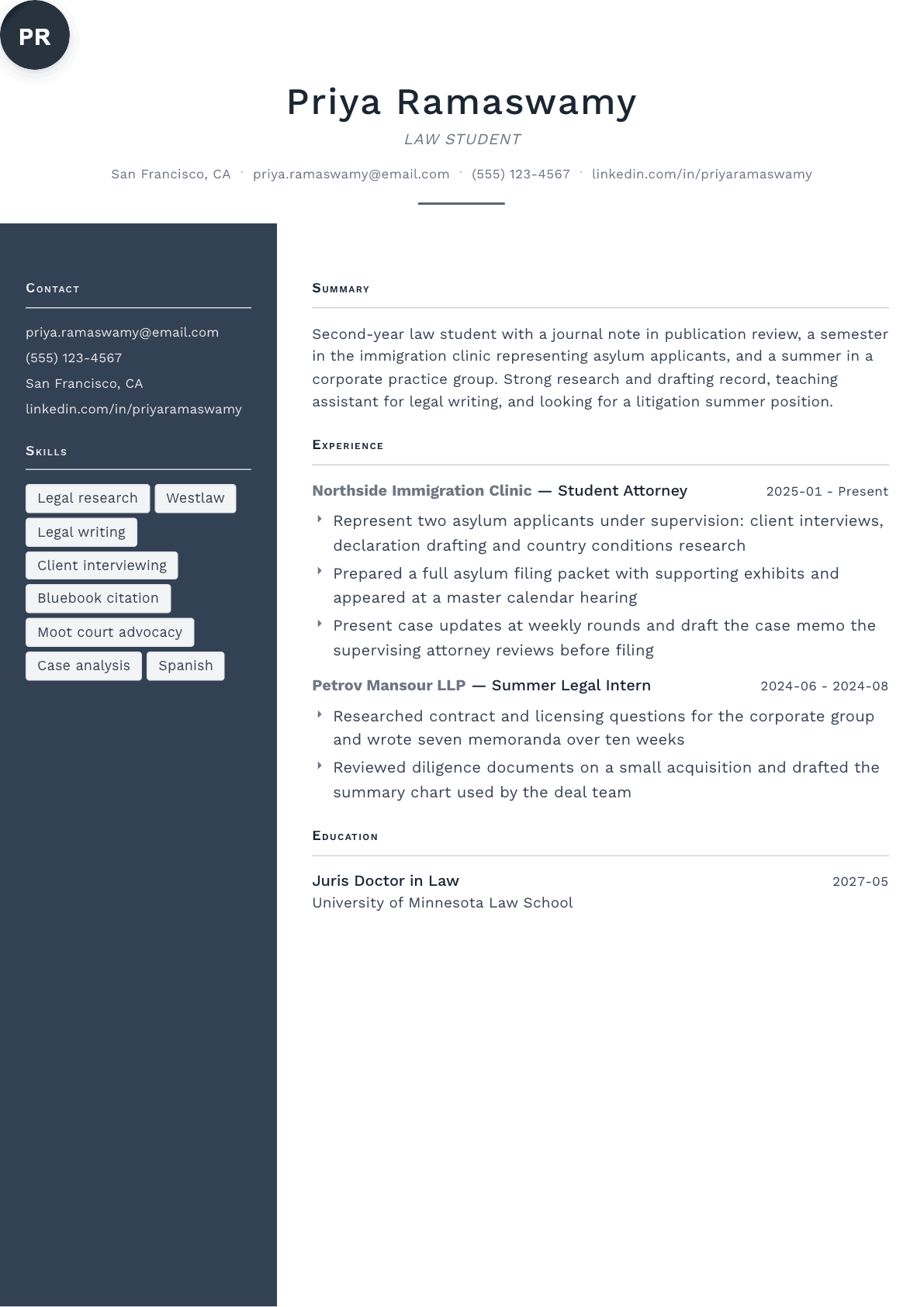
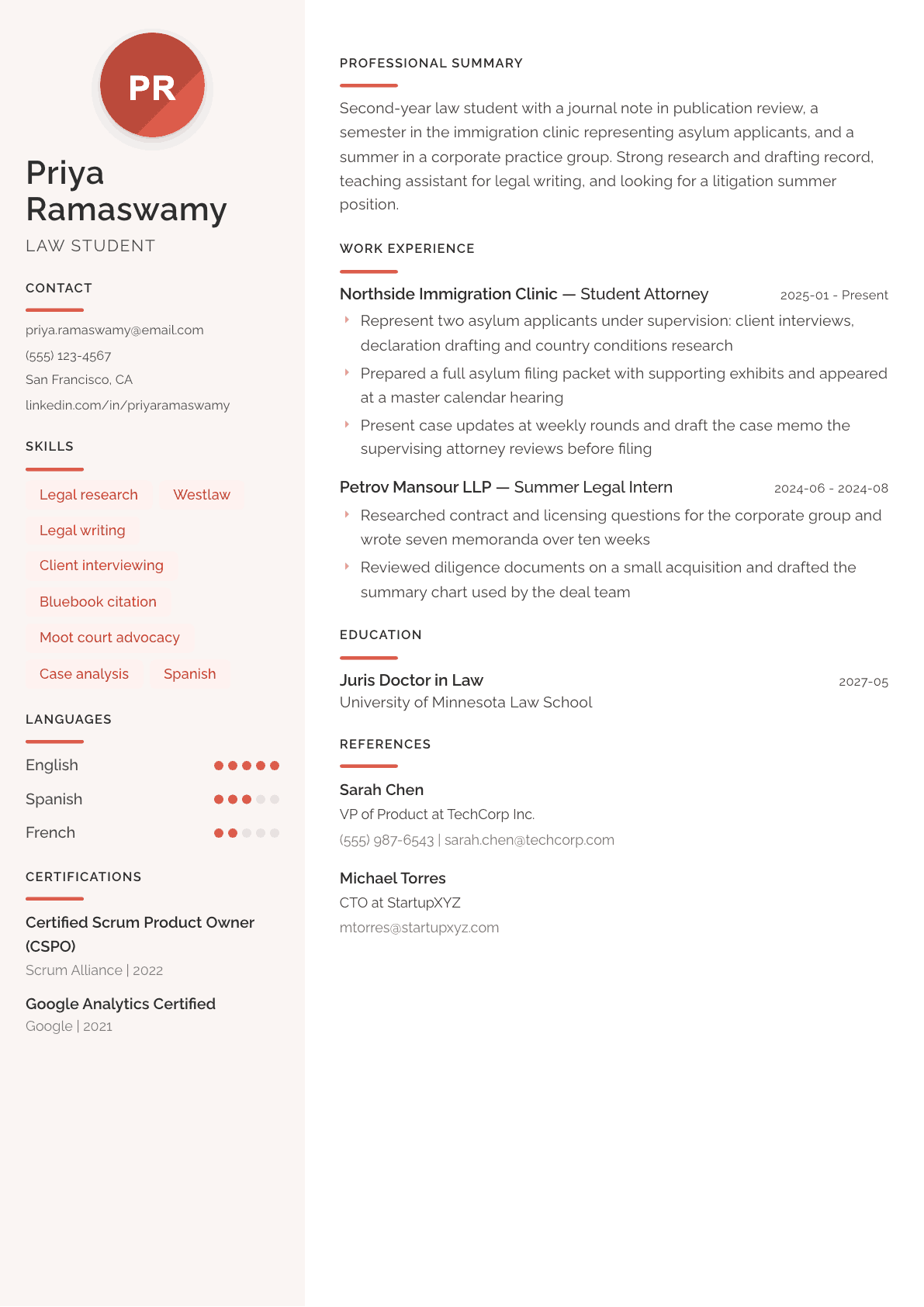
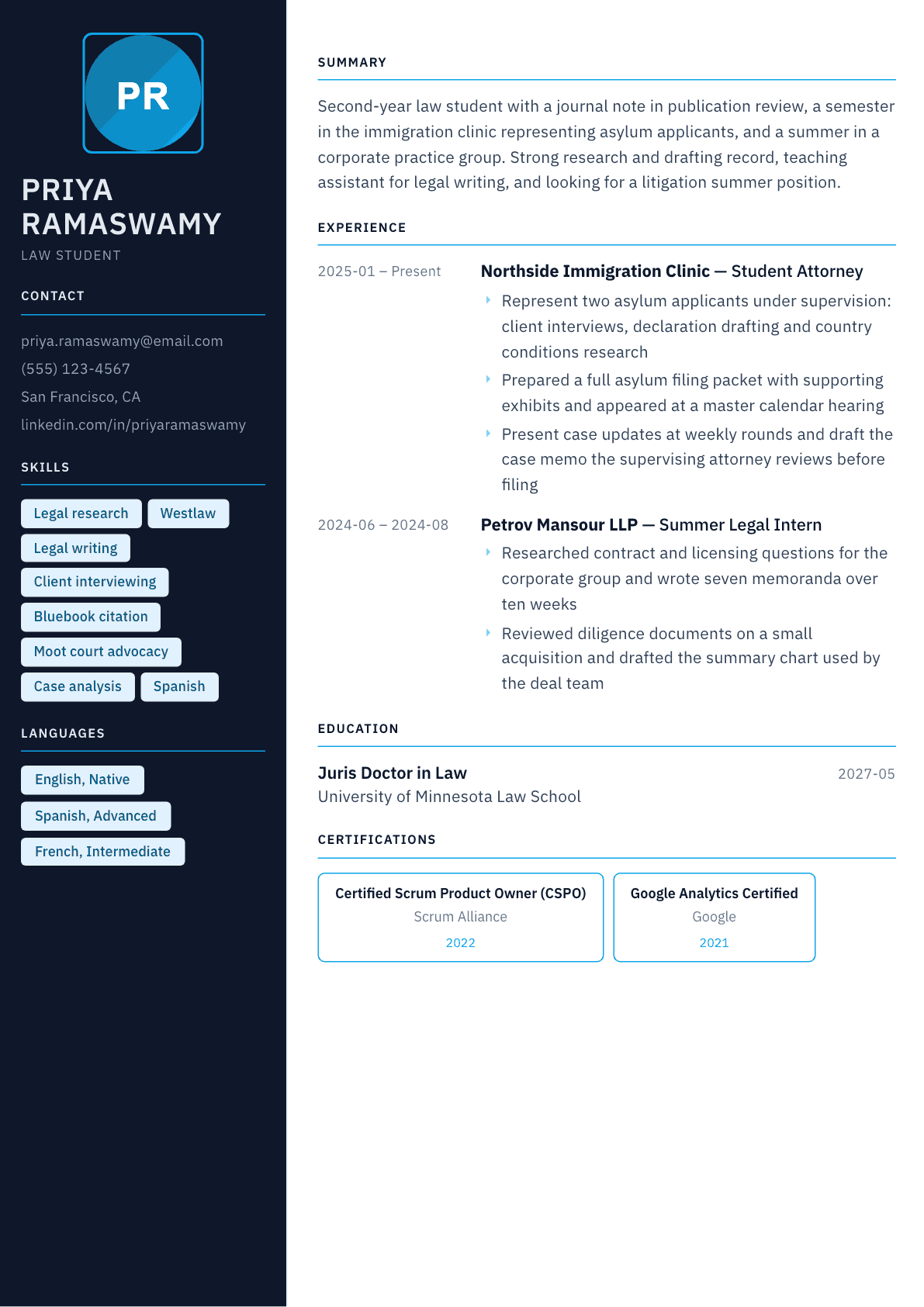
The same law student content laid out in three CVBooster templates, so you can see what the finished document looks like before you write a word.
Example Law Student summary
Second-year law student with a semester in the immigration clinic representing asylum applicants, a journal note in publication review, and a corporate summer internship where seven research memoranda were written in ten weeks. Teaching assistant for first-year legal writing and a moot court quarterfinalist. Seeking a litigation summer position with courtroom exposure.
Skills to list on a Law Student resume
- Legal research
- Westlaw and Lexis
- Legal writing and memoranda
- Bluebook citation
- Case briefing and analysis
- Client interviewing
- Clinic advocacy
- Moot court and oral argument
- Journal cite checking
- Document review
- Statutory interpretation
- Research presentations
What actually gets this resume read
- Keep it to one page and lead with education, including your school, expected graduation and any journal or honors.
- List the clinic by name and say what you did under supervision, because clinic work is the closest thing you have to practice.
- Give your journal role a line of substance: your note topic, your editing duties, and the volume you worked on.
- Put class rank or honors only if they help, and use the exact terms your school uses rather than inventing a label.
- Include pre-law work experience when it shows responsibility, language skill or an industry a firm serves.
- Add an interests line with two or three genuine, specific items, because interviewers open with it more often than students expect.
How to write a law student resume
A law student resume is a one page document with a very narrow job: get you into a twenty minute interview during a recruiting window where the reader has forty other students to see. Career services will tell you the format, and they are right, because the format is a convention that lets an interviewer find your school, your year, your journal and your last position in about six seconds.
Inside that convention there is still room to be a specific person. Two students with identical class years and journal positions read completely differently depending on whether their entries describe what they produced or simply list where they sat. The student who writes that a clinic filing was submitted, that a memo was used, that a research project became a chapter, wins the interview.
This guide covers the layout law schools expect, how to write education and journal entries that carry weight, how to describe clinic and internship work honestly under supervision rules, and the questions students ask about grades, pre-law jobs and the interests line at the bottom of the page.
Format: one page, education first, no exceptions
One page for the whole of law school, including career changers with a decade behind them. Education sits at the top with your law school, expected graduation, and your undergraduate institution and degree below it. Reverse chronological within each section, consistent date alignment on the right, and no photographs or graphics.
Use full institution names rather than abbreviations that only your campus uses. An interviewer at a firm in another city may not know your school's shorthand for a clinic or a journal, and a resume that requires local knowledge loses a few seconds of the reader's attention.
- Header: name, one address line or city and state, phone, email, and a link to nothing unless it is a real portfolio.
- Order: education, experience, activities and leadership, skills and languages, interests.
- Keep honors, journal, moot court and research assistant positions attached to the school entry.
The education block carries more than a degree
This block is doing most of the work in your first two years, so fill it properly. Expected graduation date, journal name and role, moot court or mock trial results, honors using the exact designation your school awards, scholarships if they are competitive, and any teaching or research assistant position with the professor and subject.
Undergraduate detail stays short but stays. Degree, institution, graduation year, and one honors line if it is meaningful. Interviewers frequently open with the undergraduate major, especially when it is technical or unusual, so it earns its space.
Clinic and internship entries: say what you produced
Clinic work is the closest thing a student has to practice, so treat it as a position rather than a course. Give the clinic name, your title as a certified student attorney if applicable, the supervising structure, the client work you handled and the documents you produced. A filing, a hearing appearance and a client interview each mean something concrete to a reader.
Internships and externships follow the same rule. Say what you wrote, for whom, and what happened to it. An internship entry consisting of assisted attorneys with various tasks tells an interviewer nothing they can ask about, and interviews run on the resume in front of them.
Where a supervision rule applies, state it. Writing under supervision or as a certified student attorney is accurate, expected and never counts against you, while an overstated entry invites a question you cannot answer well.
Activities, leadership and pre-law work
Student organization roles belong on the page when you did something in them. Organizing a symposium, running a first-year mentoring program or managing a chapter budget are all leadership evidence. Membership without a role can be listed in a single line rather than given bullets.
Pre-law employment stays if it shows responsibility, an industry, a language or a technical skill. A former teacher, engineer, paramedic or analyst brings something an interviewer will remember, so keep one compact entry rather than deleting years of work in the name of space.
Skills, languages and the interests line
Skills stay short and factual: research platforms, citation, any document review or e-discovery exposure, and languages with an honest level. Do not list common office software, and do not claim conversational when you mean two semesters of study.
The interests line is not filler. Interviewers use it to start a conversation, so give two or three specific things rather than reading, travel and sports. Distance running, competitive chess, restoring bicycles and Balkan history are all better because they are answerable, and an interviewer who enjoys the first two minutes of a conversation is a friendlier reader for the next eighteen.
Law Student resume summary examples
First-year student
First-year law student with a research assistant position in constitutional law, a legal writing grade in the top band of the section, and four years as a high school teacher before law school. Seeking a summer position in public interest litigation or a government office.
Second-year student
Second-year law student with a semester in the immigration clinic representing asylum applicants, a journal note in publication review, and a corporate summer internship where seven research memoranda were produced in ten weeks. Teaching assistant for first-year legal writing and a moot court quarterfinalist.
Third-year student
Third-year law student and journal senior editor returning to a commercial litigation group after a summer of research assignments and drafted brief sections. Two clinic semesters, a judicial externship on a civil calendar, and a trial advocacy competition final. Targeting a litigation associate position after graduation.
Work experience bullets: before and after
Before: Worked in the law school legal clinic assisting clients.
After: Represented two asylum applicants as a certified student attorney: client interviews, declaration drafting, country conditions research and a full filing packet with supporting exhibits.
The certification, the client count and the documents produced make a course entry read as supervised practice.
Before: Member of the law journal.
After: Journal staff editor: cite checked and source verified two published articles, and wrote a note on municipal liability currently in publication review.
Editing volume and a named note topic give an interviewer something to ask about instead of a membership line.
Before: Summer intern at a law firm doing research.
After: Researched contract and licensing questions for a corporate group, writing seven memoranda in ten weeks and building the diligence summary chart the deal team used at closing.
Output volume in a stated period and a deliverable that was used show productivity rather than attendance.
Before: Participated in moot court competition.
After: Moot court quarterfinalist: drafted the respondent brief with a partner and argued twice before panels of practicing attorneys and a sitting judge.
A result plus the specific writing and arguing you did converts an activity into demonstrated advocacy work.
Before: Teaching assistant for legal writing.
After: Teaching assistant for first-year legal writing: ran weekly small group sessions for sixteen students and gave written feedback on two memoranda and one appellate brief per student.
Group size and the feedback workload prove real teaching responsibility instead of a title on a list.
Hard skills
- Legal research
- Westlaw and Lexis
- Legal writing and memoranda
- Case briefing and analysis
- Bluebook citation
- Cite checking and source verification
- Client interviewing under supervision
- Oral argument
- Statutory interpretation
- Document review basics
- Declaration and affidavit drafting
- Research presentation
Soft skills
- Written precision
- Receiving edits well
- Managing competing deadlines
- Preparation before meetings
- Professional discretion
- Working with a supervising attorney
Mistakes that cost law student candidates the interview
- Running to two pages because a previous career felt too important to cut down to one compact entry.
- Listing clinic and internship placements without a single document, hearing or client interaction described.
- Using campus abbreviations for journals, clinics and honors that a reader in another city will not recognize.
- Overstating a supervised role by dropping the student attorney designation the certification actually requires.
- Filling the interests line with reading, travel and music, which gives an interviewer nothing to open with.
- Leaving graduation year off the education block, which is the first thing a recruiting coordinator sorts on.
Law Student resume questions
Should a law student resume be one page?
Yes, without exception during law school, including for career changers. Interviewers compare students on a fixed set of signals and expect them in a known place. Compress prior work into short entries rather than adding a second page that will not be read closely.
Do I put my grade point average on a law student resume?
Include it if your school reports one and yours is competitive for the employers you are targeting, along with class rank where published. If it is unremarkable, leave it off and give the space to journal work, clinic output and research positions instead.
How do I write a resume as a first-year law student?
Lean on education, legal writing performance, any research assistant position and your pre-law work. First-year hiring assumes almost no legal experience, so the reader is looking for writing ability, work ethic and a plausible reason you want that office.
Should I keep jobs from before law school?
Keep the ones that show responsibility, an industry an employer serves, a language or a technical skill, and compress them to one or two lines each. Drop unrelated short-term work once you have two legal entries worth describing in detail.
What goes in the interests section of a law student resume?
Two or three specific, true items that you can talk about for a minute. Specificity is the whole point, because interviewers use this line to open a conversation and a generic entry wastes the one part of the page designed to make you memorable.