Lobbyist Resume Examples: free score, then the gap list
Write a Lobbyist Resume That Proves Access and Outcomes
By Mustafa Tarabya, founder of CVBooster · Published · Updated
A lobbyist resume example with sample advocacy bullets, registration and disclosure keywords, and a guide to writing every section clearly.
Sample resumes for a lobbyist
The same lobbyist content laid out in three CVBooster templates, so you can see what the finished document looks like before you write a word.
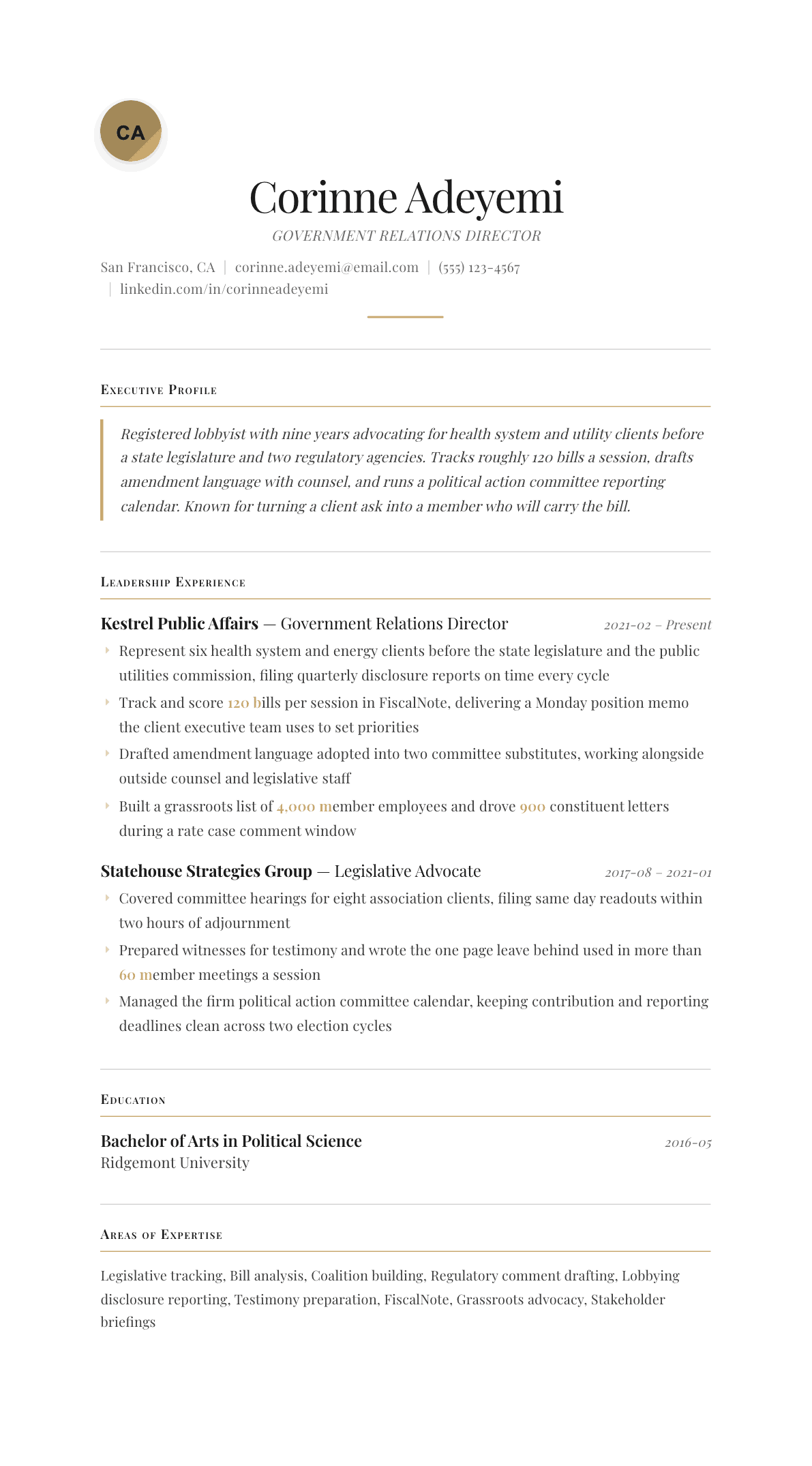
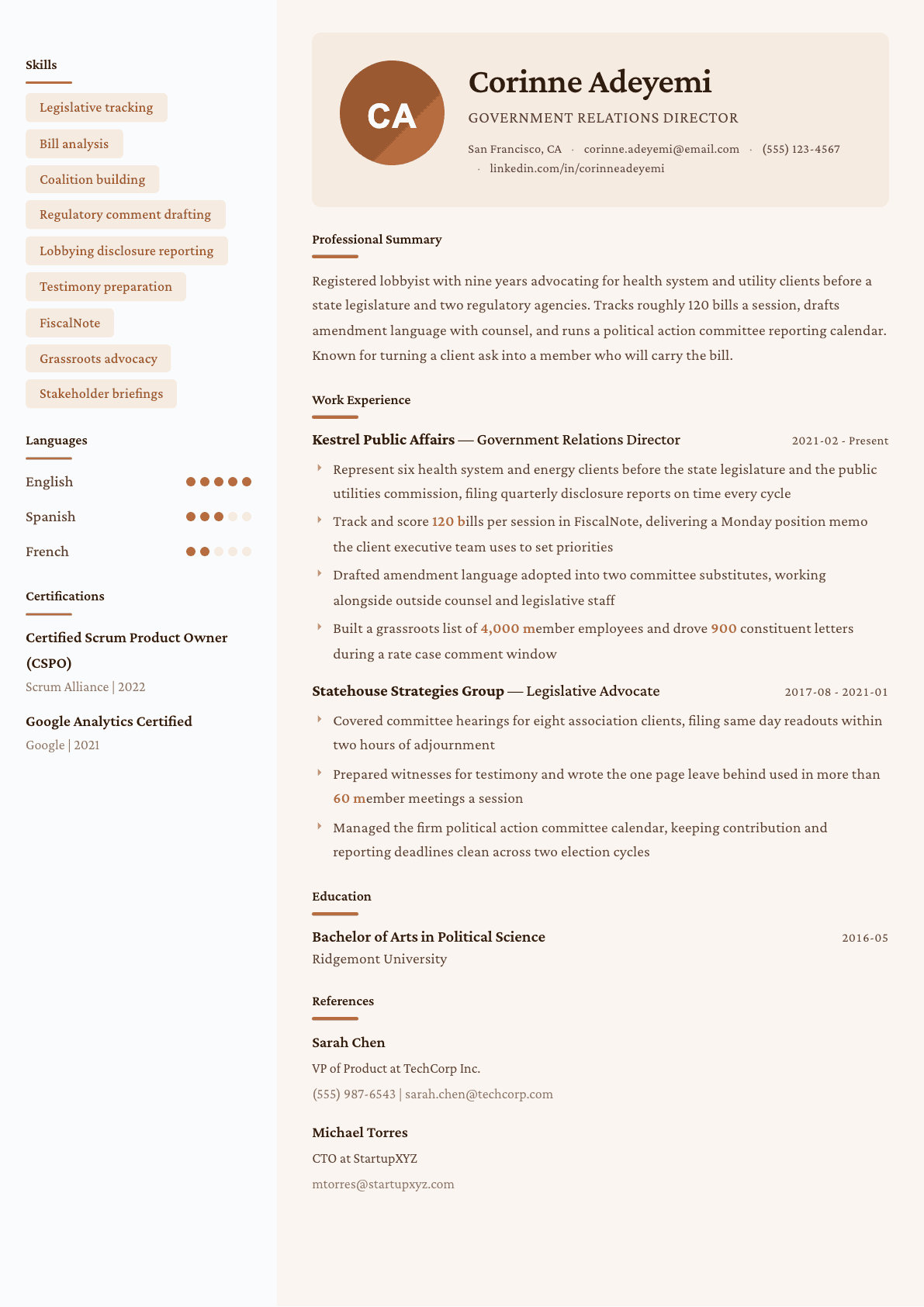
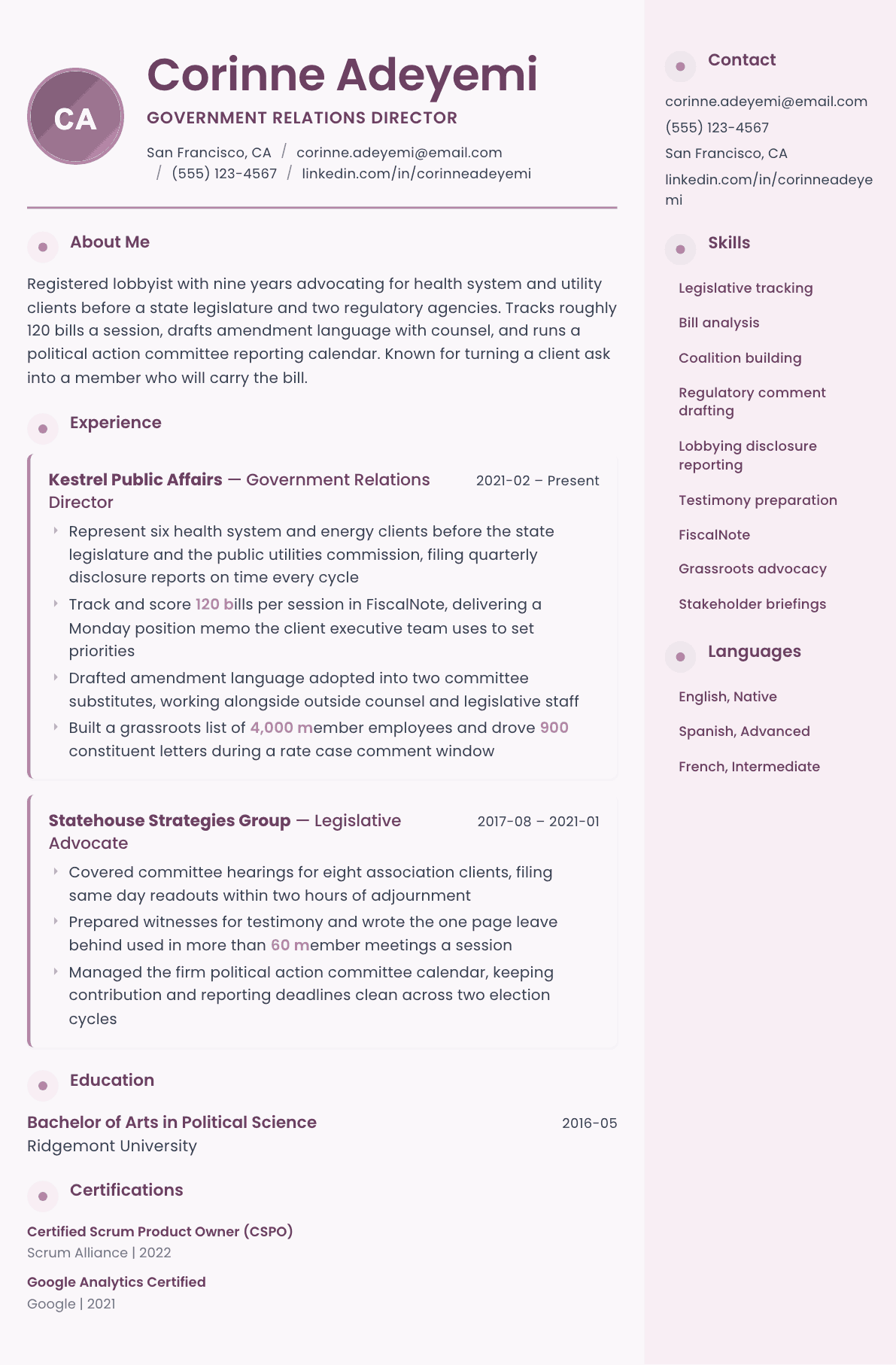
Example Lobbyist summary
Registered lobbyist with nine years of state legislative and regulatory advocacy for health system, utility and trade association clients. Tracks a full session bill load, drafts amendment language with counsel, prepares witnesses for committee testimony and keeps disclosure filings clean. Built a grassroots network that produced hundreds of constituent comments during a rate proceeding. Seeking a government relations lead role with multistate scope.
Skills to list on a Lobbyist resume
- Legislative tracking
- Bill and amendment drafting support
- Committee hearing coverage
- Regulatory rulemaking comments
- Lobbying disclosure filings
- Coalition management
- Grassroots mobilization
- Political action committee compliance
- Testimony preparation
- Client counseling
- Policy research and analysis
- Stakeholder mapping
- Fiscal note review
- Public affairs writing
- Ethics and gift rule compliance
What actually gets this resume read
- Name the chambers, agencies and jurisdictions you are registered in, because a hiring firm screens first on where you already have standing.
- Show outcomes as bills, amendments, rules or budget lines by number or short title rather than as a claim that you influenced policy.
- Put disclosure and ethics compliance in its own bullet, since a clean filing record is a hiring condition and not a nice extra.
- Quantify the session load: bills tracked, hearings covered, client accounts held, and meetings booked during a fly in week.
- Separate direct lobbying from grassroots and coalition work so a reader can tell which muscle you actually built.
- Keep client names general where confidentiality applies, but always describe the sector so the reader can judge subject matter depth.
How to write a lobbyist resume
Nobody hires a lobbyist on adjectives. A managing partner at a public affairs firm, or the head of government relations at a company, reads your resume looking for three things: where you are registered, who you already know in that building, and what has actually moved because you were working the issue. Everything else on the page is supporting material.
That makes the lobbyist resume unusual. It has to satisfy a compliance instinct, because your registrations and disclosure history are part of your professional record, and it has to satisfy a business instinct, because most lobbying jobs are paid for by clients who want a result they can point at. A page full of process language, attended hearings, monitored legislation, built relationships, fails both tests at once.
This guide covers the section order that works for advocacy hiring, how to write summaries at three career stages, how to convert vague advocacy claims into bullets with a bill number and an outcome, and the questions people ask when they sit down to write this document for the first time.
Format: jurisdictions near the top, two pages once you have a decade
Reverse chronological order, one page while you are still a legislative assistant or junior advocate, two pages once you have held client accounts. Put a short registration line directly under your contact block: the chambers, agencies and jurisdictions where you are or have been a registered lobbyist. A firm screening for someone who can walk into a specific statehouse tomorrow will stop reading if that line is missing.
Keep the layout conservative. This field still reads printed leave behinds, and a two column design with icons signals the wrong thing to a reader who spends the day in committee rooms. One font, clear headings, dates on the right.
- Header: name, city, phone, email, and the jurisdictions where you hold or have held a lobbyist registration.
- Sections in this order: summary, government relations experience, policy areas, education, affiliations.
- Add a short issue expertise block naming the subject areas you can speak to without preparation.
Summary: the building, the issues, the client type
Four lines at most. Say which legislature or agency you work in, the issue areas you carry, the kind of clients or members you represent, and one result a reader can picture. A summary that opens with a passion for public policy could belong to an intern or to a former committee chair, so it says nothing about you.
If you are crossing over from a staff job or a campaign, name that history plainly. Time as a committee staffer, a budget analyst or a district director is an asset in this market, and the reader wants it stated rather than inferred from three lines of dates.
Experience: bills, rules, and what happened to them
Every position should open with the practice or organization, the jurisdictions covered, and the client or member load. A line reading six clients across health care and energy, registered in two chambers and before the utilities commission, tells the reader more than a paragraph of narrative.
Then write outcome bullets. A lobbying outcome is usually one of five things: a bill passed, a bill stopped, an amendment adopted, a rule changed or withdrawn, or a budget line secured or protected. Name which one it was, name the vehicle by number or short title, and say what your part was: drafting the language, finding the sponsor, building the coalition, preparing the witness, working the fiscal note.
Keep one bullet for the machinery of the job that never appears in the win column but gets you rehired: filing quarterly disclosure reports on time, running the political action committee calendar, delivering a session readout your client executive reads on Monday morning. Reliability is a selling point in a field where a late filing becomes a news story.
- Say who carried the bill and what you did to get them to carry it.
- Distinguish direct lobbying from grassroots mobilization and from coalition management.
- Where a client is confidential, describe the sector and the ask instead of naming the company.
Issue expertise and coalitions: the part that gets you the meeting
Lobbying hiring is subject matter hiring. A firm with an opening usually has a client problem in a specific area: Medicaid rates, transmission siting, cannabis licensing, data privacy, occupational scope of practice. List your issue areas as a compact block and make sure the two you know best appear in a bullet as well, attached to a real fight.
Coalition work deserves its own visible thread. Say how many organizations you convened, who else was at the table, and what the coalition produced: a joint letter, a shared fiscal analysis, a witness lineup, a comment campaign during a rulemaking window. That is evidence you can assemble force rather than just carry a message.
Compliance, ethics and the things a firm checks anyway
A hiring firm will look at your public filing history whether or not you mention it, so mention it. Note the registrations you maintain, that your disclosure reports have been filed on time, and any experience you have with gift rule and revolving door restrictions in the jurisdictions where you work. If you have managed a political action committee, say so and describe the reporting calendar you kept, not the amounts you raised.
Federal work adds the Lobbying Disclosure Act reporting cycle to the picture, and many states run their own registration and quarterly reporting regime on top of that. Naming the specific regime you have filed under is a quiet credibility signal that a generalist writer would never think to include.
Lobbyist resume summary examples
Moving from legislative staff
Former committee staffer with three sessions in a state senate finance office, now registered as a lobbyist. Drafted fiscal analysis for tax and appropriations bills, staffed a chairman through two budget conferences, and knows the committee calendar from the inside. Seeking an associate role at a multi client public affairs practice.
Six sessions in
Registered state lobbyist with six sessions representing hospital systems and provider associations. Tracks a full bill load each session, drafts amendment language with outside counsel, and prepares client witnesses for committee testimony. Secured adopted amendments in two committee substitutes and has never filed a disclosure report late.
Government relations lead
Government relations director with twelve years across two state capitals and one regulatory commission, leading a three person advocacy team and a client book in energy and health care. Runs coalitions, directs grassroots programs, and staffs the executive team through budget and rulemaking cycles from the first draft to the signature.
Work experience bullets: before and after
Before: Monitored legislation and reported to clients.
After: Tracked and scored a full session bill load in FiscalNote and delivered a Monday position memo that set client priorities for the week ahead.
The tool, the cadence and the use of the memo turn passive monitoring into a product someone relies on.
Before: Built relationships with legislators and staff.
After: Secured a bill sponsor in the house commerce committee for a client licensing fix and coordinated the witness lineup for its first hearing.
Relationships are only credible when they produce a named action, here a sponsor and a hearing.
Before: Worked on regulatory issues before state agencies.
After: Drafted and filed comments during a utility rate proceeding and organized a coalition of four trade groups to file in parallel with a shared technical analysis.
Naming the proceeding type, the filing and the coalition shows the actual mechanism of regulatory advocacy.
Before: Managed grassroots advocacy campaigns.
After: Built a grassroots list of four thousand member employees and drove nine hundred constituent letters into a comment docket inside a three week window.
The list size, the response count and the window make the campaign measurable instead of merely claimed.
Before: Handled compliance and reporting requirements.
After: Filed quarterly lobbying disclosure reports for six client registrations across two jurisdictions with no late or amended filings in four years.
A clean filing record is a hiring condition, and stating it precisely removes a question the firm would otherwise ask.
Hard skills
- Legislative tracking and bill analysis
- Amendment and bill drafting support
- Regulatory comment filing
- Lobbying disclosure reporting
- Committee hearing coverage
- Coalition building
- Grassroots program management
- Political action committee compliance
- Fiscal note analysis
- Witness and testimony preparation
- Stakeholder mapping
- Policy research and briefing
Soft skills
- Persuasive writing
- Reading a room
- Client counseling
- Discretion
- Negotiation
- Rapid triage under a session clock
Mistakes that cost lobbyist candidates the interview
- Leaving off the jurisdictions where you are registered, which forces the reader to guess whether you can start work immediately.
- Writing advocacy in the abstract when the bill number, the rule docket or the budget line is the entire proof.
- Claiming credit for a broad legislative victory without naming your specific contribution to it.
- Burying the staff or campaign background that gives you access, because it reads as unrelated experience when it is the asset.
- Ignoring compliance history, so a reader who checks your public filings learns something you chose not to mention.
- Listing every issue area you have ever touched, which reads as thin coverage rather than as breadth.
Lobbyist resume questions
Should a lobbyist resume name clients?
Name them when the representation is already public through your registration filings, which is usually the case. Where an engagement is confidential or a firm policy forbids it, describe the sector and the ask instead, such as a regional hospital system seeking a rate adjustment.
How do I show results when most bills never pass?
Count the outcomes that matter besides passage. Amendments adopted, harmful language removed, a bill held in committee, a rule withdrawn or softened, a budget line protected. Defensive wins are real work and hiring partners understand them better than anyone.
Does campaign or legislative staff experience belong on the resume?
Yes, prominently. Time as committee staff, a district director, a budget analyst or a campaign manager explains where your access comes from. Describe the substantive work you did there rather than listing the title and the dates alone.
How long should a government relations resume be?
One page while you are an associate or a former staffer entering the field. Two pages once you carry client accounts across multiple sessions, since jurisdictions, issue areas and outcomes all need room. Three pages reads as an unedited career history.
What if I have worked only in one state?
Say so and make depth the selling point. Deep familiarity with one legislature, its committee chairs, its budget process and its agency practice is worth more to most employers than shallow exposure to several capitals, and it is easily verified.