Quality Assurance Inspector Resume Examples: free score
Write a Quality Assurance Inspector Resume Plants Call Back
By Mustafa Tarabya, founder of CVBooster · Published · Updated
A quality assurance inspector resume with the gauges, tolerances, standards and inspection records employers check, plus a sample and a writing guide.
Sample resumes for a quality assurance inspector
The same quality assurance inspector content laid out in three CVBooster templates, so you can see what the finished document looks like before you write a word.
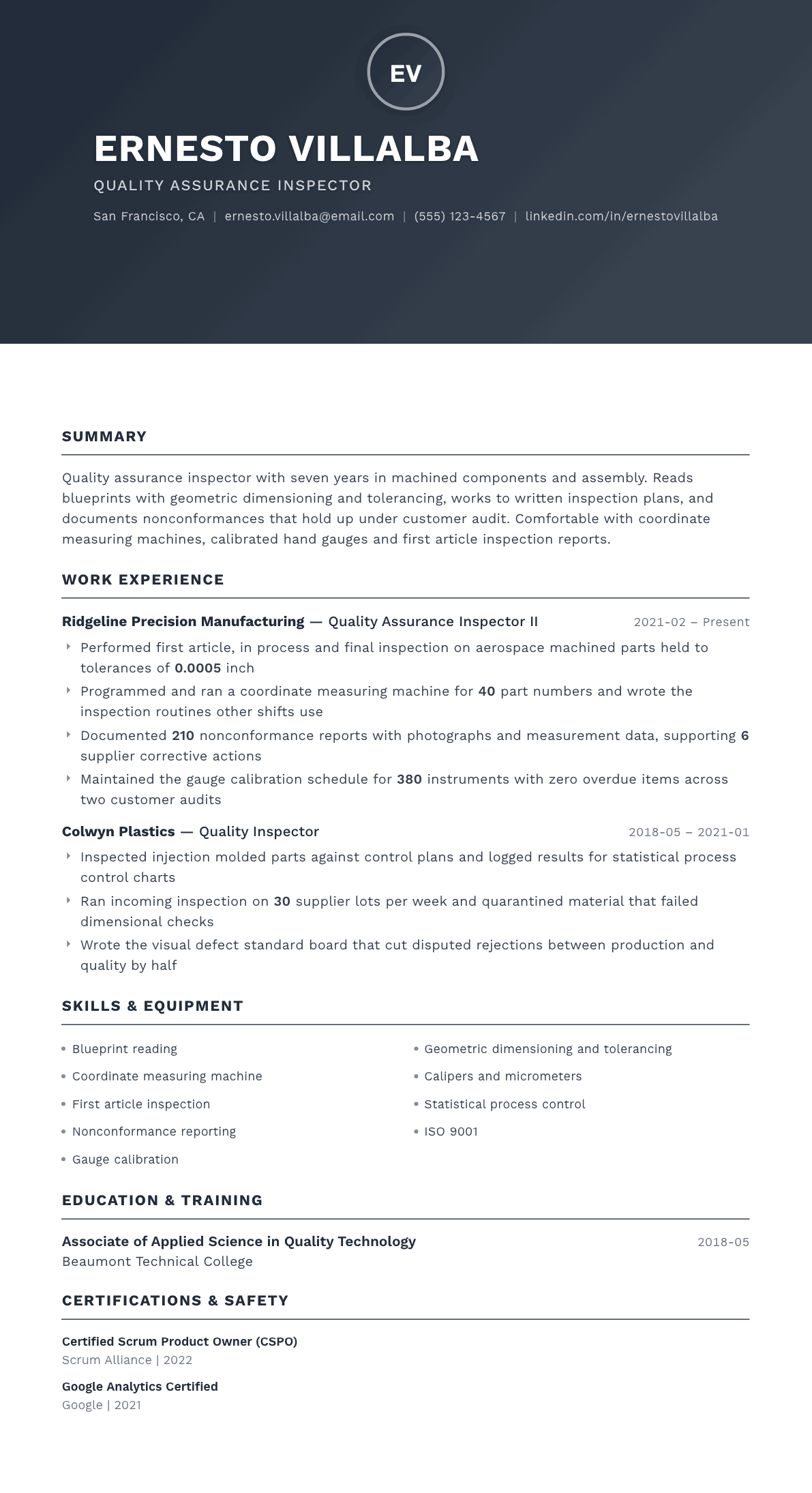
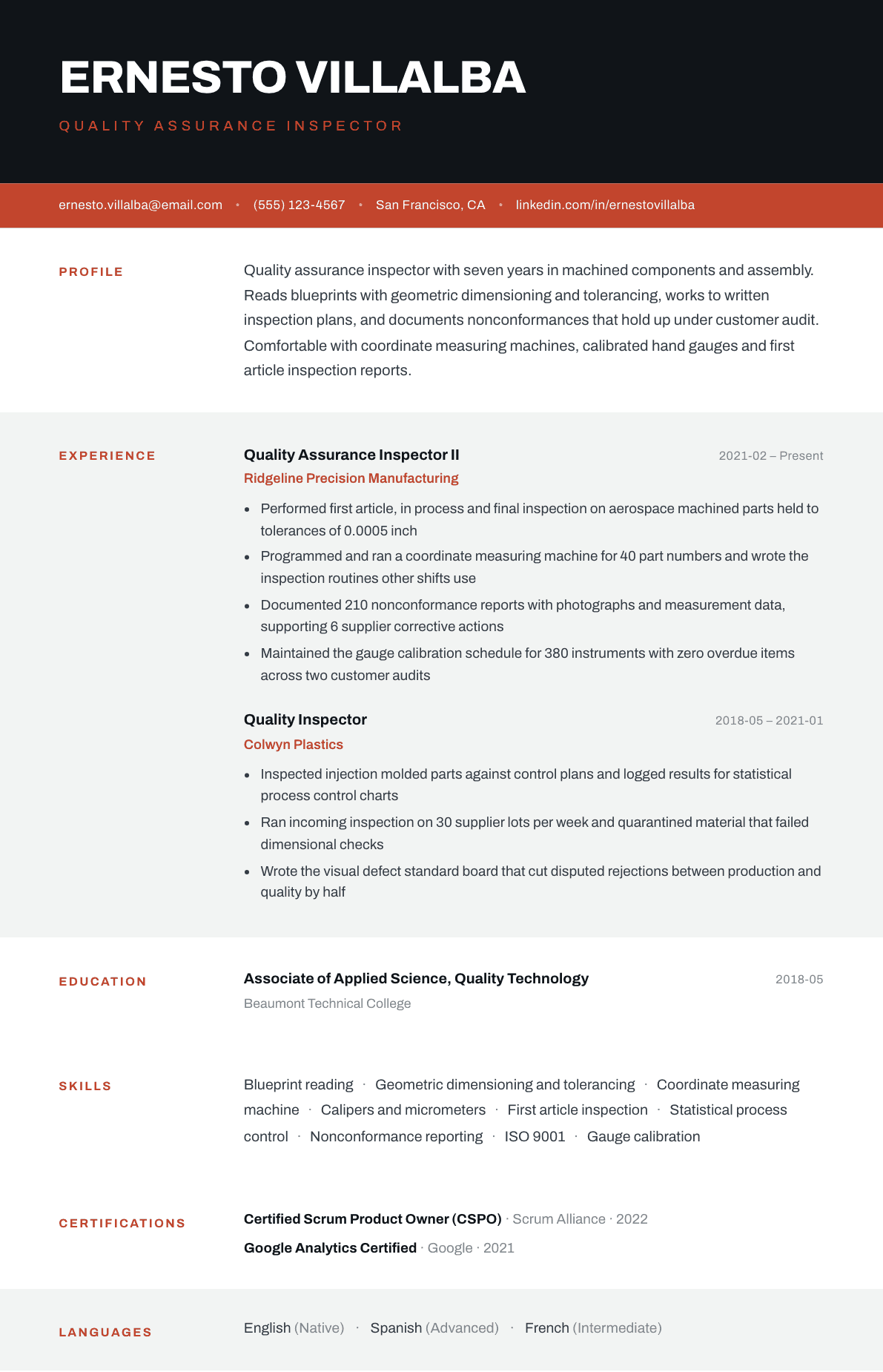
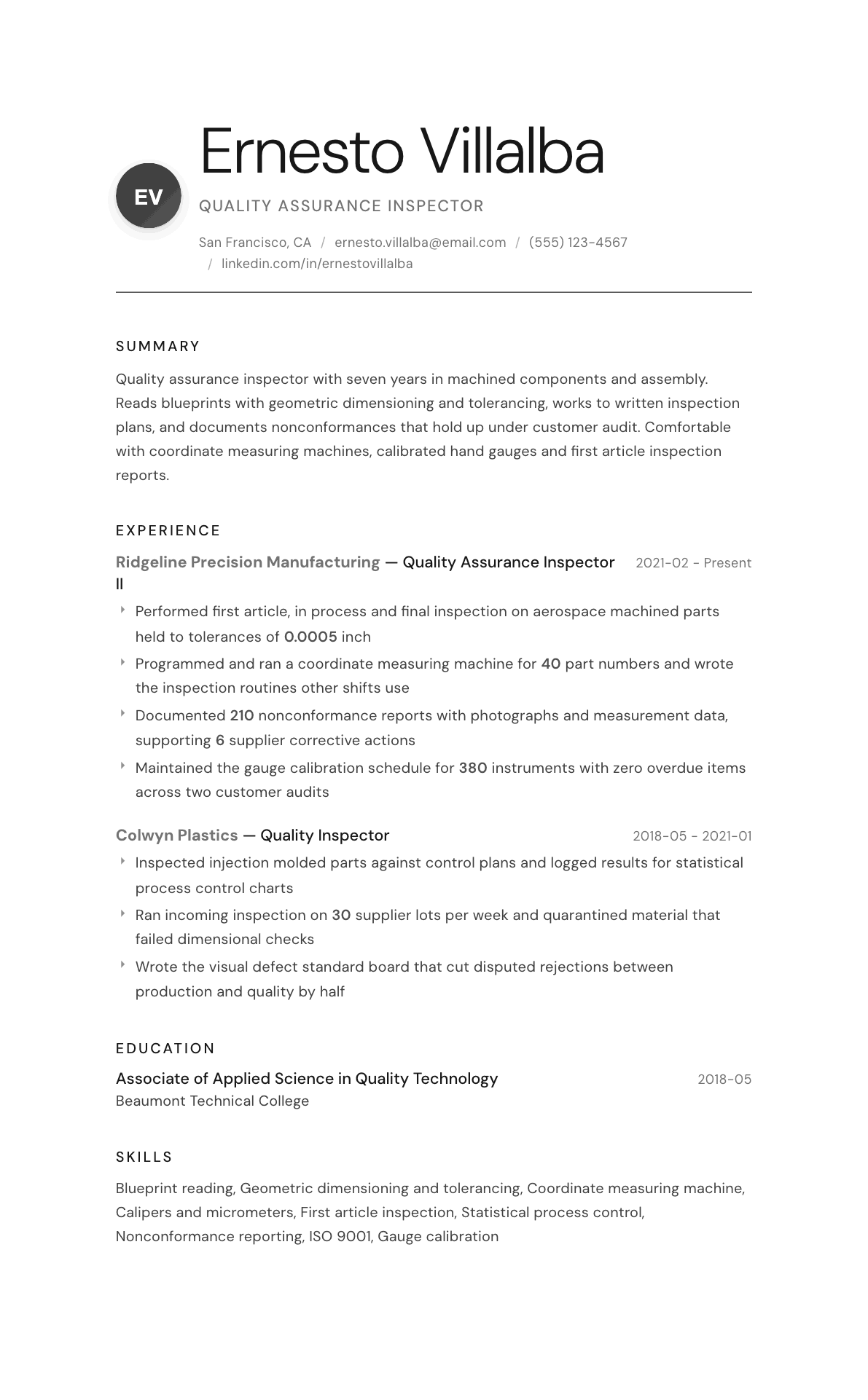
Example Quality Assurance Inspector summary
Quality assurance inspector with seven years across machined aerospace components and molded plastics, holding tolerances to five ten thousandths of an inch. Programs and runs coordinate measuring machines, writes first article and nonconformance reports that survive customer audit, and keeps a several hundred instrument calibration schedule current without an overdue item.
Skills to list on a Quality Assurance Inspector resume
- Blueprint reading
- Geometric dimensioning and tolerancing
- Coordinate measuring machine
- Micrometers and calipers
- Height gauges
- First article inspection
- Statistical process control
- Nonconformance reporting
- Root cause analysis
- Gauge calibration
- ISO 9001
- AS9100
- Control plans
- Incoming inspection
What actually gets this resume read
- List the measuring equipment by name, because a shop hiring for coordinate measuring work screens for that exact phrase.
- Give the tightest tolerance you routinely hold, since that single number tells a quality manager what work you can take.
- Name the standards your plant worked to, whether ISO 9001, AS9100, IATF 16949 or a customer specification.
- Show your paperwork: first article reports, nonconformance reports, control plans and calibration records all count as output.
- Say which product families you inspected, as machined metal, injection molded plastic and food packaging are different jobs.
- Include shift, volume and audit experience, because inspectors are often hired to cover a specific shift and audit cycle.
How to write a quality assurance inspector resume
A quality assurance inspector resume is read by a quality manager who is trying to answer one question quickly: can this person walk onto my floor and inspect my parts without being retrained from zero. That answer lives in four details, the equipment you measure with, the tolerances you routinely hold, the standard your plant works to, and the product family you have inspected. Everything else on the page is secondary.
Most inspector resumes fail on vagueness. Inspected products for defects and ensured quality standards were met describes the job title, not the person. Two candidates with identical duty lists are separated entirely by whether one of them wrote down that she programs a coordinate measuring machine and works to five ten thousandths of an inch.
This guide covers the layout that reads fastest, how to describe measurement and documentation work, three example summaries from a first inspection job to a lead inspector, before and after bullets, and the questions that come up when inspectors move between industries.
Format: one page, equipment visible near the top
One page is right for most inspectors and two only when you have more than a decade across several industries. Reverse chronological, plain single column, no graphics. Many manufacturers use screening software that reads columns out of order, and an inspector resume that loses its dates is finished before a human sees it.
Put a short technical block directly under the summary listing measurement equipment, standards and software. A quality manager scanning for coordinate measuring machine experience should find the phrase in the top third of the page rather than in the third bullet of a job from four employers ago.
- Header: name, city and state, phone, email, and shift availability if you are open on it.
- Sections: summary, inspection equipment and standards, experience, certifications, education.
- Under each employer: product family, materials, tolerance range, then the bullets.
Summary: parts, tolerances, and the tightest work you do
Three lines. Name the industry, the parts, the equipment and the tightest tolerance you hold routinely. Aerospace machined components at five ten thousandths of an inch and injection molded housings at plus or minus twenty thousandths are entirely different jobs, and the number tells a manager which one you have been doing.
If you are moving between industries, say so and name what transfers. Blueprint reading, geometric dimensioning and tolerancing, gauge handling and documentation discipline carry across, while the specific standard and material knowledge does not, so be honest about which is which.
Experience: what you measured, with what, and what you wrote down
Each employer needs a context line before the bullets: the product, the material, the process it came off, the production volume and the tolerance band. That line does more work than three achievement bullets because it lets the manager map your background onto her own parts.
Then describe the inspection you actually perform. First article, in process, final, incoming, receiving, layout inspection, and sampling to a published plan are all different activities and postings ask for particular ones. Name the equipment against each: coordinate measuring machine, optical comparator, height gauge, surface plate work, thread gauges, hardness tester, calipers and micrometers.
The documentation is the output of the job, so it belongs on the page. First article reports, nonconformance reports with measurement evidence, control charts, calibration records and supplier corrective action requests are all countable. An inspector who can show that her paperwork survived a customer audit is more valuable than one who only says she inspected parts.
Standards, calibration and audit experience
Name the quality system your plant ran under, whether that was ISO 9001, AS9100 for aerospace, IATF 16949 for automotive, or a customer specific specification. Say whether you participated in an audit, what your part in it was, and what findings came out, because audit exposure is a genuine differentiator.
Calibration is often the quiet responsibility that separates a senior inspector from a junior one. If you kept a gauge calibration schedule, say how many instruments were on it and whether anything was ever overdue when an auditor looked.
Skills and the keywords a manufacturer screens for
The phrases that recur in inspector postings are blueprint reading, geometric dimensioning and tolerancing, first article inspection, statistical process control, nonconformance, corrective action, calibration, sampling plan, incoming inspection, and the named equipment. Put each one where you demonstrated it rather than in a wall of terms at the bottom of the page.
Include the software too. Coordinate measuring machine programming environments, statistical process control packages, and the enterprise system where you logged inspection results all matter, because a plant hiring for a specific setup will screen for its own tools.
Quality Assurance Inspector resume summary examples
First inspection role
Quality inspector with 2 years in injection molding, checking parts against control plans with calipers, micrometers and go no go gauges. Reads blueprints including geometric dimensioning and tolerancing, logs results for statistical process control charts, and quarantines nonconforming lots at incoming inspection.
Five years in a machine shop
Quality assurance inspector with 7 years across machined aerospace parts and molded plastics, holding tolerances of 0.0005 inch. Programs and runs a coordinate measuring machine for 40 part numbers, writes first article and nonconformance reports, and maintains a 380 instrument calibration schedule.
Lead inspector
Lead quality inspector with 12 years in aerospace machining, responsible for inspection routines across three shifts and for training 9 inspectors. Runs layout inspections and first articles, chairs the material review board, and has supported four customer audits with no major findings raised.
Work experience bullets: before and after
Before: Inspected parts to make sure they met specifications.
After: Performed first article, in process and final inspection on machined aerospace parts held to tolerances of 0.0005 inch, using a coordinate measuring machine, height gauge and thread gauges.
The inspection types, the tolerance and the named equipment give a quality manager everything she needs to place your skill level.
Before: Used a CMM to measure parts.
After: Programmed and ran coordinate measuring machine routines for 40 part numbers, and wrote the setup instructions that second and third shift now run without engineering support.
Programming and documenting routines is a much higher skill than operating one, and the bullet now makes that distinction visible.
Before: Wrote up defects and reported them.
After: Documented 210 nonconformance reports with photographs and measurement data, and supplied the evidence behind 6 supplier corrective action requests that closed recurring dimensional issues.
Volume, evidence quality and the downstream corrective actions show documentation that changed supplier behavior rather than filing paperwork.
Before: Helped maintain calibration of tools.
After: Maintained the gauge calibration schedule for 380 instruments, coordinating outside calibration vendors and closing two customer audits with zero overdue items.
The instrument count and the audit result turn a maintenance task into proof of a system you personally kept clean.
Before: Worked with production to solve quality problems.
After: Built the visual defect standard board for molded housings with production supervisors, cutting disputed rejections between production and quality by half.
A named artifact and a measurable reduction replace a generic claim of collaboration that every inspector writes.
Hard skills
- Blueprint and drawing interpretation
- Geometric dimensioning and tolerancing
- Coordinate measuring machine operation
- Micrometers, calipers and height gauges
- Optical comparator
- First article inspection reports
- Statistical process control
- Sampling plans
- Nonconformance and corrective action reporting
- Gauge calibration
- ISO 9001 and AS9100 requirements
- Incoming and receiving inspection
Soft skills
- Attention to detail
- Written documentation
- Standing your ground on a reject
- Communication with production
- Time management across a shift
Certifications worth listing
- Certified Quality Inspector (CQI) (American Society for Quality)
- Certified Quality Technician (CQT) (American Society for Quality)
- Certified Quality Auditor (CQA) (American Society for Quality)
- Certified Six Sigma Green Belt (CSSGB) (American Society for Quality)
Mistakes that cost quality assurance inspector candidates the interview
- Writing duties that describe the job title instead of the equipment, tolerances and parts you personally handled.
- Leaving the tightest tolerance off the page, which is the fastest signal of skill level in this trade.
- Skipping the quality standard the plant ran under, so the reader cannot tell aerospace discipline from general manufacturing.
- Treating documentation as invisible, when reports and calibration records are the measurable output of the role.
- Listing equipment you saw in training next to equipment you use daily, with nothing to separate the two.
- Omitting shift history and audit involvement, both of which are frequently the reason a specific opening exists.
Quality Assurance Inspector resume questions
How long should a quality assurance inspector resume be?
One page for most inspectors. Go to two only when you have a decade or more across several industries and quality systems, and use the extra space for equipment and standards rather than repeating similar duty bullets.
Do I need a certification to get an inspector job?
Many shops hire without one, but a recognized quality credential moves you up the pile and sometimes unlocks a pay band. If you hold one, place it near the top with the issuing body rather than at the bottom of the page.
How do I show coordinate measuring machine experience properly?
Separate operating from programming. Say how many part numbers you programmed, which control software you used, and whether you wrote the routines and setup sheets other shifts run, because that distinction changes the level you are hired at.
Can I move from automotive inspection to aerospace?
Yes, and the transferable half is blueprint reading, geometric dimensioning and tolerancing, gauge work and documentation discipline. Name the standard you worked to, then say plainly that you are moving into aerospace and are prepared to learn its requirements.
What should I put on the resume if I have no manufacturing background?
Lead with measurement, documentation and pattern recognition from wherever you gained them, then add any technical schooling, blueprint reading coursework or hand tool experience. Apply to plants with structured inspector training and say clearly that you are seeking one.
Related resume examples
- Quality Manager Resume example
- Operations Manager Resume example
- Plant Manager Resume example
- Continuous Improvement Manager Resume example
- Lean Six Sigma Black Belt Resume example
- Team Leader Resume example