Mortgage Processor Resume Examples: the lines they read
Build a Mortgage Processor Resume That Proves Files Reach the Table
By Mustafa Tarabya, founder of CVBooster · Published · Updated
Mortgage processor resume example, keyword list and writing guide covering pipeline size, turn times, condition clearing, disclosures and loan origination systems.
Sample resumes for a mortgage processor
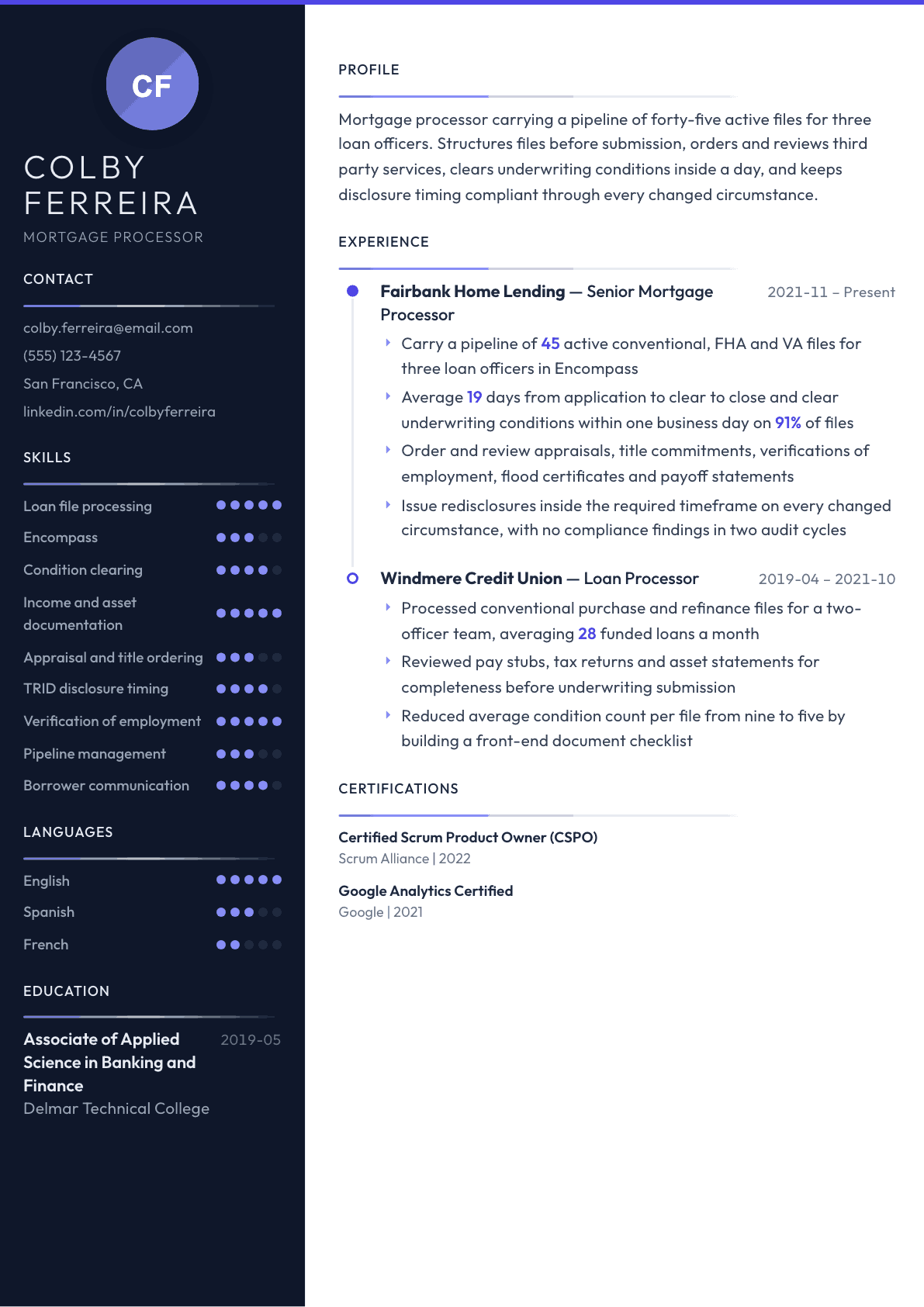
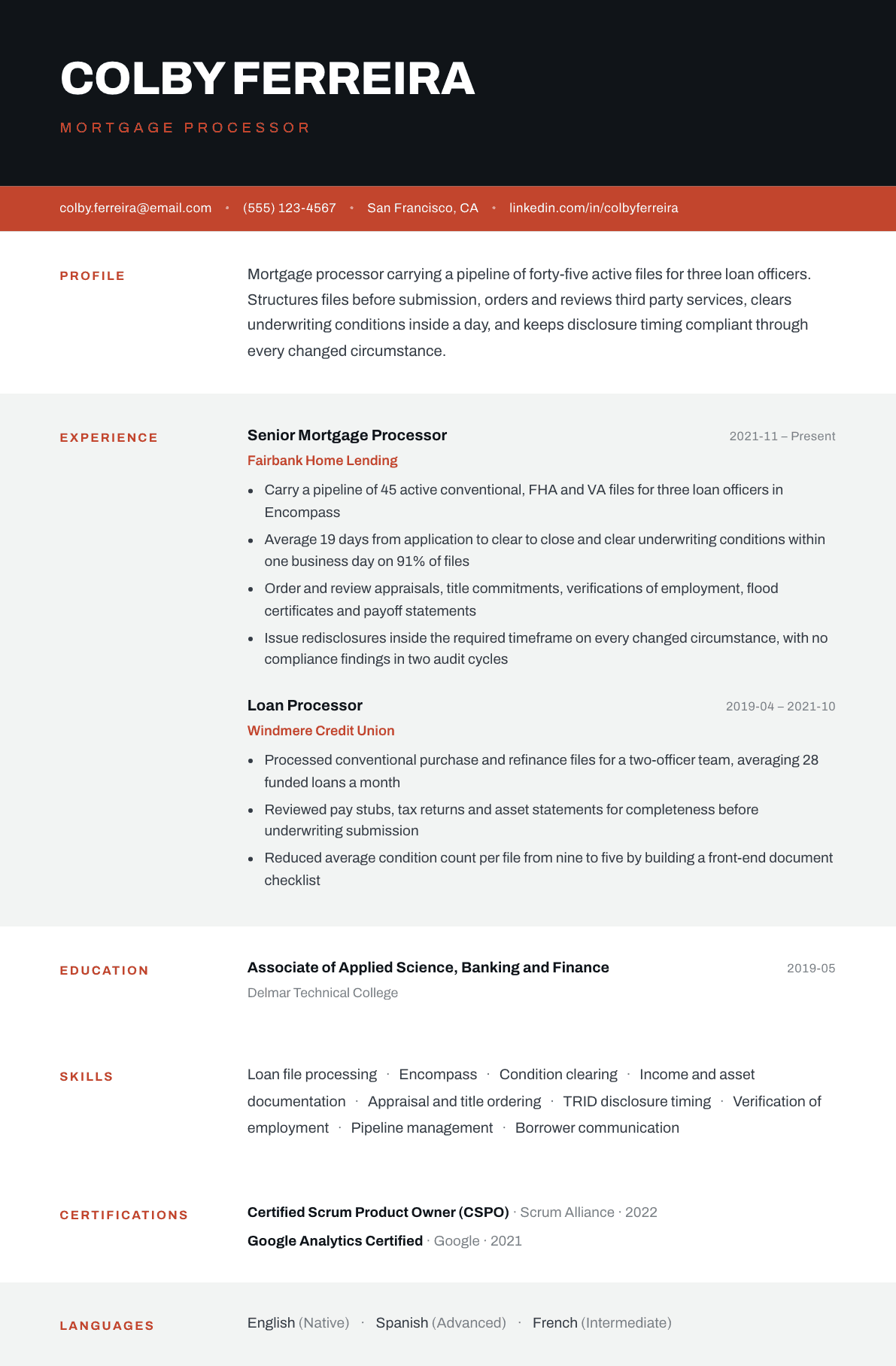
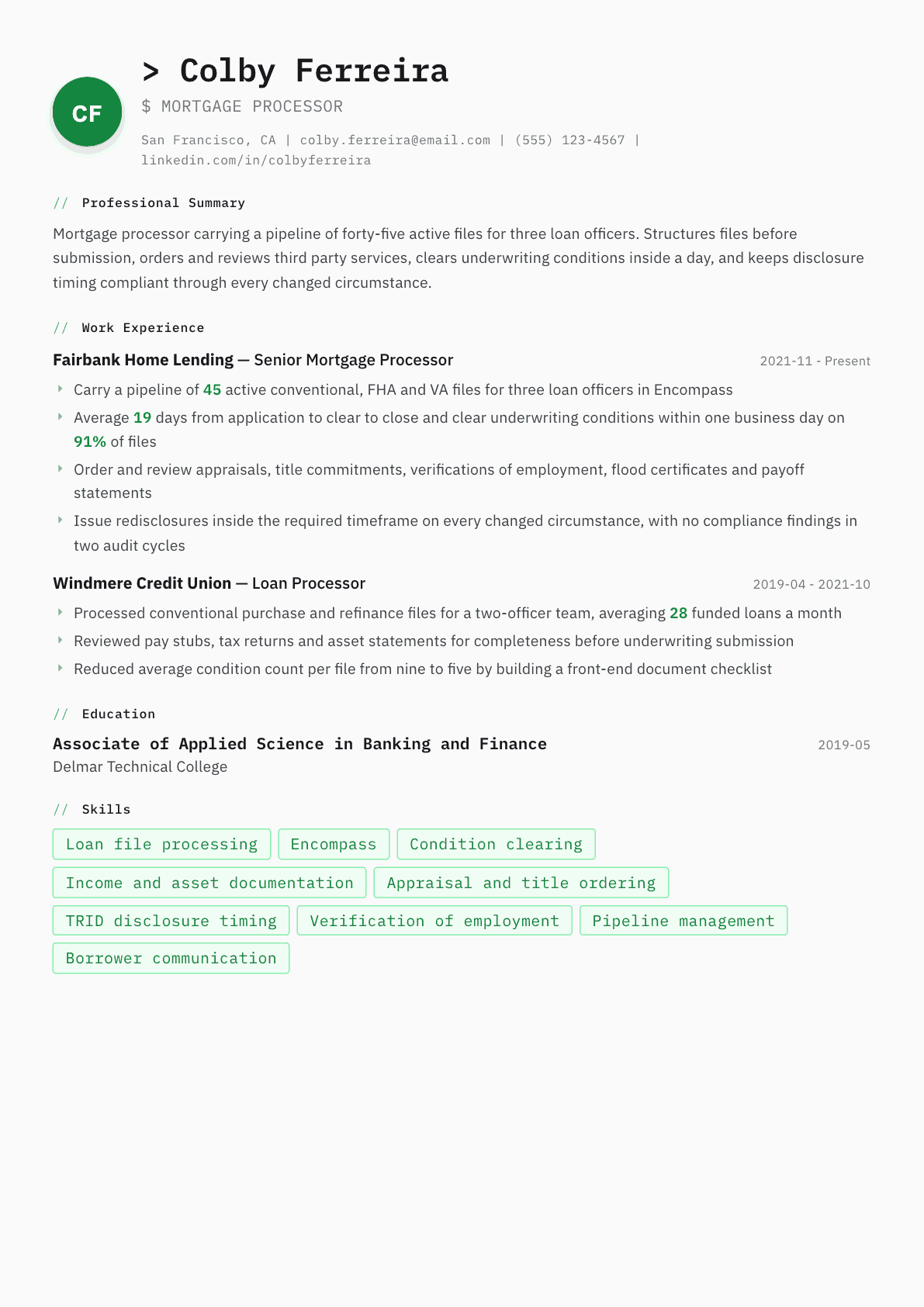
The same mortgage processor content laid out in three CVBooster templates, so you can see what the finished document looks like before you write a word.
Example Mortgage Processor summary
Mortgage processor with six years supporting retail and credit union origination, currently carrying forty-five active files for three loan officers. Averages nineteen days from application to clear to close and turns underwriting conditions inside one business day. Orders and reviews appraisals, title, verifications and payoffs, and keeps redisclosure timing clean through every changed circumstance. Works Encompass daily.
Skills to list on a Mortgage Processor resume
- Mortgage loan processing
- Conventional and government loan files
- Income and asset documentation review
- Tax return and pay stub analysis
- Underwriting condition clearing
- Appraisal and title ordering
- Verification of employment and deposit
- TRID and RESPA disclosure timing
- Changed circumstance redisclosure
- Encompass and Byte
- Empower and MeridianLink
- Pipeline and turn time management
- Borrower and agent communication
- Closing package preparation
What actually gets this resume read
- Give your pipeline size and how many loan officers you support, because that is how processing capacity is measured.
- Report average days from application to clear to close and how fast you turn underwriting conditions.
- Name the loan origination system by name, since Encompass, Empower, Byte and MeridianLink imply different workflows.
- Split your experience by product: conventional, FHA, VA, USDA, jumbo, construction or non-QM.
- Show disclosure and changed circumstance discipline, since that is where processors create real compliance exposure.
- List the third party services you order and review, from appraisals and title to flood, VOE and payoff demands.
- Mention audit results if you have them, because a clean compliance record is worth more than raw file counts.
How to write a mortgage processor resume
A processing manager hiring for this role is solving a throughput problem. She needs someone who can hold a large pipeline without dropping a lock, satisfy conditions faster than the underwriter can write them, and never be the reason a redisclosure went out late. Your resume should answer those three worries in order.
Most mortgage processor resumes read as a list of documents. Ordering appraisals, collecting pay stubs, submitting to underwriting. Every processor does that. What distinguishes a strong one is the size of the pipeline carried, the speed from application to clear to close, and how few conditions a file generates because of how it was structured before submission.
This guide covers pipeline sizing, the turn time numbers that matter, condition clearing as a measurable skill, third party ordering, disclosure and changed circumstance discipline, and how to write about the loan origination system so it reads as fluency rather than exposure.
Format: one page with pipeline and turn time visible immediately
One page. Processing is hired on capacity and speed, and the reader is scanning for two numbers she can compare against her current team average.
Put the loan origination system in the summary rather than only in a skills list. Lenders schedule training weeks around system conversion, and a processor who already works in theirs is worth interviewing before anyone else.
- Header: name, city and state, phone, email, and your originator identifier if your state licenses processors.
- Sections: summary, pipeline and turn time, experience, product types processed, systems, compliance record, education.
- Give each role a scope line: active pipeline size, loan officers supported, monthly funded units and lender type.
- List product types processed as their own short block, since government and construction files change the workload.
Pipeline: how much you carry and for whom
Say how many active files you hold and how many originators feed you. Forty-five files for three loan officers is a capacity statement a manager can staff against, and it is the number she will compare to her own ratios.
Add the lender context. A retail bank branch, a credit union, an independent mortgage bank and a brokerage each hand a processor a different amount of the file, and the same pipeline number means different things in each. State which environment you worked in and what fell to you versus a closer or a funder.
Give funded units per month alongside the pipeline. Carrying a large pipeline that funds slowly is a warning sign, and a processor who reports both numbers looks like someone who understands what the pipeline is for.
Turn time and condition clearing
Two numbers define processing performance: average days from application to clear to close, and how quickly you clear underwriting conditions once they are issued. Report both, and say whether the days are calendar or business, because the difference is large enough that a manager will assume the less flattering reading otherwise.
Then attack the condition count itself. A processor who reduces average conditions per file by building a front-end document checklist has moved work upstream where it is cheaper, and that is a genuinely senior behavior. State the before and after figures.
Describe how you handle a stalled item. Calling an employer directly for verification rather than waiting on a vendor, requesting a payoff with a longer good through date because the closing may move, or asking the underwriter to clarify an ambiguous condition instead of guessing are all small decisions that protect a closing date.
Third party services and the file you build
List what you order and, more importantly, what you review when it comes back. Appraisals checked against the sales contract and the borrower name, title commitments read for vesting and unexpected liens, flood determinations, verifications of employment and deposit, homeowners insurance binders with the correct mortgagee clause, condominium project documents and payoff statements with per diem.
Reviewing rather than forwarding is the entire distinction between a strong processor and a document collector. A processor who catches a title vesting problem the day the commitment arrives saves a week that would otherwise be lost at the closing table.
Say how you keep the borrower informed. A weekly status touch and a clear list of outstanding items in plain language reduces the calls the loan officer takes and is usually the reason originators request a particular processor by name.
Disclosure discipline and audit record
Processing sits on the compliance line. Initial disclosure timing after a complete application, redisclosure inside the required window on a valid changed circumstance, fee tolerance categories and cures, and the closing disclosure timing before consummation are the areas that create real exposure for a lender.
Write this as behavior with a record. Redisclosing on every valid changed circumstance inside the timeframe, with no findings across two audit cycles, is a specific claim a manager can act on. Saying that you understand the rules is not.
If you have supported a state examination, an investor audit or a post-closing review, name it. Processors rarely include this and it distinguishes a resume immediately.
Mortgage Processor resume summary examples
Loan processing assistant
Loan processing assistant with eighteen months setting up files, ordering appraisals, title and verifications, and stacking documents for two senior processors. Reviews pay stubs, returns and asset statements for completeness before handoff, works in Encompass daily, and is ready to carry an independent pipeline.
Processor with a full pipeline
Mortgage processor carrying 45 active conventional, FHA and VA files for three loan officers in Encompass. Averages 19 days from application to clear to close and clears underwriting conditions within one business day on 91% of files, with no compliance findings across two audit cycles.
Senior processor and team trainer
Senior mortgage processor with eight years across retail and credit union lending, handling construction to permanent and jumbo files alongside a standard pipeline. Built the front-end document checklist that cut average conditions per file, and trains new processors on disclosure timing and changed circumstance handling.
Work experience bullets: before and after
Before: Processed mortgage loan files from application to closing.
After: Carried a pipeline of 45 active conventional, FHA and VA files for three loan officers in Encompass, from submission through clear to close and closing package delivery.
Pipeline size, product mix, originators supported and the system turn a generic duty into a capacity statement.
Before: Worked quickly to get loans closed on time.
After: Averaged 19 business days from application to clear to close and cleared underwriting conditions within one business day on 91% of files.
Two measured numbers with the counting basis stated are what a processing manager benchmarks against her team.
Before: Ordered appraisals, title work and verifications.
After: Ordered and reviewed appraisals, title commitments, flood certificates, verifications of employment and payoff statements, checking vesting and mortgagee clauses on arrival rather than at submission.
Reviewing on arrival is the behavior that saves closing dates, and the weak version omits review entirely.
Before: Helped reduce the number of conditions on files.
After: Reduced average conditions per file from nine to five by building a front-end document checklist applied at application rather than after underwriting.
A before and after figure with the mechanism shows process improvement rather than incidental luck.
Before: Followed disclosure requirements on every loan.
After: Issued redisclosures inside the required timeframe on every valid changed circumstance and documented the reason in the file, with no findings in two audit cycles.
Timing, documentation and an audit outcome make compliance verifiable instead of assumed.
Hard skills
- Mortgage loan file processing
- Conventional, FHA and VA files
- Construction to permanent processing
- Income and asset documentation review
- Tax return and pay stub analysis
- Underwriting condition clearing
- Appraisal and title order review
- Verification of employment and deposit
- Homeowners insurance and flood requirements
- Disclosure and changed circumstance timing
- Encompass and Byte
- Empower and MeridianLink
- Pipeline and lock expiration management
- Closing package preparation
Soft skills
- Prioritizing a pipeline by lock date
- Persistent follow-up with vendors
- Plain language borrower updates
- Working with impatient originators
- Accuracy at the end of a long month
Certifications worth listing
- Certified Master Loan Processor (CMLP) (National Association of Mortgage Processors)
- Accredited Mortgage Professional (AMP) (Mortgage Bankers Association)
- Mortgage Loan Originator License (Nationwide Multistate Licensing System and Registry)
Mistakes that cost mortgage processor candidates the interview
- Listing documents ordered instead of stating pipeline size, which is the measure of processing capacity.
- Giving turn time without saying whether the days are calendar or business.
- Omitting the loan origination system, when system familiarity often decides the interview list.
- Failing to separate government, construction and jumbo files from a standard conventional pipeline.
- Describing condition clearing without a speed figure or a reduction in condition count.
- Skipping disclosure and changed circumstance work, which is where processors create genuine lender exposure.
- Never mentioning lock expiration management, the mistake that costs a lender money most directly.
Mortgage Processor resume questions
What pipeline size should a mortgage processor put on a resume?
Report the number you actually carried at a normal point in the month, not your record week. Add the product mix and the lender type in the same line, because a pipeline of government purchase files is a heavier load than the same count of conforming refinances.
Do mortgage processors need a license?
Some states license or register processors, and requirements differ depending on whether you have borrower contact or discuss loan terms. Check your state rule and put the license or registration in the header if you hold one, since it removes an early screening question.
How do I move from processing into underwriting?
Build the income calculation evidence on your resume now. Bullets about working self-employed returns, reconciling rental income and catching guideline issues before submission are what an underwriting manager looks for, and they read as underwriting aptitude rather than document handling.
Should I list the loan officers I supported by name?
No, but give the count and their production level. Supporting three originators funding a combined thirty units a month tells a manager exactly what workload you absorbed, while names mean nothing outside the previous company and take up space.
How do I explain leaving a lender that closed its origination channel?
Say it plainly in one line under the role, such as a channel closure or a branch consolidation. Origination headcount contracts with volume and hiring managers in this field see it constantly, so an unexplained short tenure raises more doubt than the actual reason.
Related resume examples
- Loan Processor Resume example
- Mortgage Loan Officer Resume example
- Mortgage Underwriter Resume example
- Mortgage Broker Resume example
- Escrow Officer Resume example
- Title Agent Resume example