Locksmith Resume Examples: free ATS score and gap list
Write a Locksmith Resume That Proves You Can Be Trusted With Keys
By Mustafa Tarabya, founder of CVBooster · Published · Updated
Locksmith resume example with keying, safe work and access control keywords, plus a guide to writing service calls, licensing and bonding.
Sample resumes for a locksmith
The same locksmith content laid out in three CVBooster templates, so you can see what the finished document looks like before you write a word.
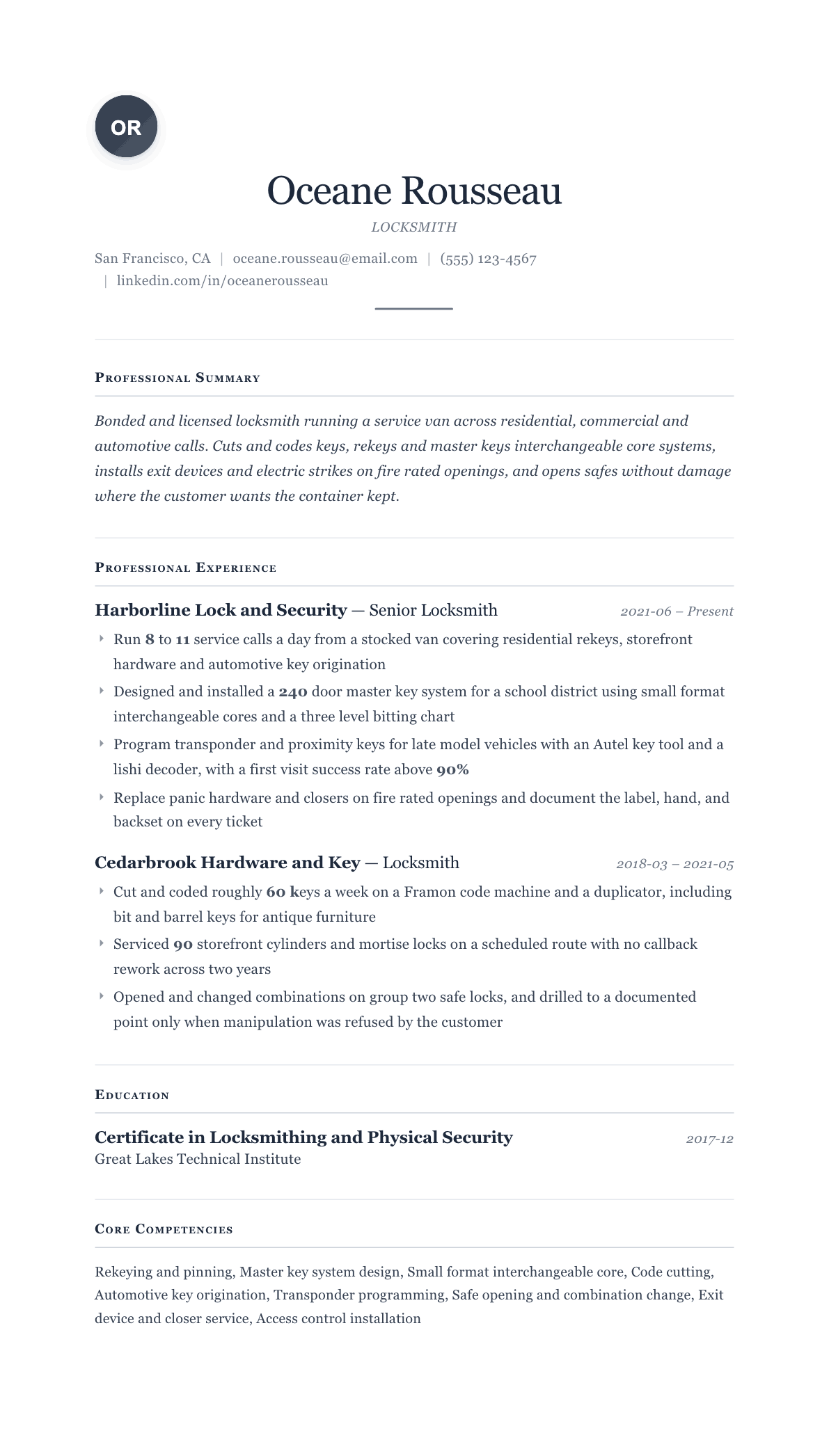
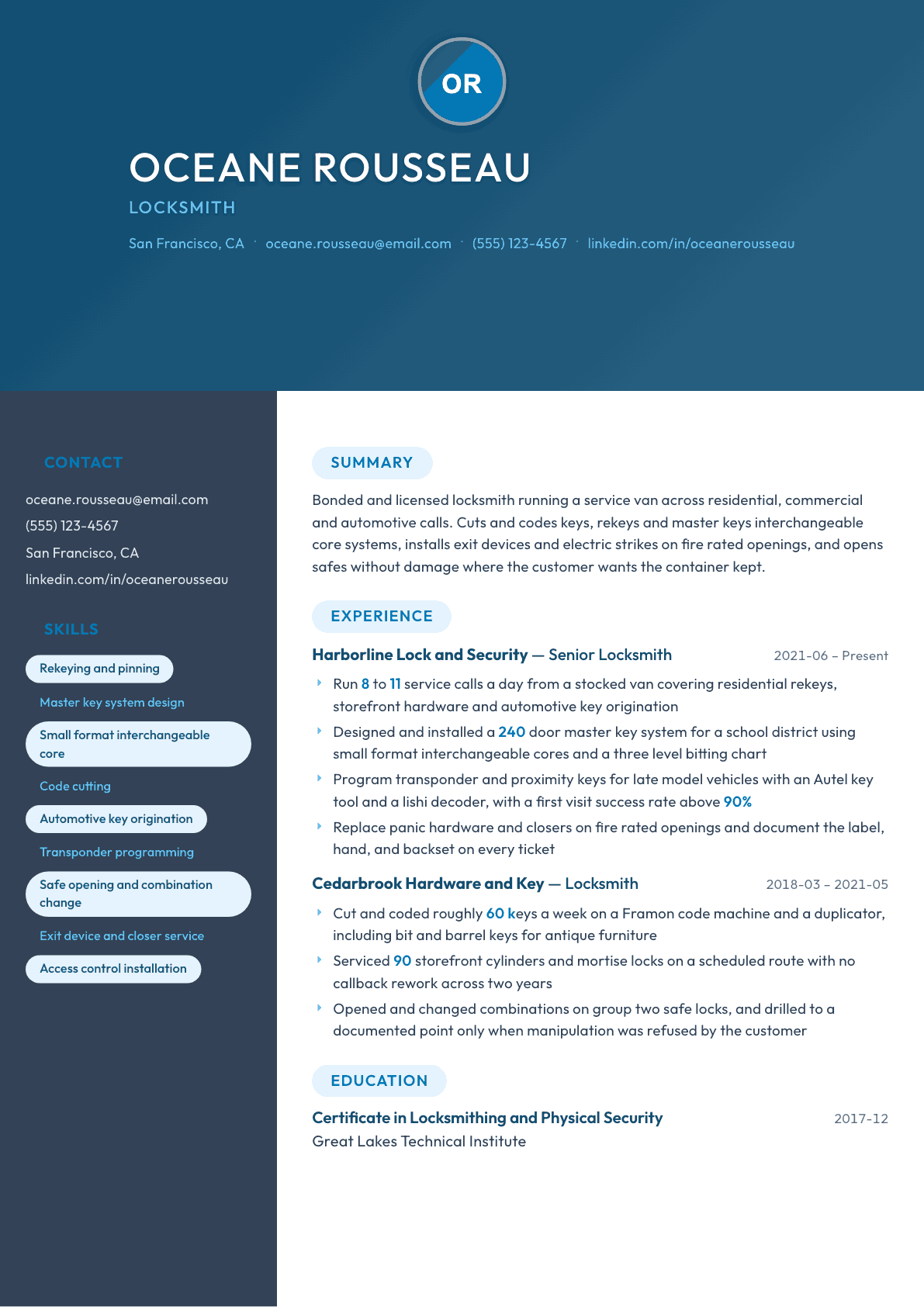
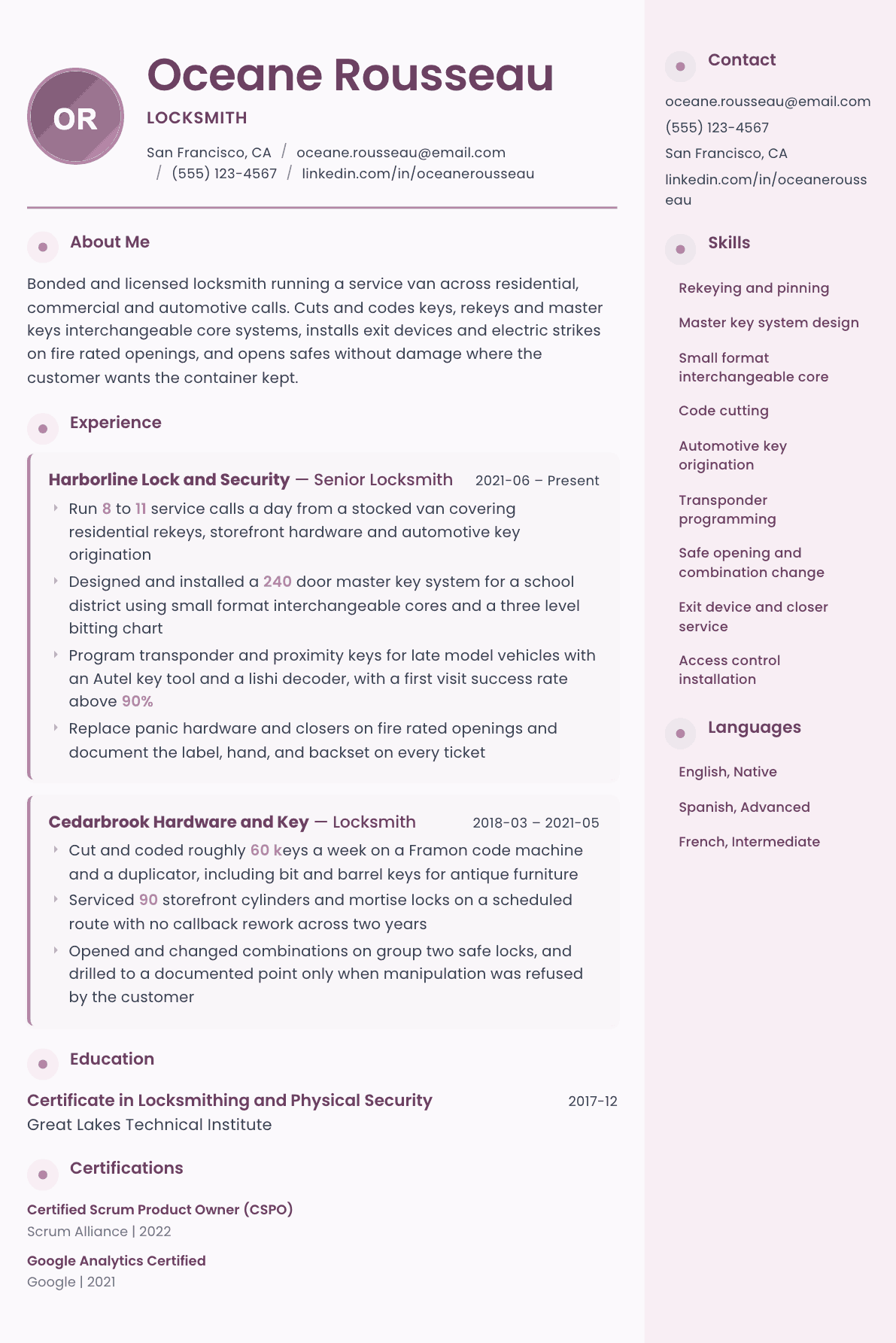
Example Locksmith summary
Licensed and bonded locksmith with seven years across residential, commercial and automotive service. Designs master key systems for multi building sites, rekeys interchangeable core hardware in place, originates and programs vehicle keys in the field, and services exit devices and closers on fire rated openings. Opens safes by manipulation before considering a drill point, and closes each call with a documented ticket the customer signs.
Skills to list on a Locksmith resume
- Rekeying and repinning
- Master key charting
- Small format interchangeable core
- Large format interchangeable core
- Code cutting and key origination
- Transponder and proximity programming
- Mortise lock service
- Exit device and panic hardware
- Door closer adjustment
- Electric strike and maglock wiring
- Access control credential enrollment
- Safe manipulation and scoping
- Combination lock service
- Fire rated opening compliance
- Service ticket documentation
- Van inventory control
What actually gets this resume read
- Put your state locksmith license number, its expiration month and your bonding status in the header block.
- Name the lock lines you service by manufacturer, because a commercial shop hires for the hardware on its route.
- Give the size of the largest master key system you designed, counted in doors and levels of keying.
- Say what you can do on automotive work: origination, transponder programming, proximity keys or push button start.
- List your safe work honestly, separating manipulation, scoping and drilling from simple combination changes.
- Show that you document fire rated openings, since replacing labeled hardware wrong voids the rating on a door.
- Add a clean driving record line if you will be given a service van and a route of unattended customer sites.
How to write a locksmith resume
Hiring a locksmith is an act of trust before it is a technical decision. The owner of a shop is handing you a van, a key machine, a code book and the addresses of customers who will not be home. So the first thing read on your resume is not your pinning speed. It is whether you are licensed, bonded, and clean enough on paper that the shop insurance will cover you.
The second thing read is scope. Locksmithing splits into residential, commercial, automotive, safe work and access control, and almost nobody does all five at a professional level. A shop with a school district contract wants master keying and interchangeable cores. A shop with a night dispatch line wants automotive origination and lockout speed. If your resume says only that you install and repair locks, the reader cannot place you in either shop.
This guide covers the sections a locksmith shop reads, the numbers that make a service history believable, three summaries for different points in the trade, before and after bullets, and the questions that come up when a bench locksmith moves to a van or a van locksmith moves into commercial hardware.
Format: license and bond first, then scope by service type
Reverse chronological, one page unless you have a long commercial hardware history worth a second. Put the license, bonding and insurance status directly under your contact line rather than burying it in a certifications block at the bottom, because in the states that regulate the trade a shop cannot dispatch an unlicensed person and will stop reading if it has to hunt for the number.
Then break your work into the service types you can actually perform unsupervised. A reader who sees residential, commercial, automotive and safe listed as separate competencies with real detail under each can price you. A reader who sees one paragraph of general lock work has to interview you just to find out what you cannot do.
- Header block: name, phone, service area radius, state locksmith license number and bond status.
- Scope block naming residential, commercial, automotive, safe and access control work at the level you perform each.
- Hardware block listing the lock manufacturers and cylinder formats you carry parts for and service daily.
- Every job says whether you worked a bench, a van route or a counter, since those are three different jobs.
Summary: license, service mix, call volume, hardest thing you do
Three or four lines. Say you are licensed and bonded, name the service mix, give the call volume you carry in a day, and finish with the hardest work you do without help. That last part is what separates two locksmiths whose first three lines are identical.
The hardest thing is usually one of three: a master key system you charted yourself, automotive origination on late model vehicles with push button start, or opening a safe without destroying the container. Pick the one you would be comfortable being tested on next week, because a shop owner will test it.
Experience: calls per day, systems you charted, callbacks you did not have
Each job needs the setting and the load. A van locksmith running nine calls a day across three service types is doing different work from a counter locksmith cutting keys and rekeying cylinders brought in by customers. Name which one you were, and give the daily count so the reader can imagine your route inside their own dispatch board.
Then get specific about the technical work. Master key systems are described by door count and by how many levels of keying the chart carries. Automotive work is described by what you can originate versus only duplicate, and whether you program transponder and proximity keys yourself. Safe work is described by method: manipulation, scoping, or drilling to a documented point with a repair afterward.
One bullet should carry the quality number. In this trade that is callbacks. A locksmith who rekeyed hundreds of cylinders in a year with no returns for a sticking key or a lost pin is making a claim the shop can check against its own history, and it is more persuasive than any adjective about attention to detail.
Commercial hardware and the fire door problem
Commercial work is where locksmiths get separated by knowledge rather than speed. Exit devices, mortise locks, closers, electric strikes and magnetic locks all sit in an opening that may be fire rated, and the rating depends on the whole assembly. Replacing labeled hardware with the wrong item voids it, and the building only finds out during an inspection.
Put on the page that you record the door label, the hand, the backset and the strike prep on every commercial ticket, and that you match replacement hardware to the rating rather than to what is in the van. Property managers have been burned by locksmiths who did not, and a resume that mentions this is speaking to a real scar.
- Name the cylinder formats you stock: small format interchangeable core, large format, mortise, rim and key in knob.
- Say whether you can wire an electric strike or maglock to an existing access control panel or only mount hardware.
- Mention door and frame repair, since a lock that will not latch is often a hinge or a strike problem.
- List credential enrollment work if you have added cards and fobs to a panel and handled lockdown schedules.
Keywords a locksmith shop and its software actually use
Postings for this trade reuse a narrow vocabulary: rekey, repin, master key, interchangeable core, code cut, origination, transponder, panic hardware, closer, electric strike, access control, safe opening and combination change. Use the exact terms from the posting once in your scope block and once inside a bullet where the work is shown, because a screener searching a stack of resumes is matching words before a human reads any of them.
Add the practical qualifiers a dispatcher needs: valid driver license, clean record, comfort working alone at night, willingness to carry a service phone on rotation, and any background check you have already cleared. Those are not filler in this trade. They are the reasons a shop chooses one of two equally skilled candidates.
Locksmith resume summary examples
First year in the trade
Locksmith apprentice with 14 months on a shop bench and a service van, rekeying residential cylinders, cutting keys by code and duplicate, and assisting on commercial hardware installs. Completed a locksmithing certificate covering pinning, master keying theory and safe basics. Licensed and bonded, seeking a full van route.
Five years in
Licensed locksmith running 8 to 11 calls a day across residential rekeys, storefront hardware and automotive origination. Charted and installed a 120 door master key system on interchangeable cores, programs transponder and proximity keys in the field, and holds a first visit success rate above 90% on vehicle lockouts and key loss.
Master locksmith and shop lead
Locksmith with 12 years across residential, commercial, automotive and safe work. Designs multi level master key systems for school and municipal clients, services exit devices and closers on fire rated openings, opens group two safe locks by manipulation, and trains two junior locksmiths on pinning discipline and ticket documentation.
Work experience bullets: before and after
Before: Rekeyed locks for customers.
After: Rekeyed and repinned roughly 40 cylinders a week across residential and storefront accounts, keying alike on request, with no callbacks for sticking or misfeeding keys over 18 months.
Volume, the keying alike detail and the callback record turn a routine task into evidence of clean bench work.
Before: Set up a master key system for a client.
After: Charted and installed a 240 door master key system for a school district on small format interchangeable cores, using a three level bitting chart with a grand master, building masters and change keys.
Door count and keying levels tell a commercial shop whether you can chart a system or only pin to someone else.
Before: Made car keys for customers.
After: Originated keys for late model vehicles from the ignition or door lock, decoded wafers with a lishi tool, and programmed transponder and proximity keys on site, closing above 90% of lockout and key loss calls on the first visit.
It separates origination from duplication and gives the first visit rate a dispatcher uses to route work.
Before: Opened safes when customers were locked out.
After: Opened group two safe locks by manipulation where the container was to be kept, scoped through a documented port when manipulation failed, and repaired the entry and replaced the lock to a working condition afterward.
Naming the method order shows judgment about the customer property rather than a habit of reaching for a drill.
Before: Installed door hardware at commercial buildings.
After: Replaced exit devices, closers and mortise cylinders on fire rated openings, recording the door label, hand, backset and strike prep on every ticket so replacement hardware matched the rating on the assembly.
The rating detail is the difference between a hardware installer and a locksmith a property manager can keep.
Hard skills
- Pinning and repinning cylinders
- Master key system charting
- Small and large format interchangeable core
- Code cutting and key origination
- Impressioning and decoding
- Transponder and proximity key programming
- Mortise and rim cylinder service
- Exit device and panic hardware repair
- Door closer adjustment and replacement
- Electric strike and magnetic lock wiring
- Access control credential enrollment
- Safe manipulation and combination change
- Door and frame repair
- Service ticket and key record keeping
Soft skills
- Verifying identity and ownership before opening anything
- Working alone at night in unfamiliar buildings
- Explaining a security weakness without frightening the customer
- Route discipline when calls run long
- Discretion about who holds which key
Certifications worth listing
- Certified Registered Locksmith (CRL) (Associated Locksmiths of America)
- Certified Professional Locksmith (CPL) (Associated Locksmiths of America)
- Certified Automotive Locksmith (CAL) (Associated Locksmiths of America)
- Certified Professional Safe Technician (CPS) (Safe and Vault Technicians Association)
Mistakes that cost locksmith candidates the interview
- Leaving the state license number and bond status off the page in a state where an unlicensed person cannot be dispatched.
- Writing that you install and repair locks without naming residential, commercial, automotive or safe work as separate scopes.
- Claiming automotive experience when you can only duplicate an existing key and have never originated one from a lock.
- Describing a master key system without the door count or the number of keying levels the chart carried.
- Skipping the fire rated opening detail, which is the first thing a property manager asks after being burned once.
- Listing every brand of lock ever touched instead of the ones you stock parts for and can service the same day.
Locksmith resume questions
Do I need a license to put locksmith on my resume?
It depends on the state, and the resume should answer the question for the state you are applying in. Where licensing exists, name the license and its expiration. Where it does not, say you are bonded and insurable and note any background check you have already cleared.
How do I move from a shop bench to a service van?
Show the two things bench work does not prove: driving and route discipline, and the ability to diagnose in a doorway without a workbench. Add any ride along days, after hours calls you covered, and the van stock you would want, so the owner sees you have thought about the route.
Should I list the tools I own?
Yes, when they are the tools that decide whether you can take a call. Key machines, a code machine, decoders, a transponder programmer and safe scoping equipment all cost real money, and a small shop reads your tool list as how quickly you become billable.
How much detail should I give about safe work?
Enough to be honest about method. Say whether you manipulate, scope or drill, whether you repair the container afterward, and which lock groups you have worked. Shops are wary of resumes that imply safe expertise and then produce a technician who only changes combinations.
What do I write if most of my experience is automotive lockouts?
Lead with the vehicle work in real terms: origination versus duplication, the programming tools you run, and your first visit success rate. Then be direct that commercial hardware is where you want to grow, because a shop would rather train a specialist who says so than discover the gap on a job.
Related resume examples
- Maintenance Technician Resume example
- Building Maintenance Worker Resume example
- Alarm Technician Resume example
- Facilities Technician Resume example
- Apartment Maintenance Technician Resume example
- Maintenance Worker Resume example