Alarm Technician Resume Examples: the lines they read
Write an Alarm Technician Resume That Passes the Panel Test
By Mustafa Tarabya, founder of CVBooster · Published · Updated
Alarm technician resume example, keyword list and writing guide covering panel programming, fire alarm work, NICET levels and first time fix rates.
Sample resumes for a alarm technician
The same alarm technician content laid out in three CVBooster templates, so you can see what the finished document looks like before you write a word.
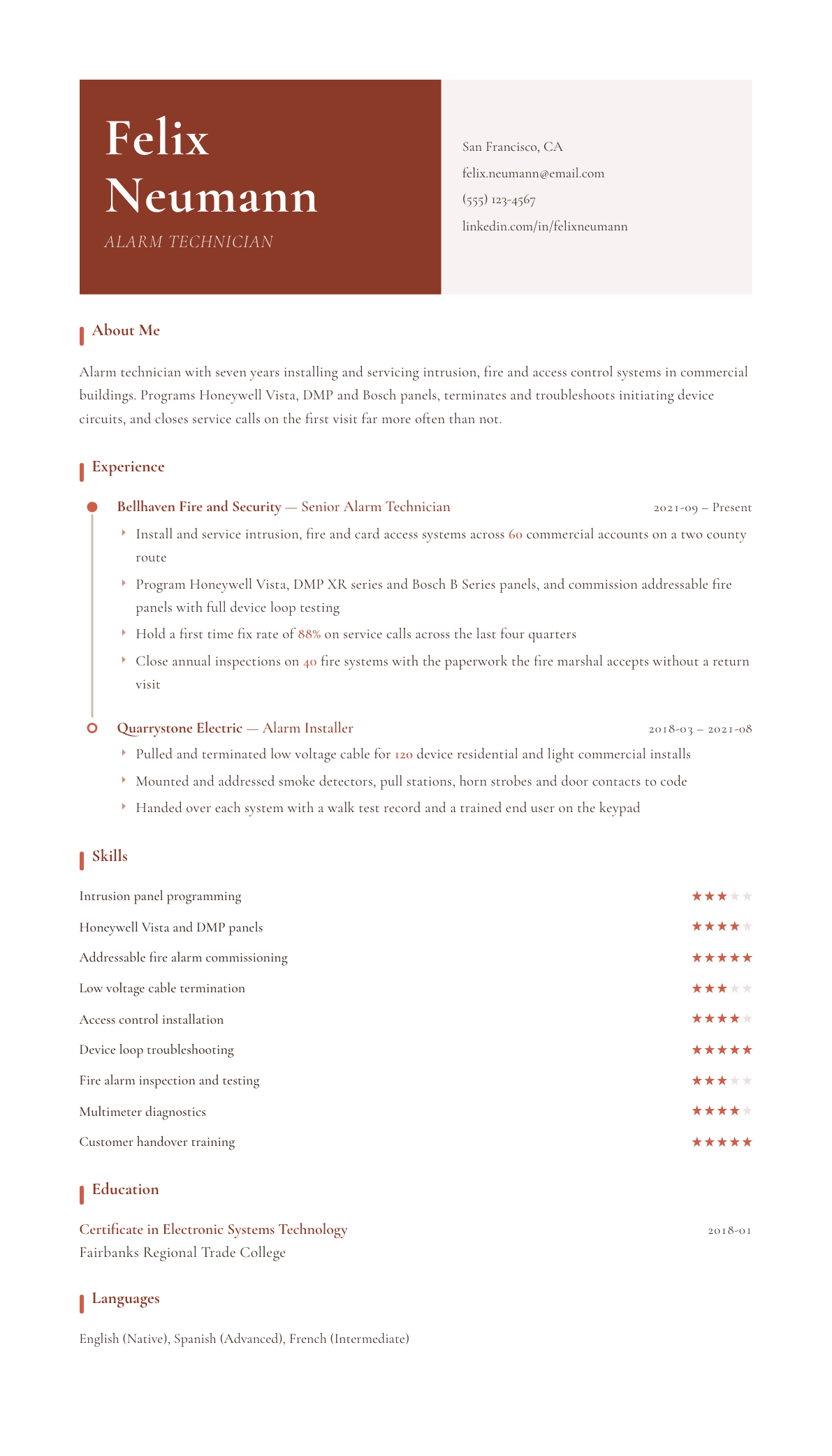
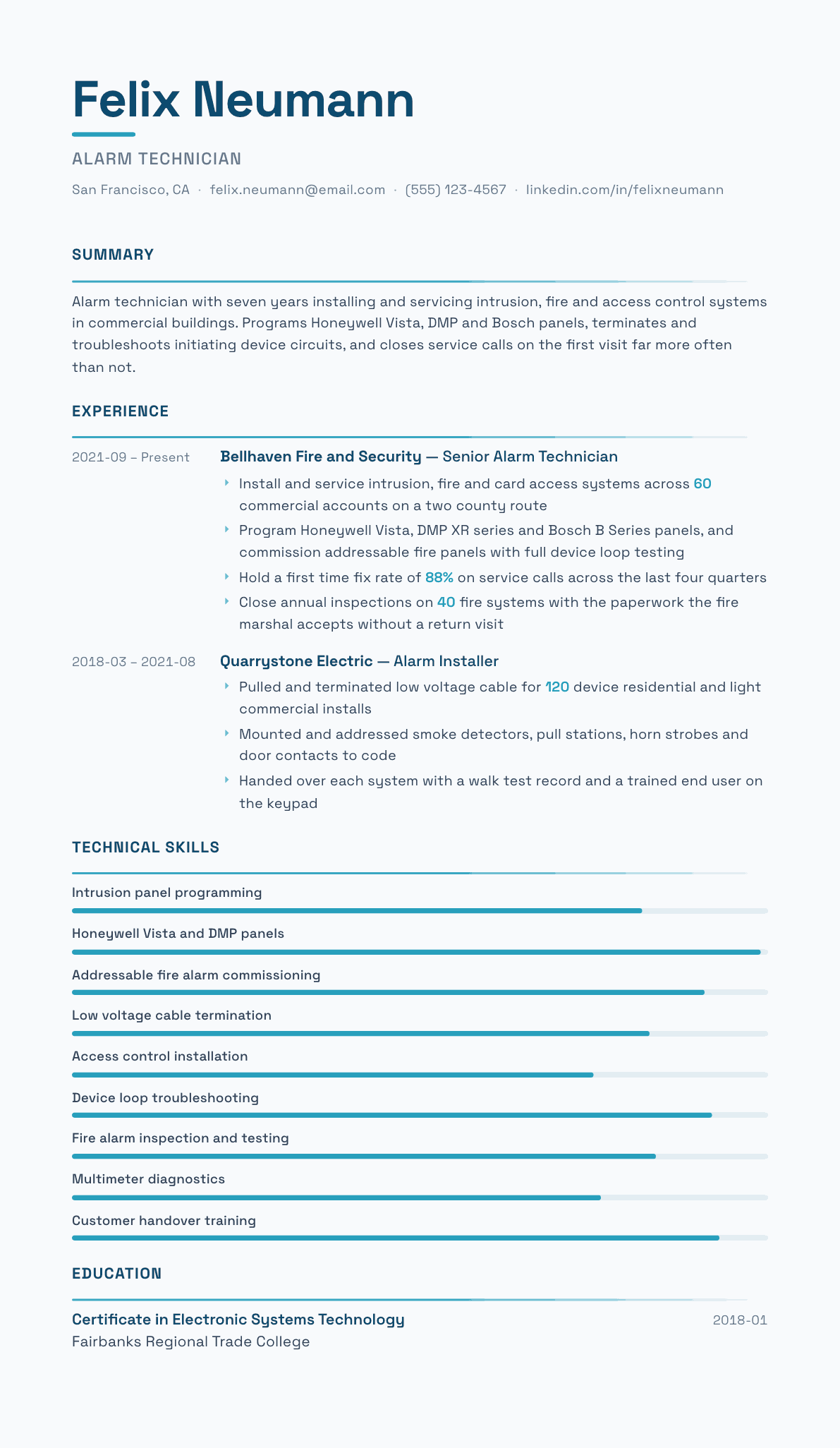
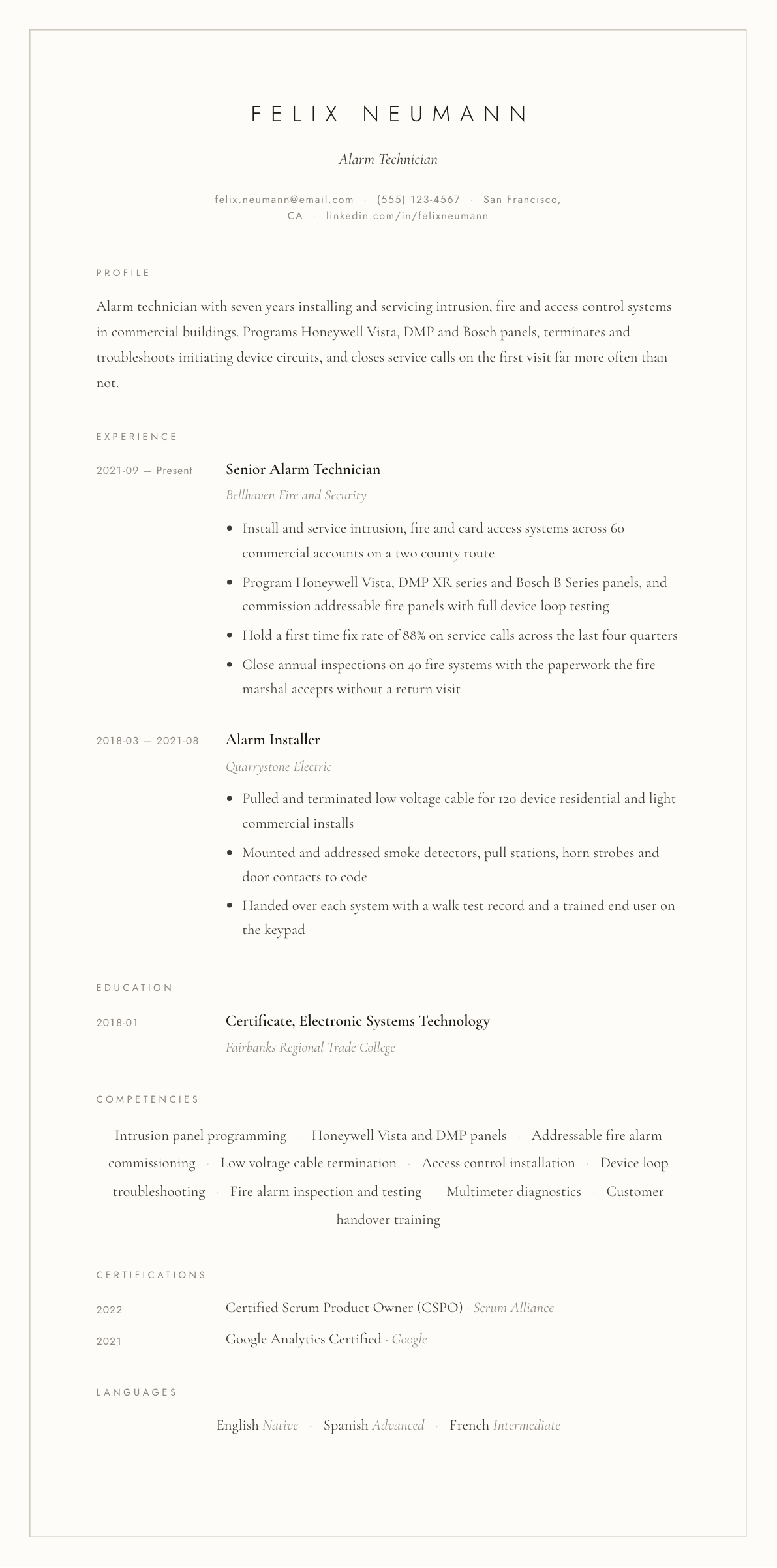
Example Alarm Technician summary
Alarm technician with seven years across intrusion, fire and access control in commercial buildings. Programs Honeywell Vista, DMP and Bosch panels, commissions addressable fire systems with full loop testing, and closes annual inspections with paperwork that does not bounce back. Runs a two county service route with a first time fix rate above the branch average and trains every customer on the keypad before leaving.
Skills to list on a Alarm Technician resume
- Intrusion alarm installation
- Fire alarm installation and testing
- Honeywell Vista programming
- DMP XR series programming
- Bosch and Napco panels
- Addressable device loops
- Access control and card readers
- Low voltage cable pulling
- Multimeter and loop testing
- Central station communication
- Cellular and IP communicators
- NFPA inspection paperwork
- Camera installation and aiming
- Service call troubleshooting
- End user training and handover
What actually gets this resume read
- Put your NICET level and its discipline near the top, because fire work is gated on it before anything else.
- Name every panel family you program, since a shop running DMP will not gamble on a Honeywell only resume.
- Give your first time fix rate and your call volume, the two numbers a service manager schedules against.
- Say whether you work intrusion, fire, access control, camera or all four, and which you carry unsupervised.
- List your state low voltage or alarm license with the issuing state, plus your driving record if it is clean.
- Show inspection work explicitly, including annual fire testing and the paperwork the fire marshal signs.
How to write a alarm technician resume
A service manager at an alarm company is filling a truck, not a job description. He has a route, a backlog of service calls, an inspection season that arrives whether he is staffed or not, and a callback rate his branch gets judged on. He reads your resume looking for one thing: how many of his calls you can close without a second visit.
That is why panel families matter more than adjectives. A technician who programs Honeywell Vista, DMP and Bosch is a different hire from one who has only ever worked behind one manufacturer, and a technician with a fire discipline credential can be sent to jobs the rest of the crew cannot touch. Put both where they are found in the first few seconds.
This guide covers the resume format an alarm shop reads, how to write installs and service calls with the detail a manager can schedule against, summaries for an apprentice through a lead technician, before and after bullets, and the questions technicians ask when they move between residential, commercial and fire work.
Format: one page, credentials and panel families in the top third
Reverse chronological, one page unless you carry a long credential list. The top third of the page should answer three questions without scrolling: what disciplines you cover, what you are certified to touch, and which panels you can program from memory. Everything below that is supporting evidence.
Put licenses and certifications in one visible block rather than at the foot of the page. Fire work is gated on credentials, low voltage licensing varies by state, and a manager who cannot find your discipline level in ten seconds will assume you do not have one.
- Disciplines line: intrusion, fire, access control, video, nurse call or intercom, marked by which you run unsupervised.
- Panel families block: every intrusion and fire panel you program, listed by manufacturer and series rather than as a general claim.
- Credential block: fire alarm discipline level, state low voltage or alarm license with the issuing state, manufacturer factory training, and first aid.
- Vehicle line: valid driver license, clean record and any experience running a route solo, since a technician is a rolling branch.
Service calls: first time fix, callbacks and the numbers a branch tracks
Service work is measured on a small set of figures and a manager already knows them all. Give the calls you close in a week, your first time fix rate and your callback rate, and if any of those improved under you, say by how much and what changed. A technician who reduced callbacks by tightening handover testing is describing a habit, not a lucky quarter.
Troubleshooting depth is worth a sentence of its own. Say what you find and fix without escalating: ground faults on an initiating device circuit, intermittent communicator failures, false alarms traced to a specific detector environment, voltage drop over long runs. Naming the fault types tells a manager what he can hand you cold.
Installs, commissioning and the inspection paperwork
For installs, give the size of the systems you have delivered: device count, building type and whether you ran the job or worked to somebody else. Say whether you pull and terminate your own cable, mount and address devices, and commission the panel afterwards, because shops divide those tasks differently and a technician who does all four covers a gap.
Inspection work deserves its own bullets. Annual fire testing is steady revenue and it lives or dies on paperwork the fire marshal accepts. State how many systems you inspect a year, that you complete the test records fully, and whether your inspections have gone back for correction. A technician whose paperwork does not bounce is worth more than one who tests faster.
If you have commissioned addressable fire systems, say so explicitly with the loop and device counts. Addressable commissioning, sequence of operation testing and coordination with the sprinkler and elevator trades is a level above pulling wire, and it is the work that gets a technician moved up.
Central station, communicators and the customer handover
Every system ends at a monitoring center, and the connection is where technicians lose hours. Name the communicator types you install and troubleshoot, cellular, IP and dual path, and say that you test signals through to the central station rather than assuming the panel is telling the truth. Include the receiver or automation platform if you have worked directly with the monitoring side.
Then write the handover. A customer who understands the keypad does not generate false alarms, and false alarms generate fines, angry municipalities and canceled accounts. One bullet showing that you walk test the system, train the end user and leave a written record separates a technician who finishes a job from one who merely completes an install.
Skills and the keywords alarm postings screen for
Alarm postings reuse a tight vocabulary: panel programming, initiating device circuit, notification appliance, addressable, conventional, access control, low voltage, walk test, communicator, annual inspection. Put the exact terms in your skills block and let at least three of them appear inside a bullet where the work carries a count.
Add the practical items that decide whether you can be dispatched tomorrow: lift certification, ladder work, confined space, working at height, and any trade card you hold. Alarm technicians work in ceilings, on roofs and in occupied buildings, and a manager who has to arrange training before your first solo call factors that into the offer.
Alarm Technician resume summary examples
Apprentice technician
Alarm apprentice with two years pulling and terminating low voltage cable on residential and light commercial installs. Mounts and addresses smoke detectors, pull stations and door contacts to plan, assists on panel programming, and completed a manufacturer training course on DMP intrusion panels in 2024.
Seven years on a route
Alarm technician covering intrusion, fire and access control across 60 commercial accounts on a two county route. Programs Honeywell Vista, DMP XR series and Bosch B Series panels, commissions addressable fire systems with full loop testing, and holds a first time fix rate of 88% over four quarters.
Lead technician
Lead alarm technician running commercial fire and security installs from rough in through acceptance testing, with a fire alarm discipline credential and factory training on three panel families. Closes 40 annual inspections a year with no returned paperwork and mentors two apprentices on troubleshooting method.
Work experience bullets: before and after
Before: Installed and repaired alarm systems for customers.
After: Installed and serviced intrusion, fire and card access systems across 60 commercial accounts on a two county route, closing 88% of service calls on the first visit.
Account volume, disciplines and first time fix give a service manager everything he needs to schedule you.
Before: Programmed alarm panels.
After: Programmed Honeywell Vista, DMP XR series and Bosch B Series panels, including partitioned commercial accounts with dual path communicators and custom user schedules.
Named panel families and a hard case beat a generic claim that every applicant makes.
Before: Performed annual fire alarm inspections.
After: Completed 40 annual fire alarm inspections a year with full device testing and test records accepted by the fire marshal without a single return visit.
Volume plus a paperwork outcome shows the inspection revenue is safe in your hands.
Before: Troubleshot faults on existing systems.
After: Traced ground faults, intermittent communicator failures and environmental false alarms on legacy conventional panels, cutting repeat calls on the eight worst accounts to none over two quarters.
Naming the fault types proves diagnostic range where the word troubleshooting proves nothing.
Before: Explained the system to the customer after installation.
After: Handed over every install with a full walk test, keypad training for two named site contacts and a signed system record, cutting false alarm callbacks on new accounts.
Handover detail links your habit to the false alarm cost a branch manager actually carries.
Hard skills
- Intrusion panel programming
- Addressable fire alarm commissioning
- Conventional fire alarm service
- Low voltage cable pulling and termination
- Access control and card reader installation
- Initiating device circuit troubleshooting
- Notification appliance circuit calculation
- Cellular and IP communicator setup
- Central station signal testing
- Annual inspection and test records
- Multimeter and loop diagnostics
- Camera installation and aiming
- End user keypad training
Soft skills
- Explaining a fault to a customer without jargon
- Working cleanly inside an occupied building
- Running a solo route and managing your own parts
- Staying methodical on an intermittent fault
- Coordinating with electricians and sprinkler trades on site
Certifications worth listing
- NICET Certification in Fire Alarm Systems (National Institute for Certification in Engineering Technologies)
- Certified Alarm Technician Level I (Electronic Security Association)
- Certified Fire Alarm Technician (Electronic Security Association)
Mistakes that cost alarm technician candidates the interview
- Writing that you install alarm systems without naming a single panel family you can program.
- Burying the fire alarm discipline credential at the foot of the page where a manager stops reading.
- Leaving out first time fix and callback figures, which are the numbers a branch is measured on.
- Treating annual inspections as filler instead of showing the volume and whether the paperwork was accepted.
- Ignoring the central station side, so nobody knows whether you test signals through or trust the panel.
- Skipping the state low voltage or alarm license, which decides whether you can legally work at all.
Alarm Technician resume questions
Do I need a fire alarm credential to get hired as an alarm technician?
Not for intrusion and access control work, but it opens the fire side of the business and the inspection revenue that comes with it. If you are working toward a discipline level, put the level you are pursuing on the resume with your current qualifying experience rather than leaving the section empty.
How many panel families should I list?
List every one you can program without a manual open beside you, and say which you have factory training on. A shop standardizes on one or two manufacturers, so matching theirs is often the difference between an interview and a pass, and honesty here is checked in the first week.
Should residential experience go on a commercial application?
Keep it, but compress it. Residential work proves you can terminate cable, program a basic panel and finish neatly in somebody home, which all transfers. Give it two lines and use the space you save on any commercial device counts, partitioned accounts or inspection work you have touched.
What if I have no first time fix figure to quote?
Use what your branch did track: calls closed a week, repeat visits on your accounts, or the backlog you cleared. If none exist, describe the fault types you resolve without escalating, since a manager can infer your fix rate from the range of problems you handle alone.
How do I move from installation into service work?
Show diagnostic evidence rather than install volume. Faults you traced, legacy panels you have worked behind, communicator problems you resolved and any calls you covered alone all argue that you can be sent to a broken system rather than a clean rough in.
Related resume examples
- Security Guard Resume example
- Security Engineer Resume example
- Security Officer Resume example
- Fire Inspector Resume example
- Unarmed Security Guard Resume example
- Air Force Veteran Resume example