Procurement Analyst Resume Examples: what gets the call
Build a Procurement Analyst Resume Around Spend and Savings
By Mustafa Tarabya, founder of CVBooster · Published · Updated
Procurement analyst resume examples showing spend analysis, sourcing events and savings validation, with keywords and a detailed writing guide.
Sample resumes for a procurement analyst
The same procurement analyst content laid out in three CVBooster templates, so you can see what the finished document looks like before you write a word.
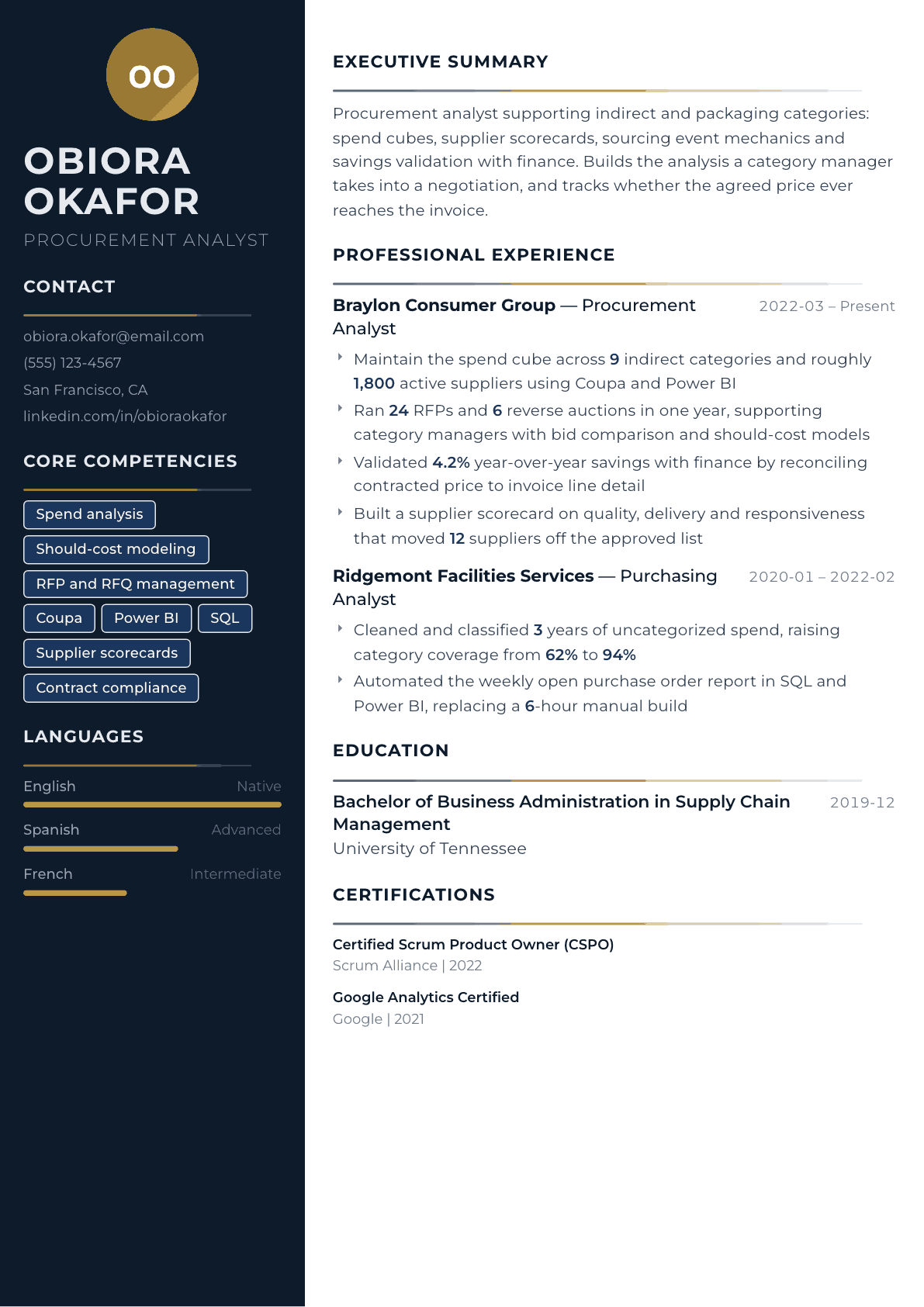
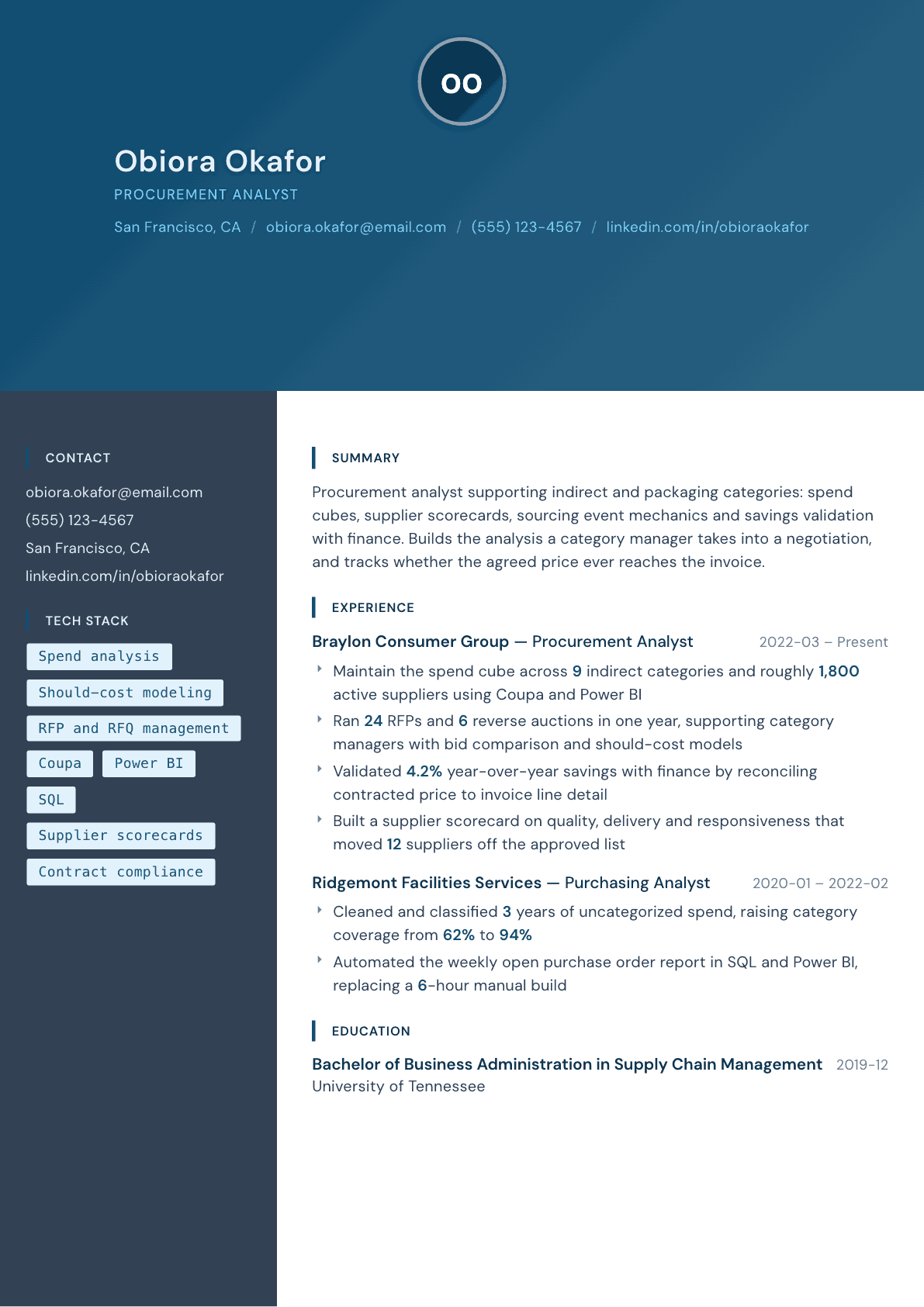
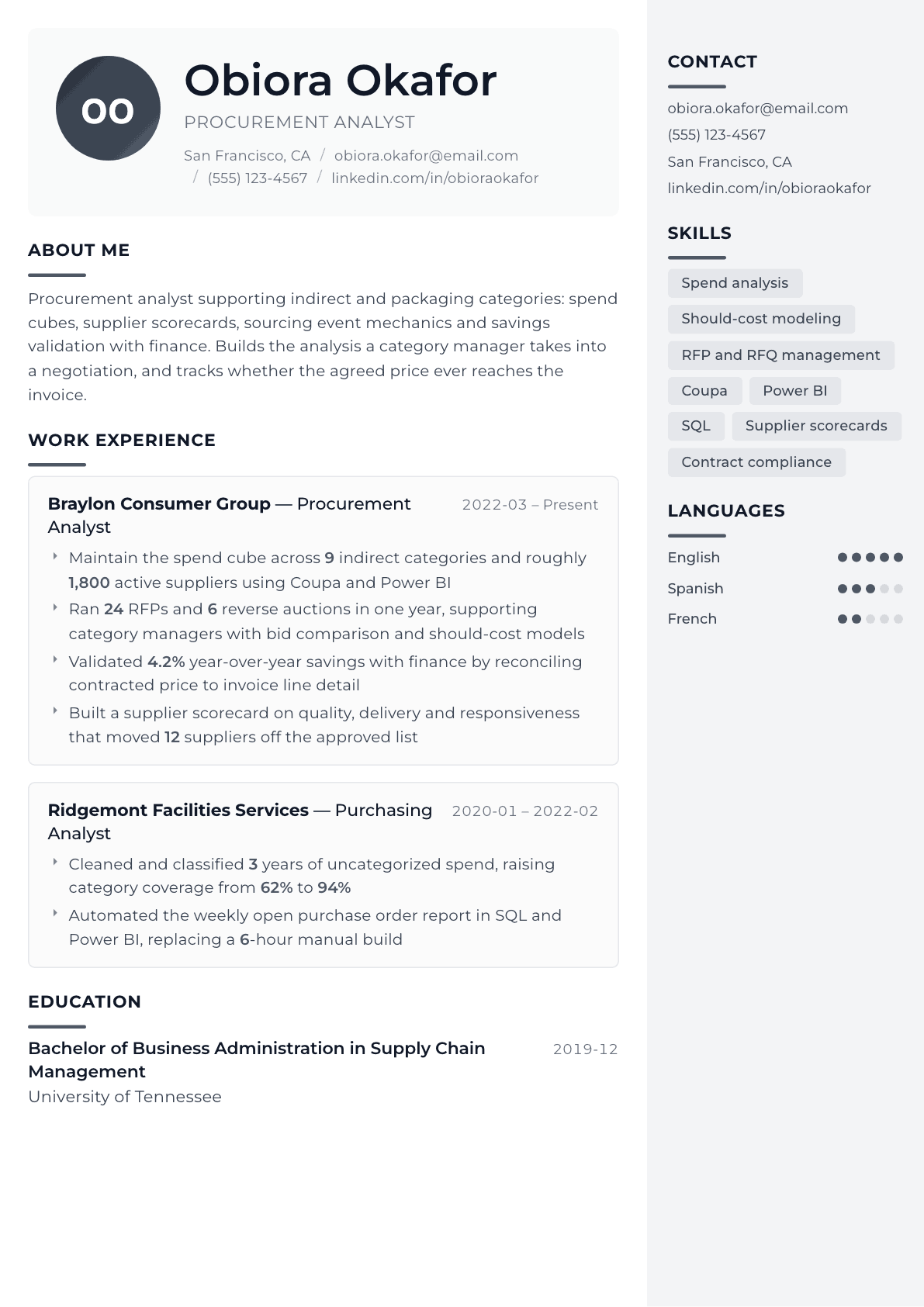
Example Procurement Analyst summary
Procurement analyst with four years supporting indirect and packaging categories through spend analytics, sourcing events and savings validation. Rebuilt a spend cube covering nine categories and close to two thousand suppliers, ran two dozen competitive events in a year, and reconciled contracted pricing to invoice detail with finance. Seeking a category analyst seat where sourcing strategy is built on evidence.
Skills to list on a Procurement Analyst resume
- Spend analysis
- Category management support
- Should-cost modeling
- Total cost of ownership
- RFP and RFQ management
- Reverse auctions
- Savings validation
- Supplier scorecards
- Contract compliance
- Coupa
- SAP Ariba
- Power BI
- SQL
- Advanced Excel
- Supplier risk assessment
What actually gets this resume read
- Quantify the spend you analyzed by category count and supplier count rather than by a headline currency figure.
- Separate identified savings from validated savings, and say who signed off, because finance sign-off is the credible number.
- List the source-to-pay platform by name, since Coupa, Ariba, Jaggaer and Ivalua are searched as exact terms.
- Show one should-cost or total cost of ownership model you built, which is what separates an analyst from a buyer.
- Prove data skill with SQL, Power BI or Tableau, because procurement analytics teams screen on those tools.
- Add a bullet on contract compliance or maverick spend, an area most candidates leave out entirely.
How to write a procurement analyst resume
A procurement analyst resume is judged on one thing above all others: whether the numbers you produce can survive contact with finance. Category managers negotiate, but the analyst is the person who classified the spend, built the should-cost model, compared the bids and later proved that the price on the contract reached the invoice. A hiring manager reads your file looking for evidence that you have done that full loop rather than only the first half.
Most candidates stop at activity. They write that they supported sourcing events and analyzed spend data, which describes the seat rather than the person in it. The files that get interviews name the categories, the supplier population, the analytical method and the point at which someone senior acted on what the analysis said.
What follows is the section order procurement leaders read in, how to talk about savings without overclaiming, three summary examples across career stages, before-and-after bullets, and the questions analysts ask when they rewrite for a category or sourcing manager role.
Format: one page, analysis tools visible near the top
One page until you have roughly eight years, reverse chronological, no columns. Procurement teams screen with keyword filters on both the source-to-pay platform and the analysis stack, so put a short tools block under the summary rather than trusting the reader to find those names inside bullets.
Group your experience by employer, not by category, and then name the categories inside the role. A reader wants to see progression through seats, with the category breadth as supporting detail.
- Header: name, city and state, phone, email, and the spend areas you cover such as indirect, packaging or logistics.
- Section order: summary, tools and systems, professional experience, education, certifications.
- Keep a two-line selected analysis block only if a model you built is more impressive than the role that contained it.
Summary: categories, supplier base, methods, and who used your work
Three lines. Name the categories, the approximate supplier count, the analysis you own and the decisions it fed. An analyst who says their spend cube supports nine category managers has communicated influence without claiming authority they did not hold, which is exactly the right register for this role.
Say whether you work indirect, direct or both. The two are different disciplines: direct sourcing runs on bill of material cost, tooling amortization and supplier capacity, while indirect runs on demand management, contract compliance and a long tail of small suppliers. Employers screen on that distinction first.
Experience: classification, models, events and validation
Start with data quality work, because everything downstream depends on it. Cleaning and classifying uncategorized spend, fixing supplier master duplicates, and raising category coverage are unglamorous but they are the foundation of every credible procurement number. State the coverage you achieved and the volume of records you touched.
Then show a model. A should-cost build for a molded part, a total cost of ownership comparison across three logistics providers, a rate card benchmark for contract labor. Name the cost drivers you decomposed, because that is what separates an analyst from someone assembling a bid comparison spreadsheet.
Finish with validation. Identified savings and validated savings are different numbers, and the second one requires reconciling contracted price to invoice line detail with someone from finance. An analyst who has run that reconciliation, and can describe where it leaked, is immediately more credible than one who reports only the negotiated figure.
- Count your sourcing events by type: requests for proposal, requests for quotation, reverse auctions, renewals.
- Name the supplier evaluation criteria you weighted, since scoring design is an analyst responsibility.
- Include contract compliance or off-contract spend work, an area most resumes in this field skip entirely.
Systems, analytics and credentials
List the source-to-pay platform by name, whether that is Coupa, SAP Ariba, Jaggaer, Ivalua or GEP, and say which modules you worked in: sourcing, contracts, catalogs or analytics. Add the ERP behind the transactions and the analysis layer, since Power BI, Tableau and SQL now appear routinely in procurement analyst postings and are a genuine differentiator against candidates who work only in spreadsheets.
The recognized credentials are the CPSM from the Institute for Supply Management and the professional qualifications from the Chartered Institute of Procurement and Supply. A CSCP from the Association for Supply Chain Management fits analysts whose work spans into planning.
Keywords procurement postings use
Spend analysis, category management, strategic sourcing, should-cost, total cost of ownership, supplier segmentation, supplier risk, contract compliance, savings tracking, request for proposal, reverse auction, purchase price variance and supplier scorecard. Use each once where it is genuine, and name the platform beside it so the automated screen and the human reader both find what they need.
Procurement Analyst resume summary examples
First analyst seat
Purchasing analyst with two years cleaning and classifying spend for a facilities services business, raising category coverage from 62% to 94% across three years of transaction history. Automated the weekly open purchase order report in SQL and Power BI, replacing a six-hour manual build with a scheduled refresh.
Four years in
Procurement analyst supporting nine indirect categories and roughly 1,800 active suppliers through Coupa and Power BI. Ran 24 competitive events in a year with bid comparison and should-cost support, and validated 4.2% year over year savings with finance by reconciling contracted price to invoice line detail.
Senior analyst
Senior procurement analyst owning the spend cube, supplier segmentation model and savings methodology for a manufacturer with direct and indirect spend. Built the should-cost library used across four category teams, designed the supplier risk scoring approach, and mentors two analysts on sourcing event mechanics and data quality.
Work experience bullets: before and after
Before: Analyzed company spend data to find savings opportunities.
After: Maintained the spend cube across 9 indirect categories and roughly 1,800 active suppliers, refreshing monthly in Power BI and flagging the top 20 fragmentation opportunities each quarter.
Category and supplier counts plus a refresh rhythm show a maintained asset rather than a one-time analysis exercise.
Before: Supported sourcing events for category managers.
After: Ran mechanics for 24 requests for proposal and 6 reverse auctions in one year, building weighted scorecards and bid comparison models for four category managers.
Event counts by type and the scoring work name a specific contribution instead of a supporting presence.
Before: Tracked cost savings for the procurement team.
After: Validated 4.2% year over year savings with finance by reconciling contracted rates against invoice line detail and reporting the leakage on two categories that had drifted off contract.
Naming the reconciliation and the leakage found is what makes a savings claim believable to a procurement leader.
Before: Created supplier performance reports.
After: Built a supplier scorecard weighting quality, delivery and responsiveness that moved 12 underperforming suppliers off the approved list during annual review.
The criteria and the consequence turn a reporting task into an analysis that changed the supplier base.
Before: Cleaned up spend classification data.
After: Classified three years of uncategorized transactions and merged duplicate supplier records, raising category coverage from 62% to 94% and making the first credible sourcing pipeline possible.
A coverage movement plus the downstream effect explains why data work mattered rather than treating it as housekeeping.
Hard skills
- Spend analysis and classification
- Should-cost modeling
- Total cost of ownership analysis
- Sourcing event management
- Reverse auction mechanics
- Supplier segmentation and scorecards
- Savings validation methodology
- Contract compliance monitoring
- Coupa and SAP Ariba
- Power BI and Tableau
- SQL
- Advanced Excel modeling
Soft skills
- Precision with numbers under scrutiny
- Working with finance counterparts
- Supplier communication
- Presenting analysis to category leaders
- Skepticism toward unverified savings
- Documentation discipline
Certifications worth listing
- Certified Professional in Supply Management (CPSM) (Institute for Supply Management)
- Certified Supply Chain Professional (CSCP) (Association for Supply Chain Management)
- CIPS Level 4 Diploma in Procurement and Supply (Chartered Institute of Procurement and Supply)
Mistakes that cost procurement analyst candidates the interview
- Reporting negotiated savings as if they were realized, when the reader has spent a career watching that gap open up.
- Describing spend volume in currency terms that mean nothing outside the original company instead of naming categories and supplier counts.
- Leaving the source-to-pay platform out of the resume entirely, which fails the first keyword filter on most procurement postings.
- Listing Excel alone as the analysis stack when postings increasingly expect a reporting tool and some SQL.
- Writing supported sourcing initiatives without ever naming an event, a model or a decision that followed from the work.
- Skipping data quality work, which is the largest part of a real analyst job and the easiest thing to prove with a coverage figure.
Procurement Analyst resume questions
How should I present savings numbers on a procurement resume?
As a rate rather than an absolute figure, and always with the basis. Saying you validated a year over year reduction against invoice detail with finance sign-off is credible, while a large headline saving with no method behind it reads as a number picked from a slide deck.
Do I need direct spend experience to move into sourcing?
Not always, but you should address the gap. Indirect analysts moving into direct sourcing should highlight any should-cost or total cost of ownership modeling, since those methods transfer, and be honest that bill of material cost and tooling amortization would be new ground.
Which certification helps most for a procurement analyst?
The CPSM from the Institute for Supply Management is the most widely recognized in North American teams, and the CIPS diploma carries equivalent weight where employers follow that framework. Either signals formal grounding, which matters most when your degree is not in a supply subject.
How do I show category management potential from an analyst seat?
Point at the decisions your work produced. Recommending a supplier consolidation that was adopted, designing the scorecard that removed suppliers, or building the should-cost that set a negotiation target all demonstrate category judgment without overstating the authority you actually held.
Should I name the suppliers I worked with?
No. Name the categories and the supplier count instead. Listing specific vendors risks confidentiality problems and tells the reader little, since what matters is the type of spend, the market structure and the leverage you had, not which company held the contract.
Related resume examples
- Procurement Manager Resume example
- Supply Chain Analyst Resume example
- Purchasing Manager Resume example
- Procurement Specialist Resume example
- Supply Chain Specialist Resume example
- Logistics Analyst Resume example