Brand Strategist Resume Examples: the lines they read
Write a Brand Strategist Resume That Shows Real Positioning Work
By Mustafa Tarabya, founder of CVBooster · Published · Updated
A brand strategist resume built on positioning, research and architecture work, with a sample resume, the keywords hiring teams search, and a guide.
Sample resumes for a brand strategist
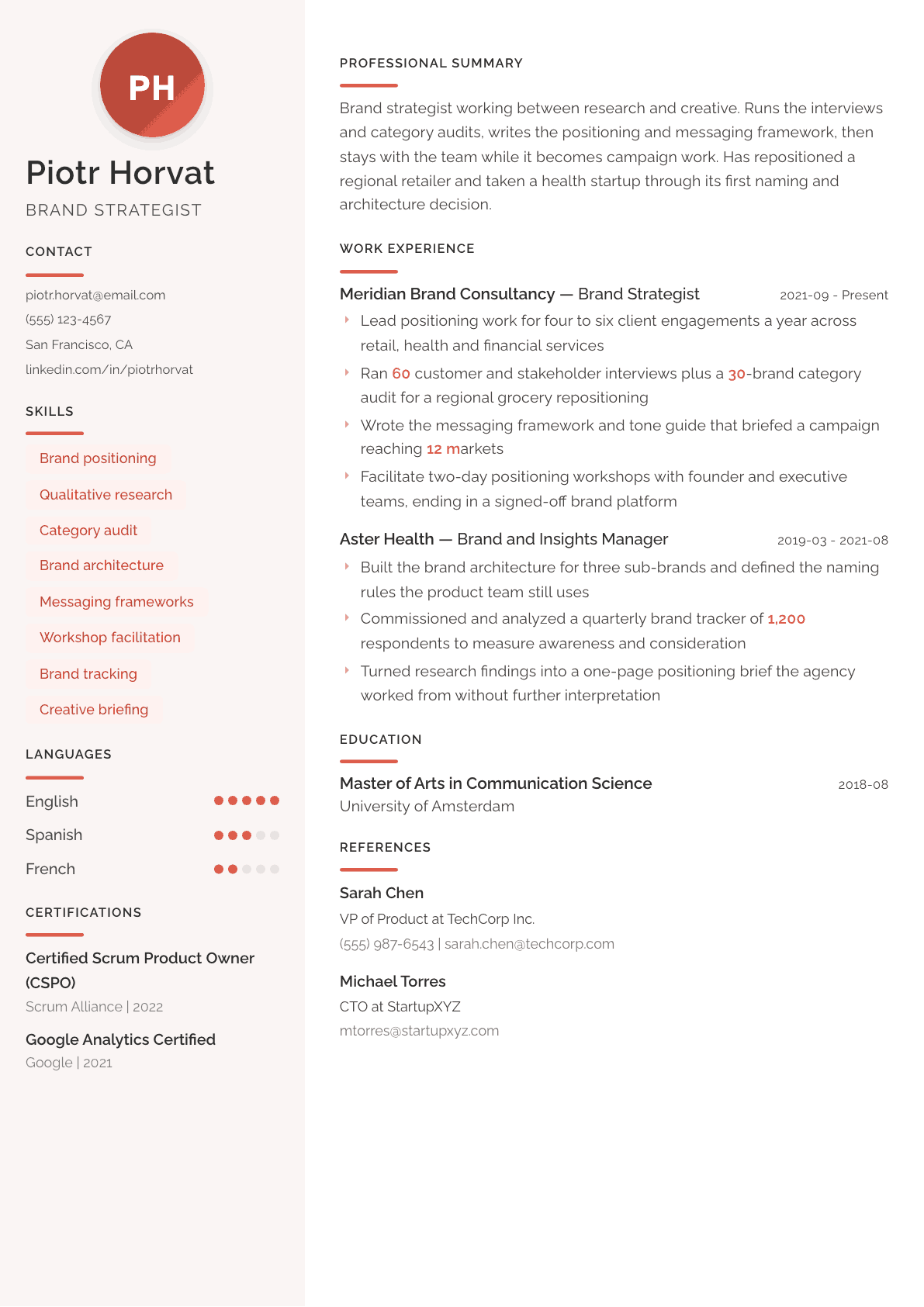
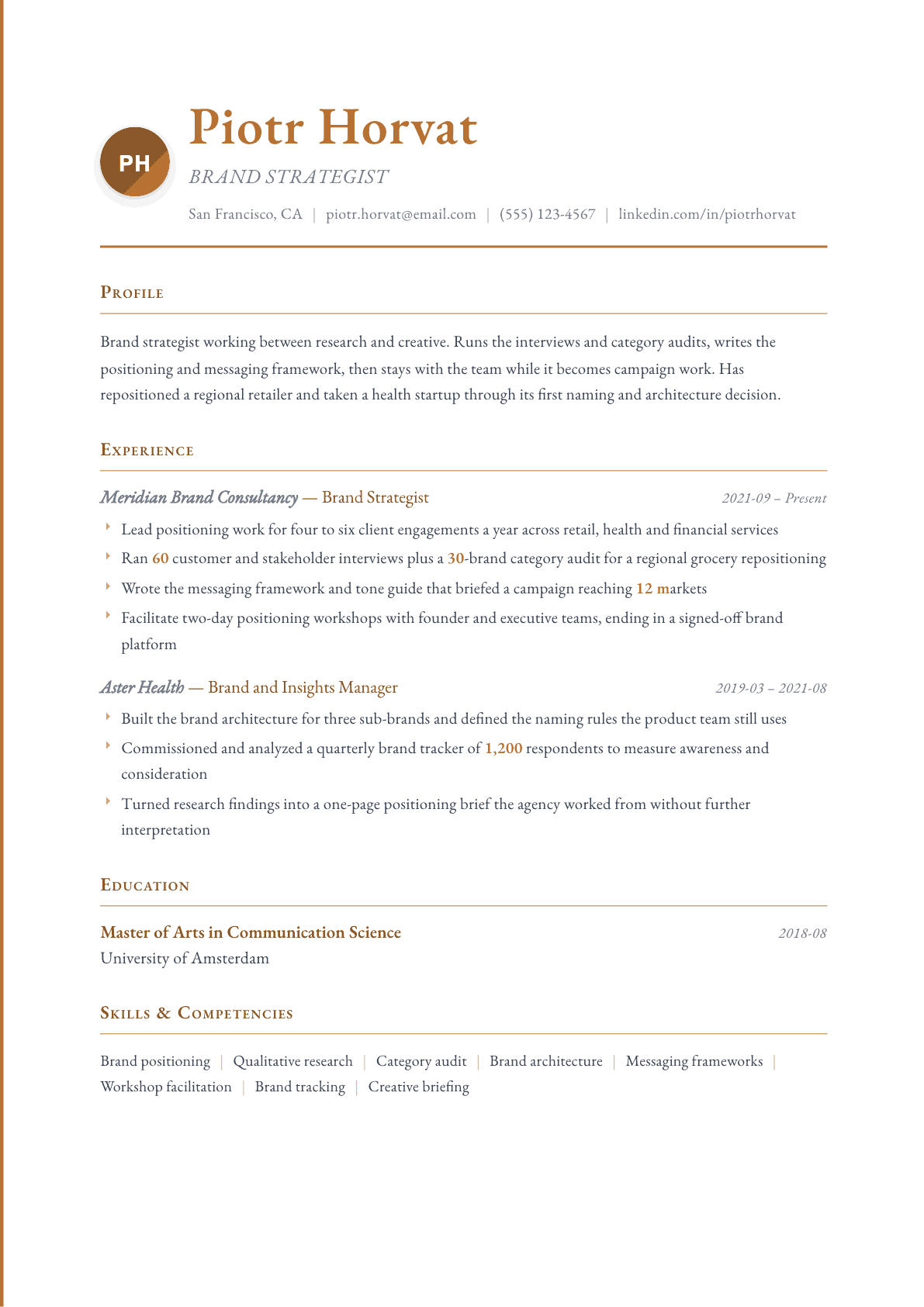
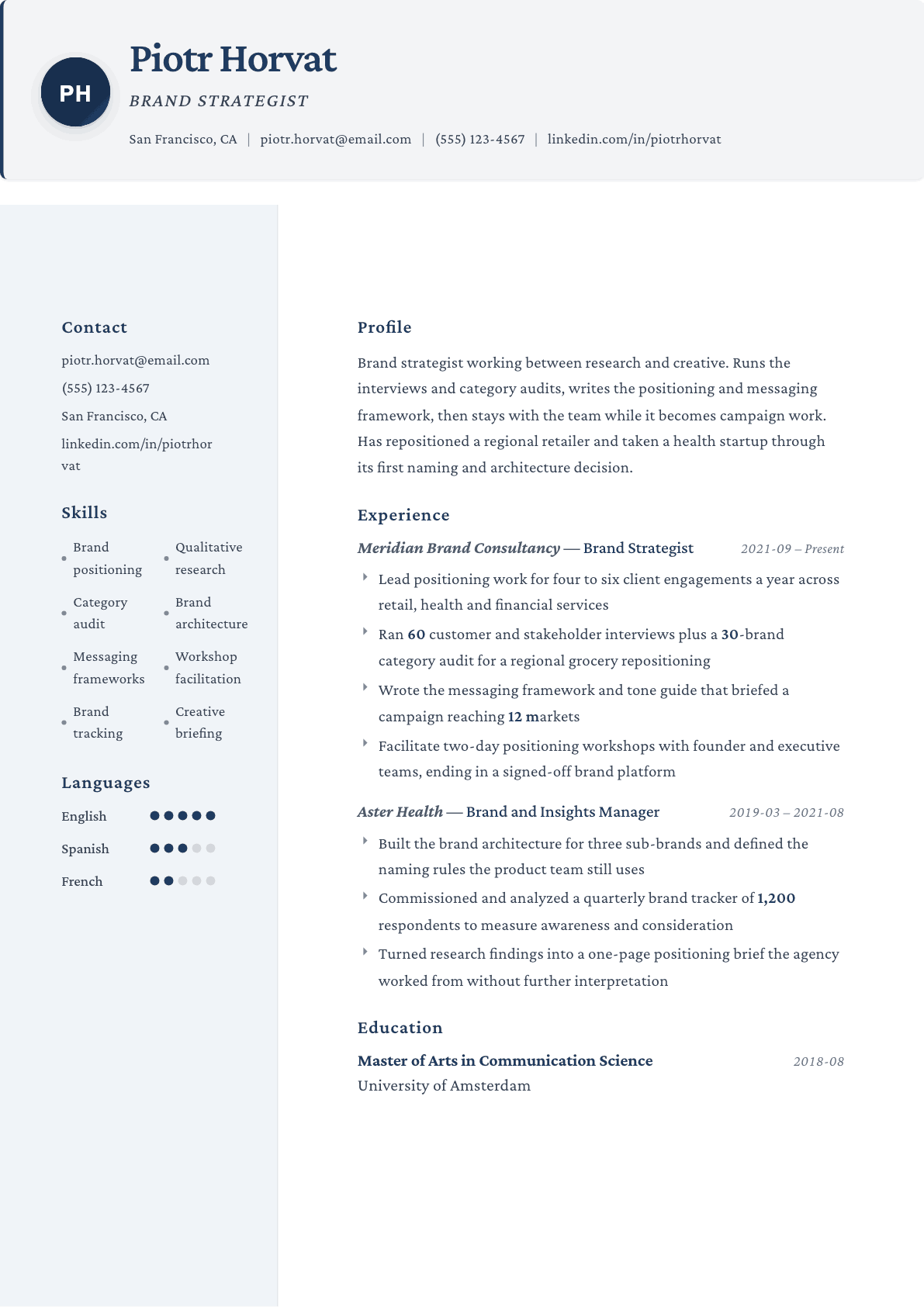
The same brand strategist content laid out in three CVBooster templates, so you can see what the finished document looks like before you write a word.
Example Brand Strategist summary
Brand strategist with seven years between research and creative, working agency side and in house. Leads four to six positioning engagements a year, most recently a regional grocery repositioning built on 60 interviews and a 30-brand category audit. Writes messaging frameworks that agencies can brief from without translation, and facilitates executive workshops that end with a signed-off brand platform.
Skills to list on a Brand Strategist resume
- Brand positioning
- Brand architecture
- Messaging frameworks
- Qualitative research
- Customer interviews
- Category and competitor audits
- Segmentation
- Brand tracking
- Workshop facilitation
- Creative briefing
- Naming strategy
- Tone of voice
- Go-to-market strategy
What actually gets this resume read
- Show the whole arc of one engagement: the research, the positioning decision, and what the brand did differently after.
- Name your research methods, from stakeholder interviews and category audits to brand trackers and segmentation studies.
- Include the categories you have worked in, because a strategist who knows regulated categories is screened differently.
- Say who you present to, since a strategist who has stood in front of a founder or board is a different hire.
- Reference the artifacts you produce: positioning statements, messaging houses, architecture maps and tone guides.
- Keep agency and client-side experience clearly labeled, as the two paths teach very different pacing.
How to write a brand strategist resume
Brand strategy resumes fail in a predictable way. They are written in the language of the discipline, full of platforms, pillars, essences and archetypes, and they never show a single decision the strategist actually made. A creative director or head of strategy reading that page cannot tell whether you ran the research, wrote the positioning, or formatted somebody else's deck.
The fix is to write engagements as arcs. What was the business problem, what did you go and find out, what did the brand decide as a result, and what changed downstream in the work. A strategist who can show that chain three times is more convincing than one who lists thirty client logos.
This guide sets out the section order that serves a strategist, how to write research and positioning work concretely, three summaries by level, before and after bullets, and the questions that come up when strategists move between agency and client-side roles.
Format: engagements, not tasks
Reverse chronological by employer, but inside each job, organize around named engagements rather than a flat bullet list. Two or three engagements described properly beat twelve bullets of activity, because strategy is judged on the quality of thinking on a single problem.
A strategist should link a portfolio. Case studies, even short ones, do the work a resume cannot: they show how you framed a problem. Put the link in the header, and make sure at least one case shows the research inputs and not only the finished platform.
- Header: name, title, city, contact details, portfolio link.
- Section order: summary, selected engagements, experience, methods and skills, education, certifications.
- One page early on, two once you have led engagements worth describing individually.
Show the research, because that is what buyers doubt
The most common gap in a brand strategist resume is evidence of primary research. Name the methods and the volume: stakeholder interviews, customer depth interviews, ethnographic visits, category and competitor audits, brand trackers, segmentation studies, social listening and search demand analysis. "Ran 60 customer and stakeholder interviews plus a 30-brand category audit" is a sentence a head of strategy trusts immediately.
Say what you did with the raw material as well. Coding transcripts, building a tension map, running a synthesis workshop with the creative team, writing the insight statements: that is the craft, and it separates a strategist from a planner who commissions research and waits for a deck.
Name the decision, not the deliverable
Positioning work is often described as a stack of artifacts: a brand platform, a messaging house, an architecture map, a tone guide. Artifacts are fine to list, but they are not the outcome. The outcome is a decision the business made and then acted on.
Write it as a change. A retailer that moved from a price-led position to a provenance-led one. A health startup that consolidated four product names into a single master brand. A financial services business that narrowed its audience definition and stopped chasing two segments. Then say what followed: the campaign, the naming decision, the packaging redesign, the change in the creative brief.
Where results are commercially sensitive, describe the direction and the mechanism rather than inventing a figure. Strategists are rarely asked for hard numbers, and an invented one is the fastest way to lose credibility in an interview with someone who has run trackers.
Facilitation and stakeholder work count as skills
A large share of the job is standing in a room with people who disagree and leaving with a decision. Say who you facilitate for: founders, executive teams, category managers, agency creatives. Describe the format, whether a two-day positioning workshop, a stimulus-based territory session or a stakeholder alignment interview series.
This matters more than most candidates realize, because a strategist who cannot hold a room ends up producing documents nobody adopts. Naming the seniority of the people you have facilitated for is a direct signal of that ability.
- Workshop formats you run, with duration and participant seniority.
- How you handle disagreement, such as forced-choice exercises or a written pre-read.
- The sign-off you secure at the end, since an unsigned platform is not a decision.
- Your handoff to creative: the brief, the stimulus, and how you stay involved afterward.
Categories, keywords and the agency question
Categories transfer unevenly. Regulated categories such as health, finance and alcohol carry claim restrictions that shape every message, and employers in those spaces screen for the experience. Business-to-business technology, consumer packaged goods, retail and services each have their own research rhythms. List the categories you have worked in as a short line, because it is a real filter.
For search, postings recycle: brand strategist, brand positioning, brand architecture, messaging framework, brand platform, qualitative research, competitive analysis, customer insight, segmentation, go-to-market strategy, naming and tone of voice. Use the posting's own phrasing in the summary and once inside an engagement description.
Finally, label agency and client-side experience clearly. Agency strategists work across many categories at speed and are used to selling ideas. Client-side strategists live with a decision for years and defend it against internal pressure. Employers want to know which muscle you have built.
Brand Strategist resume summary examples
Junior strategist
Junior brand strategist with two years agency side supporting positioning and campaign planning for retail and hospitality clients. Runs competitor audits, social listening and search demand analysis, moderates customer interviews, and writes the insight sections of pitch and platform decks.
Leading engagements
Brand strategist leading four to six positioning engagements a year across retail, health and financial services. Most recently repositioned a regional grocer on 60 interviews and a 30-brand category audit, then wrote the messaging framework that briefed a campaign running in 12 markets.
Strategy director
Brand strategy director with eleven years across agency and client-side roles, leading a team of three planners. Owns brand architecture and naming decisions for a multi-product portfolio, runs the quarterly tracker, and facilitates executive positioning workshops that close with a signed brand platform.
Work experience bullets: before and after
Before: Developed brand positioning for a range of clients.
After: Led positioning for a regional grocery chain, from 60 stakeholder and shopper interviews through a 30-brand category audit to a signed-off platform the board adopted.
The research volume and the sign-off show the full arc, so the reader knows you ran it rather than assisted.
Before: Created a messaging framework for the marketing team.
After: Wrote the messaging framework and tone guide that briefed a campaign across 12 markets, with proof points mapped to each claim for legal review.
Naming the downstream use and the legal mapping shows the document was operational, not decorative.
Before: Worked on brand architecture for the product portfolio.
After: Defined the brand architecture for three sub-brands and wrote the naming rules the product team still applies to every new release.
Durability is the real test of architecture work, and saying the rules are still in use proves adoption.
Before: Ran workshops with senior stakeholders.
After: Facilitated two-day positioning workshops with founder and executive teams, using forced-choice territory exercises to reach a single agreed platform by the closing session.
The method and the exit condition demonstrate facilitation skill rather than meeting attendance.
Before: Used research to inform creative work.
After: Turned tracker and interview findings into a one-page positioning brief the agency worked from directly, with no further interpretation round needed.
Compression is the strategist craft, and the absence of a rework loop is a concrete quality signal.
Hard skills
- Brand positioning and platform development
- Brand architecture and naming strategy
- Messaging frameworks and proof mapping
- Qualitative interviewing and synthesis
- Category and competitor auditing
- Segmentation and audience definition
- Brand tracking and survey design
- Social listening and search demand analysis
- Workshop design and facilitation
- Creative briefing
- Tone of voice development
- Go-to-market planning
Soft skills
- Framing an ambiguous problem
- Writing with compression
- Holding a room of senior stakeholders
- Presenting to founders and boards
- Constructive disagreement with creatives
- Listening in interviews without leading
Certifications worth listing
- Professional Researcher Certification (Insights Association)
- Market Research Society Certificate in Market and Social Research (Market Research Society)
Mistakes that cost brand strategist candidates the interview
- Writing in discipline vocabulary without ever naming a decision the business made as a result.
- Listing client logos instead of describing two or three engagements from problem to outcome.
- Leaving out primary research, which makes a strategist look like a deck producer.
- Failing to say whether you led the work or supported someone who did.
- Skipping the facilitation side, when holding a room is half the job at senior level.
- Inventing commercial results for work whose numbers you never saw.
- Applying to a regulated category without flagging the claim experience employers there require.
Brand Strategist resume questions
What is the difference between a brand strategist and a brand manager?
A strategist defines what the brand means and how it is expressed, usually across engagements or launches. A brand manager runs the brand day to day: plans, budgets, agencies and product marketing. The resumes read differently, one on thinking, one on ownership.
Do I need a portfolio as a brand strategist?
Yes, even a small one. A resume cannot show how you framed a problem. Two or three short case studies covering the research inputs, the positioning decision and the resulting work will do more than any bullet you can write.
How do I move from agency strategy to a client-side role?
Emphasize the engagements where you stayed involved after the platform was signed, and any work touching architecture, naming or go-to-market. Client-side hiring managers worry that agency strategists leave once the deck lands, so answer that concern directly.
What if my strategy work never had measurable results?
Describe the decision and the mechanism instead of a number. Say what the brand stopped doing, what it started doing and what changed in the creative brief. Interviewers in this discipline expect qualitative evidence and distrust suspiciously precise figures.
Should I include research methods on the resume or keep it high level?
Include them. Naming interview counts, audit scope, tracker design and synthesis approach is the fastest way to prove you do the work yourself rather than commissioning it and presenting somebody else's findings.