Lube Technician Resume Examples: the lines they read
Write a Lube Technician Resume That Leads to a Full Bay
By Mustafa Tarabya, founder of CVBooster · Published · Updated
Lube technician resume example, keywords and a writing guide on service intervals, multi-point inspections, fluid specification and bay throughput.
Sample resumes for a lube technician
The same lube technician content laid out in three CVBooster templates, so you can see what the finished document looks like before you write a word.
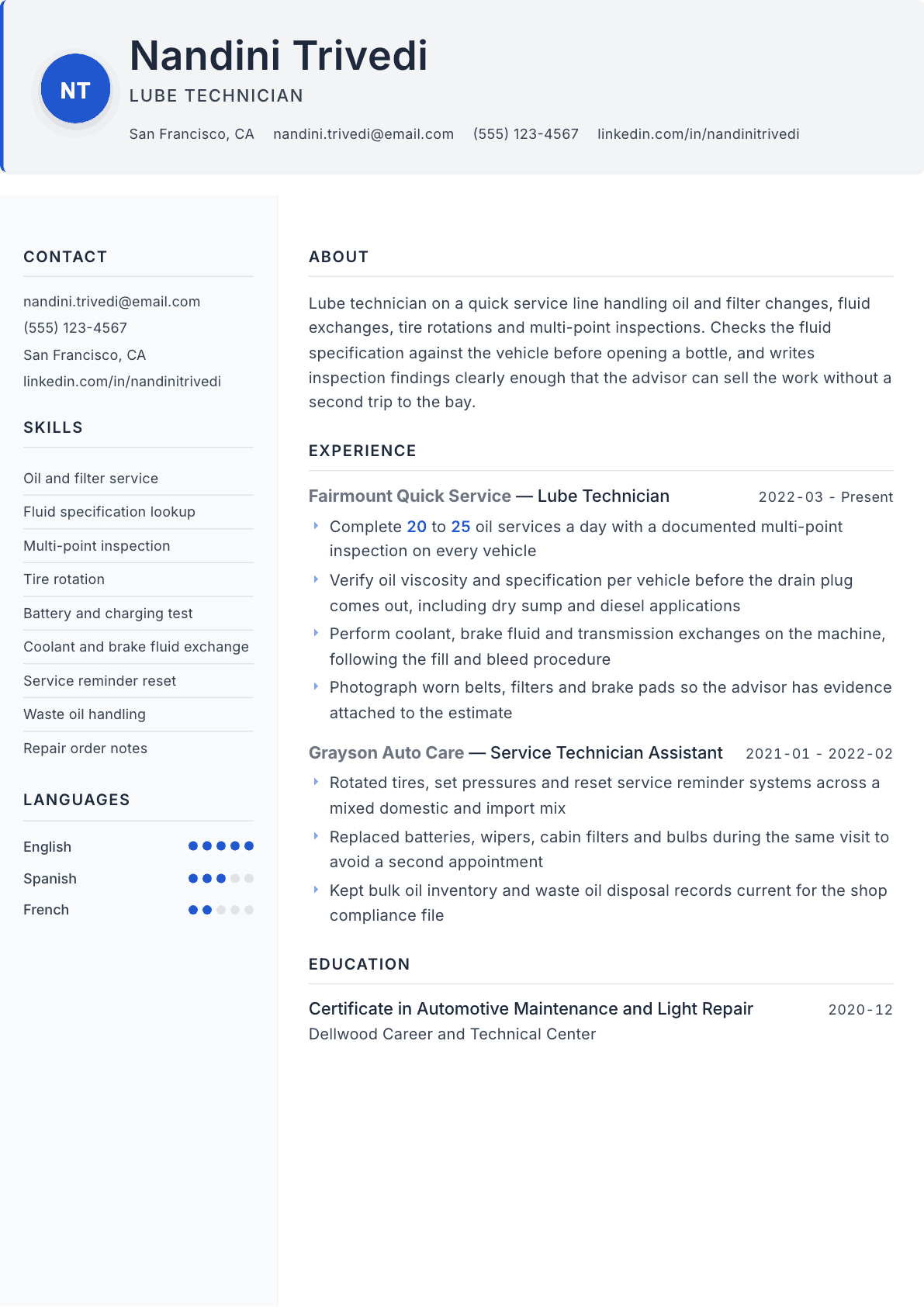
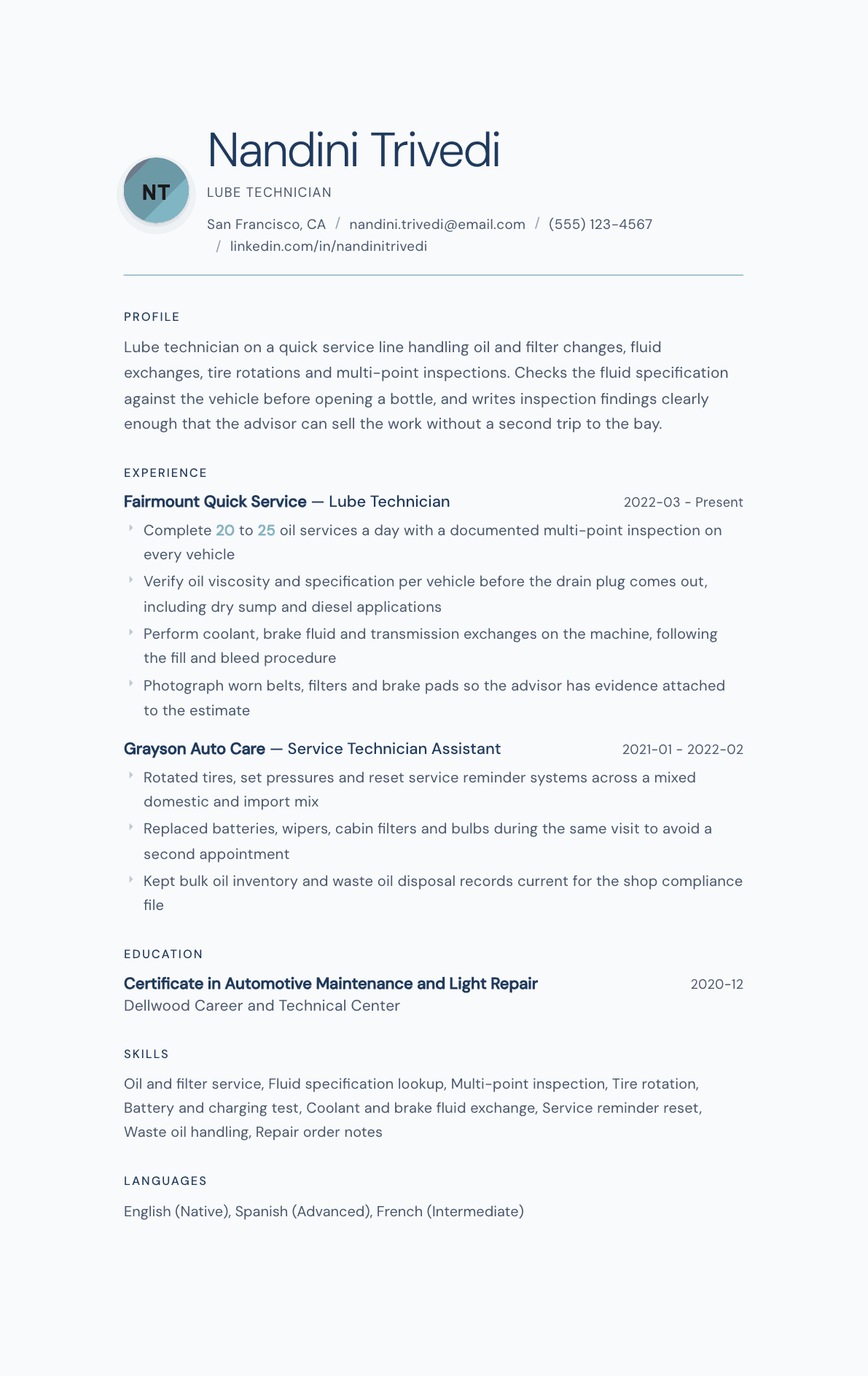
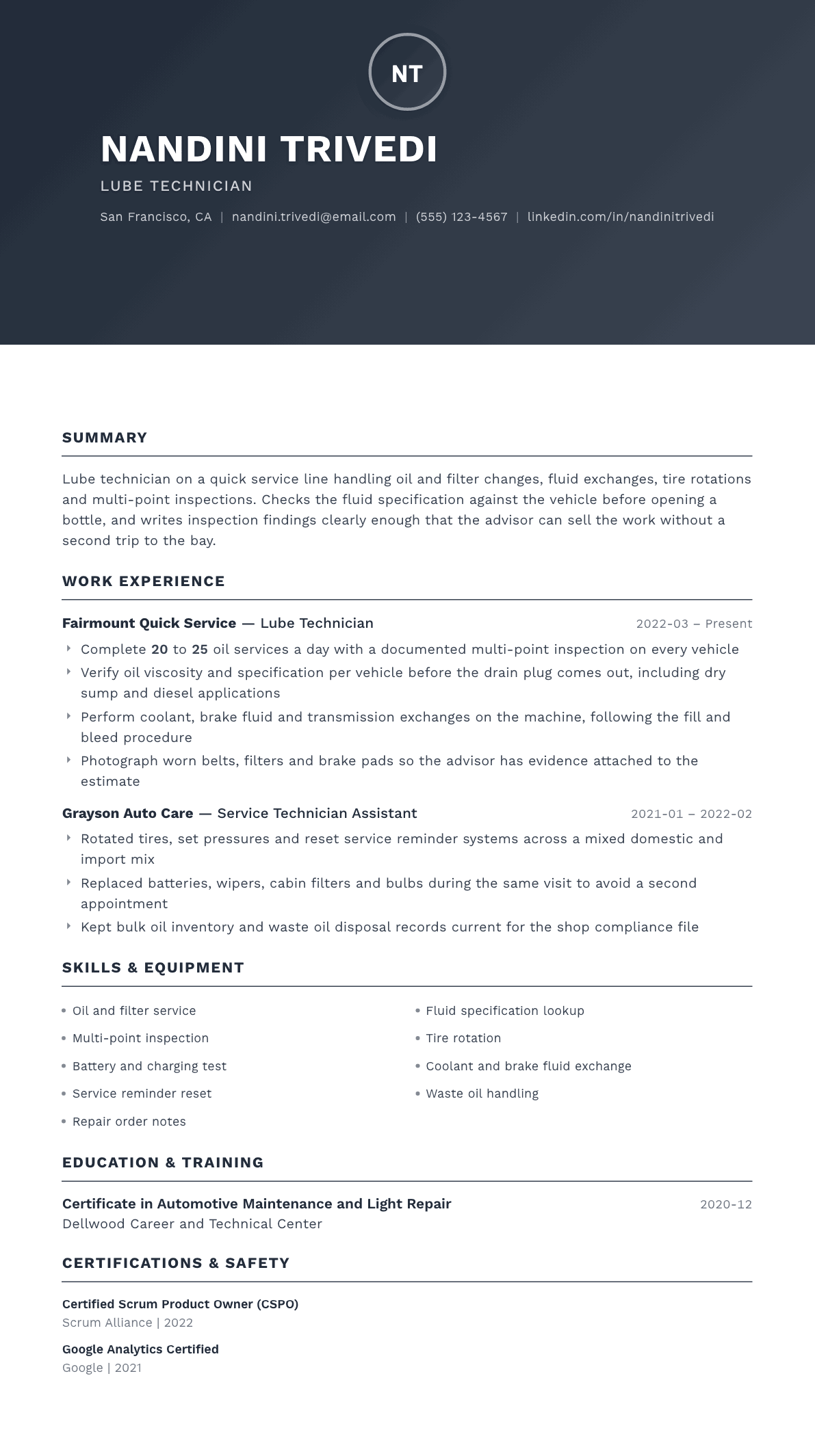
Example Lube Technician summary
Lube technician with three years on a quick service line running oil and filter changes, fluid exchanges, rotations and documented multi-point inspections. Verifies viscosity and specification for each vehicle before draining, handles light repairs such as batteries, filters and bulbs in the same visit, and photographs findings so the advisor can quote from evidence. Keeps waste oil records current and studying toward automotive certification.
Skills to list on a Lube Technician resume
- Oil and filter changes
- Oil specification and viscosity lookup
- Multi-point vehicle inspection
- Coolant exchange and bleeding
- Brake fluid exchange
- Transmission fluid service
- Tire rotation and pressure setting
- Battery and charging system testing
- Cabin and engine air filters
- Wiper and bulb replacement
- Service reminder and oil life reset
- Waste oil and filter disposal
- Repair order documentation
- Bay safety and lift operation
What actually gets this resume read
- State your services per day, because a quick service manager hires on throughput before anything else.
- Show that you verify oil specification per vehicle, which is the mistake that costs a shop an engine.
- Describe how you write inspection findings, since your notes are what the advisor sells from.
- List the light repairs you already do, such as batteries, filters and bulbs, to argue for a bigger bay.
- Name any certification you hold or are studying for, because lube bays are the normal path into diagnostics.
- Mention waste oil handling and compliance records if you kept them, as that is real responsibility.
How to write a lube technician resume
A lube technician job is the front door of the automotive trade, and the shop manager reading your resume knows it. He is hiring for two things at once: someone who can hold pace in a quick service bay today, and someone who might be worth training into a diagnostic technician over the next couple of years. A resume that only proves you can drain oil answers half of that question.
The half most applicants miss is judgment. Verifying the oil specification for the vehicle in front of you, catching a leaking axle seal during the inspection, writing findings clearly enough that the advisor can quote from them, keeping the waste oil records straight. Those are the details that separate a technician a shop invests in from a pair of hands it replaces every few months.
This guide sets out how to write each part of a lube technician resume, with summaries for a first job, a settled quick service technician and someone moving into light repair, before and after bullets that turn routine tasks into evidence, and the questions technicians ask when they want a bigger bay.
Format: one page, services and pace before anything else
One page is right for this role, and it should be readable in about twenty seconds. Under the summary, list the services you perform without supervision and the number you complete in a day, because those two facts decide whether a quick service manager keeps reading.
Do not pad the page with soft claims to reach a length. A short resume full of specific services reads as confident. A long one full of teamwork sentences reads as someone hiding thin experience, and quick service managers have seen a great many of both.
- Header: name, city and state, phone, email, and your availability if you can work the weekend and evening shifts shops struggle to fill.
- Service block: oil and filter service, fluid exchanges, rotations, batteries, filters, wipers, bulbs, inspections.
- Equipment line: the lifts you operate, the fluid exchange machines you have run and any inspection software you have used.
- Then experience with services per day, then education and any certification, then a plain skills list.
Summary: pace, service range and one habit that shows care
Three lines. Say how many services you complete in a day, name the range beyond oil changes, and add one habit that shows judgment. Verifying viscosity and specification against the vehicle before the drain plug comes out is the strongest habit a lube technician can name, because getting it wrong is the mistake that costs a shop an engine.
If you are aiming at a full technician role, say so and say what you are doing about it. A line stating that you are working toward maintenance and light repair certification tells a manager you are worth training rather than someone who will leave when the work gets harder.
Experience: services, inspections and what you found
Open each job with the shop type and pace: quick lube, dealership express lane, independent shop or a tire and service chain, with services completed a day. Then write bullets that separate routine work from the parts of the job that need attention.
The routine work still deserves specifics: drain and fill with the correct viscosity, filter replacement including cartridge housings and their torque, reset of the oil life or service reminder system, and pressure setting on tires after a rotation. Naming the cartridge housing and reminder reset shows you have worked on modern vehicles rather than only on older engines.
The inspection work is where you separate yourself. Every vehicle on your lift is a chance to find brake wear, a torn boot, a leaking shock or a filter due for replacement. Say how you record those findings, whether you photograph them, and what happens to your notes afterward. An advisor who can sell from a technician notes without walking to the bay will fight to keep that technician.
Add the fluid services that carry more risk: coolant exchange with a proper bleed procedure, brake fluid exchange, transmission service where the manufacturer allows it. Those show a technician who was trusted with work that has consequences when done carelessly.
Compliance, cleanliness and the parts of the job nobody writes down
Waste oil and filter disposal, bulk oil inventory, spill handling and lift inspection are duties that quietly get handed to a reliable technician. If you carried any of them, put them on the page, because they show responsibility without requiring you to claim it.
Bay safety belongs here too: correct lift points, checking a vehicle is secure before going underneath, and keeping a clean floor in a shop where oil gets spilled every day. A manager reading those lines is picturing someone who will not create an incident during a busy Saturday.
Skills and keywords that get a quick service resume through
Postings repeat a short list: oil change, multi-point inspection, fluid exchange, tire rotation, battery testing, cabin air filter, preventive maintenance, lift operation, repair order. Use them where the work is shown so the words carry evidence with them.
Then add the terms that point upward: brake inspection, suspension inspection, service reminder reset, diagnostic scan exposure and maintenance certification. A shop deciding between two similar candidates will usually pick the one whose resume shows a direction of travel.
Lube Technician resume summary examples
First automotive job
Automotive maintenance graduate seeking a first quick service bay. Trained on oil and filter service, tire rotation, fluid checks and multi-point inspection, with practice on lifts and torque procedure during the program. Available for weekend and evening shifts and studying toward maintenance and light repair certification.
Two to three years
Lube technician completing 20 to 25 oil services a day with a documented multi-point inspection on every vehicle. Verifies viscosity and specification per vehicle before draining, performs coolant and brake fluid exchanges on the machine, and photographs worn parts so the advisor can quote without a second trip to the bay.
Moving into light repair
Quick service technician handling the full maintenance menu plus batteries, brakes, filters and bulbs, and covering the bay lead role on weekends. Holds maintenance and light repair certification, keeps the waste oil and bulk inventory records, and trains new technicians on lift safety and specification lookup.
Work experience bullets: before and after
Before: Changed oil and filters on customer vehicles.
After: Completed 20 to 25 oil services a day, verifying viscosity and specification per vehicle before draining, including diesel and dry sump applications that use a different fill procedure.
Pace plus a specification check turns the most common bullet in the trade into evidence of judgment.
Before: Performed inspections on vehicles.
After: Documented a multi-point inspection on every vehicle and photographed worn belts, filters and brake pads so the advisor could attach evidence to the estimate.
The documentation and the hand-off show the inspection actually produced work rather than a checked box.
Before: Did fluid services.
After: Performed coolant, brake fluid and transmission exchanges on the machine, following the fill and bleed procedure so no air was left in the system.
Naming the procedure separates a technician who was trained from one who followed the machine prompts.
Before: Rotated tires and checked pressures.
After: Rotated tires to the pattern specified for each drivetrain, set pressures to the door placard, and reset the tire monitoring and service reminder systems before the vehicle left the bay.
The rotation pattern, the placard and the reminder reset show the whole task was finished properly.
Before: Kept the shop area clean and organized.
After: Maintained bulk oil inventory and waste oil disposal records for the shop compliance file, and kept the bay floor and lift points clear through a full weekend rush.
Compliance records and a specific busy period give the housekeeping claim something concrete behind it.
Hard skills
- Oil and filter service including cartridge housings
- Oil viscosity and specification lookup
- Multi-point vehicle inspection
- Coolant exchange and bleeding procedure
- Brake fluid exchange
- Transmission fluid service
- Tire rotation patterns and pressure setting
- Battery and charging system testing
- Cabin and engine air filter replacement
- Wiper, bulb and small part replacement
- Service reminder and oil life reset
- Waste oil and filter disposal records
- Lift operation and vehicle lift points
- Repair order notes and inspection reporting
Soft skills
- Holding a steady pace without skipping the specification check
- Writing findings a service advisor can read and act on
- Admitting a mistake before the vehicle leaves the bay
- Taking direction from a technician you are trying to learn from
- Staying courteous with a customer waiting in view of the bay
Certifications worth listing
- Automobile Maintenance and Light Repair (G1) (National Institute for Automotive Service Excellence)
- Section 609 Motor Vehicle Air Conditioning Certification (United States Environmental Protection Agency)
Mistakes that cost lube technician candidates the interview
- Writing only that you changed oil, when the inspection and reporting side is what earns a shop money.
- Leaving out services per day, so a quick service manager has no way to judge whether you can hold a bay.
- Failing to mention specification verification, the one habit that prevents the most expensive mistake in the bay.
- Padding the page with generic teamwork sentences instead of listing the light repairs you already perform.
- Ignoring certification progress, which is the clearest signal that you want a bigger role than the one advertised.
- Skipping compliance duties such as waste oil records, which quietly demonstrate that you were trusted.
Lube Technician resume questions
What experience do I need for a lube technician job?
Most shops will hire without paid automotive experience if you can show mechanical aptitude, reliability and a willingness to work weekends. Trade school, farm or motorcycle work, and any job where you followed a procedure carefully all belong on the page.
How do I get promoted out of the lube bay?
Show the light repair you already do, add brake and suspension inspection findings, and start a certification path. Then make sure the resume says which technician you assist and what you have learned from them, because managers promote people they can see progressing.
Do I need my own tools?
Quick service bays usually supply the equipment, though a basic personal set helps. If you own tools, one short line is enough. Spending resume space on a tool list is only worth it when applying to an independent shop that expects a full box.
Should I include unrelated jobs on the resume?
Keep them if they show reliability, pace under pressure or customer contact, and cut the duties down to a line each. A record of showing up on time in a demanding job matters to a shop manager who has lost technicians to no-shows.
What certification is worth getting first?
The maintenance and light repair credential maps directly onto quick service work and is the normal first step toward the full automobile series. Refrigerant handling certification is a useful second, since it lets a shop assign you air conditioning service.
Related resume examples
- Tire Technician Resume example
- Auto Mechanic Resume example
- Automotive Technician Resume example
- Automotive Service Advisor Resume example
- Auto Detailer Resume example
- Auto Technician Resume example