Geologist Resume Examples: free ATS score and gap list
Build a Geologist Resume on Solid Ground
By Mustafa Tarabya, founder of CVBooster · Published · Updated
Create a geologist resume showcasing fieldwork, geological mapping, and resource exploration expertise with ATS-friendly templates for mining, oil & gas, and consulting roles.
Sample resumes for a geologist
The same geologist content laid out in three CVBooster templates, so you can see what the finished document looks like before you write a word.
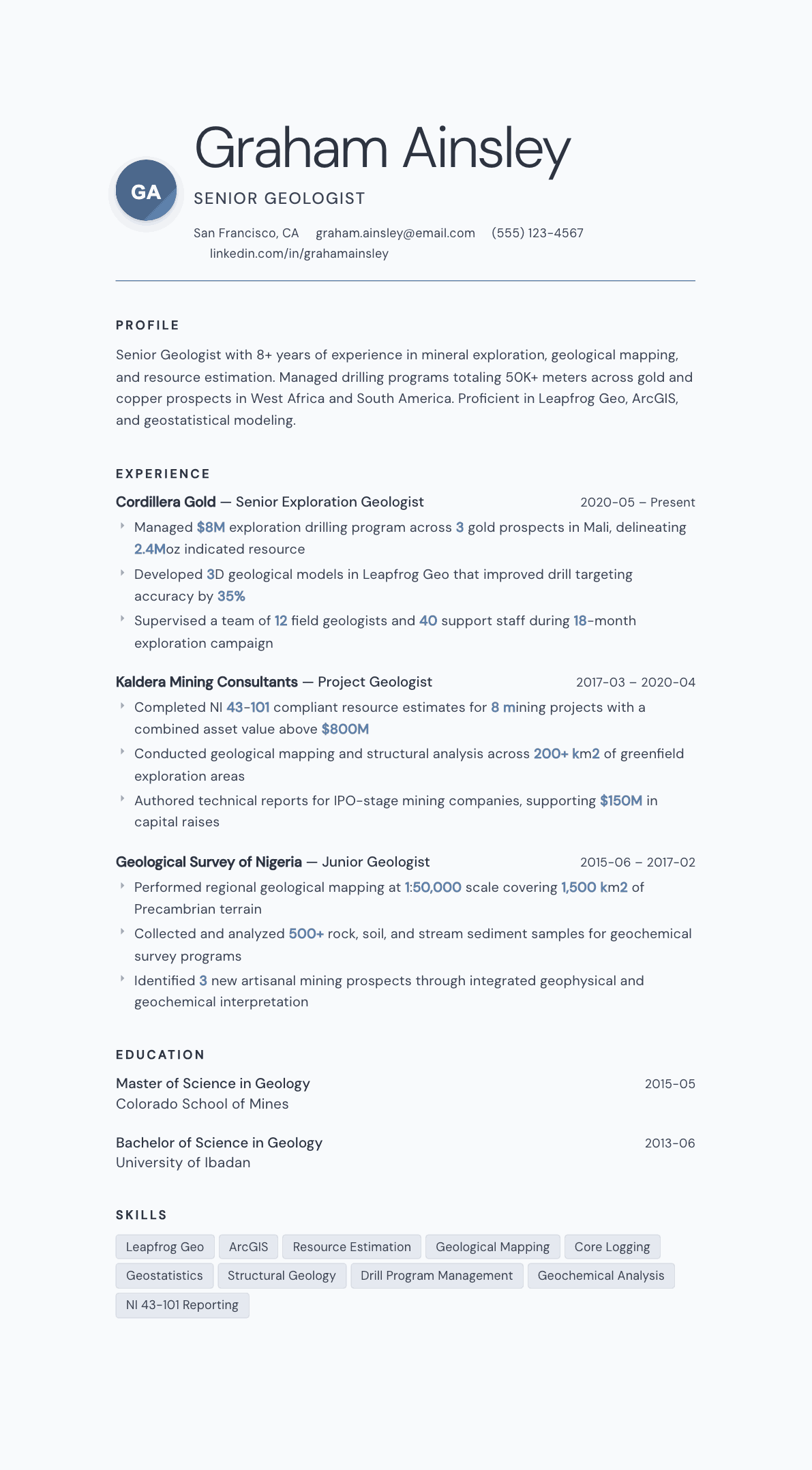
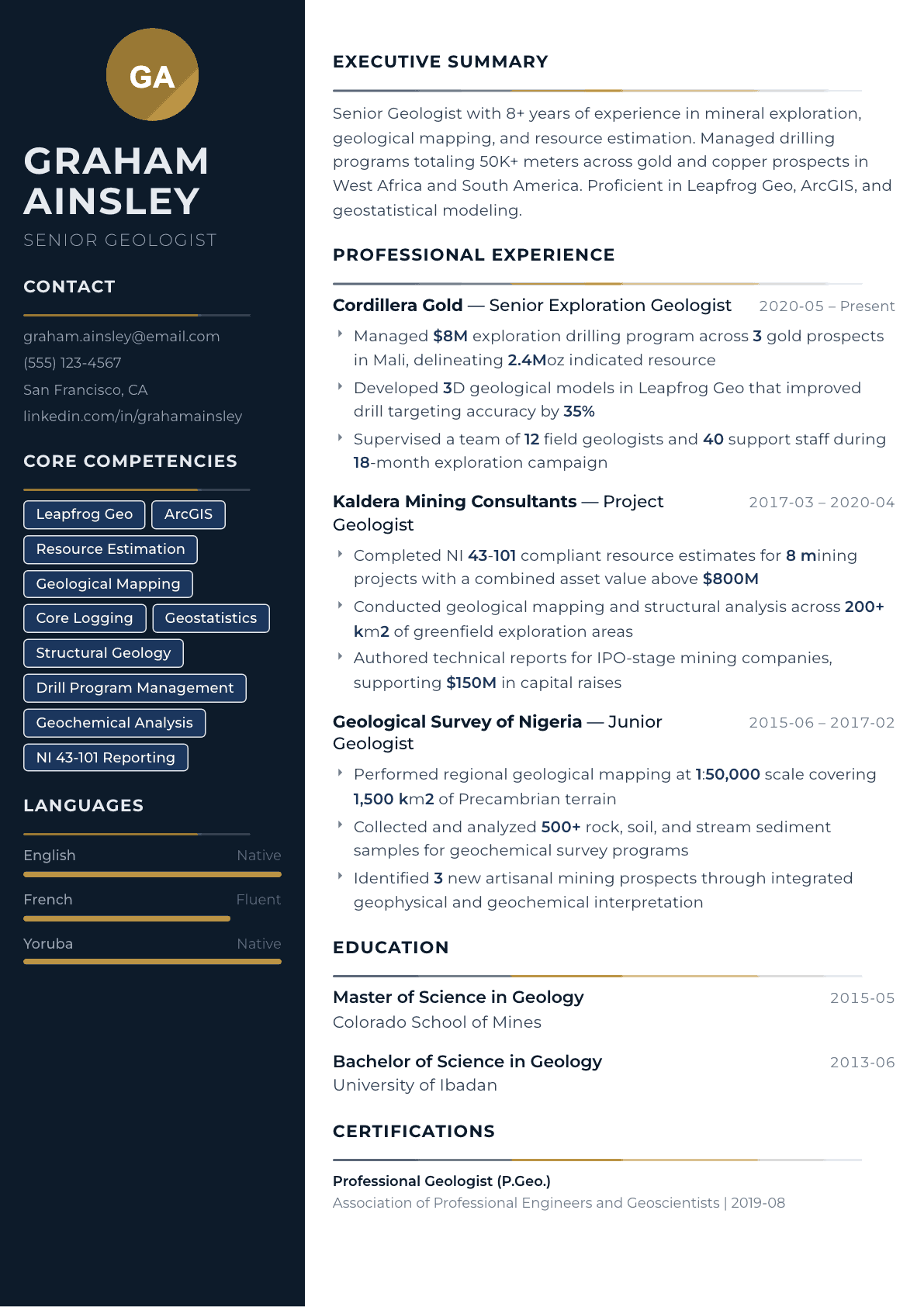
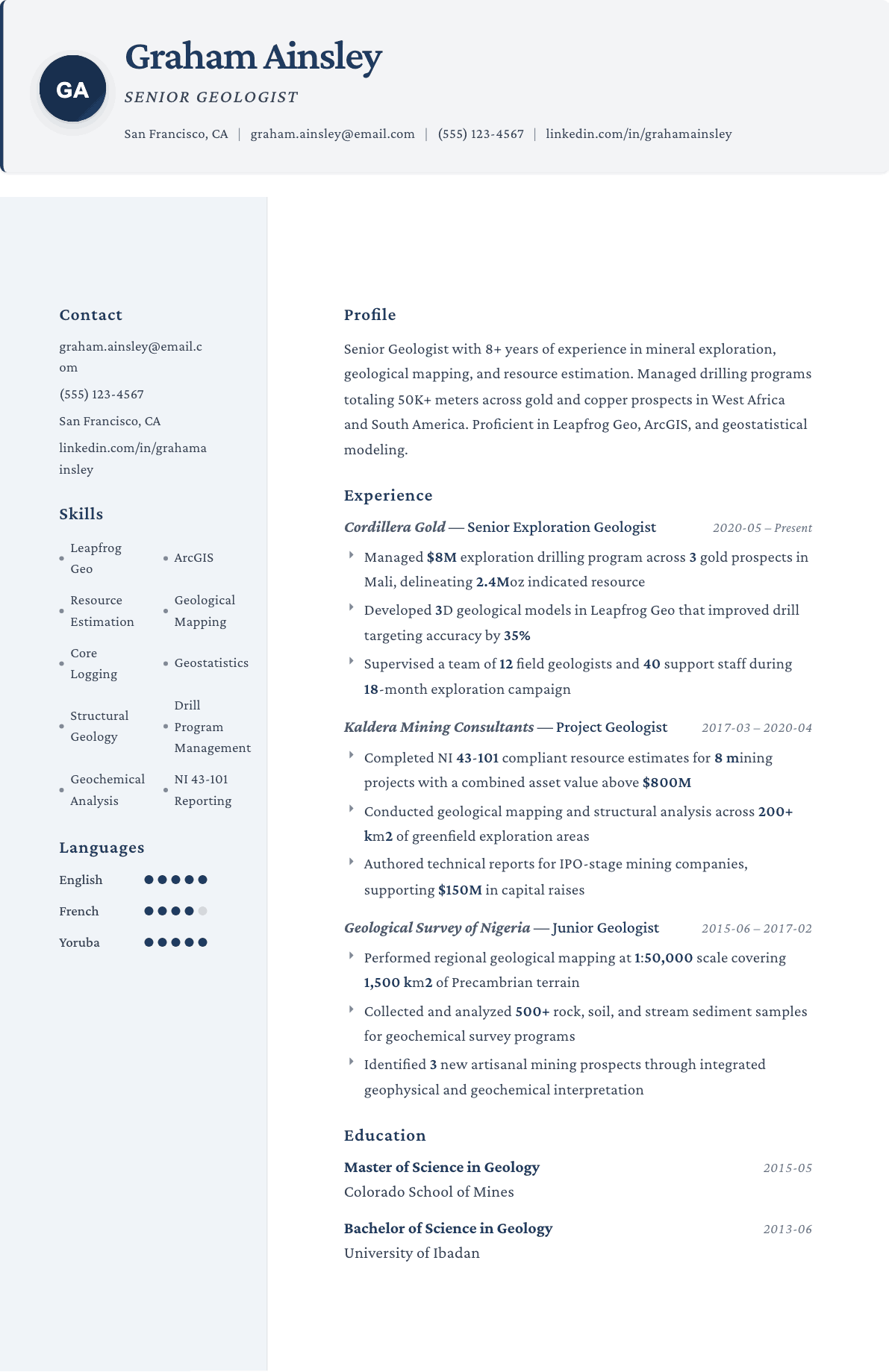
Example Geologist summary
Registered Professional Geologist with 8+ years in mineral exploration and resource estimation. Managed $8M+ drilling programs delineating 2.4Moz gold resources. Expert in Leapfrog Geo, geostatistical modeling, and NI 43-101 reporting. Has run programs across West Africa and South America, working in English and French.
Skills to list on a Geologist resume
- Leapfrog Geo
- ArcGIS
- Geological Mapping
- Resource Estimation
- Core Logging
- Structural Geology
- Geostatistics
- NI 43-101 / JORC
- Drill Program Management
- Geochemistry
- Remote Sensing
- Petrography
What actually gets this resume read
- List geological software prominently: Leapfrog Geo, Vulcan, Micromine, ArcGIS, Datamine.
- Quantify drilling programs: meters drilled, resources delineated, and project budgets managed.
- Highlight field experience including mapping scale, area covered, and samples collected.
- Include compliance standards: NI 43-101, JORC, or SAMREC reporting experience.
- Mention your professional registration: PGeo, CPG, EurGeol, or equivalent designations.
How to write a geologist resume
Geologist resumes are sorted by commodity and by stage. An exploration company drilling greenfield targets wants a mapper and a core logger who can generate targets. A producing mine wants grade control, reconciliation and short term modeling. A consultancy writing public resource reports wants modeling discipline and reporting code literacy. An engineering firm wants a geologist who understands foundations, slopes and groundwater.
What every one of those readers checks first is field time and software. Field seasons and meters logged are the currency of the early career, and the modeling package you drive is the filter for the mid career. Registration and qualified or competent person status become the filter after that, because public reporting requires a named person to sign.
This guide covers how to organize a geologist resume around programs, models and reports, three summaries covering a field geologist through a senior resource geologist, before and after bullets from mapping, drilling and modeling work, and the questions that come up when geologists move between exploration, mining and the environmental and geotechnical side.
Format: commodity, stage, registration, software
Put four things in the top inch: the commodities you have worked, the project stages you have covered from reconnaissance through feasibility and production, your professional registration, and the modeling software you drive. A hiring exploration manager decides from those four whether to keep reading.
One page while you are a field geologist, two once you are building models and contributing to reports. Keep the layout simple, because international recruiting for mining runs through applicant systems that mangle graphics, and a lost software line costs you a role you would have won.
- Header: name, registration, commodities, location, willingness to work rotational schedules, phone, email.
- Order: summary, registration and tickets, project experience, technical skills and software, education, publications and conference papers.
- State your rotation experience and remote camp history explicitly, since it is a real scheduling constraint for employers.
Summary: deposit type, meters, and what you delivered
Name the deposit styles you actually know: orogenic gold, porphyry copper, volcanogenic massive sulfide, sediment hosted base metals, lithium brine or pegmatite, iron formation, coal, or industrial minerals. Deposit knowledge is what a geologist is hired for, and generic phrasing hides it.
Then give the scale in units the industry uses: meters logged, meters of drilling supervised, square kilometers mapped and at what scale, and the resource models you built or contributed to. Finish with the deliverable, whether that is a target package, a resource estimate, a technical report contribution or a mine plan input.
Experience: field program, database, model, report
Field first. Geological mapping with the scale and the area, structural measurements and interpretation, core and chip logging with meters and the logging codes used, sampling protocols, and the quality control program with certified reference materials, blanks and duplicates and how you monitored their performance. Quality control detail signals a geologist who understands that a model is only as good as the database beneath it.
Then the database and the model. Data validation and survey checks, geological and structural interpretation into wireframes or implicit models, domaining, compositing and statistical analysis, variography and estimation by inverse distance or kriging, density assignment, block model construction and classification into measured, indicated and inferred categories, and the reconciliation of predicted to actual grade if you have worked at an operation.
Close with the reporting and the decision. Drill target generation and ranking, program design and budget, contractor and camp management, resource statements prepared for public reporting under a recognized code, and the technical report sections you authored. A geologist who has been through a report cycle with reviewers is worth more than one who has only produced internal work.
Software: name what you build in, not what you have opened
Separate modeling packages from data and mapping tools. Modeling: Leapfrog Geo for implicit modeling, Datamine, Vulcan, Micromine, Surpac and Deswik depending on the operation. Estimation and statistics: Supervisor, Snowden tools, Isatis or an equivalent geostatistical package, and scripting in Python for data handling. Data and mapping: acQuire or a comparable drillhole database, ArcGIS Pro or QGIS, Oasis montaj for geophysics, and remote sensing platforms for target generation.
Say which package you build models in end to end. Every candidate lists five packages, and the interviewer only cares about the one you would be trusted with on day one.
Registration, codes and field tickets
Registration matters because public reporting requires a signature from a person with a recognized professional designation and relevant deposit experience. State your registration, the licensing body, and whether you meet the experience test to act as the responsible person for the deposit style you work in.
Field tickets are the practical gate for site work. First aid and remote first aid, four wheel drive and off road training, helicopter or float plane safety, underground entry induction, blasting or explosives awareness, and any country specific site induction all reduce the friction of hiring you, so list the current ones with dates left off.
Geologist resume summary examples
Field geologist, first seasons
Exploration geologist with 3 field seasons in orogenic gold. Logged 9,000 meters of diamond core, mapped 40 square kilometers at reconnaissance scale, ran sampling and quality control protocols with reference materials and blanks, and maintained the drillhole database for a 4 rig program.
Project geologist, seven years
Project geologist with 7 years across copper and gold exploration and grade control. Designs and supervises multi rig drill programs of up to 18 kilometers a season, builds implicit geological models in Leapfrog Geo, and delivers monthly reconciliation between the block model and mill feed at an operating mine.
Senior resource geologist
Registered professional geologist with 14 years in base and precious metals, responsible for resource estimation across 3 operations. Builds domained block models with variography and kriging, classifies resources under a recognized reporting code, and has authored resource sections of 5 public technical reports.
Work experience bullets: before and after
Before: Logged drill core for exploration projects.
After: Logged 9,000 meters of diamond core to a structured lithology, alteration and mineralization code set, marked sampling intervals, and captured structural measurements with an oriented core tool for later interpretation.
Meters, a code set and oriented structural capture show logging that feeds a model rather than filling a sheet.
Before: Mapped geology in the field.
After: Mapped 40 square kilometers at reconnaissance scale and 6 square kilometers in detail, defined 3 structural corridors from cross cutting relationships, and generated the target package that guided the following season's drilling.
Area, scale, the structural conclusion and the drilling that followed prove mapping that changed a program.
Before: Used Leapfrog to build geological models.
After: Built implicit geological and mineralization models in Leapfrog Geo from 600 drillholes, defined estimation domains from grade continuity, and passed the wireframes to the resource geologist with a documented interpretation rationale.
Hole count, domaining and documented rationale distinguish modeling work from software familiarity.
Before: Ran quality control on the sampling program.
After: Managed the quality control program across every assay batch of a 4 season drill program: inserted certified reference materials, blanks and field duplicates at set frequencies, tracked performance on control charts, and triggered 2 laboratory reruns after bias was detected.
Insertion rates, control charting and a triggered rerun show quality control enforced rather than merely present.
Before: Worked on resource estimates for the company.
After: Completed a resource estimate on a gold deposit: composited to a set length, ran variography by domain, estimated by ordinary kriging, validated against the declustered mean and swath plots, and classified into indicated and inferred categories.
Naming the estimation steps and validation checks is how a competent person demonstrates defensible work.
Hard skills
- Geological and structural mapping
- Diamond core and reverse circulation logging
- Drill program design and supervision
- Sampling protocols and quality control
- Leapfrog Geo implicit modeling
- Datamine, Vulcan and Micromine
- Variography and kriging estimation
- Block model construction and classification
- Grade control and reconciliation
- Drillhole database management in acQuire
- ArcGIS Pro and QGIS
- Geochemical data interpretation
- Geophysical data integration
- Public resource reporting under a recognized code
Soft skills
- Leading field crews in remote camps
- Contractor and driller supervision
- Working rotational schedules
- Communicating uncertainty in an estimate
- Cross cultural work on international projects
Certifications worth listing
- Professional Geologist (PG) state licensure via the ASBOG examinations (National Association of State Boards of Geology and state licensing boards)
- Certified Professional Geologist (CPG) (American Institute of Professional Geologists)
- European Geologist (EurGeol) (European Federation of Geologists)
- Professional Geoscientist (P.Geo.) (Provincial geoscience regulators in Canada)
Mistakes that cost geologist candidates the interview
- Leaving out meters logged and area mapped, the two numbers that tell an exploration manager how much field time you really have.
- Listing six modeling packages without saying which one you build a model in from start to finish.
- Describing a resource estimate without the domaining, estimation method or validation, which reads as attendance rather than authorship.
- Skipping the quality control program, since a database without documented control performance is not reportable.
- Omitting registration and the deposit styles you have relevant experience in, which are the tests for signing public reports.
- Hiding rotational and remote camp experience, when availability for that schedule is a practical hiring requirement.
Geologist resume questions
How much field experience do exploration employers expect?
They count seasons and meters rather than years. Two or three full seasons with substantial core logging, mapping and program support makes you employable as a project geologist, and stating those numbers plainly beats any adjective you could use instead.
Do I need professional registration as a geologist?
You can build most of a career without it, but public resource reporting requires a person with a recognized designation and relevant deposit experience to take responsibility. Registration also gates senior consulting work, so start the experience log early.
Which software should I learn first?
Learn one implicit modeling package properly, most commonly Leapfrog Geo, plus a mapping tool and enough scripting to handle data. Depth in one package that you can demonstrate in an interview is worth more than a superficial list of five.
How do I move from exploration into a mine site role?
Emphasize grade control, short term modeling, reconciliation and any production interface you have had, and be explicit about rotational availability. Mine sites hire for reliability against a schedule as much as for geology, so make your availability and site tickets easy to find.
Can I switch to environmental or geotechnical geology?
Yes, and the transferable core is logging, mapping, sampling and data discipline. Add the vocabulary of the target field, such as monitoring wells and site characterization for environmental work or rock mass classification and slope stability for geotechnical work, and pursue the registration that field expects.